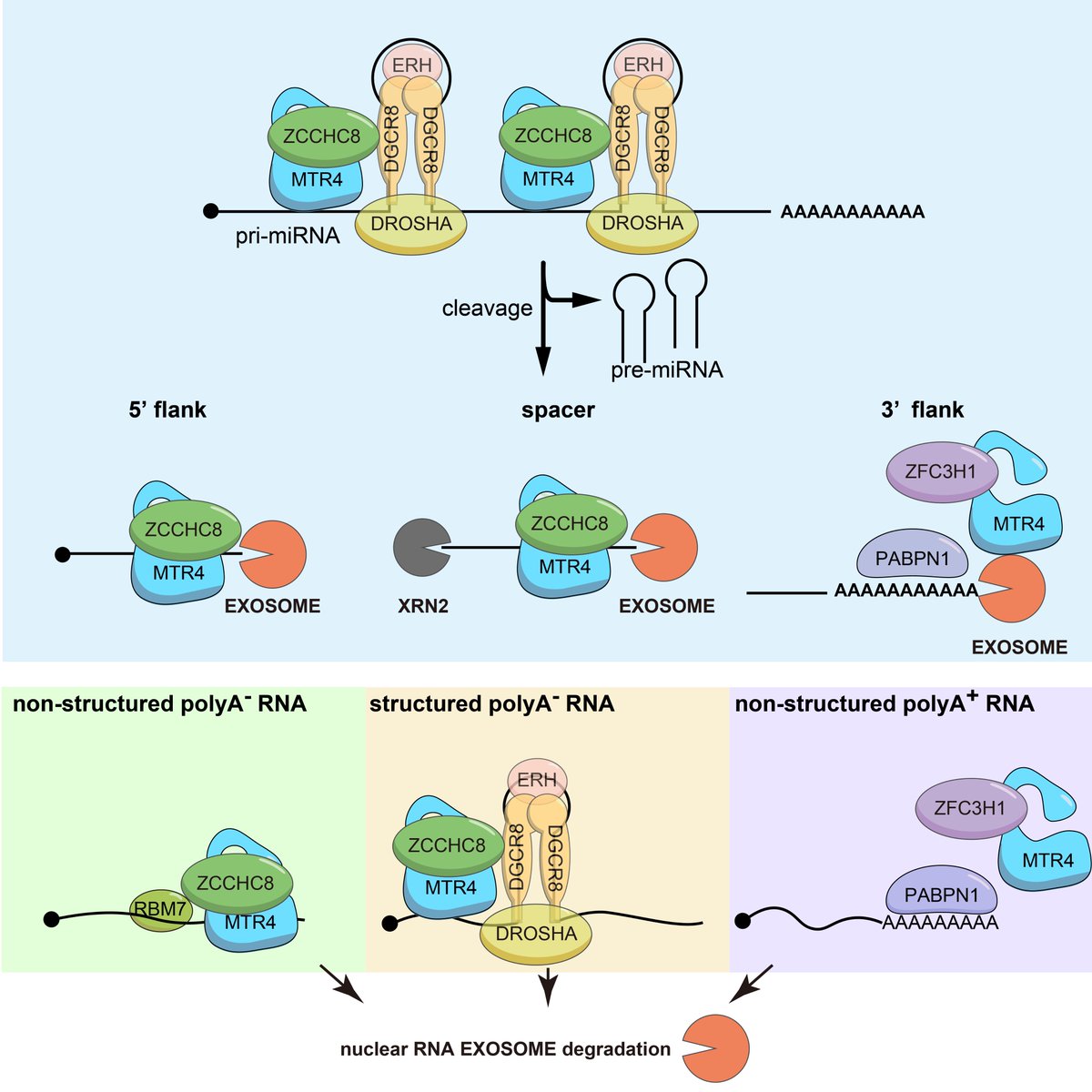
Latest from the lab, finally out in @MolecularCell . Here we show a physical and functional link between the Microprocessor and a variant NEXT complex. Together, these complexes degrade the 5' flanks of pre-miRNAs and other stem-loop-containing RNAs.
https://t.co/YPbi1TvHHo
AlphaBridge: tools for the analysis of predicted macromolecular complexes
• AlphaBridge introduces tools to analyze and visualize the interfaces between predicted macromolecular complexes using data from AlphaFold3. It processes the predicted interactions into intuitive diagrams and 3D models for easy interpretation.
• The tool uses a novel “Predicted Merged Confidence” (PMC) matrix, which combines the Predicted Local Distance Difference Test (pLDDT) and Predicted Aligned Error (PAE) metrics to identify multi-component structural modules and binary interfaces with high confidence.
• AlphaBridge uses graph-based community clustering to detect interaction motifs in biomolecular complexes, then visualizes these interactions as chord diagrams (“AlphaBridge diagrams”) to provide a clear and intuitive summary of predicted binding interfaces.
• The tool allows researchers to evaluate the reliability of interactions in predicted protein-protein, protein-DNA, and protein-RNA complexes, offering a scoring and ranking system for predicted interfaces before detailed analysis.
• By varying the cut-off for contact predictions, AlphaBridge can help distinguish between reliable and unreliable predictions, providing insights into physiological relevance. It was particularly useful for evaluating interactions in DNA mismatch repair proteins and RNA binding proteins.
• The AlphaBridge webserver (https://t.co/HMxfguvmnn) offers an interactive platform where users can upload AlphaFold3 prediction files, visualize the predicted 3D structures, and analyze contact interfaces through an integrated web viewer.
• AlphaBridge enhances accessibility for both expert and non-expert users by combining multiple layers of information—contact links, prediction confidence, and visual representations—into one interactive diagram, simplifying the evaluation of complex predictions.
@TassosPerrakis @rborza_
💻Code: https://t.co/pwKfDtQ7MM
📜Paper: https://t.co/EB8po1CCfP
Come and explore the mechanisms of gene expression with us! We are hiring two postdocs in cryo-EM and - with @BalzarottiFran - in super-resolution microscopy.
👉https://t.co/ipeZ4iQigE
👉https://t.co/XXlCLZUdBC
🎉Congratulations!
The @ERC_Research awarded an Advanced Grant to IMP senior group leader Tim Clausen @clausen_lab to study protein misfolding in muscle with the goal to develop new tools against age-related muscle protein disorders.
Read more👇
https://t.co/3OrzxB1Vw9
I’m beyond excited to present my postdoc work with @plaschka_lab and @JuliusBrennecke at @IMPvienna@IMBA_Vienna . We uncovered a mechanistic framework for a general and conserved mRNA nuclear export pathway. A thread: 1/x
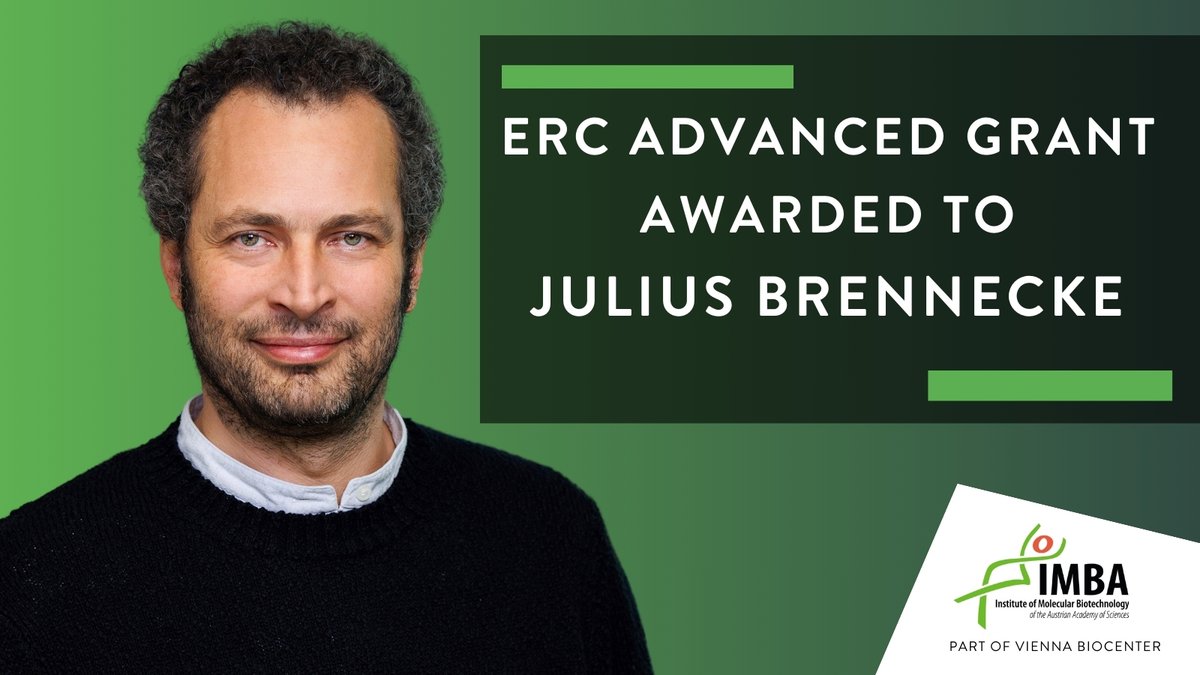
Congratulations to Julius Brennecke for securing one of this year’s @ERC_Research Advanced Grants! Julius will study the arms race between transposons and host genomes. #ERCAdG More here: https://t.co/lpPytYNJpG
The U5 snRNP makes up the “heart” of the human spliceosome, which is made and recycled by two chaperones, CD2BP2 and TSSC4. But how is this done? See our latest work to find out, co-lead by the great @DarRiabov and Pat Visanpattanasin. https://t.co/5ZGTpRsevt (1/5)
Are you (or a friend) looking for a molecular biology 🧬🧪 group leader position in a stable, democratic welfare state? 🇩🇰
Then have a look at our call for two faculty (assoc or TT ) 📣
Broad topic, good funding landscape, wonderful colleagues!
https://t.co/bqCzbnkxsZ
Really happy that our paper on Obox, an oocyte/embryo-specific TF family including 8 members and over 60 copies in the genome, as a key regulator of mouse ZGA is now out in Nature!
https://t.co/FHd4rRyBA8
Excited to share the final version of my Postdoc work in the @stark_lab on mapping and unravelling the regulatory specificities between transcriptional corepressors (CoRs) and active enhancers. (1/5)
https://t.co/5lYaZoLz2j
Our new work in @Nature to explain how retrotransposons synthesize the 2nd-strand DNA by a circularization process.
Story: made some cool findings (we thought) -> actually scooped 40-yr ago by textbook knowledge -> textbook appear to be incorrect. https://t.co/7Glvf2qFEw
In short, we are looking to hire a number of positions in the next 6-9 months, so if you are interested in these or other interests of the lab, please reach out.
It was a long journey from putting together the first observations from many sources to the understanding of #TFIID assembly using co-translation mechanisms published at @NatureSMB in collaboration with the Marc Timmers lab. Thanks for the great help from the @IGBMC facilities.
Our lab is recruiting post docs on the role of nuclear architecture and 3D genome organisation in genome stability.
https://t.co/WoSUOrxYKN
https://t.co/k7Ccq44399
Be in touch or apply at the links if you are interested! Thanks !!!
Well well, what's this?! It's more Z4! Delighted this is now out, big congratulations to our co-submitters @torbenheick / Jerome Rouviere and the "West Massive" (@XRNchew) , especially my partner in crime Lee Davidson
https://t.co/u0Jhi9cVOz
Check out this brand new work on the role of #H4K16ac in activating transposable elements, and making them function as #enhancers
https://t.co/gLYsWkcRTj
Funded by MRC @UKRI_News and @Barts_Charity 1/3
I am happy to share with you the second work of my postdoc @PauliGroup aimed at understanding how maternal mRNAs are stored in the egg : https://t.co/8frFfgSGDn Want a summary? Check out our tweetorial here 👇
Joint work with @lab_lawson and @leung_holden on how transposable elements shape and maintain 3D genome. Thank you @NatureRevGenet, and apologize to those whose work we did not have space to cite. @WUSTLdbbs @WashUGenetics@GenomeInstitute@wustlcrm
https://t.co/edWbpb94qF