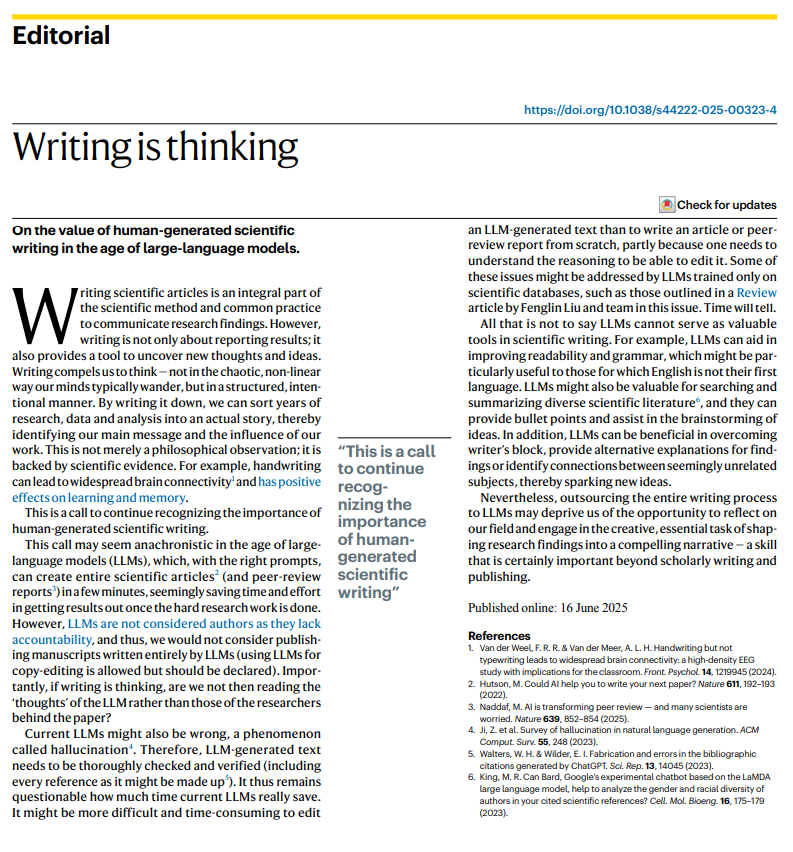
🚨 BREAKING: Claude can now research like a Stanford PhD student.
It can expose unlimited hidden research problems from top professors' papers in 60 seconds.
Here are 15 insane Claude prompts to master research with Claude: 👇
(Save it. 📌 Don't start your PhD without these 15 cheat codes.)
🚨Anthropic just showed a 24-minute workshop on how to actually do prompts for Claude.
Taught by the people who built it.
Free. No registration. No paywall.
I've seen $300 courses that don't cover what they teach in the first 8 minutes.
Watch it and bookmark it now!
Instead of watching an hour of Netflix, watch this 2-hour Stanford lecture, which will teach you more about how LLMs like ChatGPT and Claude are built than most people working at top AI companies learn in their entire careers.
Apply for the EITN EBRAINS Fall School in Computational Neuroscience 2026!
This 10-day course is designed for Master’s and PhD students and postdocs interested in advancing their knowledge in theoretical and computational neuroscience.
This year’s school will take place in the beautiful city of Pavia, Italy.
It will focus on multiscale brain modelling, from molecular-cellular models to whole-brain models, including the use of cutting-edge simulation environments for model building.
Apply before 15 May: https://t.co/tPkSkKemL1
How to climb all 4 layers of Claude in one weekend:
(even if you just signed up yesterday)
✦ Level 1: Claude Chat (Saturday morning)
Go to claude .com/download. Install the app.
Pay the $20. Select Opus 4.6 + Extended Thinking.
Connect Slack, Drive, Notion through Connectors.
Stop writing long prompts. Prompt this instead:
"I want to [TASK] for [SUCCESS CRITERIA]. Use AskUserQuestion before you start."
Most people stay here forever.
You're leaving 90% of Claude untouched.
Claude Basics: https://t.co/jw2qdIbLxJ.
——
✦ Level 2: Claude Cowork (Saturday afternoon)
Go to 'Cowork'. Create a folder "Claude-Cowork."
4 subfolders. About me, template, project & outputs
Create about-me .md: what you do, how you do.
Create anti-ai-style .md: words you'd never say.
Set Global Instructions (Settings → Cowork → Edit):
"Always read my files first, never edit my originals, deliver everything to CLAUDE OUTPUTS."
You just killed prompting.
From now on, your prompt is 2 lines + your folder.
Move on to Cowork: https://t.co/uWTpOI3oyE
——
✦ Level 3: Skills + Plugins (Sunday morning)
Open Cowork. Type: "Use the skill-creator to help me build a skill for [your most repeated task]."
Claude interviews you. Answer and be specific.
It generates a SKILL .md. Test it: "When would you use this skill?" If the description is vague, fix it.
Upload: Settings → Capabilities → Skills → Upload.
Now it fires automatically. No slash command.
Install Plugins: Cowork > Customize > Browse plugin
Skills with about-me .md. Skill handles the process.
Voice file handles tone. Two layers simultaneously.
Set up Claude Skills: https://t.co/SAErc3JcLL
——
✦ Level 4: Code + Computer (Sunday afternoon)
Click the Code tab. Create a folder. Connect GitHub
(free account → Settings → Connectors).
Prompt: "Create a GitHub repo named [project]. Code everything. Don't ask for permissions."
Download VS Code. Install the Claude extension.
Turn on "Skip Permissions" to go 100x faster.
After your session, paste this: "Create a CLAUDE .md file with everything you learned about this project." Now Claude remembers your fonts, colors, and structure forever.
Claude code guide: https://t.co/UgE9xBXnm6
Claude Computer: Settings → Desktop app → turn on Browser use + Computer use.
Connect your phone with Dispatch. Text a task.
Schedule a recurring task: left sidebar → Scheduled → write the prompt → pick the frequency.
Claude Computer: https://t.co/ZfjFaaMknc
This is where you stop working inside Claude.
Claude starts working on your computer.
——
Saturday, you were prompting like it's ChatGPT.
Sunday, Claude is running your screen, building your website, & sending you text updates.
That's all 4 layers. In one weekend.
Aging clocks may be shaped by neurosyndemics, multiple interacting physical and social real-world environments jointly influencing brain health. Out in Nature Medicine (https://t.co/h6kbJntHRV), we assessed 18,701 participants from 34 countries, showing that the combined aggregate-level exposome (73 physical, social, and political factors measured at country-level) predicts multimodal brain aging far better than isolated exposures (up to 15-fold more variance). Moving beyond single risks, we provide evidence that synergistic, nonlinear exposome burden accelerates brain clocks across health and disease, with physical exposures linking more strongly to structural brain aging and social exposures to functional brain aging. Exposome burden increased the risk of accelerated brain aging by 3.3–9.1-fold, in some cases exceeding the effects associated with dementia, and these findings held in out-of-sample, longitudinal, individual-level variation, and sensitivity analyses. Thus, the pace at which the brain ages may be shaped by syndemic environmental and societal conditions, calling for much more intersectoral policies. Congrats @AgustinaLegaz Sebastian Moguilner @HernHdezL & all coauthors. 1/5👇 @GBHI_Fellows









![rubenhassid's tweet photo. How to climb all 4 layers of Claude in one weekend:
(even if you just signed up yesterday)
✦ Level 1: Claude Chat (Saturday morning)
Go to claude .com/download. Install the app.
Pay the $20. Select Opus 4.6 + Extended Thinking.
Connect Slack, Drive, Notion through Connectors.
Stop writing long prompts. Prompt this instead:
"I want to [TASK] for [SUCCESS CRITERIA]. Use AskUserQuestion before you start."
Most people stay here forever.
You're leaving 90% of Claude untouched.
Claude Basics: https://t.co/jw2qdIbLxJ.
——
✦ Level 2: Claude Cowork (Saturday afternoon)
Go to 'Cowork'. Create a folder "Claude-Cowork."
4 subfolders. About me, template, project & outputs
Create about-me .md: what you do, how you do.
Create anti-ai-style .md: words you'd never say.
Set Global Instructions (Settings → Cowork → Edit):
"Always read my files first, never edit my originals, deliver everything to CLAUDE OUTPUTS."
You just killed prompting.
From now on, your prompt is 2 lines + your folder.
Move on to Cowork: https://t.co/uWTpOI3oyE
——
✦ Level 3: Skills + Plugins (Sunday morning)
Open Cowork. Type: "Use the skill-creator to help me build a skill for [your most repeated task]."
Claude interviews you. Answer and be specific.
It generates a SKILL .md. Test it: "When would you use this skill?" If the description is vague, fix it.
Upload: Settings → Capabilities → Skills → Upload.
Now it fires automatically. No slash command.
Install Plugins: Cowork > Customize > Browse plugin
Skills with about-me .md. Skill handles the process.
Voice file handles tone. Two layers simultaneously.
Set up Claude Skills: https://t.co/SAErc3JcLL
——
✦ Level 4: Code + Computer (Sunday afternoon)
Click the Code tab. Create a folder. Connect GitHub
(free account → Settings → Connectors).
Prompt: "Create a GitHub repo named [project]. Code everything. Don't ask for permissions."
Download VS Code. Install the Claude extension.
Turn on "Skip Permissions" to go 100x faster.
After your session, paste this: "Create a CLAUDE .md file with everything you learned about this project." Now Claude remembers your fonts, colors, and structure forever.
Claude code guide: https://t.co/UgE9xBXnm6
Claude Computer: Settings → Desktop app → turn on Browser use + Computer use.
Connect your phone with Dispatch. Text a task.
Schedule a recurring task: left sidebar → Scheduled → write the prompt → pick the frequency.
Claude Computer: https://t.co/ZfjFaaMknc
This is where you stop working inside Claude.
Claude starts working on your computer.
——
Saturday, you were prompting like it's ChatGPT.
Sunday, Claude is running your screen, building your website, & sending you text updates.
That's all 4 layers. In one weekend.](https://pbs.twimg.com/media/HFc-d84bMAAKsWw.jpg)