Thrilled to see this work out in @ESAEcology . It stems from our suspicions on the proper use of statistics in meta-analysis. Using simulations, we found that statistically significant results are probably not all justified in ecological meta-analyses.
https://t.co/7sPZhceqEe
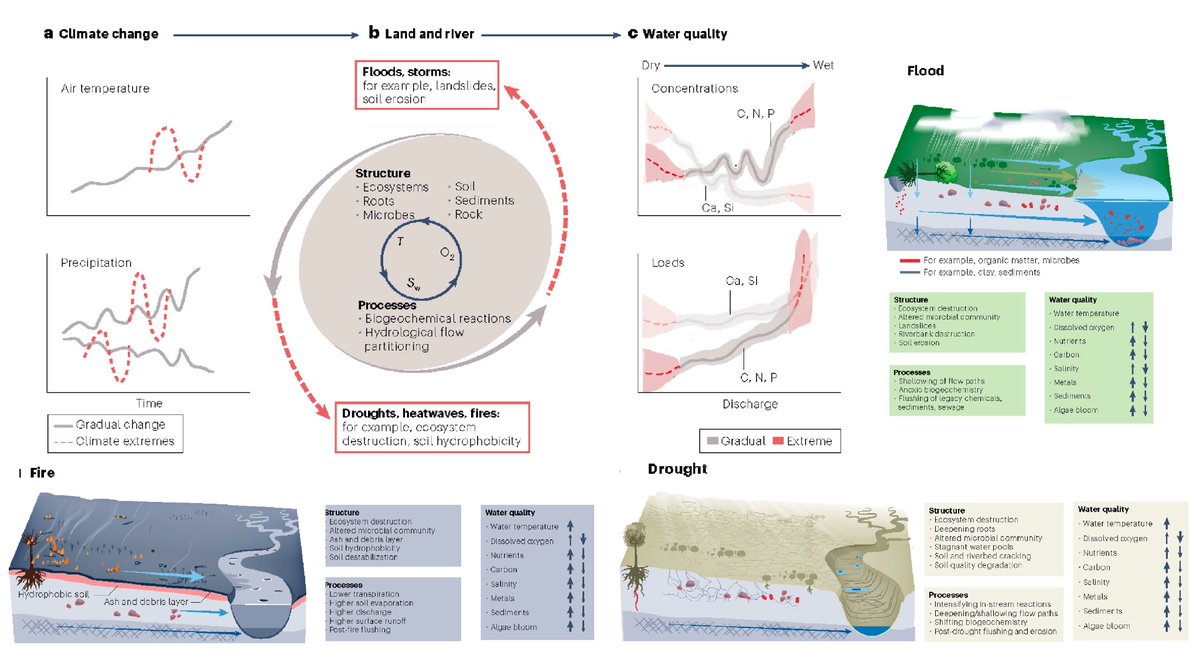
How does land-river connectivity shape river water quality in persistent, gradual climate changes & episodic, intense #extremes?
New paper @NatureClimate reviews overlooked impacts of #climatechange on water quality.
https://t.co/hrCqKiaKnA
SharedIt: https://t.co/gbqS8koNEC
Happy BIRTHday to MacroSheds: A synthesis of long‐term biogeochemical, hydroclimatic, and geospatial data from small watershed ecosystem studies - harmonized and accessible data for 169 watershed ecosystem studies. Learn more at https://t.co/R1UzTBrzKg https://t.co/dGQutDpbun
From our #Methods, Tools, & Technologies track:
Using ordinary differential equation models on #TimeSeries data? A new study demonstrates best practices - and includes a tutorial in R
https://t.co/M31sW6SOLY
#BayesianInference#Statistics#OpenAccess @b_rosen_baum @efronhofer
@Ecology_Letters publishes six different kinds of articles. Recently, @Jon_Chase03 and I wrote about how to publish a "Perspective" or "Synthesis". https://t.co/GCVQSW9o25
Model uncertainty or across-model spread shrinks to zero after its sources are precisely pinned down using the matrix approach. We converted eight land C cycle models , e.g., CLM5 and ORCHIDEE, in a unified matrix form and did traceability analysis. https://t.co/gb5kV7HfCA
A new estimate of the extent of wetland losses over the past few centuries reveals that an area about the size of India has been lost since 1700 https://t.co/UV7yNbsxA0
Our paper on the effect of changes in species interactions on the temperature dependence of microbial community respiration is now out: https://t.co/sLT6txRU3E
Thank you @CleggTom , @paquiydeleite , @GabYvonDurocher, Ruth Warfield and @DBarriosONeill for collaborating!
Our new Paper in @ESAEcology:
Integrating gradient with scale in ecological and evolutionary studies https://t.co/5WpsnaT62V
Great effort led by Qinfeng Quo and co-authors ( @FeiNrsa Xiongwen Chen, Erin Crokett, Angpin Chen)
Carbon uptake by the ocean has increased alongside rising atmospheric CO2 concentrations, but with substantial variability. A Review in @NatRevEarthEnv examines trends in ocean CO2 uptake and the internal and external factors driving its variability. https://t.co/tlTi17wsNV
New methods for #MetaAnalysis using log response ratio (lnRR) with @wviechtb@DanielWANoble @BecksSpake Losia + Alistaidr
https://t.co/WbpbRsX7Rg
>50% of meta-analyses in EcoEvo use lnRR
ALL future meta-analyses of lnRR should use our method.
Why?