Compositional coding of individual finger movements in human posterior parietal cortex and motor cortex enables ten-finger decoding https://t.co/QyeYPdmJ1t #medRxiv
🚨 Forest Neurotech is hiring an EE Lead! 🚨
If you've shipped 3+ product lifecycles of small/mixed-signal devices, let's talk. We're looking for mission driven, high IQ+low ego. If you/someone you know matches this description, please reach out.
Time to revisit a 40-yr-old theory on brain reorganization
We longitudinally scanned patients with planned hand amputations and see highly stable hand and face cortical representations before and after arm amputation
@plasticity_lab@Chris_I_Baker
🧵1/13
https://t.co/zbZDOXIvOf
Forest Neurotech is hiring!
Three roles on the engineering team (Palo Alto, CA)
- Principal Mechanical Engineer
- Principal Electronics Systems Engineer
- Principal Engineering Program Manager
@ all my Neurotech friends -- please share 😊
https://t.co/tjTBLdr9fG
New Ultrasound BCI results are out!
"I remember how impressive it was when this kind of predictive decoding worked with electrodes two decades ago, and it's amazing now to see it work with a much less invasive method like ultrasound," -@mikhailshapiro .
https://t.co/O8l2EFIzKp
💭Imagine relying on a brain-computer interface (BCI) for your only means of communication, but it's inconsistent and needs frequent recalibration. For those who can't move or speak, this isn't just frustrating; it's a huge barrier.
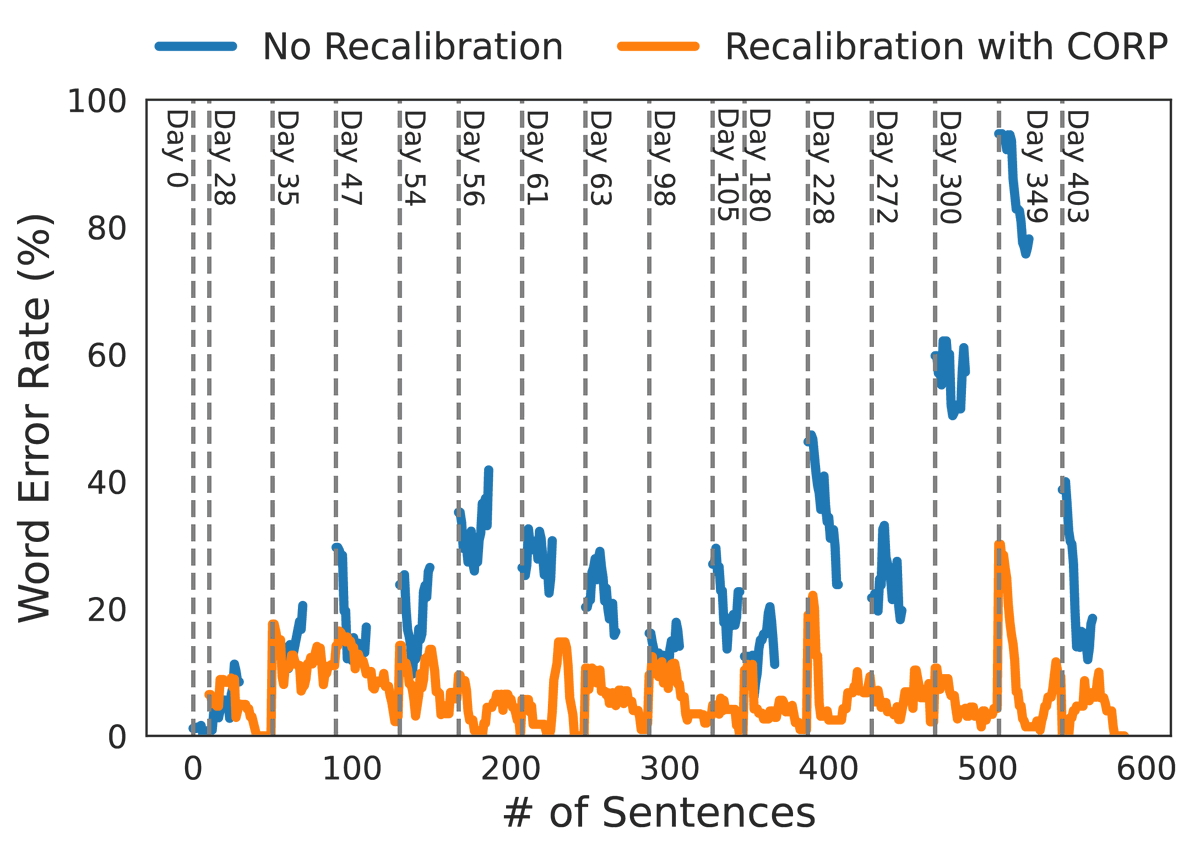
🌟Our #NeurIPS2023 paper introduces a promising solution: Continual Online Recalibration with Pseudo-labels (CORP). Over an entire year (403 days), CORP demonstrated remarkable stability in an online handwriting BCI task. With a 6.16% word error rate, it significantly outperforms existing recalibration methods. 🥇To the best of our knowledge, this is the longest demonstration of intracortical BCI plug-and-play stability to date.
⚙️Technical Insight:
1⃣CORP leverages large language models to auto-correct BCI outputs. The outputs are accurate enough to be used as pseudo training labels, enabling unsupervised recalibration without user interruption.
2⃣We also implemented a replay buffer and data augmentation strategies to tackle the challenges of continual learning.
🤝We encourage the research community to build on our findings. Our data and code are open for further research and collaboration.
Paper: https://t.co/y0kumbxq3d
Code: https://t.co/SKlNxr1gxd
Data: https://t.co/YCuyx188Ha
This work was the result of amazing collaboration with @WillettNeuro, @xoxo_meme_queen, Nick Hahn, Foram Kamdar, Donald Avansino, Leigh Hochberg, Krishna Shenoy, Jaimie Henderson, and our clinical-trial participant T5!
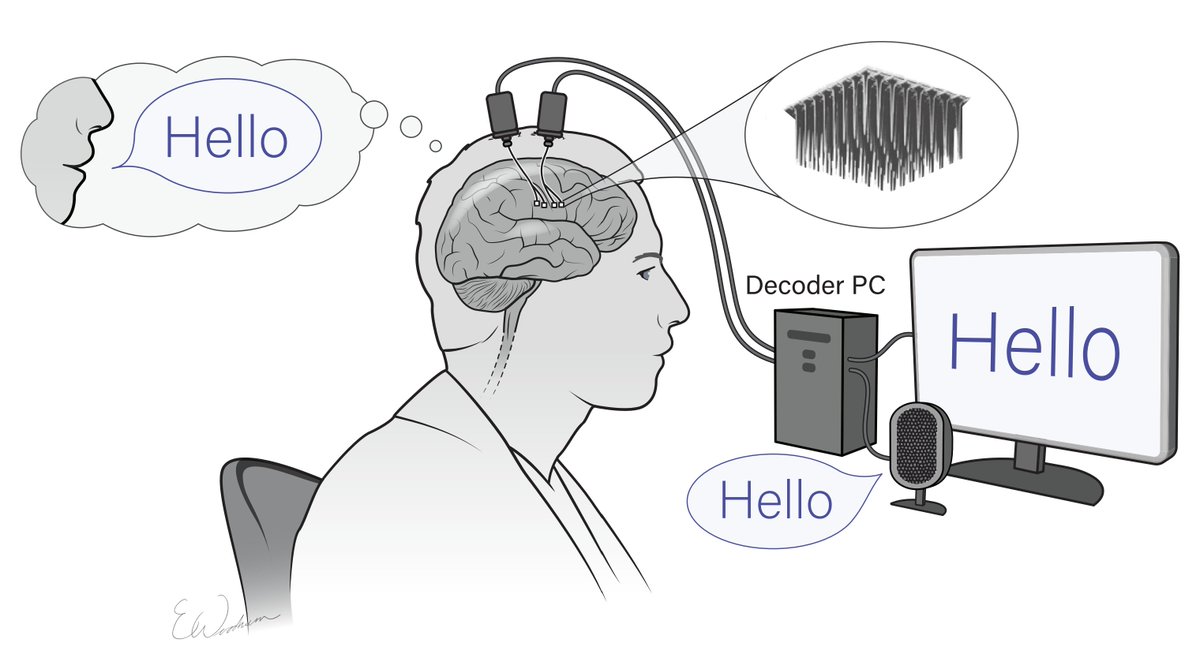
I'll present a poster at #SfN23 on "brain-to-voice" #BCI where we synthesise speech in closed-loop from intracortical signals with real-time audio feedback in a person with ALS. @SergeyStavisky@DrDavidBrandman
Visit us on Wednesday AM (PSTR488.14/JJ25) https://t.co/58YRcGc1cP
We’re hiring a variety of positions: postdoc, research coordinator, and full-time researchers. Come to Austin and help advance iBCI technology for humans with new algorithms for brain-controlled digital and robotic prostheses. Visit https://t.co/lfswcYG2Dw to apply or come find me at #Sfn23. @DellMedSchool@UTAustin
Can we image intracellular calcium with ultrasound?
Yes, w/ultrasonic reporters of calcium - URoCs!
Congrats to @ZhiyangJin and co-authors on creating the first genetically encoded acoustic biosensors of this universal cell signal based on #gasvesicles.
https://t.co/cXqHM3awH4
I have been dying to share our news and it’s finally here:
@ForestNeurotech and @ButterflyNetInc are teaming up to build the next generation of neurotechnology!
https://t.co/51c7UgHQ4p
If you are interested in exploring focused ultrasound neuromodulation, check out our Neurotech Development Kit (NDK) toolbox. It is an open-source, community-driven software library designed to lower the barrier of entry to FUN https://t.co/8n1J5v4LdM
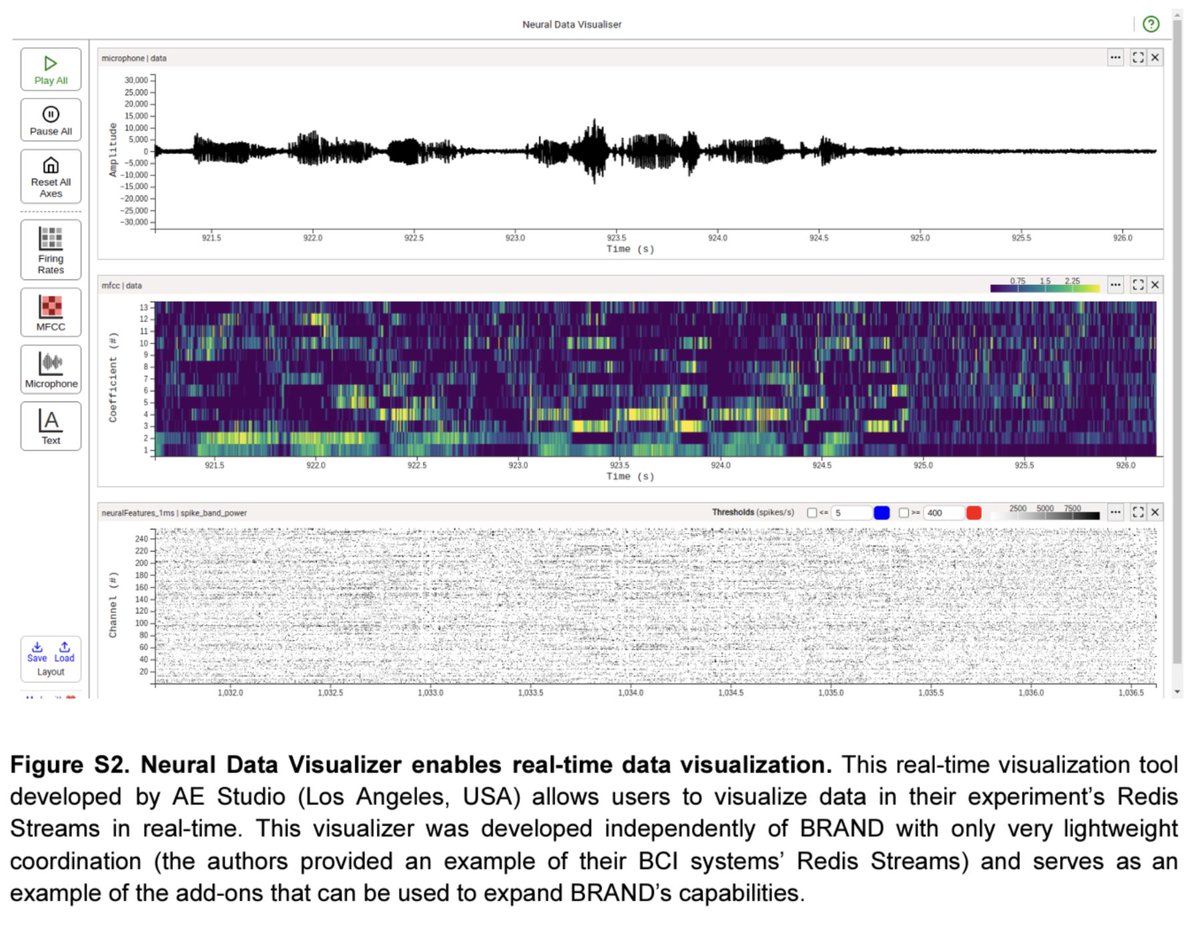
We are excited to see our Neural Data Visualizer featured in the amazing BRAND preprint by @_yahiaali, @NS_Card, @sergeydoestweet, @PresNCM, @DrDavidBrandman, @chethan, et al
Building BCI #opensource together! And pushing agency-increasing BCI forward, one tool at a time!
We're thrilled for another ML competition on BCI! Participating in Neural Latent Benchmark '21 was exhilarating (check out our open-source, 🎉winning 🎉 model here: https://t.co/Kr3BnMt5t5)! We’re eager to see the amazing solutions this new challenge will bring!
Our new study is out today in Nature! We demonstrate a brain-computer interface that turns speech-related neural activity into text, enabling a person with paralysis to communicate at 62 words per minute - 3.4 times faster than prior work. 1/3 https://t.co/6pB7NLAqjG
The edited version of our paper on finger movement (de)coding in motor cortex and posterior parietal cortex is out in Journal of Neural Engineering @IOPPublishing:
https://t.co/vlZnUlHljT
Thanks to the team and to our participants! @CaltechN
I'm excited to see the amazing experiments and tools people will build with @aestudiola's Neural Data Simulator. Its modular design enables integration into existing workflows, and it can be easily extended. We'll be presenting the work at the upcoming @BciSociety#BCIMeeting
The most important part of a brain-computer interface #BCI? The brain! Unfortunately, data from implanted BCIs are hard to come by. @AEStudioLA and @chadBoulay have developed an (open-source!) solution: Neural Data Simulator (NDS) https://t.co/69MOgNbLTG
Introducing: The BCI Exhibit.
In collaboration with @aaas, we are excited to announce the opening of the world's first BCI-driven, thought-generated art exhibition in Washington D.C.
Watch more: https://t.co/KaTmD6VUgr
Read more: https://t.co/yEWV0BvVgd