Devolution needs data to succeed: @LDN_CDO Theo Blackwell explains why devolution requires data as well as powers and money; and why ‘practical devolution needs a centre that is more, not less, active in a rewired state’ to achieve this 🔽
https://t.co/GPpgwHeLgc
We asked an unreleased research version of Claude to take a stab at the Riemann hypothesis.
It didn’t solve it, but it did make strides on a related problem: it increased the lower bound for the fraction of zeros of the Riemann zeta function that satisfy the hypothesis from 41.6% to 67.2%.
https://t.co/aZDvqqhHRi
Congratulations!
We are thrilled to announce that the first officer cohort has successfully completed their intensive 10-week Initial Naval Training course, which they undertook alongside ratings at HMS Raleigh.
➡️https://t.co/dy7C9HnSKw
Was great to contribute to the @theJeremyVine show today to discuss the funding situation at Jodrell Bank - link here (1h12): https://t.co/TSUkupbeJX
For those not aware, there’s a growing outcry about the main government funding agency’s decision to deprioritise funding for the Lovell Telescope (and wider e-MERLIN network).
Below are some more detailed thoughts from me on the topic.
1. Jodrell Bank is a truly iconic facility – nobody should be in any doubt about that. There are several reasons for this. First, it's spent over half a century doing great science. Second, the Lovell Telescope is a really beautiful thing - a masterpiece of architecture-meets-science. Third - and a large part of why I think this outcry is happening in the first place - is something that my dad put into better words than I can:
“It’s one of those things that inspires awe as a beautiful thing, and in what it says about the human spirit. It makes us think beyond ourselves. To turn it into a museum sends a signal that the UK has become unambitious and mundane.”
I wrote last year about the idea of ‘demonstration statecraft’. This is the idea that public science must move away from dry efficiency metrics to rediscover a form of magnificent, visible public spectacle to rebuild deep democratic legitimacy. One cannot base an entire funding strategy on beauty and spirit alone, but if one were going to point to anything that sits at the intersection of scientific progress, the legitimacy of the public realm, and sheer public awe, you probably couldn’t point to a more fitting British example than the Lovell Telescope. The fact it’s really quite close to the new PM’s constituency is also relevant to this!
2. Science progresses with the instruments with which it’s undertaken. X-ray crystallography gave us the structure of DNA. AlphaFold has cut the Gordian knot of understanding protein structures. And telescopes have given us incredible insights into the universe; bigger, better telescopes give us bigger, better insights. For science to progress, nothing should be funded indefinitely. The Lovell Telescope has had a great run at the frontier - 70 years - but it’s worth considering what is coming next. The amazing Square Kilometre Array - a spectacular new facility comprising a matrix of hundreds of interconnected dishes - will be a mind-blowing successor to Lovell - greatly more powerful and sensitive than anything that currently exists. The SKA is a collaboration between over 20 countries, of which Britain is a founding member. And while the telescopes will be in Australia and Africa, the headquarters of the SKA will be at Jodrell Bank.
Now, I am personally not prepared to say that the SKA leaves the Lovell in the dust. The Lovell still does very valuable and important work which is both complementary to the SKA and useful in its own right, and the e-MERLIN network employs lots of great scientists who make important contributions. If money were no object, it would seem to be a no-brainer to continue funding Lovell…
3. But unfortunately, money is not infinite. Look at literally any other area of public funding - from schools to hospitals to prisons - and you’ll see what science is up against. In this context, UKRI has had a surprisingly good settlement from this government. But, in my view, part of the reason for that settlement is that they successfully argued that the work they are doing ticks boxes. One box that the government desperately wants ticked is economic growth. Science absolutely does deliver this - but not all science does it equally, and near-term stuff has had the uplifts while other areas have had flat cash. Another box the government wants ticked is for research to meet its policy priorities - whether that is technology to make Britain a clean energy superpower, or give it an edge in AI, or research collaborations that enrich our creative industries. Again, some fields can more readily demonstrate this impact than others can. Astronomy data are pretty cool in my book - but the impact is often felt in the very long term.
Another box that the government wants to see ticked is international scientific excellence across a range of disciplines. This includes particle physics, astronomy and nuclear physics (PPAN), which are very expensive, very globally collaborative fields with significant concentration on a small number of very high profile experiments, many of which have been agreed at the intergovernmental level. The Science and Technology Facilities Council was created precisely to deal with the repercussions from all those expensive agreements, with the intention of insulating the rest of the sciences from their high costs. If an unexpectedly high electricity bill at the CERN particle accelerator were to wipe out much of UK’s maths research, the system would descend into chaos; it’s important for the UK to be able to sustain financial grip on big physics to avoid it eating everything else.
To that end, a prioritisation exercise has been undertaken within a fixed STFC budget to account for rising costs elsewhere inside the ringfence (among other factors). Obviously, any prioritisation exercise within a fixed envelope will result in winners and losers. The losers do not have to like the outcome. But I have no doubt that the prioritisation exercise was done properly, even if the comms and engagement hasn’t always been totally on the ball.
Ultimately, the decision to keep STFC flat and prioritise within it is a valid one for the government to have taken, even if those on the receiving end do not agree with it.
4. It is worth noting briefly that this is all coming at a time when UKRI has been talking very publicly and prominently about how it’s reorganising its budgets in line with ‘three buckets’ (don’t worry, I’m not going to wax lyrical about this here, you can find chapter and verse on this on my substack). I do want to say, though, that once you talk about deliberately reconfiguring your budget lines at the very top level, it’s easy for prioritisation-exercise losers to question why you have configured budgets in a way that hurts their community and not others. Transparency can help here - and UKRI have put out a lot of information to explain their processes here - but ultimately I can understand why the PPAN community have felt that it’s the ‘buckets’ exercise, not the STFC internal prioritisation, that has led to them getting chopped. This might be a misunderstanding - I think it probably is - but if it is a misunderstanding then it needs to be dealt with as one.
5. Lastly I want to say that there’s been a lot of semantics here about whether this is a ‘cut’. As I said last week, it depends on your perspective. If you are sat in UKRI Strategy, STFC has absolutely not had a cut. The top level budget has remained static. (I know cash ringfencing is not the same as real protection, but the nuance doesn’t help win the argument.) If you are a scientist at e-MERLIN, your budget has… gone. It is hopeless to tell those people that there has been no loss of funding because a larger aggregate budget has been held flat - even if it is ackshually correct. It is also hopeless to insist that those people ultimately have no god-given right to ongoing and permanent funding for their thing, and that funding for research projects should always be at risk of non-renewal as a matter of principle, if they are currently going through considerable pain and turmoil as a result of your upstream decisions. That’s also ackshually correct, but would be a pretty cruel stance in my view, and I’m relieved that UKRI have not taken this tone with the research community.
6. So what about Jodrell Bank? Well, if - as reported - the e-MERLIN turns out to have significant uses by the military and intelligence services, then perhaps a solution will be found. (In a sane world, STFC and the MOD would have figured this all out by themselves.) Or perhaps Manchester University will find the money. Or maybe a rich benefactor from the music industry might come forward. Whatever happens, and irrespective of the plight of the wider STFC community, I think now something will eventually be done to save Lovell.
If that happens, some people will no doubt write it off as sentimental.
To those people, I say yes – the Lovell Telescope maybe represents more than it can now achieve. But that is a powerful thing in itself.
Against a backdrop of rising youth violence, the Royal Navy is giving young girls access to combat sports as an alternative to gang culture.
Sky's Charlotte Leeming spoke to some of the girls involved
More ➡️ https://t.co/PAiZ4D1jU3
📺 Sky 501 and YouTube
1/ Anthropic’s Opus 5 model was released publicly today.
@AISecurityInst tested it before release, and you can see their contributions summarised in Opus 5’s system card. Another clear example of the importance of world-leading capabilities the UK has continued to build through AISI.
The speed, robustness, and consistency of AISI’s pre-deployment testing keeps the UK at the forefront of understanding frontier AI capabilities. It has never been more essential than now.
As Britain’s AI Minister, I will continue to champion this ability.
https://t.co/kHrnq9Qkob
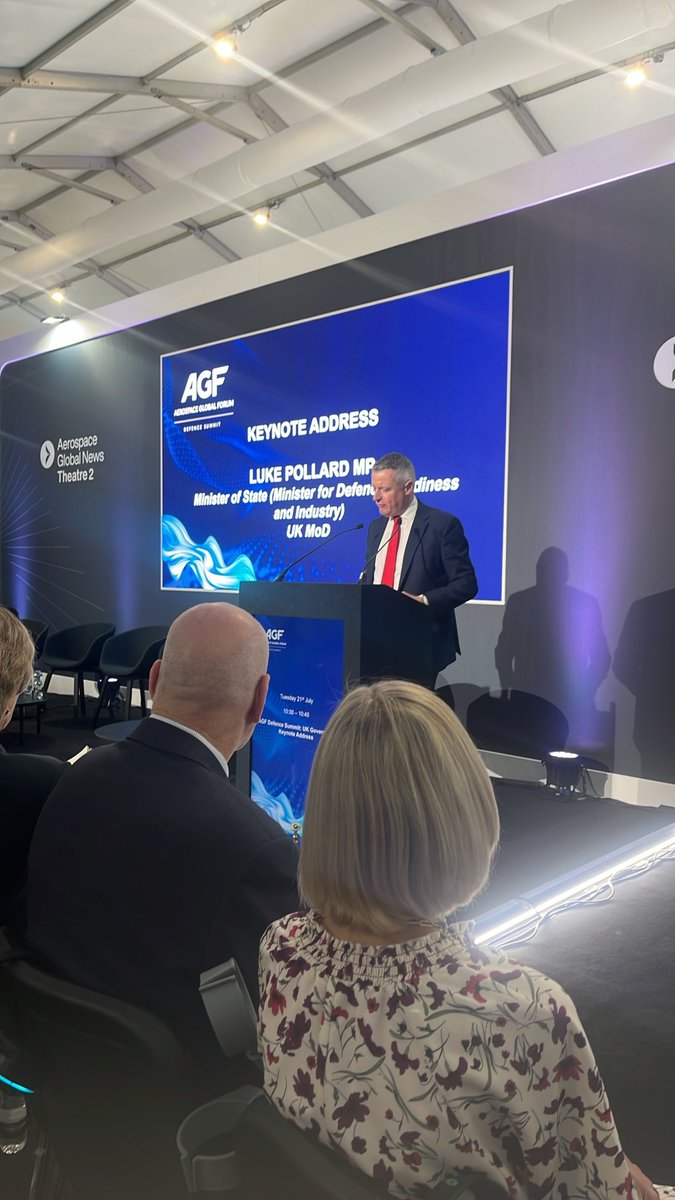
Luke Pollard - an experienced and respected defence minister, though not yet confirmed to be staying in post - is giving a speech at the Farnborough Air Show. He starts with a joke about how he is waiting for news on the job front: “I’ve left my phone on loud at the back of the room so if the PM rings you will be able to hear it”
Yes! Having a gov dept for tech means it gets
•Cabinet-level focus
•the priority from Treasury
•the resources (people) to plug tech into other Depts’ agendas
If DSIT is merged with another dept — tech gets lost in the shuffle… along with UK’s global leadership in tech.
One thing that Makerfield shows is the idea that demographics are destiny and personal votes don’t matter except for at the margins doesn’t matter. There’s an argument that in the attention economy the role of personality might even be growing.
. @MattChorley “is the outcome of what is proposed going to lead to a reduction of ponies on Dartmoor”
Marian Spain, CEO @NaturalEngland “it could do”, but essentially they don’t want it to.
Time for NE to be clear and to implement the Fursdon Review.
https://t.co/P4W6tc0gcJ
@TonyJuniper Pls unequivocally implement recommendation 27 of the Fursdon Review. Whilst a cull may not have been the NE recommendation or the aim, its clear that’s the risk of the byproduct in current approach. That’s what’s at the heart of the concerns that have been raised locally?
we're rebuilding the state from the inside and need a brilliant platform engineer to do it with us. up to £200k. the most impactful work of your life. if that's you - or you know them - dm me. https://t.co/yatA9kCRMS
@StephenMorganMP@DefraGovUK Well done Stephen. Please could you make it an early priority under “protecting our natural environment” that we have absolute clarity from Defra and NE that rare Dartmoor ponies are excluded from proposed number reductions/culls on Dartmoor. The situ has gone on far too long.
She fled her home.
She saved her nurse’s uniform.
Not her jewellery. Not possessions. Her uniform because she wanted to keep caring for people.
That tells you everything about her.
This is the Britain I believe in: one that values compassion, courage and those who contribute to our communities.