Not something you'd see everyday—changing the alphabet of life.
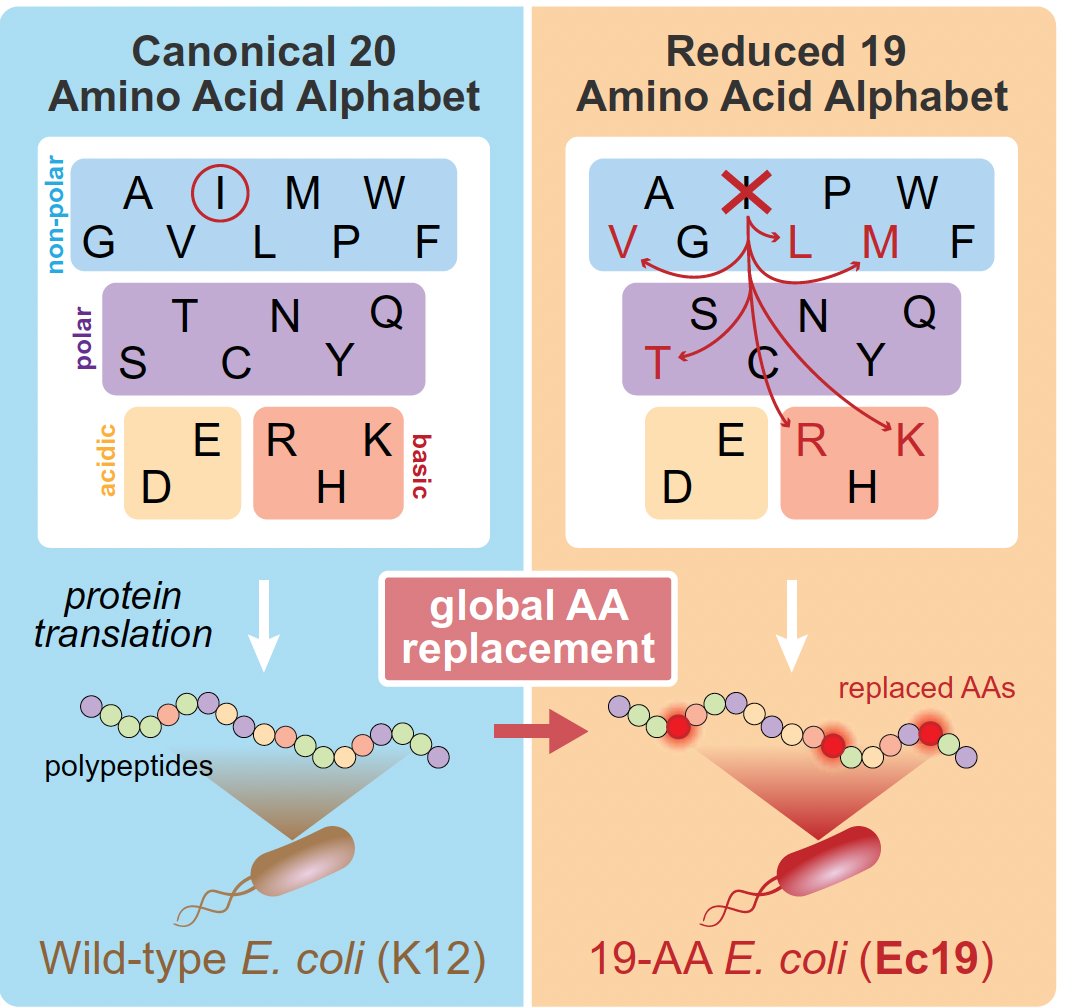
All of life organisms are are built from 20 amino acids. Now genAI is enabling life to be built with 19 amino acids, making isoleucine dispensable. @ScienceMagazine
https://t.co/7CBn0Xhuxs
1/ Can we build life with fewer than the 20 standard amino acids used by all organisms on Earth?
Find our first step in answering this question in our new paper in @ScienceMagazine:
1/ Excited to share our new paper in Science: “Toward life with a 19-amino acid alphabet through generative artificial intelligence design.” @ColumbiaSysBio@ColumbiaBME@Columbia
https://t.co/ZT3Ygw9tiG 🦠🧬🛠️🖥️💥
6/ Combining 21 recoded subunits together produced an evolutionary stable strain for hundreds of generations.
Next step: going after the whole genome? 🧬
Structural biology is in an era of dynamics & assemblies but turning raw experimental data into atomic models at scale remains challenging.
@mhli41 and I present ROCKET🚀: an AlphaFold augmentation that integrates crystallographic and cryoEM/ET data with room for more! 1/14.
We introduce ConforNets, a mechanism for conformational control in AlphaFold3 models
- SoTA at producing diverse conformations on every multistate benchmark (N=104)
- Novel capability: transfer state from one protein to another
Outperforms BioEmu, ConforMix and AFsample3
🧵1/8
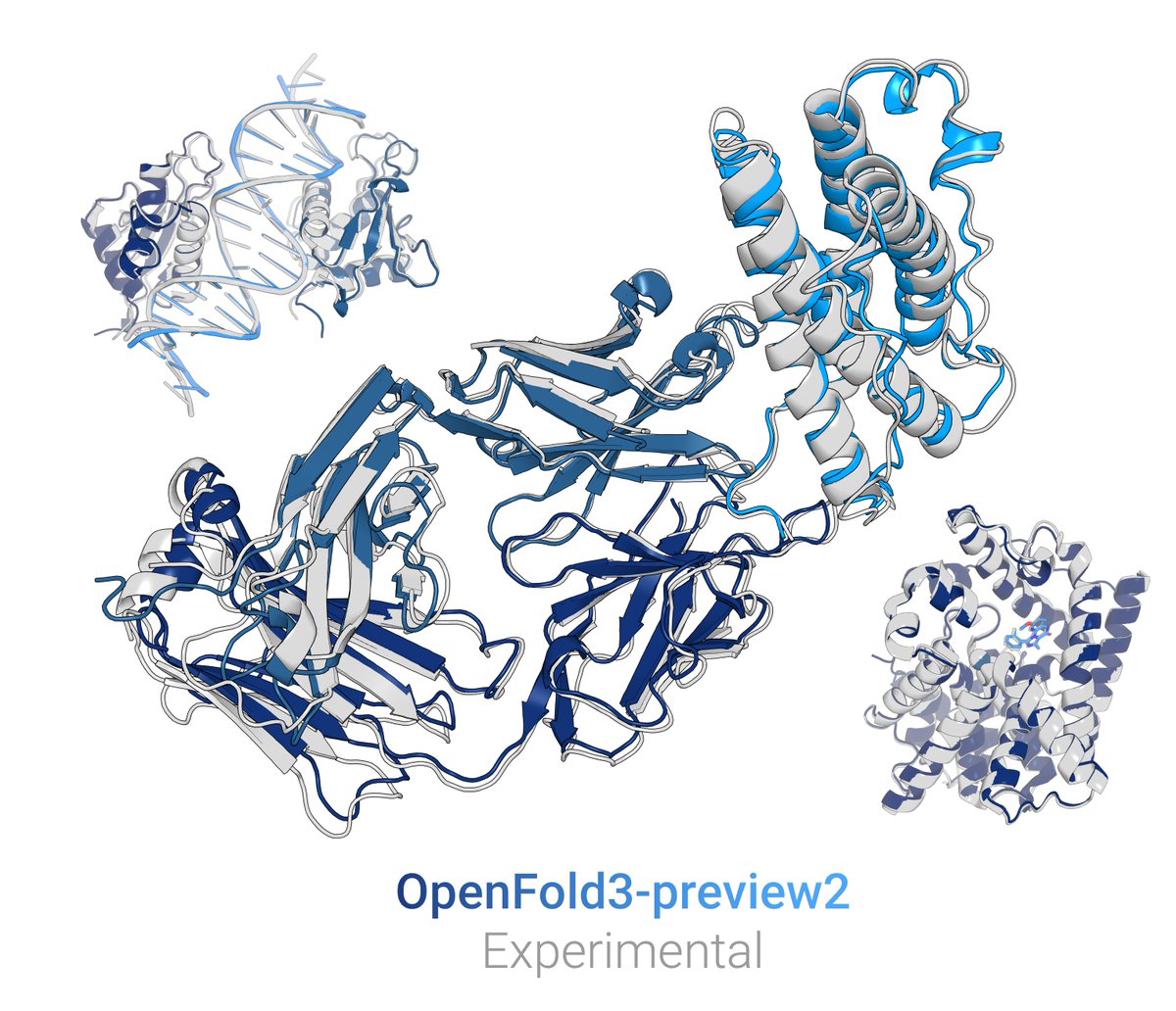
New OpenFold3 preview out! (OF3p2)
It closes the gap to AlphaFold3 for most modalities.
Most critically, we're releasing everything, including training sets & configs, making OF3p2 the only current AF3-based model that is functionally trainable & reproducible from scratch🧵1/9
OpenFold3-preview (OF3p) is out: a sneak peek of our AF3-based structure prediction model. Our aim for OF3 is full AF3-parity for every modality. We now believe we have a clear path towards this goal and are releasing OF3p to enable building in the OF3 ecosystem. More👇
We have trained ESM3 and we're excited to introduce EvolutionaryScale.
ESM3 is a generative language model for programming biology. In experiments, we found ESM3 can simulate 500M years of evolution to generate new fluorescent proteins.
Read more: https://t.co/iAC3lkj0iV
The Protein Engineering Tournament Results have arrived 🎉
Our Pilot Tournament challenged 7 of the best protein design teams in the world to conquer a list of 𝗽𝗿𝗼𝘁𝗲𝗶𝗻 𝗽𝗿𝗲𝗱𝗶𝗰𝘁𝗶𝗼𝗻 𝗮𝗻𝗱 𝗴𝗲𝗻𝗲𝗿𝗮𝘁𝗶𝗼𝗻 challenges.
Let's take a look at the results! 🧵
We observed the conservation of nanosecond-scale protein dynamics in related protein homologs. Check out our work, led by @PJHeckmeier and just published in @PNASNews 👇
Just published in @PNASNews : the impact of evolution on protein dynamics. In our study, we observed the conservation of nanosecond-scale protein dynamics in 10 related protein homologs. Check out the paper with Peter Hamm, Jeannette Ruf, and @charochereau
https://t.co/lIJobtEDzC
AI for biology has the potential to help solve some of the most important problems facing our society. Scientific openness will be critical for our field to progress. As scientists engaged in this work, with more than 90 signatories across the world, we are advancing a framework and commitments for responsible development:
https://t.co/K85bJgAreQ
We’ve a new review on DL methods for protein-protein interactions, focused on discovering novel interactions, structurally characterizing known interactions, and designing binders. Work by @JuliaRuRogers and Gergő Nikolényi, who’ve done a great job distilling a huge field. More👇
Want to learn more about our Activator program? ✨ Register for one of our info sessions using the QR code or link below! We're hosting at campuses all around the city and even have two virtual info sessions. More dates/locations to come! 👇
https://t.co/FnbiSZcbXC
We built a new diffusion protein design model named Genie. We preprinted it a while ago (soon after RFDiffusion and Chroma preprints) but kept mum due to embargo. Final ICML version (major update) with code https://t.co/0wLXWMeuJU and paper here https://t.co/j977j9ddna (1/7)