🍻 The 1st episode of Beers With Brownie, featuring Tas Baitieri is now live on our @youtube channel.
🏉 When we hit 1,000 subscribers, we will buy 100 footies to send out to developing @IntRL nations across the globe.
🗣 RT to spread the word.
📺 Link: https://t.co/Sk9zNrBtj8
Rugby league still lacks full recognition as an independent sport within the global sporting system. International Rugby League (IRL) never achieved full membership of the Global Association of International Sports Federations (GAISF), which voted to dissolve in 2022 and completed its liquidation in 2023.
Today, SportAccord has taken over many of GAISF's former responsibilities, while the Alliance of Independent Recognised Members of Sport (AIMS) provides a pathway towards recognition within the Olympic Movement. Unfortunately, rugby league is still not an AIMS member.
Without international recognition, genuine global development will remain extremely difficult. National federations will continue to struggle to secure government funding, access public sports facilities, enter schools and establish themselves as legitimate, independent sporting organisations.
And we must not ignore another longstanding challenge: rugby union (RU). Historically, rugby union has actively obstructed the development of rugby league in numerous countries. Such opposition may no longer be as open or aggressive as it once was, particularly given modern legal protections and human rights standards, but I remain convinced that resistance continues behind the scenes, often below the radar.
Until rugby league achieves genuine institutional independence and international recognition, we will continue fighting the same battles rather than building a truly global sport.
Super League clubs have approved the vote to expand to 15 this morning. This will move quite quickly now. I'd expect London ratified by the start of next week.
FULL HOUSE 📣 The #RLWC26 Final has officially SOLD OUT 🏆
Kicking off this Sunday from 4:10pm AEDT (Women's Final) and 7:35pm AEDT (Men's Final)
Live on Channel 7 & 7Plus 📺
🏉🇨🇦 Final stop for the Canada Grizzlies Masters Rugby League Team!
Catch Team Canada take on Great Britain & Australia this Friday on the Gold Coast.
📍 Tugun Seahawks ⏰ 1:00 PM 🎟 Free entry
Come cheer on the Maple Leaf! 🍁
#CanadaGrizzlies#TeamCanada#RugbyLeague
What we are doing here is extremely important for the future of international Rugby League.
Let's look at basketball, a sport that is far bigger, more globally established and more widely recognised than Rugby League, yet one that offers some striking similarities.
The NBA is basketball's equivalent of the NRL, the strongest professional competition in the world, attracting the very best talent.
Europe has the EuroLeague, widely regarded as the second strongest club basketball competition in the world. Yet, commercially and financially, it is nowhere near the NBA.
Now the NBA is looking to reshape European basketball through its proposed new competition, NBA Europe, developed in partnership with FIBA, while discussions about possible cooperation with the EuroLeague continue.
Does this sound familiar? The NRL and Super League?
But here is where the comparison becomes particularly interesting.
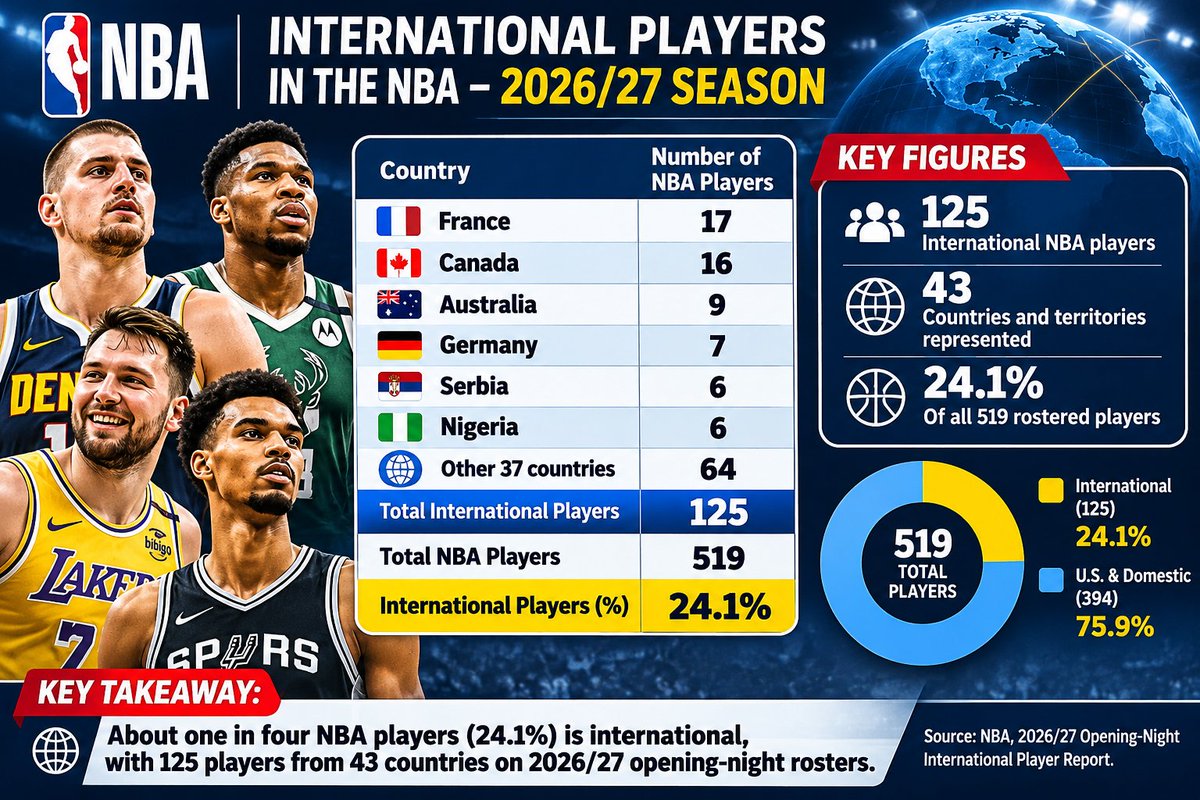
The NBA attracts the best basketball players from around the world. In the 2026–27 season, there are 125 international players from 43 countries and territories, representing approximately 24% of all NBA players.
And here is the crucial difference.
Many of these players were not developed within the American basketball system. They are products of their own countries' basketball structures their local clubs, academies, domestic competitions and national development programmes.
Think of Nikola Jokic from Serbia, Luka Doncic from Slovenia or Victor Wembanyama from France.
They did not become international stars simply because they qualified to represent another country through their ancestry. They developed as basketball players within established basketball systems before reaching the NBA.
And that is precisely what makes basketball's international development model so powerful.
The NBA benefits enormously from this global talent pool. International stars attract millions of fans in their home countries, helping the NBA expand its international television audiences, broadcasting revenues, sponsorship opportunities and commercial partnerships.
But, equally importantly, these players demonstrate the value of strong domestic basketball structures around the world.
The NBA does not need to manufacture international basketball through ancestry rules. It benefits from basketball genuinely being played, developed and supported internationally.
That is the fundamental lesson I believe Rugby League must understand.
We should be developing Rugby League players in Serbia, France, Ukraine, Greece, the Netherlands and other emerging nations creating strong domestic competitions, developing coaches, gaining government recognition and building sustainable national federations.
If those players eventually reach the NRL or Super League, everyone benefits: the players, their countries, their national federations and the professional competitions themselves.
The ultimate objective should not simply be to create stronger national teams by recruiting players with ancestral connections. It should be to create stronger Rugby League nations capable of producing their own players.
That is how you build a genuinely global sport and, ultimately, a much bigger global market for the NRL and Rugby League as a whole.
Our Kiwi side is named for the RLWC finals! 🇳🇿🏆
The Kiwis are ready to take on Australia this weekend, with a World Cup title on the line. Watch LIVE on #SkySportNZ 📺
One more game for World Cup glory! 🏆🇳🇿
The Kiwi Ferns have named their side to face Australia in the RLWC final this weekend. Watch LIVE on #SkySportNZ 📺
The 2030 Rugby League World Cup format sounds mad, but we've just seen a version of it work.
The NRL has finally woken up to Test footy's potential.
Next time around, they've earned the right to be ambitious with it.
✍️ @loverugbyleague
https://t.co/nTp99j9RDS
Seven sets new records with a massive Rugby League World Cup Semi-Final weekend
Men’s Rugby League World Cup Semi-Final 2 Sunday, Australia v Samoa the most watched RLWC match ever, reaches 3.68 million
Men’s Rugby League World Cup Semi-Final Saturday, New Zealand v Tonga reaches, 2.84 million
Women’s Rugby League World Cup Semi Final Sunday, Australia v Fiji, biggest ever women’s RLWC audience, reaches 1.81 million
The Seven Network’s coverage of the Rugby League World Cup Semi-Finals broke audience records across the weekend on broadcast and streaming, with the most watched men’s and women’s World Cup matches ever recorded, as well as the most streamed international rugby league game.
Australia’s win over Samoa on Sunday evening reached a massive 3.68 million and had an average audience of 2.05 million, making it the most watched RLWC match ever. The match also had an audience of 733,000 on 7plus, making it the largest streaming audience for a RLWC game and for an international rugby league game.
Sunday night’s women’s match, Australia v Fiji, was the most watched women’s RLWC game ever, reaching 1.81 million with an average audience of 903,000. The match had 241,000 viewers on 7plus.
New Zealand’s win over Tonga was the most watched program on Saturday night, reaching 2.84 million with an average audience of 1.47 million. The match was viewed by 531,000 on 7plus.
Both men’s Semi Finals matches, Saturday’s New Zealand v Tonga and Sunday’s Australia v Samoa, won all demos, 25 to 54’s, 16 to 39’s and grocery shoppers.
Seven Network Head of Rugby League World Cup, Lesley Tapsall said: “It's been an incredible weekend for rugby league, with audiences right across the country turning to Seven in record numbers for two exhilarating semi-finals between Australia and Samoa and the Jillaroos and Fiji.
“To see the men's semi-final reach more than two million Australians, setting a new record for the biggest audience ever for a Rugby League World Cup match, is an extraordinary result,” she said.
“The women's semi-final was another landmark moment, with our Jillaroos taking on Fiji in front of a record-breaking 902,000 viewers – the biggest audience ever for a women's Rugby League World Cup match.
“These numbers reflect the incredible appetite for international rugby league and the growing interest in both the men's and women's games. We're incredibly proud to deliver these moments to Australians live and free, and there's still so much more to come on Seven this week.
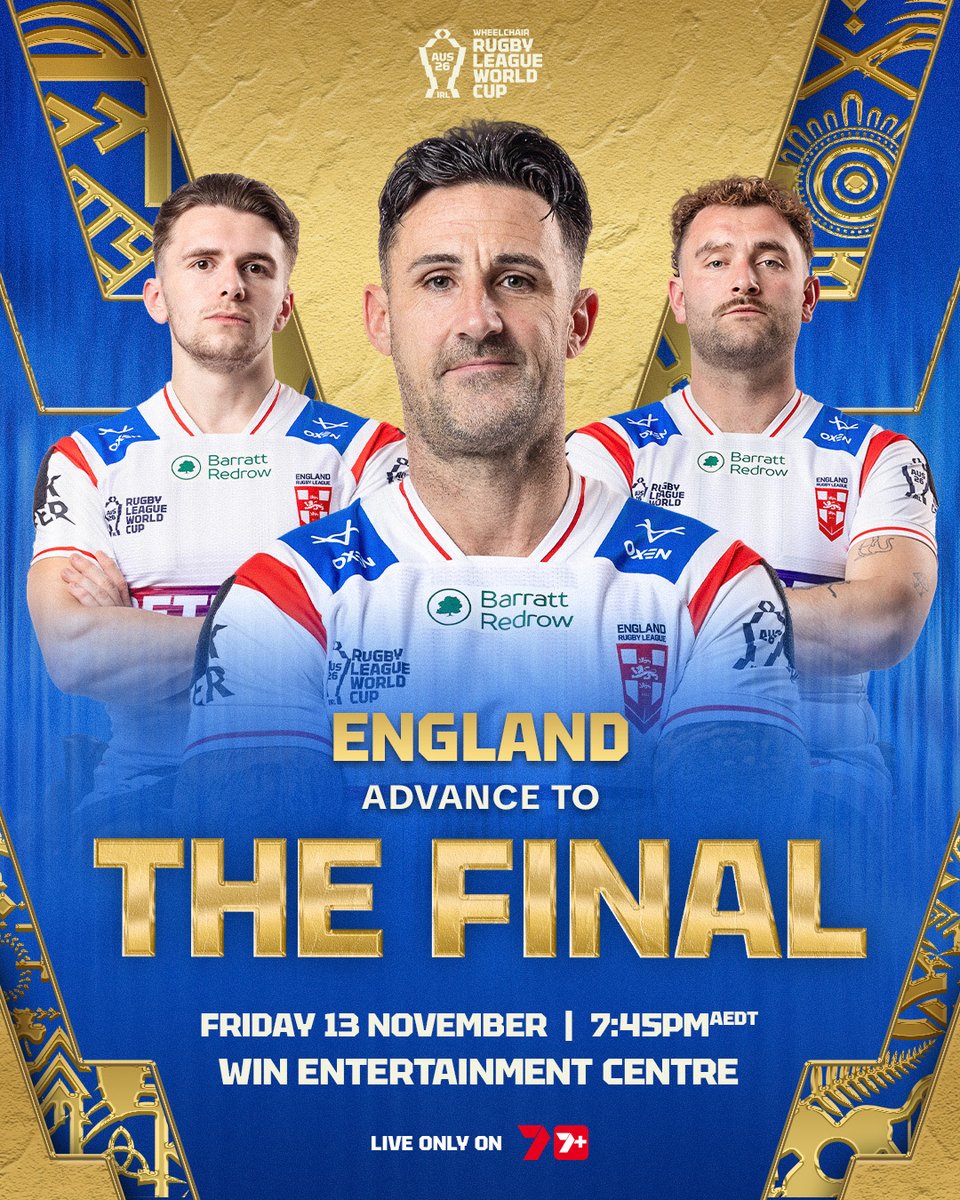
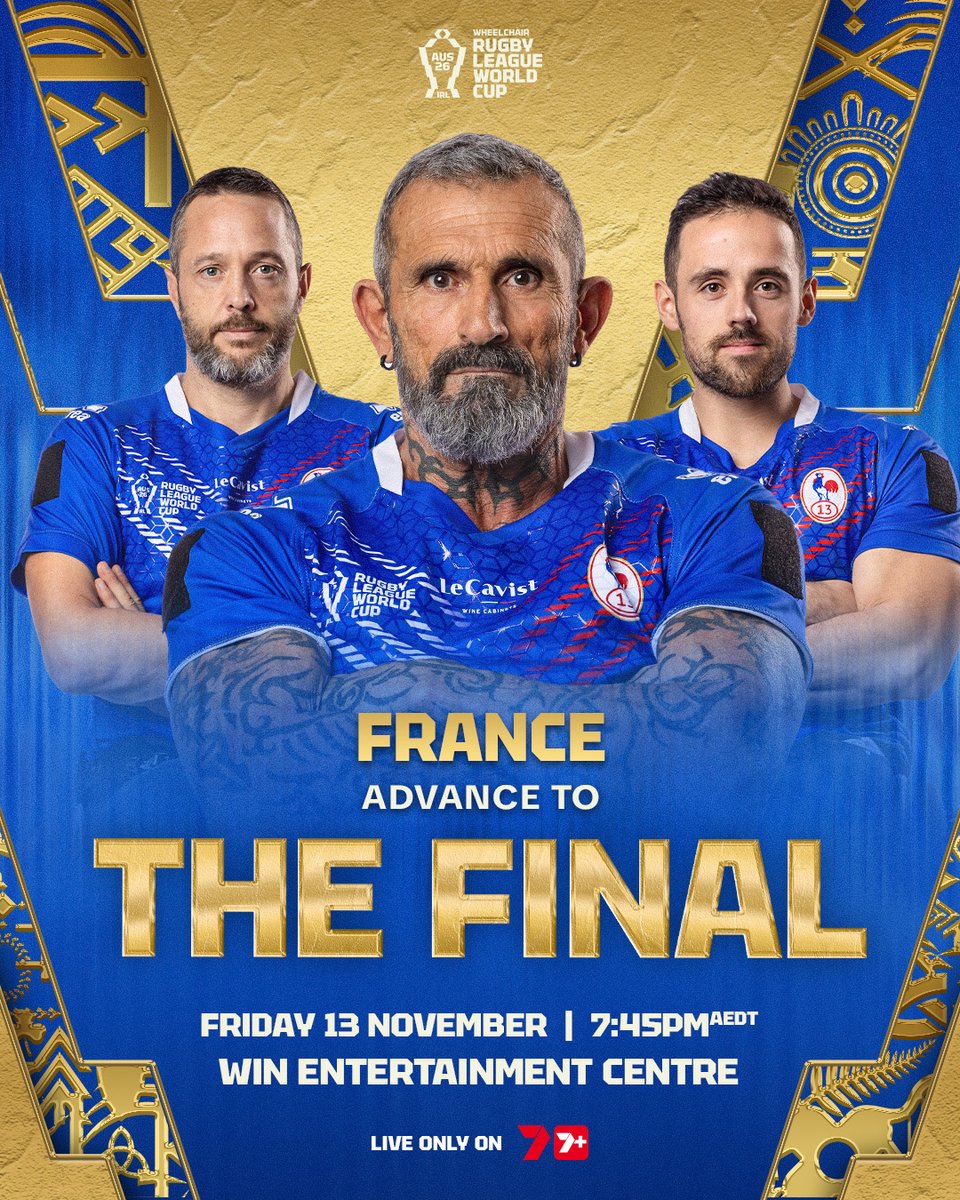
“The wheelchair semi-final action continues tomorrow from 5.00pm, with France taking on Ireland before England face Australia, as our national wheelchair side looks to secure its place in Friday’s final. Both matches will be live and free on 7mate and 7plus, building towards the all-important final at 7.30pm AEDT Friday.”
“Then Australians can tune into what promises to be a huge Sunday, with the women's and men's Rugby League World Cup Finals, both against New Zealand. To have both titles decided in one massive double-header, from 3.30pm live and free only on Seven and 7plus, is a fantastic way to finish the tournament. We cannot wait.”
Seven’s Semi-Finals coverage was led by 7Sport hosts, Mel McLaughlin and Matt White, Sunrise co-host Matt Shirvington and The Agenda Setters: Rugby League host Corey Parker.