We are at a crossroads when humanity will have to form a new kind of identity. We form our identities in relation to others. We’re Bowles and not fraternities or dorms. We’re Bears, we’re Cal and not that school across the Bay. For the longest, we were humans and not animals. AI is changing that last one. Perhaps it can even bring us closer to the natural world, by making painfully clear that we’re biological, not artificial intelligence.
In this moment, when humanity is realizing that its intelligence might not be the most exclusive and unique, it is worth forming our alliances with other biological beings.
Last week, Baishen Liang (postdoctoral associate) led a discussion on a recent ieeg
speech paper from the Chang Lab by Patrick W. Hullett and colleagues on the frontal
and temporal parallel cortical speech processing pathways.
Yesterday I taught my brand-new lecture on autoencoders, showing students how we can design neural network architectures to perform specific tasks—like information compression!
I’ve added the full lecture with codes to my free, online e-book, including:
1. All the nuts and bolts, with clear equations and explanations
2. The full training cycle—forward pass, backpropagation, and weight updates
3. A simple, from-scratch coded example to make the concepts come alive
I’m excited to keep building out these resources and sharing them with everyone! Check it out @ https://t.co/6ejtjBiJIu ∀.
We presented our #ManyTones project at the 2025 #BigTeamScience Conference. We talked about project background, pilot study, and challenges. The slides are available at https://t.co/iVS8W62ElA. Feel free to check them out 👀
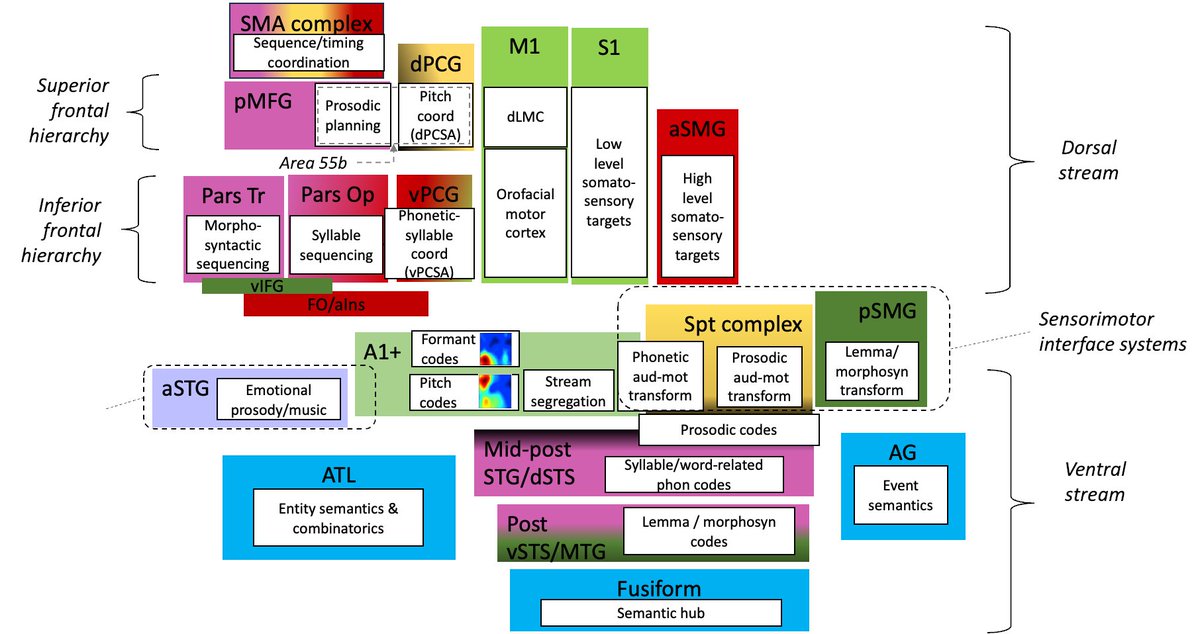
My attempt to depict the neural architecture of language as motivated in my forthcoming book, Wired for Words. Like colors represent functional connectivity. Main insight: linguistic levels are all organized with a sensorimotor-like architecture, the Linguistic Sensorimotor Model. Ventral areas code targets for production, dorsal areas code plans for execution and a translation system, at each level. Receptive function only involves ventral systems for the most part.
Our video poster on prosodic and phonetic subtypes of apraxia of speech and their neural correlates in stroke. New work lead by Lynn Kurteff with Grant Walker and Julius Fridriksson. To be presented at Academy of Aphasia.
https://t.co/r029ZRnKDf
Human auditory cortex integrates information in speech across absolute time (e.g., 200 ms), not phonemes, syllables, words, or any other time-varying speech structure: https://t.co/63T8qdQkUH
How do different languages converge on a shared neural substrate for conceptual meaning? We’re excited to share our latest preprint that specifically addresses this question, led by @zaidzada_
Happy to have concluded another iteration of our 5-day open LLMs course, together with @ZakASHussain.
If you are interested in LLMs for behavioral and social sciences, check out our...
Tutorial: https://t.co/DDQ2ydc5P0
Open materials: https://t.co/lH6qIQwdHI
Thrilled to share our #Interspeech2025 paper: “A Silent Speech Decoding System from EEG & EMG with Heterogeneous Electrode Configurations.” We show, for the first time, that models trained on healthy data can be fine-tuned to decode the attempted speech of a totally paralyzed man
Our brain-to-voice synthesis brain-computer interface paper was published in @Nature today! This neuroprosthesis synthesized the voice of a man with ALS instantaneously, enabling him to ‘speak’ flexibly and modulate the prosody of his BCI-voice. 1/7
Paper: https://t.co/STKtfgypAW
🧠🗞️🗣️Finally out! Paper with a way-too-long name for social media. How does the brain turn words into sentences? We tracked words in participants' brains while they produced sentences, and found some unexpectedly neat patterns. 🧵1/9
https://t.co/ufiNYEIWOw in @CommsPsychol
This Comment from Gary Charness and colleagues discusses how various LLM tools can support different stages of the experimental research process.
https://t.co/tHpuaiJAaK