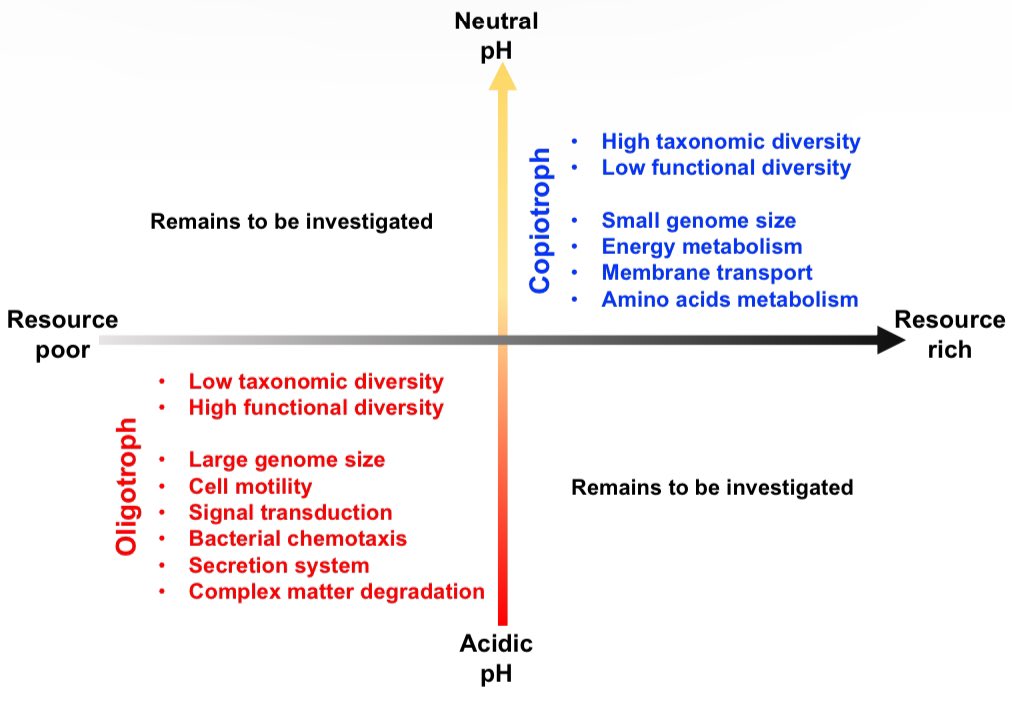
Glad to learn that @NatureComms picks our research as editors’ highlight, Bacterial genome size and gene functional diversity negatively correlate with taxonomic diversity along a pH gradient. https://t.co/IeVz9nre0i
New @NatureComms paper out, Bacterial genome size and gene functional diversity negatively correlate with taxonomic diversity along a pH gradient, https://t.co/RNjrpWKjhV
The 11th International Conference on Mycorrhiza #ICOM11 will kick off in Beijing in a few hours. During the next 4 days, 100+ speakers will present their most recent findings on the biology, ecology and applications of mycorrhizal symbioses. Stay tune!
Fungi and bacteria show contrasting patterns in honey bees, with implications for transmission of plant pathogens. New paper with Leslie Decker (@lesldeck), Priscilla San Juan (@priscillaasj), Maggie Warren, Cory Duckworh, and Cheng Gao (@chenggucb).
https://t.co/6C4YUfwssD
Today, @mykophile prof Kabir Peay gave an excellent talk to more than 500 Chinese ecologists and mycologists via VooV. Thank you so much! We are looking forward to seeing you next year in Beijing for the #ICOM11 conference.
Time-lapse light microscopy footage of a Vampyrella lateritia trophozoite (round) moving along and feeding on cells forming a strand of Spirogyra algae (tubular).
Video: Dr Oliver Skibbe
https://t.co/rTOzS2kenD
Poor ability to connect with mycorrhizal spore banks may explain why bristle cone pine is slow to expand its' elevational range with climate change
https://t.co/ob9h7KDbET
The second newsletter of the international mycorrhiza society is out. With the top 10 mycorrhiza papers and very nice articles and youtube interviews on fungal succession, #rRNAs, host #immune systems, #breeding, mycorrhizal #ecology & #evolution!
https://t.co/jWaRp7mLMJ
Familial dominance of Dipterocarpaceae is a unique features of rainforests in Borneo. With help from #NSFfunded @NSF_BIO RAPID, @maxsegnitz shows that positive phylogenetic feedbacks driven by Dipts unique assoc. w/ ectomycorrhizal fungi may be the answer https://t.co/HzW7c7wAto
Why is local species diversity higher in geologically older regions? Experiments with Hawaiian fungi suggest that it may be because species in old regions have evolved traits that facilitate local coexistence. New preprint with @DevinLeopold.
https://t.co/f7IGN1ZC0p