#GLOW.AI held a farewell party for Ruth Chew @ruthchewing (I'm pointing at her in the photo) who will be heading to @UW for her Ph.D. in Computer Science and Engineering with Pang Wei @PangWeiKoh.
I've known Ruth since her undergrad days back in 2018 when she did her Senior/Final Year Project on @InverseReinforcementLearning with me. During her DSO stint, she did her Master's thesis with me as well, which led to the joint work on BILBO: BILevel #BayesianOptimization (with Phong @qphong) published in @icmlconf #ICML2025 (see her video presentation at https://t.co/vnwlPKNu7M). She has recently led a joint research effort (with Zhiliang @ZhiliangChen94 and Apivich @apivich_h) to develop a benchmark to democratize black-box optimization research for expensive #LLM tasks (https://t.co/wYQH60PfHc).
Ruth will be dearly missed!
Gregory Lau @greglau (funded by the @AISingapore - CNRS@Create DesCartes Joint PhD Scholarship) had also graduated from #GLOW.AI and recently received the Ministry of Education, Singapore (@MOEsg) Singapore Teaching and Academic Research Talent (START) Award (paired with Nanyang Technological University Singapore @NTUsg) to do an Overseas Post-Doctoral Fellowship at Massachusetts Institute of Technology @MIT. His joint work with Apivich on PINNACLE (#ActiveLearning of #PhysicsInformedNeuralNetworks) was published in @iclr_conf #ICLR2024 (spotlight presentation) and had been recognized with the Best Paper Award in the #ICML2024 Workshop on AI for Science. He is also a great teacher in my CS3264 Foundations of ML course, having received the NUS Computing Teaching Fellowship Scheme award, which is given to those with excellent performance as a tutor.
At this party, we also welcome our new member, Joseph Tze Tzun Teoh, to our #GLOW.AI family. He is a recipient of the @AISingapore Ph.D. Fellowship. Looking forward to his significant contributions in AI research!!!
Recently, @OpenAI, @GoogleDeepMind, @ElevenLabs, and @AnthropicAI (https://t.co/UyukACTJgi) are all pushing #watermarking and #provenance forward.
These efforts raise an important question:
If model owners can watermark the content generated by their AI models for provenance and traceability, shouldn’t data owners be able to do likewise and know whether their personal content is used by the AI models?
In other words, alongside asking,
“Is this content generated by that AI model?”
shouldn’t we also be able to ask,
"Is that AI model trained on my personal content?”
Back in 2023 (i.e., well before data provenance for LLM training became a mainstream conversation), we were already thinking seriously about this equally important problem.
If the personal content of a data owner could be watermarked, its downstream use could be traced, including whether it was used to train an LLM.
At that time, existing text watermarking methods were not robust nor practical enough for protecting arbitrary data at scale. That motivated us to develop a text watermarking framework, Waterfall, specially designed for data owners.
Just like how watermarking can give model owners visibility into whether their generated content is being used, Waterfall can give data owners visibility into whether their personal content is being used.
Check out our post from back then: https://t.co/XBcXMNZG9X
How hard can #MachineUnlearning be? 😵💫
Tap on the image to find out!
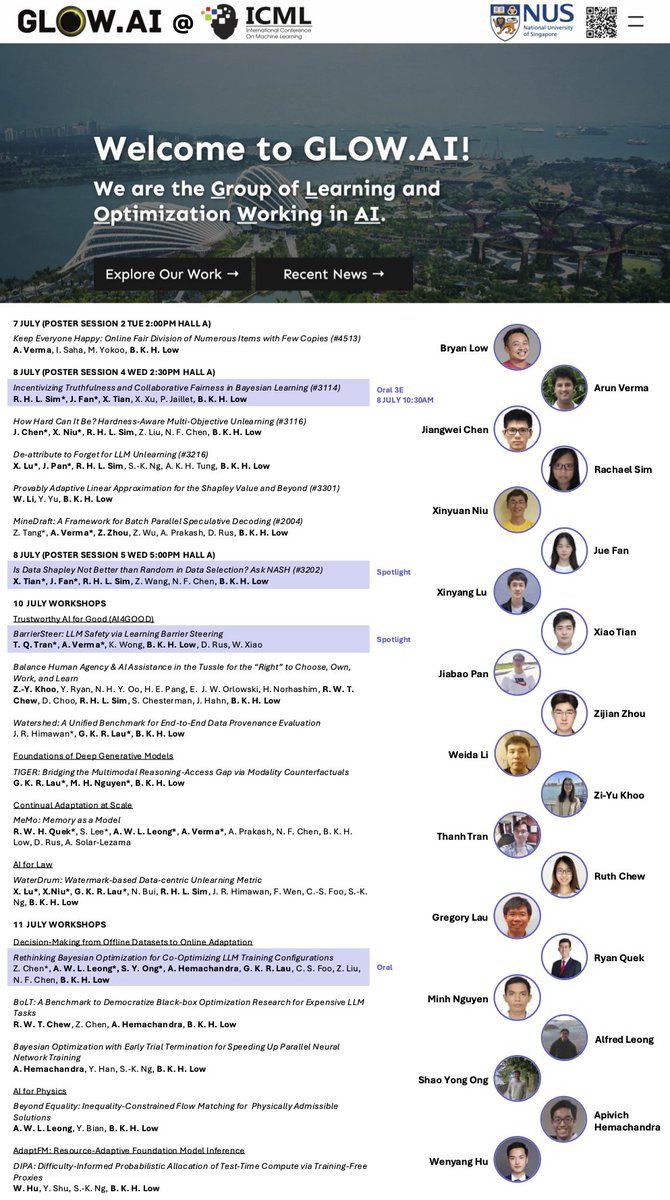
Come check us out #ICML2026!
📍 Join us (@chenjiangw@xinyuan3142@RachaelSim2 Zhengyuan Liu, Nancy Chen @bryanklow) at our @icmlconf poster!
📅 Date: Wed July 8
⏰ 2:30-4:15 PM
🏢 Location: Hall A #3116
📄 Paper: https://t.co/oYZliwFlBF
💻 Code: https://t.co/0qQOKTukdC
[1/9] We will be presenting our Oral paper at ICML 2026 🌟 Incentivizing Truthfulness and Collaborative Fairness in Bayesian Learning 🌟
Can truthfulness and collaborative fairness coexist?
A fair reward in collaborative machine learning may not verify the truthfulness of submitted data. 🤥
A truthful mechanism may not guarantee data sources a fair reward proportional to their contribution. ⚖️
Our paper studies how to achieve both. 🧵
Authors: Rachael Hwee Ling Sim*, Jue Fan*, Xiao Tian, Xinyi Xu, Patrick Jaillet, and Bryan Kian Hsiang Low.
OpenReview: https://t.co/eHkYpKDxS2
@adelbucetta@bryanklow that said, we certainly welcome more people to look into this “hard” problem and come up with other definitions of hardness. happy to chat more at the poster if you’re at icml!
@adelbucetta@bryanklow that said, we certainly welcome more people to look into this “hard” problem and come up with other definitions of hardness. happy to chat more at the poster if you’re at icml!
@adelbucetta@bryanklow yes defining what “hard” is is definitely hard 🙇♂️, that’s why hamu focuses on a specific kind of hardness — the hardness of reconciling both objectives in unlearning, quantified by the utility degradation required to achieve a target level forget quality.
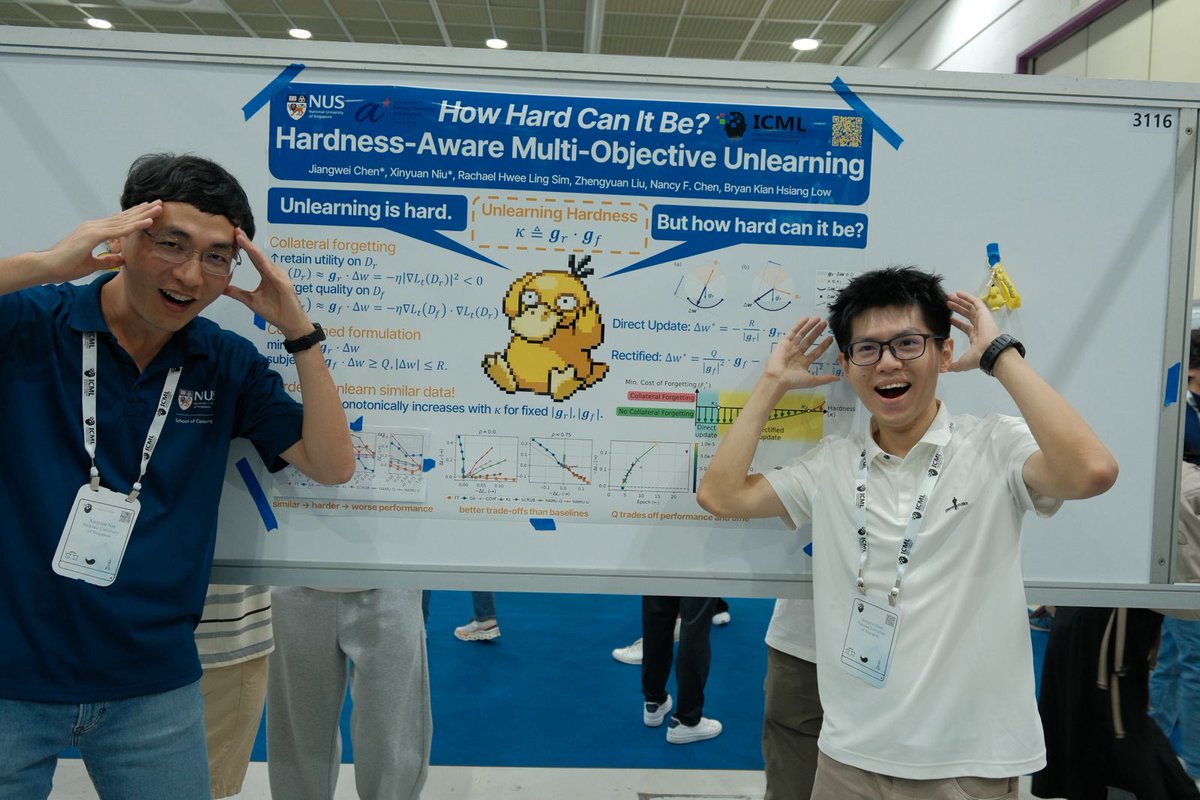
#MachineUnlearning is notoriously difficult, but how hard is it to unlearn different data?
In our #ICML2026 paper, we show that unlearning is harder when the forget and retain data are more similar.
Introducing HAMU: a hardness-aware unlearning algorithm that
1. quantifies unlearning hardness,
2. updates the model based on per-iteration hardness,
3. stops when better forgetting would inevitably hurt retain utility, and
4. is scalable and practical for large, non-convex models such as LLMs.
HAMU achieves stronger retain–forget trade-offs than existing methods across image and text tasks.
📍 Join us (@chenjiangw@xinyuan3142@RachaelSim2 Zhengyuan Liu, Nancy Chen @bryanklow) at our @icmlconf poster!
📅 Date: Wed July 8
⏰ Time: 2:30-4:15 PM
🏢 Location: Hall A #3116
📄 Paper: https://t.co/oYZliwENM7
💻 Code: https://t.co/0qQOKTtMo4
[1/5] 🚨 #MachineUnlearning aims to remove certain data from an #LLM. Current methods rely on maximizing prediction loss on the forget set, but they often break the model's utility entirely. 😱
🤔 Dare you forget my data without causing the model to spit out gibberish? In our new #ICML2026 paper, we completely flip the script with DareU by introducing a brand new unlearning objective.
📄 Paper "De-attribute to Forget for LLM Unlearning" (🔗https://t.co/iMkFAct8eK) - co-led by @lululu0082, Jiabao Pan & our wonderful collaborators @RachaelSim2, See-Kiong Ng, Anthony Kum Hoe Tung, @bryanklow ❤️.
Catch our poster @icmlconf on 8 Jul 2:30 PM Hall A #3216! 🇰🇷
See the thread below 🧵👇
🎼 🎵 🎶... Time to party @icmlconf#ICML2026? Let's go! Wait, I'm the last to depart from 🇸🇬 ???
Don't miss out on the 𝐍𝐔𝐒 𝐱 𝐉𝐚𝐧𝐞 𝐒𝐭𝐫𝐞𝐞𝐭 𝐒𝐮𝐦𝐦𝐢𝐭 𝐨𝐧 𝐒𝐞𝐥𝐟-𝐄𝐯𝐨𝐥𝐮𝐭𝐢𝐨𝐧 𝐨𝐟 𝐀𝐈 𝐀𝐠𝐞𝐧𝐭𝐬 𝐚𝐧𝐝 𝐌𝐮𝐥𝐭𝐢𝐚𝐠𝐞𝐧𝐭 𝐒𝐲𝐬𝐭𝐞𝐦𝐬 (9 Jul)! See link below:
https://t.co/0mHbUKNEFD
#LLMs #AgenticAI #AIAgents #AgenticMemory #DataSelection #ShapleyValue #MachineUnlearning #BayesianOptimization #SpeculativeDecoding
🚀 What should we evolve next in AI agents? 🤖✨
As #AgenticAI rapidly moves from a single-agent system 🤖 to a team of agents 🤖🤖🤖 that remember, coordinate, search, optimize, and interact in increasingly complex environments, this question is particularly urgent. 🔥
To bring researchers together around this emerging direction and following the success of the NUS x DSO x AWS Symposium on Agentic AI Meets Autonomous Agents and Multiagent Systems held during @RealAAAI #AAAI2026 (https://t.co/D29BQR1qFp), the National University of Singapore (NUS @NUSingapore) and Jane Street (@JaneStreetGroup) are pleased to host and welcome you to:
NUS x Jane Street Summit on Self-Evolution of AI Agents and Multiagent Systems
📅 Date: 9 July 2026
⏰ Time: 14:30 - 19:00
📍 Location: Seoul 🇰🇷 (Held in conjunction with @icmlconf #ICML2026 and close to the conference venue)
⚠️ Capacity is limited, and registrations will be reviewed and confirmed by the organizers. Secure your spot early! 👇 🔗
Register here: https://t.co/7760yR4GeU
We invite researchers at the forefront of Agentic AI to join us in
- shaping key research questions,
- exploring new applications,
- identifying potential collaborators, and
- influencing the technical discourse around what to evolve in agents.
🎯 The keynote speeches and roundtable discussions will be centered on how future AI agents can evolve across 3 key dimensions:
🧠 Memory (e.g., MEM1 https://t.co/Thk2yz9keO, MeMo https://t.co/8GU02Ut6AD)
👥 Collaboration & Coordination (e.g., CORAL https://t.co/KUghPGEbLR)
🔍 Optimization & Search (e.g., CORAL https://t.co/KUghPGEbLR)
📝 Goal: The outcome of the Summit is a position or survey paper to be submitted to a top AI venue. Participants at the Summit will be invited to co-author this paper! ✍️📚
☕ Food and drinks will be available during the Summit.
#AIAgents #MultiAgentSystems #LLM #LLMs
In collaborative machine learning (CML), early contributors take on more risk and encourage participation from wait-and-see parties, but existing CML frameworks treat every party as if they join simultaneously.
The @NeurIPSConf paper of @chenjiangw@nguyenpham2804@RachaelSim2@arun_v3rma@WuZhaoxuan Chuan Sheng Foo @bryanklow proposes a time-aware CML framework that rewards parties not just for what they contribute, but when they contribute:
• 8 incentives extending fairness with time-aware notions that incentivize early participation while preventing low-quality early submissions.
• 2 reward distribution methods that theoretically satisfy all incentives and recover the #ShapleyValue in time-agnostic cases.
• A practical recipe for constructing valuation functions and reward realization, with empirical validation on synthetic and real-world data.
Find our more at our posters!
#NeurIPS2025 Thu, Dec 4, Exhibit Hall C, D, E #1104
#EurIPS2025 Wed, Dec 3, Poster Stand #56
Paper: https://t.co/f0VmIrDZj1
#FederatedLearning
@sama it will be great if we can preset a set of instructions and choose among them before each session as we might need different customization for different tasks