Binder design has come of age thanks to generative models—but how can we access the wider array of dynamic, multistate protein functions, so elegantly employed by nature?
@mihirbafna14 and I are excited to share SwitchCraft, a framework for designing such functions. (1/7)
Compared to the preprint, we‘ve added an experimental HX/NMR benchmark showing near-perfect agreement. It’s also fully compatible with the new HXMS standardized file format.
🎉 PIGEON-FEATHER is now published online. In this work, we present a Bayesian framework for extracting site-resolved free energies of opening (∆Gop) from HX/MS data, linking experimental exchange kinetics to underlying conformational free energy landscapes.
Excited to share our study on how proteins with the same fold evolve distinct allosteric networks to drive different functions—even in response to the same chemical triggers.
https://t.co/mZjes4Pi2Z
Super excited to preprint our work on developing a Biomolecular Emulator (BioEmu): Scalable emulation of protein equilibrium ensembles with generative deep learning from @MSFTResearch AI for Science.
#ML#AI#NeuralNetworks#Biology#AI4Science
https://t.co/yzOy6tAoPv
I am excited to share our recent work on deriving site-resolved energetic information (∆Gop) from hydrogen exchange/mass spectrometry (HX/MS) experiments, ensemble energy determined by the distribution of conformational states it occupies.
https://t.co/iUbmPJ0ucJ
Roughly one year ago we started out venturing in the world of #proteindesign. Today I am very happy to share our first preprint ‘Efficient and scaleable de-novo protein design using a relaxed sequence space’ (https://t.co/UCZJoNSXhE) with @sokrypton & @hendrik_dietz 1/x
Constant pH molecular dynamics in GROMACS - our two publications are finslly out!✨🖥️ Theory, code, small tutorial and best practices are out there🏆
(method) https://t.co/NtBEawiSvB
(best practices) https://t.co/Q32eeu4Unz
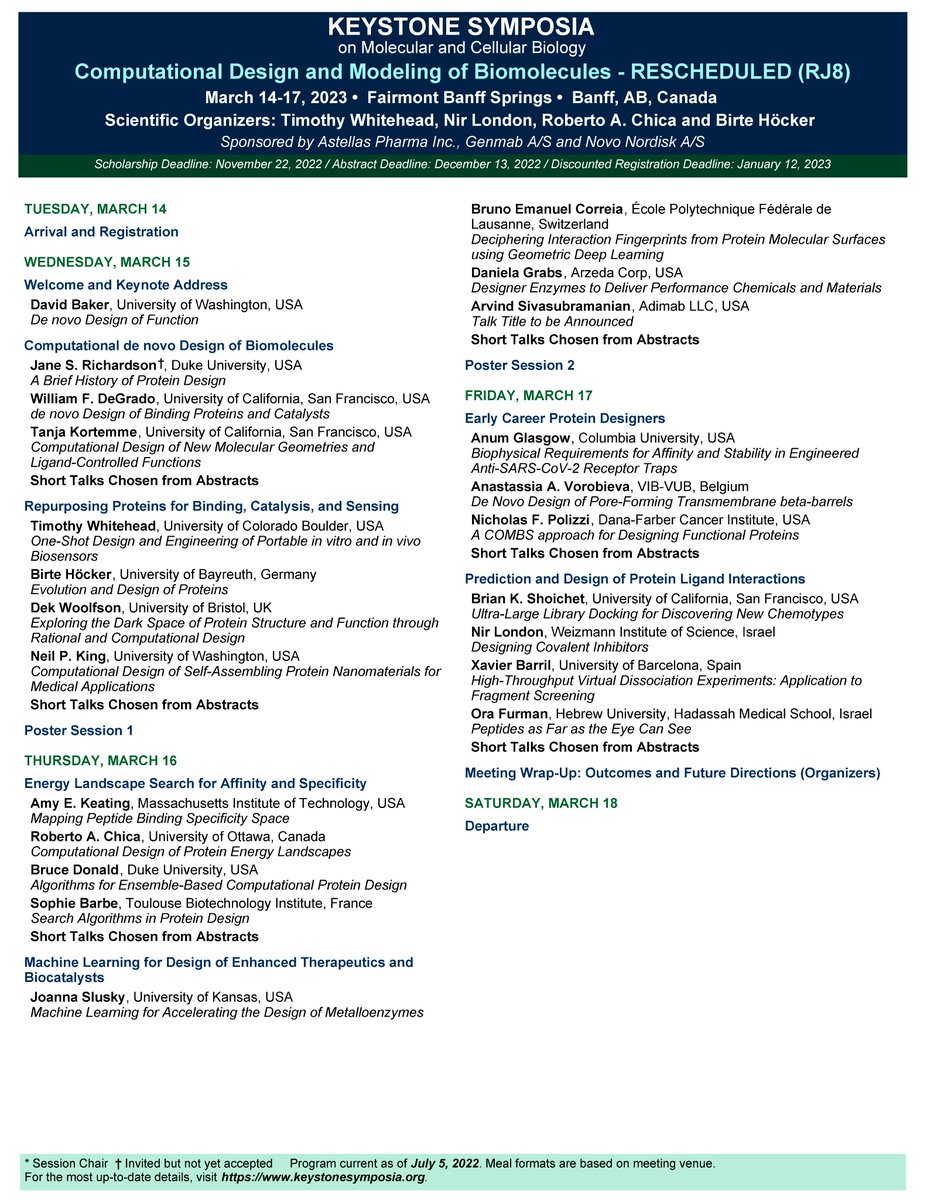
Save the date! The rescheduled Keystone Symposium on "Computational Design and Modeling of Biomolecules" will take place in Banff 🇨🇦 on March 14-17, 2023. #proteindesign
https://t.co/q6lNpvypaB
🚨🚨 New paper alert! 🚨🚨
Need to compute k_off, k_on & deltaG for your ligand-protein complexes? 🤔
Check out SEEKR2 - now out @JCIM_JCTC & powered by @openmm_toolkit
Highlights... 🧵:
https://t.co/CsUTYxjrpn
Building on last week’s announcement of OpenFold, an academic-industry consortium is being announced today within the non-profit @openmsf. The OpenFold Consortium https://t.co/vwzkot9aVA will develop open source ML-based molecular modeling tools in a community-driven fashion. 1/3
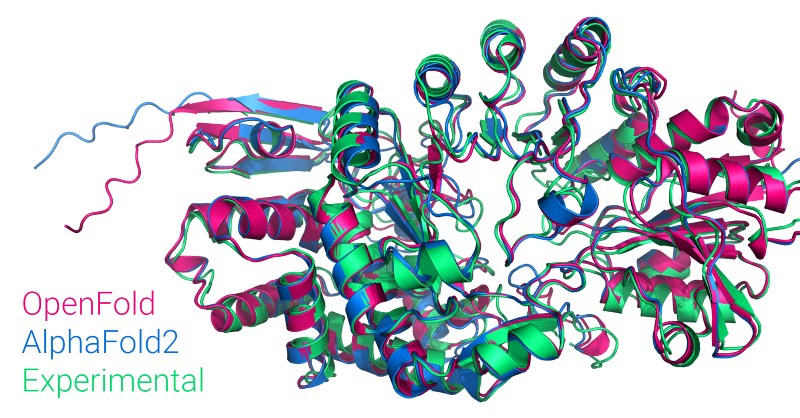
We have successfully trained OpenFold from scratch, our trainable PyTorch implementation of AlphaFold2. The new OpenFold (OF) (slightly) outperforms AlphaFold2 (AF2). I believe this is the first publicly available reproduction of AF2. We learned a lot. A🧵1/12
Protein folding from single sequences is enabled by replacing MSAs with protein language models! Amazing how rapidly this field has evolved since we started with LM-based "contact prediction" in 2019 🚀
.@chenlin_lu@maitybasudev@pengxuexue and coworkers elucidate the formation of a multinuclear Au cluster in apo-ferritin using SCXRD and quantum chemical calculations
https://t.co/eNUPJ6GsAy
New preprint from the lab! Toby Turney shows how the K+ channel TWIK1 is gated shut by a selectivity filter "zipper". Congrats Toby + Vivian! https://t.co/EvqzLxZbeb