a machine learner, indoor climber, plays the cello and is interested in biology, language, and human. Favourite authors: James Tiptree Jr. and Ted Chiang.
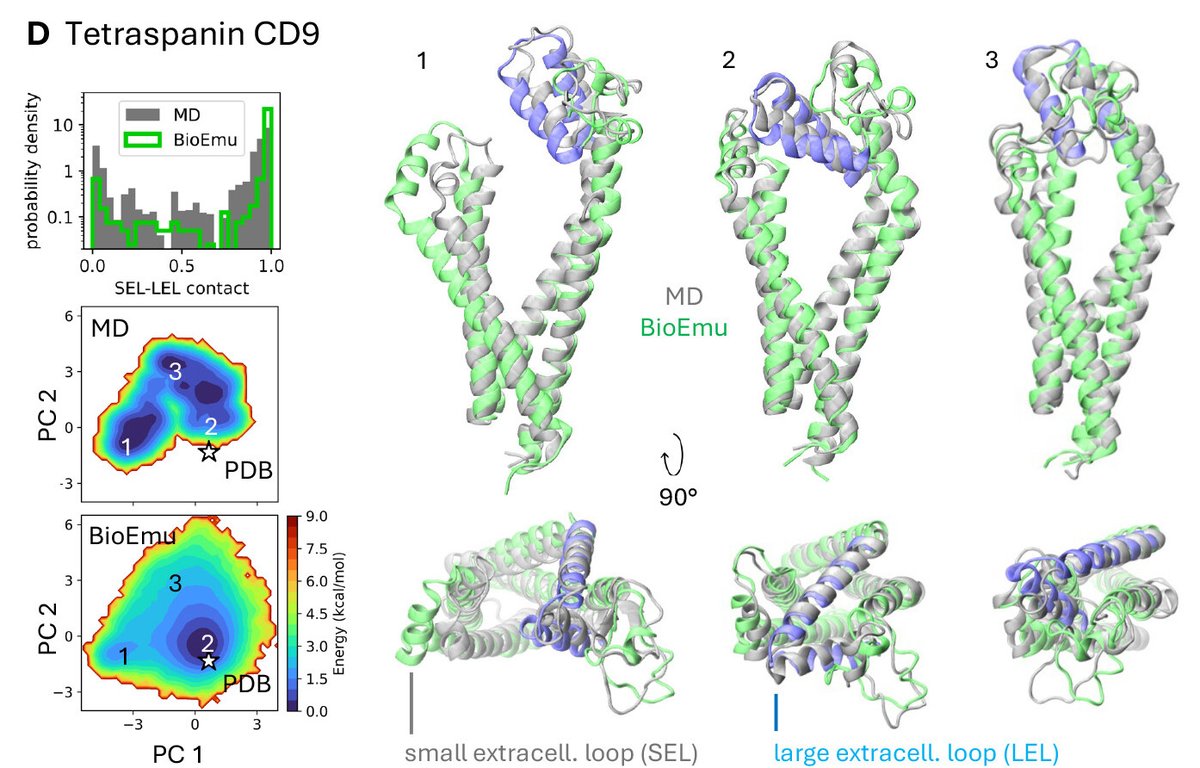
BioEmu is now published in Science! 🎉
I’m deeply grateful to the incredible highly collaborative team that made this happen.
Can't wait to see how the community uses BioEmu to better understand protein structure ensemble and their implilcations in biology and medicine.
Today in the journal Science: BioEmu from Microsoft Research AI for Science. This generative deep learning method emulates protein equilibrium ensembles – key for understanding protein function at scale. https://t.co/WwKjj5B0eb
Join us at @MSFTResearch AI for science and work on exciting Materials Design challenges!
This is a 2-year Machine Learning post-doc position within the team.
Location: Cambridge (UK), Berlin (DE), or Amsterdam (NL).
Link in comments below 👇
Excited to announce major #MatterSim updates!
👩🔬 Experimentally synthesized high thermal conductor identified by MatterSim
⚡️ 3-5x inference speed-up
💪 MatterSim-MT: a new multi-task foundation model for in silico materials characterization
⬇️ Details below (1/6)
Do you want to work on ambitious collaborative research at MSR Cambridge, UK? We are looking for a two-year postdoc role in machine intelligence team at MSR Cambridge. Come work with fantastic colleagues on topics spanning foundational ML research. Apply:
https://t.co/xdkPmGLI1s
I study authoritarianism for a living, so I do not say this lightly: America isn't facing an authoritarian future. America is living an authoritarian present.
(A long 🧵)
/1
We show that our tuned LM can outperform frontier models (incl. retrieval) on the task, and retains high steerability via prompting. https://t.co/3qGhG6F5uX - work lead by the legendary @fiberleif !
MLFFs 🤝 Polymers — SimPoly works!
Our team at @MSFTResearch AI for Science is proud to present SimPoly (SIM-puh-lee) — a deep learning solution for polymer simulation.
Polymeric materials are foundational to modern life—found in everything from the clothes we wear and the food we consume to high-performance materials in aerospace, electronics, and medicine. Today, we introduce a new way to simulate them.
We built a machine learning force field (MLFF) to predict macroscopic properties across a broad range of polymers—trained only on quantum-chemical data, with no experimental fitting. Specifically, we accurately compute polymer densities via large-scale MD simulations, achieving higher accuracy than classical force fields. We also capture second-order phase transitions, enabling prediction of glass transition temperatures. These two properties are fundamental to processing and application design. Finally, we created a benchmark based on experimental data for 130 polymers plus an accompanying quantum-chemical dataset—laying the foundation for a fully in silico design pipeline for next-generation polymeric materials.
The incredible team: Jean Helie, @temporaer, Yicheng Chen, Guillem Simeon, @a_kzna, @ErnestoCheco, @erunzzz, Gabriele Tocci, @chc273, @yatao_li, @SherryLixueC, @zunwang_msr, Bichlien H. Nguyen, Jake A. Smith, and Lixin Sun.
📄 Preprint: https://t.co/CfFTJJA0nk
⚙️ Data and code release: in progress⏳
#MLFFs #Polymers #AIforScience #DeepLearning #SimPoly #ScientificML #Microsoft #MicrosoftResearch #MicrosoftQuantum
🚨We are hiring! 🚨 Want to join a highly talented, collaborative team and build the next frontier model for materials design? Apply to the following roles and join our materials team at @MSFTResearch AI for Science. Location can be Cambridge UK or Amsterdam NL or Berlin DE.
Senior Researcher in Deep Learning: https://t.co/WzwWJNpRFq
Senior Applied Scientist: https://t.co/RdTyynFsOE
Senior Research Engineer on Data: https://t.co/bBvvRA2Phc
Senior Research Software Development Engineer(w/ our engineering team): https://t.co/ywcGBrGANB
Skala is now available to everyone!
Why are we releasing it? Because we’re not just aiming to publish a cool paper — we’re on a mission to bring DFT to chemical accuracy using deep learning. And to make real progress, we need the community’s feedback. #compchem
Hiring for BioEmu project @MSFTresearch AI for Science. Berlin DE or Cambridge UK.
https://t.co/M4cNZrVo49 - #MachineLearning Researcher
https://t.co/19D9MpdeCY - Data Engineer
https://t.co/72S24Pa5Yq - Applied Researcher
https://t.co/cP3jwgOCoi - Principal Applied Researcher
We’re thrilled to share that Tian Xie, Principal Research Manager at Microsoft Research AI for Science, has been named to MIT Technology Review’s 2025 Innovators Under 35! Tian recently led the development of MatterGen, our generative AI model for materials discovery. https://t.co/5Y7pWKYo5M
Researchers have developed a #DeepLearning system called BioEmu that rapidly generates diverse protein conformations, enabling fast, accurate insights into protein flexibility and function.
Learn more this week in Science: https://t.co/Pe15hm9F52
Featured on the cover of @ScienceMagazine, BioEmu @MSFTResearch, a deep learning system that rapidly generates diverse protein conformations for accurate insights into protein function. Illustration: N. Burgess/Science; Data: S. Lewis et al., https://t.co/V0fRBX4EXc.
Aurora is fully open! 🥳
The air pollution model 🌬️, the ocean wave model 🌊, and the TC tracker 🌀 are now available.
And that's not all: all model weights (pretrained and fine-tuned) are now released under the MIT license. 😎
GitHub: https://t.co/3AAv4Pjds8
#AIforGood
So pleased to launch @MSFTResearch Asia – Singapore today. This takes our longstanding collaborations to the next level and gives new opportunities to advance AI to benefit humanity. We're grateful for the engagement of so many great people and orgs here. https://t.co/cCNYsLQJPJ
In a new Science study, researchers present BioEmu—a new #AI model that rapidly and accurately predicts the full range of shapes a protein can adopt, offering a faster, cheaper alternative to traditional molecular simulations.
Learn more: https://t.co/GNQjDbqaIY