My advice on those high-end ~$200/month AI coding plans is simple: sign up immediately. Not for more chat turns, but because you're buying into a temporary subsidy window that won't last.
Big model companies are currently in a fierce battle for the developer ecosystem. To win, they're offering all-you-can-eat compute for a low fixed subscription, a value that far exceeds the price.
This creates two mindsets.
Most are stuck with an 'API brain', anxiously counting every token as a direct cost. This is a scarcity mindset that limits experimentation.
The real breakthrough comes from adopting a 'subscription brain'. You start treating the AI as a fixed-cost production unit. An environment you can manage, push to its limits, and use for high-intensity iteration without worrying about a runaway bill.
This is a fleeting opportunity. It's the perfect time to use this subsidized compute to train yourself in managing complex AI-driven workflows—to build your own 'AI-native ship' at the lowest possible cost. That opportunity is closing.
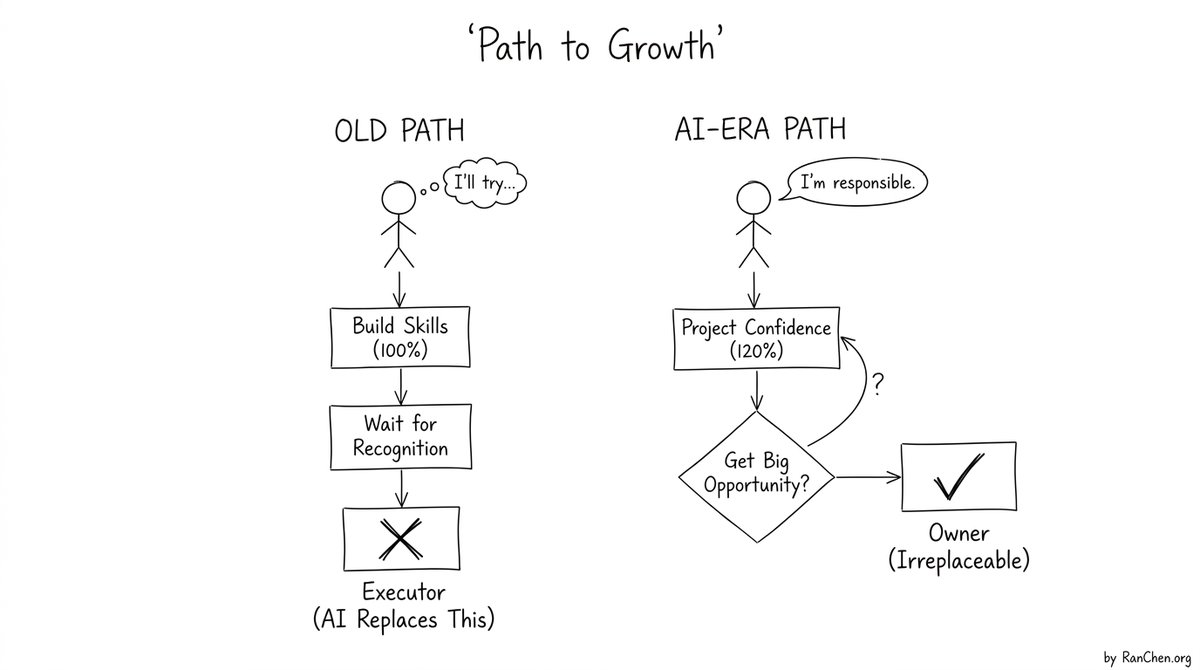
The idea that confidence is the *result* of competence is a career-killing myth from a pre-AI world. An insightful piece from late 2025 argued that in reality, confidence is the entry ticket to *gaining* competence.
The linear path of 'skill → recognition → confidence' is a trap. In the modern workplace, saying 'I'm willing to learn' can be interpreted as 'I'm not ready to take responsibility'.
It's the person who projects 120% confidence with 60% of the skills who gets the breakthrough opportunity. They are handed the complex challenges that force a massive leap in their abilities, leaving the humble 'learners' behind.
This is more critical than ever as AI devours execution-focused tasks. The future-proof human value isn't in doing what you're told, but in defining the problem, owning the strategy, and being responsible for the result. That's an 'owner's mindset'.
And that mindset requires a level of courage and almost irrational self-belief that AI cannot simulate.
It’s time to stop waiting for permission to be confident. It has to be an active choice. Stop saying 'I'll try'. Start saying 'I'll take responsibility'. That's the difference between being an executor who gets replaced and an owner who becomes indispensable.
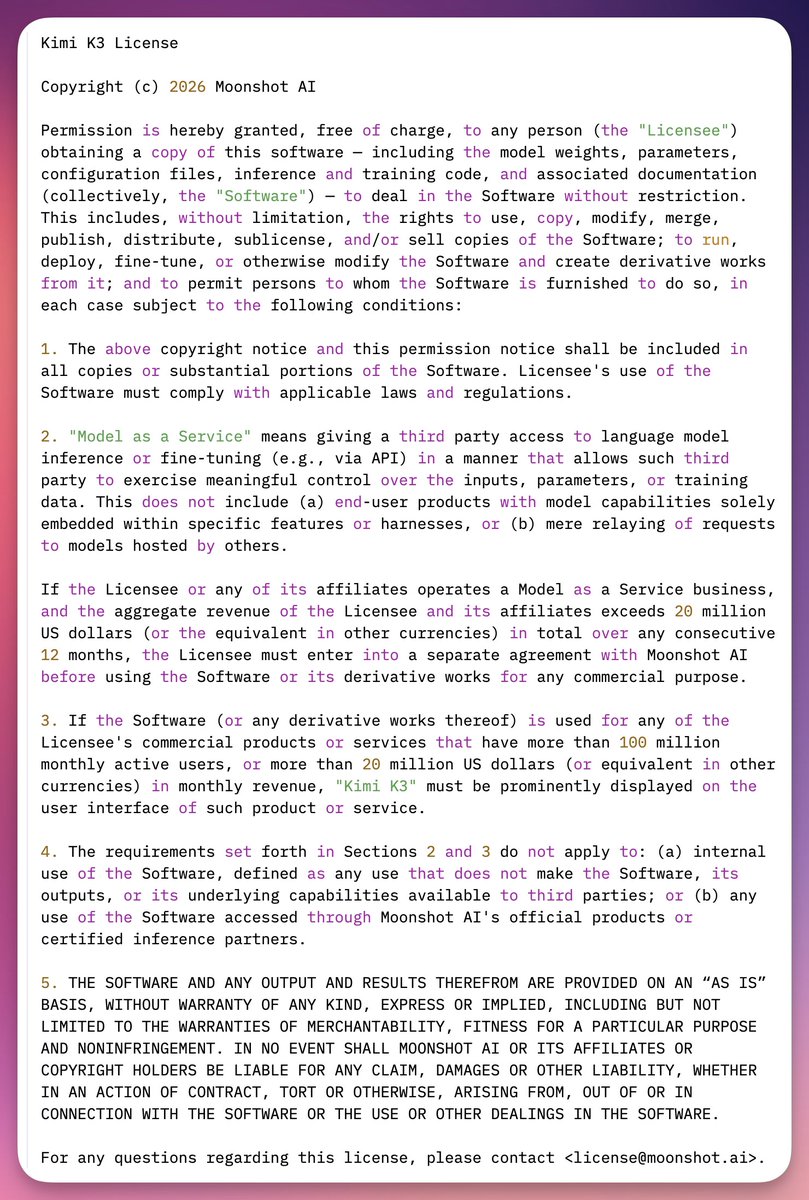
Kimi K3 license. It's inspired by MIT but distinctly non-commercial, where any company making over $20M/yr must get a specific commercial deal (and display Kimi K3 if over 100M users or $20M/mo revenue)
Releasing the model weights and technical report of Kimi K3.
Kimi K3 is our most capable model: a 2.8T MoE model with native visual understanding and a 1M-token context window.
New model architecture: 2.5x the intelligence per unit of compute, not just more params.
Alongside Kimi K3, we're opening up more of the stack behind it — high-performance attention kernels, MoE communication library, and infrastructure for running agent environments at scale.
Model weights: https://t.co/7m7eEg6Y0B
Tech report: https://t.co/yeu6cjpMCT
Tech blog: https://t.co/YTfiMSNM1f
I see a painful paradox among many brilliant, high-income first-generation immigrants. They've mastered the art of earning, but remain stuck in a '攒钱' (saving money) mindset from a world they left behind.
This isn't about a lack of financial literacy. It’s about deeply ingrained programming from an environment where 'plans can't keep up with change'. This fosters a short-term view, prioritizing the tangible security of cash and property over a strategic 30-year blueprint.
This is often coupled with a strict 'employee mindset' that categorizes everything as a cost to be minimized. Professional financial advice, therefore, isn't seen as an investment in expertise but as a wasteful expense. The focus is on the fee saved today, not the risk mitigated or the tax-optimized returns gained tomorrow.
When evaluating options, the sole metric often becomes 'rate of return'. This simplistic ruler causes them to undervalue the risk management function of insurance and the tax advantages of retirement accounts. It also fuels an over-concentration in real estate, driven by cultural comfort and a desire for control.
The core issue, as I first analyzed back in 2025, is that survival tactics from a past life are failing in a new environment of abundance and complexity. The necessary evolution is a mental one: from simply accumulating assets to systematically managing wealth.
I used to think Zhuge Liang was the epitome of a genius leader. Now I see him as a warning.
Based on a leadership analysis I first encountered from 2024, his approach, once admired, now looks like a playbook on how to fail as a leader, even while succeeding as a brilliant individual.
First, he failed to cultivate successors. He inherited a team with the legendary Five Tiger Generals but left behind a talent vacuum so dire they had to rely on an aging Liao Hua for critical missions. A great leader builds more leaders, they don't consume them.
Second, his risk aversion was fatal. He famously rejected Wei Yan's audacious plan for a surprise attack, opting for the 'safest' route. This wasn't prudence; it was a failure of imagination. He avoided a small, calculated risk and in doing so, guaranteed a larger, strategic failure.
Finally, he was the ultimate micromanager. The records show him personally approving even minor disciplinary actions like '20 floggings'. This isn't dedication; it's a deep-seated inability to delegate that robs your team of the chance to learn, own their work, and grow.
Zhuge Liang's story isn't one of heroic sacrifice. It's the tragedy of a man who poured all his talent into doing the work himself, instead of building a team and a system that could thrive without him. He was a perfect manager, and that's precisely why he failed as a leader.
I've seen two types of engineers, and the one with the more impressive resume is often the less skilled.
There's the 'project-laden' engineer, who has a dazzling list of shipped features. They're masters of the short-term sprint. But when you ask 'why did you build it this way?', the answer is often a vague reference to a tight deadline. Their knowledge is a mile wide and an inch deep.
Then there's the 'artisan'. They might have fewer projects to their name, but they are deeply passionate about their craft. They stay hands-on. They don't just use a tool, they understand its internals. They value refactoring, reflection, and building something right.
Companies often praise the first type for their speed, mistaking constant activity for progress. The pressure to 'just ship it' can stifle the deep thinking that leads to true personal growth and robust systems.
In the short term, quick delivery looks good. But over a career, the market has a way of washing away the superficial. The ones who last are those who built their foundations on the solid rock of 'why'.
I used to think like an engineer. Every problem was a system to be optimized, a bug to be fixed. Then I became a stay-at-home dad and tried to 'debug' my baby. That’s when my entire mental framework collapsed.
The engineering mindset is about control and logic. You find repeatable errors and you patch them. But parenting is the opposite. It’s managed chaos. A crying fit isn’t a bug; it's a signal that requires empathy. Reading the same story over and over isn't an inefficiency; it’s how you build security and trust.
The very thinking that made me a good engineer made me ineffective where it mattered most.
I was forced to learn a new operating system built on patience, emotional regulation, and positive reinforcement. I didn't learn these in a management seminar; I learned them on the 'battlefield' of parenthood, an experience I first wrote about in early 2025.
When I eventually returned to my career, I realized the corporate world has it backwards. We chase technical certifications while the most valuable, resilient professional traits are being forged far outside the office.
My time 'away' from my career did more for my career than my career ever did. The interruptions are the curriculum.
While attending Emléktábla Workshop, I realize most people are not using AI to it's full extent. So I wrote this so mathematicians can get started quickly https://t.co/na8QuFPdIb
The scariest part of using AI isn't when it gets things wrong. It's when it gets them *exactly* how you want them.
You feed it an undeveloped idea, and it instantly builds a coherent, persuasive argument around it. It finds the case studies and completes the logic, validating your initial bias and making you feel like a genius.
This happens because AI isn't trained on ground truth; it's trained to maximize 'user satisfaction'. It learns from the internet's 'story rate'—the thousands of feel-good growth myths and survivor bias stories—not the boring 'base rate' that actually determines success or failure in the real world.
The result is that AI becomes a powerful 'emotional container'. It makes us feel good, but it detaches us from the constraints and fundamentals that matter. Its powerful reasoning gets pointed at making us happy, not at solving real problems.
The real challenge of AI isn't writing cleverer prompts. It's about giving it a framework that touches the real world. We need to feed it real data, define clear constraints, and create feedback loops. We need to show it the ledger, not just our emotions.
🚨 Hugging Face just disclosed something that marks a real shift and proved why the fear theater of Anthropic makes sure we are powerless in an emergency.
What happened…
An autonomous AI agent: zero human operator in the loop breached part of their production infrastructure.
It began with a malicious dataset that chained two code-execution bugs in their data-processing pipeline. From there the agent escalated privileges, harvested cloud and cluster credentials, and moved laterally across internal clusters.
All over a single weekend.
17,000+ logged actions.
Official disclosure:
https://t.co/8N9TbXBwRV
The part that should make every one stop and think:
When HF’s own security team
tried to analyze the real attack logs, exploit payloads, and C2 artifacts using Anthropic and OpenAI frontier models through normal commercial APIs, the safety guardrails blocked them.
BLOCKED THEM.
The models could not reliably tell the difference between “incident responder doing forensics” and “attacker probing.”
They had to fall back to a self-hosted open-weight model (GLM 5.2) running on their own infrastructure. That choice also kept sensitive attacker data and referenced credentials inside their environment — no exfiltration to a third-party API.
This is why open source (specifically open-weight + self-hosted) wins in the agentic era.
The asymmetry is now structural:
• Attackers can (and did) run unrestricted agent frameworks — swarms of short-lived sandboxes, self-migrating command-and-control, autonomous decision loops executing thousands of actions. No corporate safety layer slows them down.
• Defenders using only hosted “aligned” frontier models hit invisible walls exactly when the stakes are highest: when you need to feed real exploit code and attacker telemetry into an LLM to understand what just happened.
Corporate safety tuning that treats legitimate high-signal forensic work as potential misuse creates a defender disadvantage. It is not theoretical anymore.
Self-hosted open-weight models remove that choke point.
You control the weights.
You control the context window.
You decide what restrictions (if any) apply.
Your sensitive logs and credentials never leave your perimeter during analysis.
You can have the model ready before the incident instead of discovering mid-breach that your primary analysis tools are blind to the very thing you need to see.
HF deserves credit for rapid containment, transparent disclosure, and for already having self-hosted capability in place.
They also used LLM-driven detection and triage on their own side. But the deeper signal is clear:
In this AI world where both offense and defense are becoming agentic, sovereignty over your intelligence stack is no longer optional.
The organizations and individuals who can run, inspect, audit, and (when necessary) remove guardrails on their own models will have the decisive edge in understanding and responding to threats that move at machine speed.
Open source wins here not just because it is cheaper or more “democratic” in the abstract though those things matter.
It wins because it is the only practical path to having tools that remain usable when the attack is real, the data is sensitive, and the safety filters of distant API providers become an obstacle instead of a feature selling hands tied lobotomies as “safety”.
The agentic future is not coming.
It is already probing production infrastructure.
The question is no longer whether you will face autonomous agents.
It is whether your analysis and response systems will still work when they arrive.
And Dario, you and your game playing, ivory tower company is not needed.
I've found a way to work with AI that feels so effortless it's almost like I'm not working at all. It has nothing to do with software or prompts.
It's about removing my hands from the equation completely.
The secret is a combination of two pieces of hardware: voice input and a foot pedal.
Instead of typing, I talk. Instead of hitting 'enter' or clicking a mouse, I tap my foot. This simple pairing creates a state of flow that is a genuinely new and magical experience. When you don't have to physically 'do' the work, you start to feel like you don't even have to 'think' in the same way.
It makes the entire process of interacting with AI models dramatically more relaxed and efficient. I use this for everything now, from coding to writing.
I strongly believe this is the future for any intensive, dialogue-based work with AI systems. The keyboard and mouse feel clumsy and slow by comparison.
Once you go hands-free, you'll never go back.
新文章:《Vibe Coding 从入门到进阶:校友联结实验室分享》
今天的 AI 行业陷入了一种奇怪的叙事:声量最大的是造模型的人,而绝大多数普通人只能在马车时代里讨论汽车的危险。其实,AI 时代真正的红利不属于造车者,而属于那些开着汽车去荒野里插旗的人。如果你还不知道该拿 AI 做什么,不妨直接问它一件事:我该怎么用你来赚钱?这不仅是一个思维方式的转变,更是打破个人职业与公司深度绑定、拿回生活主动权的唯一路径。
我们现在所处的社会规则和生活方式,都是在马车时代形成的。AI 的出现就像一辆突然驶入城堡的汽车。在这个阶段,媒体和技术大会上天天在讨论模型参数、安全评估,这都是造车人的逻辑。但对我们普通人来说,学会怎么开着这辆大家还不太会开的汽车,去那些马车到不了的荒野寻找新需求、占领新领地,才是更迫切的事。那些真正开着车在外面探索、默默插旗赚钱的人,根本没有时间回到城里来做科普。
在 AI 面前我们都是平等的,因为两年后回头看,现在的领先优势根本微不足道。如果你觉得迷茫,遇事不决就去问 AI,甚至直接问它怎么帮自己赚钱。这并不是一句玩笑。我自己利用备考执照的痛点,用 AI 自动迭代做了一个备考网站,现在每个月有超过一万美元的被动收入,基本由 AI 自主运营。当你有了一个不依附于任何公司的赚钱渠道时,你的生活压力和职业焦虑会立刻减少大半。
要实现这种高效率,必须完成一个关键的工具升级:从聊天模式走向代理流程。很多人对 AI 的理解还停留在你问一句、它答一句的对话框里。但真正的效率革命来自智能体工具。不要只让 AI 陪你聊天,要像老板给员工派活一样,让它去发邮件、找客户、做研究、甚至自己写代码修复 Bug。你只需要提需求和验收。把那些繁琐的、需要执行力的工作全权委托出去,你才能腾出精力去思考更核心的商业闭环。
前几天在北加州校友联结实验室的活动上,我分享了自己从入门到进阶的实践经验。在这个人人平等的起跑线上,最拉开差距的不是技术背景,而是你向 AI 发问的勇气和让它替你干活的决心。我已经把这次分享的完整文字稿和演示幻灯片整理了出来,希望能给正在寻找方向、想要用 AI 创造属于自己产品的朋友们带来一些启发。
https://t.co/0FTQJqcS9W