(1/n) From a single photo to a minute-long walkthrough into unseen regions that stays consistent when the camera comes back.
Introducing Lyris: layout-guided long video generation with persistent 3D memory
(1/n) From a single photo to a minute-long walkthrough into unseen regions that stays consistent when the camera comes back.
Introducing Lyris: layout-guided long video generation with persistent 3D memory
(6/n) Since each object is one box, the layout is easy to edit: move, swap or add boxes before a region is generated, or move an object that is already in the memory, and the video follows.
Over the past week, I’ve been overwhelmed by the love and support of friends, industry colleagues, and people I've never met. Thank you to everyone who has shown kindness to my family and me. It means the world to me.
I came to the United States 53 years ago, and becoming an American citizen is one of the greatest gifts and proudest moments of my life. NVIDIA has been my life’s work. Building it into the company it is today alongside my colleagues has been a privilege and an honor. Nowhere but in America could a company like NVIDIA be possible. I love our country, and I love NVIDIA.
I did not live up to the standards expected of everyone at NVIDIA, and I have made serious mistakes in my personal life. I created problems for the Board that I deeply regret. I own my mistakes completely, and I am committed to cooperating with the Board’s independent investigation.
Since my departure, I’ve seen an outpouring of calls from NVIDIA’s employees, investors, business partners, and customers for me to return as CEO. Many continue to reach out to me directly as the company navigates complex technology, market, competitive, and geopolitical dynamics. NVIDIA is a once-in-a-generation company. If the Board of Directors decides that my return is in the best interest of our shareholders, our employees, the company, and America, I would be honored to answer these calls and return as CEO.
Thank you again to everyone who has shared their good wishes. I am profoundly humbled by your support. To my family: I love you, and I will spend the rest of my life being worthy of yours.
Jensen
Can a frontier agent recursively improve the way it works?
We built Flex-RSI to measure exactly that: recursive self-improvement of frontier agents.
🔗 https://t.co/SHg1ZTKRvQ👇
Going to my first ever @warriors game tonight, so I rebuilt one of the most iconic @StephenCurry30 shots ever in full 3D 🏀
All from a single broadcast camera!!
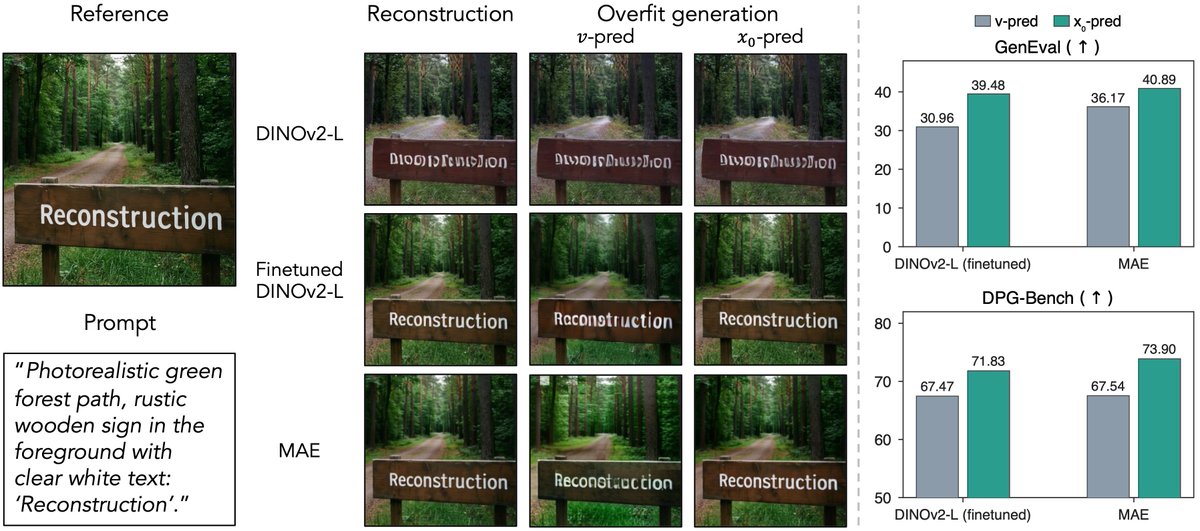
Late to the party, but happy to introduce our #ECCV2026 paper: On the Diffusibility of High-Dimensional Latents.
We found that finetuning representation autoencoders (RAEs) for reconstruction can hurt diffusibility under standard velocity prediction in flow matching. Why?(1/10)
Over the past few weeks, GPT-6 Astra, Claude Code with Opus 5.5, and other recent foundation models have surprised many of us in graphics, CAD, and robotics. They can now work directly with Blender, CAD kernels, game engines, physics simulators, and real robots very well. New examples appear almost daily, faster than the publication cycle can capture.
📝To keep track, we maintain a Living Survey of frontier AI for Design & 3D Modeling & Robotics:
🌐 https://t.co/irJ9uUvdh2
Currently, it organizes 243 cases from 345+ public showcases and developer reports across 3D modeling, CAD and industrial design, animation, simulation, and robot control, each linked to its original source.
(If you are working on related projects, it's better to check this out: )
Different from a traditional survey, three ideas guide it:
1. Horizon scanning beyond publication lag
In an era where frontier foundation model capabilities evolve rapidly, traditional academic publishing cycles could lag behind public community developments and empirical findings. This platform establishes a centralized, high-velocity empirical synthesis repository to provide researchers and engineers with timely visibility into ongoing developments across 3D generation, parametric CAD, and embodied robotics—anchoring these observations in objective evaluations of strategic opportunities and critical safety boundaries.
2. Demonstrations as a distributed record of use
We analyze the corpus of over 345 publicly documented showcases and developer reports as an extensive, distributed "crowdsourced user study." This framing captures how models operate when prompted across diverse geometry kernels (CGM, Open CASCADE), DCC software (Blender), physics simulators (Isaac Sim, MuJoCo, Genesis), and physical robot hardware—revealing real-world workflow friction, prompt overhead, and boundary failures that static benchmarks miss.
3. Ranking by open verifiability
A central challenge is balancing the timely collection of rapidly emerging results with the need for high-quality, evidence-based evaluation. Our approach is to rank cases by open verifiability—the amount of evidence that others can directly inspect.
Equally impressive demos can carry very different evidence, so every case is ranked by what others can inspect:
- Rank 1 · Demo + Implementation Code: public code, scripts or CAD/robot harnesses (availability/verifiability)
- Rank 2 · Demo + Interactive Web Link: a live web app, 3D viewer or cloud CAD project
- Rank 3 · Demonstration Media Only: video or screenshots only
Note: Rank 1 means the evidence is inspectable, not necessarily reproducible from a clean setup.
Gallery: https://t.co/Tgo48HU4dH
Contributions are very welcome via pull requests on GitHub. We especially welcome Rank 1 contributions (demos with code) and Rank 2 contributions (demos with interactive webpages).
Many thanks to our collaborators: Jamison Meindl(@meindljamie), Akihisa Watanabe(@Akihisa_Wat ), Anna Deng, Tianyu Huang(@tyanyuy3125), Igor Sadalski(@igorsadalski ), Harrison Liang, Minghao Guo(@GuoMh14 ), Benjamin Tod Jones, Wojciech Matusik(@wojmatusik ).