(1/n) From a single photo to a minute-long walkthrough into unseen regions that stays consistent when the camera comes back.
Introducing Lyris: layout-guided long video generation with persistent 3D memory
One boring but very consequential reason why models feel bad at non-verifiable tasks is they never put any effort into them.
Humans can take years writing a novel, or months thinking about a game spec - but ask a model and it will just spit something out. Same, I imagine, would apply to capabilities like research taste - if you ask Ilya or Karpathy for 10 research ideas, they might agonise for days, ask Claude and you get them in minutes at best.
Models don't seems to have any sense of self-awareness if their subjective output is good or bad. Humans have a sense of when they should keep working on a subjective task to get it just right.
So now we have this dichotomy, ask Claude to solve a millennium prize problem and it might spend months working away at it. Ask it to formulate a new set of Millennium Prize Problems and it will slop something up in minutes. This feels closer to a mechanical failure that fundamental lack of capability. I bet if models could find a way of working for months at non-verifiable tasks productively the outputs would be just as impressive as as those that we get with verifiable tasks. Hope labs will fix this.
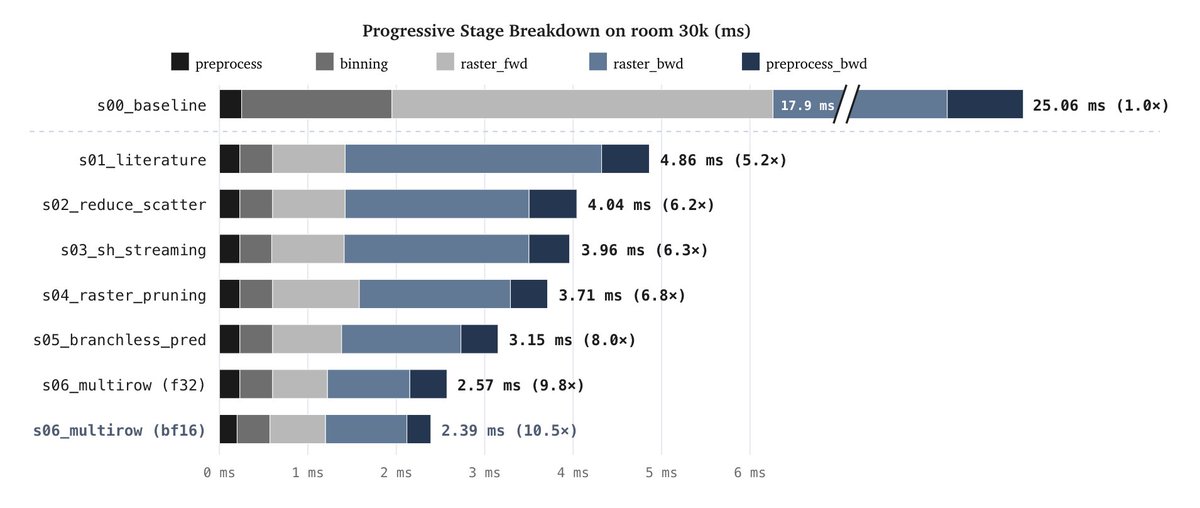
Is it possible to make 3D Gaussian Splatting even faster?
Short answer YES!
Enjoy a 10.5x optimization on forward/backward cuda kernels over the published 3DGS ones!
https://t.co/fVyIexfh6N
Excited to introduce reactive optimizers: We let an agent reactively adapt the optimizer code during the training run! The agent acts like a team of scientists constantly choosing the best algorithm, learning rate, momentum, etc, based on its own analysis of step-to-step training dynamics! The results are really exciting. Besides out-performing standard "best-practice" recipes across everything we threw at it, the agent gains a few "superpowers" that no human could have designed into the optimizer... (1/n)
Film once. Move the camera later. 🎥
Our video model reconstructs what you see and generates what you don’t. Feed it a rough 4D reconstruction, get back a dynamic world you can explore in real time!
Led by the amazing @liyuan_zz. Come see how at #NeurIPS2026!
Glad to share that World from Motion has been accepted to #NeurIPS2026! We’re releasing the code, model weights and DyCheck reproduction scripts:
Code: https://t.co/q3cpUp3YCz
Model weights: https://t.co/MuYVlz2GDP
See you in Sydney 🌏🇦🇺🐨!
#neurips2026#NVIDIA@alextrevith
GPT-6 Astra recreated the Palace of Fine arts in Blender.
This is favorite building in San Francisco because it was built for the World's Fair in 1914 where the steam locomotive and telephone were showed off. It was a time when technology gave us all a deep sense of optimism for the future.
I feel like some of that sense has been lost since, but I hope models like astra can help restore it, and push us towards a more hopeful future.
NVIDIA Research is looking for 2027 PhD interns! If you are interested in 4D reconstruction and/or world models, check out https://t.co/XQ2Pl8cqbv and send me an email/DM!
How can 4D reconstruction leverage generative priors for unseen dynamics and regions, while respecting the constraints of projective geometry?
Introducing World from Motion: a generative method that reconstructs freely-renderable dynamic 3D Gaussians from monocular video. 🧵🔥
Introducing MilliVid, our new method for long-context video generation! MilliVid creates videos that are consistent over long time spans, without using retrieval heuristics or 3D maps! (1/n)
https://t.co/evmf5dL5Sg
Today, @MichaelElabd, @QuantumArjun, and I are excited to announce Trajectory.
We are a research lab and product company building the platform for Continual Learning.
Our platform unlocks the signal already sitting in product usage, so companies can continuously post-train large-scale agentic models that outperform the frontier. @trajectorylabs
We’ve raised $15M from @Conviction, @BessemerVP, @radicalvcfund, @jeffdean, @drfeifei and more.
We’re partnering with some of the best AI-native companies: @ClayRunHQ @Harvey, @DecagonAI, @mercor, @RogoAI to power their agentic systems, some of which we are already in production with.
We’ve brought together a world class research team from DeepMind, OpenAI, Apple, Meta Superintelligence, Amazon AGI, Scale AI, and an elite product team from Stripe and Figma.
AI will never again start on day one. Every correction, every retry, every edit will make products smarter. This is Continual Learning.
Collecting demos for training robots is expensive 💸. Each demo is paired with a one-line label that throws away the spatial relations, subgoal structures, etc. The rich pixel information is there — we're just not fully using it.
🚀Introducing DeMiAn: Dense Multi-aspect Annotation as a scaling lever for robot policy learning.
📈 +5 pts on RoboCasa365 tasks, +9 pts on unseen composite tasks
⚡ ~62% less compute at 1M-clip scale (~1.3 × 10²⁰ FLOPs saved)
🤖 Zero new demonstrations collected
🚀Tired of floaters, flickering, and blur in 3DGS? We introduce a geometry-informed video generator that refines 3DGS renderings in the wild. 🎥✨
We let the video model actually "see" the rendering process using a Gaussian Primitive buffer. #CVPR2026@CVPR
Project page: https://t.co/IjE8h0QVuS
🔥 Highlights:
✅ Geometry-Buffer-conditioned video generator
✅ Refines optimization-based & feed-forward 3DGS
✅ Novel artifact simulation pipeline
✅ Highly efficient bidirectional processing ⚡
Thread 👇
Introducing RTFM (Real-Time Frame Model): a highly efficient World Model that generates video frames in real time as you interact with it, powered by a single H100 GPU.
RTFM renders persistent and 3D consistent worlds, both real and imaginary.
Try our demo of RTFM today!
📢 SceneComp @ ICCV 2025 🏝️
🌎 Generative Scene Completion for Immersive Worlds
🛠️ Reconstruct what you know AND 🪄 Generate what you don’t!
🙌 Meet our speakers
@angelaqdai, @holynski_, @jampani_varun, @ZGojcic@taiyasaki, Peter Kontschieder
https://t.co/LvONYIK3dz
#ICCV2025
📢 Lyra: Generative 3D Scene Reconstruction via Video Diffusion Model Self-Distillation
Got only one or a few images and wondering if recovering the 3D environment is a reconstruction or generation problem? Why not do it with a generative reconstruction model!
We show that a camera-conditioned video diffusion model can be transformed into a generative reconstruction model that directly outputs a high-quality 3D Gaussian Splatting representation through self-distillation, without requiring real-world training data.
Check out our results in the video (wait for dynamic scenes in the second half!) :
Project Page: https://t.co/pKtry0BdOL
Code and Models: https://t.co/p4zVBrMKU5
Paper: https://t.co/ZuMM1LCP82
If you’re at SIGGRAPH 2025 in Vancouver, join us Thu 2 PM for our talk “Generative Neural Materials”! We introduce a universal neural material model for bidirectional texture functions and a complementary generative pipeline. 1/2