ANDREJ KARPATHY COULD HAVE CHARGED $2,000 FOR THIS COURSE.
He put it on YouTube.
The full training stack. Tokenization. Neural network internals. Hallucinations. Tool use. Reinforcement learning. RLHF. DeepSeek. AlphaGo.
3 hours of the most comprehensive LLM education that exists anywhere at any price.
Not how to use the tools.
How the entire system was built from the ground up and why it behaves the way it does.
The engineers who understand this build things the ones who only use the tools cannot even conceive of.
The gap between those two groups is not 3 hours.
It is everything those 3 hours quietly unlock for the rest of your career.
how to self-study math
don’t treat it like a class. treat it like a machine you need to understand inside out.
what actually works:
• start with foundations → arithmetic, algebra, basic geometry. every advanced concept builds on these.
• don’t memorize → understand why a formula works, not just how to use it
• solve problems → intuition comes from doing, not watching
• explore proofs → see the logic, see the connections, see the patterns
• build connections → link math to physics, cs, economics. patterns repeat across disciplines
• iterate → revisit topics. depth grows on second, third passes, not first exposure
• teach yourself → explain concepts aloud, write notes, challenge your own understanding
math isn’t a subject.
it’s a way to see and reason about structure, patterns, and reality.
self-study is slow, but mastery is permanent.
#FindYourIn. #linkedin@LinkedIn An interesting metric would be the rate at which profiles are moving to “Open to work” @LinkedInHelp
If histogram it by age band - we have rise / fall in unemployment?
@maheshperi@careers360 India owes them NOTHING.
They are THANKLESS people. They care free to go where ever they want to.
India is TOO big to bother about them…and it’s a fallacy that they are the brightest. They are just few amount the thousands of exceptionally bright Indians who work here.
In 1905, Einstein published special relativity. In 1915, he published general relativity. Einstein was just trying to understand the universe.
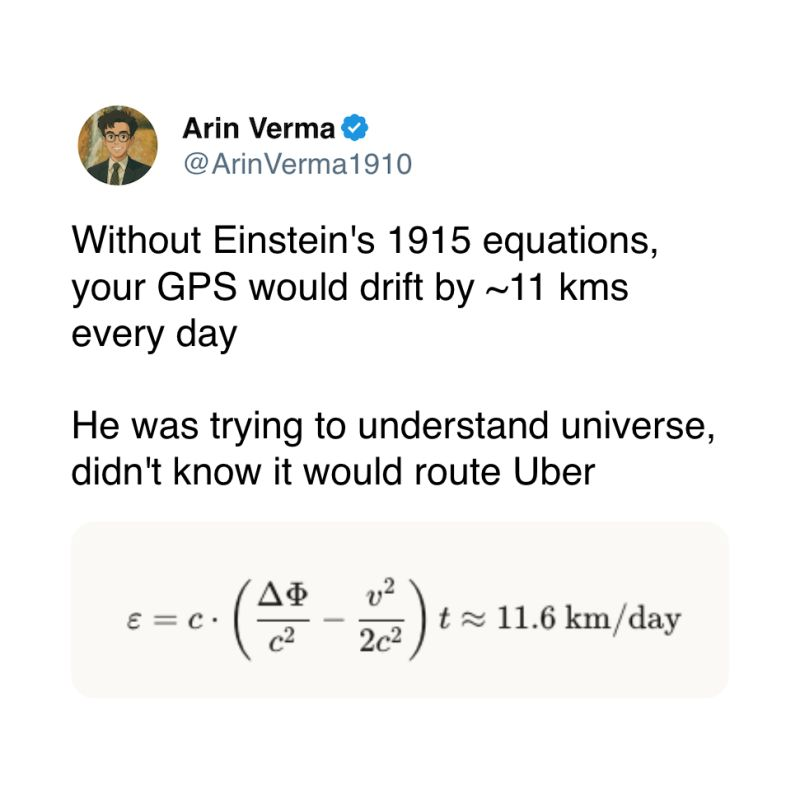
But without Einstein's math, Google Maps would be wrong by 11 kms every single day.
Let me tell you why - this is very interesting :))
Your phone doesn't "talk" to GPS satellites. It only listens. Each satellite is broadcasting one thing, constantly: "I am satellite 'A', and it is currently 14:23:00.000000."
Your phone receives signals from 4 satellites simultaneously. Because light travels at a known speed, tiny differences in arrival time tell it exactly how far it is from each satellite.
'A' satellite tells you: you're somewhere on a sphere of radius 20,000 km.
'B' satellite: that sphere intersects another sphere - now you're on a circle.
'C' satellite: that circle intersects a third sphere - now you're at 2 points.
'D' satellite: eliminates the last ambiguity and only one point remains.
That's you!
Except there's a problem nobody thought about until Einstein.
The satellites are orbiting at 20,200 km altitude, moving at 14,000 km/h.
Two things happen to their clocks simultaneously:
- Special relativity: Moving clocks tick slower. At orbital velocity, the satellite clock loses 7.2 microseconds per day
- General relativity: Clocks in weaker gravity tick faster. At that altitude, gravity is weaker. The clock gains 45.9 microseconds per day.
Net effect: 45.9 - 7.2 = +38.7 microseconds per day.
In 38.7 microseconds, light travels 11.6 kilometers.
So without correction, the system would accumulate 11.6 km of error. Every single day. In a week, your navigation is useless.
The fix is one of the most elegant things in all of engineering.
Before each satellite launches, its atomic clock is physically tuned to tick slightly slower than it would on Earth - by exactly 38.7 microseconds per day.
Once in orbit, relativistic effects speed it back up. And it arrives at exactly the right rate.
Einstein's 1915 paper is baked into the hardware of your phone's navigation system.
The next time Google Maps routes you correctly, you're experiencing general relativity.
You just didn't know it.
🚨 BREAKING: Google Research just dropped the textbook killer.
Its called "Learn Your Way" and it uses LearnLM to transform any PDF into 5 personalized learning formats. Students using it scored 78% vs 67% on retention tests.
The education revolution is here.
Thank you for reading this thread.
What’s your ONE big takeaway from this story?
Follow me @GeniusGTX for more threads about the hidden brilliance of ancient civilizations.
Like/Repost the first tweet below to share the wisdom. ↓
If you think knowing about data structures and algorithms is not important in software development, consider what is used in the Linux kernel:
1. Linked list and doubly linked list
2. B+ Trees
3. Interval trees
4. Red-Black trees used for scheduling, virtual memory management, and more
5. Priority sorted lists used for mutexes, drivers,
6. Radix trees, used for memory management and networking-related functionality.
7. Hash functions
8. Priority heap, used in the control group system
9. Bit arrays, used for dealing with flags, interrupts
10. Binary search, used for interrupt handling, register cache lookup
11. Hash tables, used to implement inodes, file system integrity checks
12. Depth first search, used in directory configuration
13. Breadth first search, used to check correctness of locking at runtime
14. Knuth-Morris-Pratt string matching
15. Merge sort on linked lists, used for garbage collection, file system management
16. Boyer-Moore pattern matching
17. Semaphores and spin locks.
When 740 children were about to die at sea and every country said “no,” one man who had every reason to remain silent said “yes.”
It was 1942.
A ship was drifting in the Arabian Sea like a floating coffin.
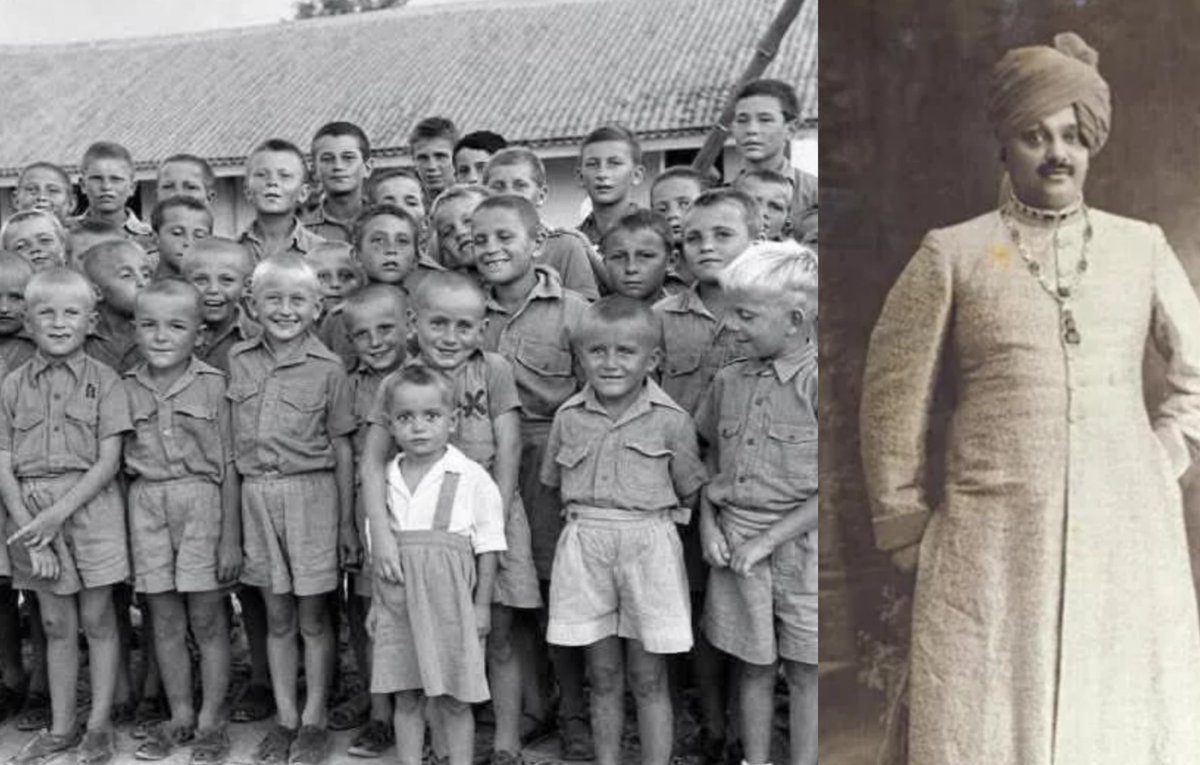
On board were 740 Polish children. Orphans. Survivors of Soviet labor camps, where their parents had died from illness or starvation. They had escaped through Iran, only to face another terrible fate.
No one would accept them.
The British Empire, the most powerful force of the time, refused entry at port after port along the Indian coast.
“This is not our responsibility. Go away.”
Food was almost gone. No medicines. Time was running out.
Twelve-year-old Maria held the hand of her six-year-old brother. She had promised her dying mother she would protect him. But how do you protect someone when the whole world turns against you?
Then news reached a small palace in Gujarat, India.
The ruler was Jam Sahib Digvijay Singh Ji, the Maharaja of Nawanagar (Jamnagar).
When his advisors told him that 740 children were stranded at sea after being denied entry to all Indian ports by the British, he asked just one question:
“How many children?”
“Seven hundred and forty, Maharaj.”
He paused and calmly said:
“The British may control my ports, but they do not control my conscience. These children will dock at Nawanagar.”
The advisors warned him:
“If you defy the British”
“Then I will,” he replied.
He sent a message to the ship: You are welcome here.
When British officials protested, the Maharaja stood firm.
“If the powerful refuse to save children,” he said,
“then I, the weak, will do what you cannot.”
In August 1942, the ship struggled into Nawanagar port under the blazing summer sun.
The children walked like ghosts, exhausted, hollow-eyed, many too weak to walk. They had learned not to hope. Hope had become dangerous.
The Maharaja was waiting for them at the dock.
Dressed simply in white, he knelt so he could be at eye level with them. Through interpreters, he spoke words they had not heard since their parents died:
“You are no longer orphans.
Now you are my children.
I am your Bapu, your father.”
He did not build a refugee camp.
He built a home.
At Balachadi, he created something extraordinary, a little Poland in India. Polish teachers who understood trauma. Polish food flavored with memory. Polish songs in an Indian garden. A Christmas tree under a tropical sky.
“Suffering tries to erase you,” he said. “But your language, culture, and traditions are sacred. Let us preserve them here.”
Children who had been told they had no place in the world finally found a home.
They laughed again. They played again. They returned to school. Maria watched her brother chase peacocks in the palace gardens, and her body remembered what safety felt like.
The Maharaja visited them often. He remembered names. Celebrated birthdays. Watched school plays. Comforted children who cried for parents who would never return. He paid for doctors, teachers, clothes, and food from his own money.
For four years, while the world was torn apart by war, 740 children lived not as refugees, but as a family.
When the war ended and it was time to leave, many cried. Balachadi had become the only home they truly knew.
The children grew up and spread across the world, becoming doctors, teachers, engineers, parents, grandparents. And they never forgot.
Warsaw’s Good Maharaja Square stands in Poland. Schools bear his name. He was awarded Poland’s highest honor.
But the true memorial was not made of stone.
Its value was measured in 740 saved lives.
Even today, 80 years later, they still gather. They tell their grandchildren about an Indian king who refused to turn compassion into political calculation.