For 2026, 250 yrs after #DeclarationOfIndependence, a new essay on how to defend democracy in America:
https://t.co/0UPWfbVT8z
Instead of demagoguery & strategic neglect, America needs two parties listening to voters and competing to represent them in every part of every state.
Cool visualization of US banking sector balance sheets and geographic footprint using call report data going back to 1970. Courtesy of @elisaxchen.
https://t.co/psp1T1nDRG
Famously (there is a beautiful Works in Progress piece on this) in 2016, Geoffrey Hinton told an audience in Toronto that medical schools should stop training radiologists, since AI would soon outperform them at reading scans. Ten years later, there are more radiologists than ever, and they earn more than they did then.
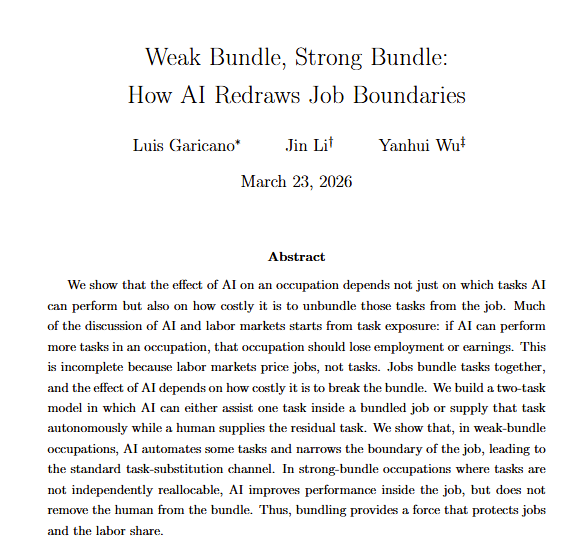
Hinton was right about the task, but he was wrong (so far!) on the future of the radiology profession. Times have never been better for them. The gap between those two claims, the difference between tasks and jobs, is the subject of a paper I have written with Jin Li and Yanhui Wu, and that we release today: "Weak Bundle, Strong Bundle: How AI Redraws Job Boundaries." (Very relatedly we are also finishing the first draft of our book "Messy Jobs" on AI and Jobs!! You will be the first to hear).
We start from the observation that the growing literature on AI and labor markets measures the AI shock by task exposure: people count how many tasks AI can perform in a given occupation AI can perform, and infer that more exposure means more displacement. Eloundou et al. published a paper in Science in 2024 that started this literature, and many follow the same logic. The inference they make is that the more exposed tasks, the worse the outcomes.
This is incomplete, because labor markets price jobs, not tasks. A radiologist does not just sell image classification, but does many other jobs: triages cases, communicates with other physicians, trains residents, makes the difficult decisions, and signs a diagnosis. The market buys a bundled service. The question AI poses is not whether it can do one task inside the bundle. The question is whether that task can be pulled out.
Thread (1/3)
https://t.co/wEYMfjGbeX
Next week! Research Seminar - Ki Young Park (Yonsei University) - Does Media Response Matter for Monetary Policy Mechanism? Evidence from News-Based Monetary Policy Surprises. Read more and register https://t.co/gY3kZP8eSg
Economics Journals as Tennis Tournaments
🧵(for an extremely niche audience)
Quarterly Journal of Economics = Wimbledon
The oldest and most influential event, but also clubby, snobby, and elitist. To win it you must train on a very particular surface/ZIP code.
Our @UChicago PhD students just finished what is likely the most grueling 7 days of their lives: 3 PhD core exams (micro, macro, econometrics) in 7 days! Perhaps the academic version of "Hell Week" for the SEALs.
Some universities have moved away from PhD core exams. I decided to create a poll to learn your views.
Which approach is best for training 1st year economics PhD students?
Exploring how, given the limits on monetary policy, fiscal policy could play a larger role in stabilization, from @ojblanchard1 https://t.co/bmbNPUXNus
🚨 New Paper and Public Good🚨
"The Global Macro Database: A New International Macroeconomic Dataset", joint with @chenzix, Mohammed Lehbib, and Ziliang Chen.
We built the most comprehensive macro database ever—covering 243 countries from 1086-today, integrating 110 sources. 🧵
For those interested in partisan biases in expectations and how they matter, check the work of some star APs:
-- Rupal Kamdar: https://t.co/pF5C5Yn992
-- Jane Ryngaert:
https://t.co/wX4GGTU4m8
-- Walker Ray: https://t.co/a5kEBOPSmR
Treasurys are on sale. It used to be the case that if you compared US Treasurys to other securities, the US Treasury would always be expensive, compared to:
1/ foreign bonds: actual Treasury were typically more expensive than synthetic US Treasury constructed from e.g. a German Bund using currency risk hedges (i.e., the yield on Treasury lower than yield on synthetic Treasury).
2/ corporate bonds: actual Treasury were typically more expensive synthetic US Treasury constructed from AAA corporate bonds using credit risk default swaps (i.e., the yield on Treasury lower than yield on synthetic Treasury constructed from AAA corporate).
3/swaps: actual Treasury were typically more expensive than synthetic US Treasury position using swap (i.e., yield on Treasury lower than swap rate or positive swap spread).
All of these yield spreads have now flipped signs at longer tenors. Actual Treasurys are now typically cheaper than the synthetic versions (or, equivalently, actual yields are higher than synthetic yields).
You can construct 'plumbing' explanations for each of these, but taken together, they suggest that the increased Treasury supply has pushed down the convenience yields investors get from the safety and liquidity of US Treasurys.
As global government bond supply increases and central banks have stopped buying, US Treasurys are now cheap relative to equivalent instruments.
Demand for the safety and liquidity of Treasurys is downward sloping. That was always a key problem with the r<g view. As you increase supply, the convenience yields disappear (see, e.g. @AtifRMian , @ludwigstraub and Sufi, 2024).
🧵 with some pictures.
@sushi_daizen Wow, I and my wife visited the last business day of 2024. Just like I visited in 2012, the food and service was impeccable! Thank you so much for your family sharing great culinary experience. I look forward to visiting again soon.
Super excited to publicly launch "All Day TA", a product @joshgans and I have been working on with our team over the last year. Short version: if you teach in spring, you will want to use this! It's the future of higher education. A short thread: 1/x
China just announced they are looking into devaluing their currency in 2025.
But I don't think that will work to revive the Chinese economy.
Here is why.
1/
On Fiscal Dominance, a classic is Sargent-Wallace "Unpleasant Monetarist Arithmetic" in the QR.
In this QR note I celebrate and revisit it. I show their spectacular example relies on being on the wrong side of a Laffer curve. I offer a variant that strengthens their conclusions.
Two macroeconomic identities, national income & product identity & the balance-of-payments identity, have been widely abused as justifications for radical policies to balance US trade.
Mistaken identities make for bad trade policy by Maurice Obstfeld: https://t.co/4EPFbsiNeQ