📣Continuing the tradition: this year's list of JMCs in International Finance and Economic History (inspired by
@TradeDiversion's list in Trade + Spatial). Check out the candidates here, and let me know if any are missing: https://t.co/OWrzhPAwFL #JMCs#EconTwitter
So happy to see this paper in print at the JFE! Ungated access: https://t.co/6WKsudOgVc
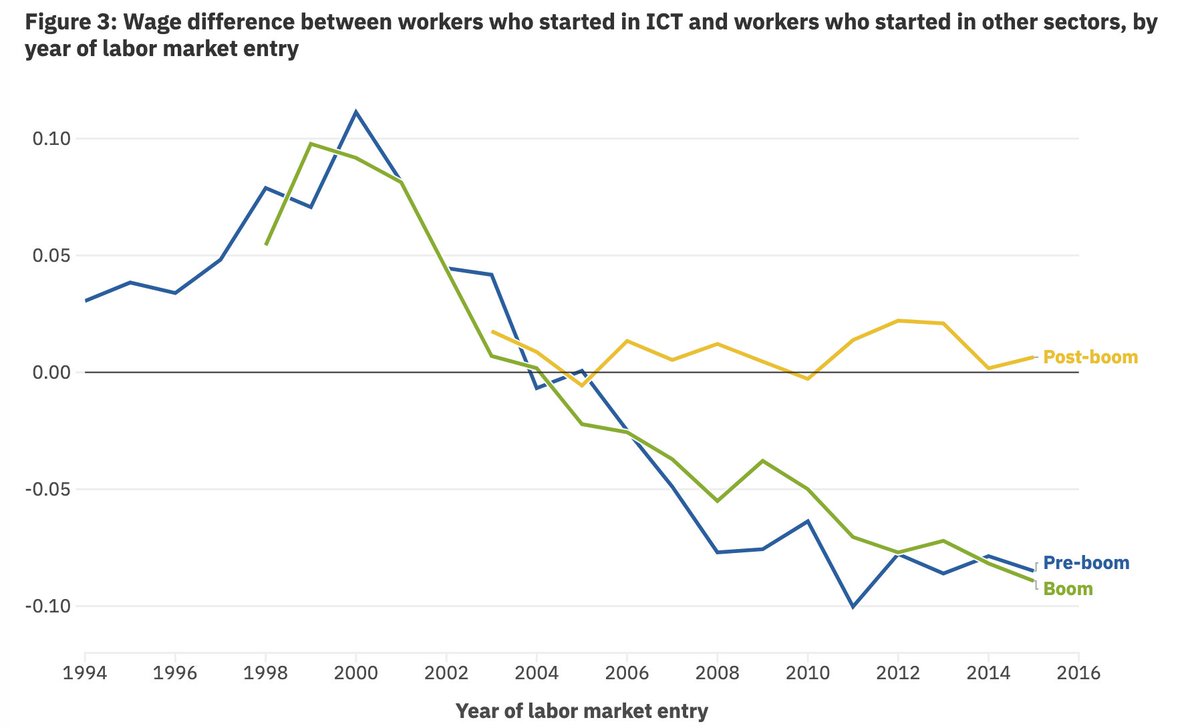
Main result: Tech workers who started during the ICT boom of the late 90s end up with a sizable long-term earnings losses 15 years later relative to similar workers in non-booming sectors
The amount of bad macro data still in circulation is staggering. That's exactly why the work of @KarstenMueIIer and @chenzix on the Global Macro Database is such a valuable public good.
Reminder! The Federal Reserve Bank of Atlanta is hiring economists! We are looking to fill four positions:
• 2 Macroeconomists
• 1 Labor Economist
• 1 Household Finance Economist
We are hiring on a rolling basis, and are particularly looking for seasoned economists
I was in Ghent last month. The place was obviously very rich once, and I wanted to know what happened to it. It turns out Ghent lost its industry to what may be the oldest export restriction on record: an English one, from 1275. (1/12)
I wrote a full guide for economists who have never used Claude. Mental model, setup, hard rules, FAQ on the Dropbox mistake, common failures.
Take a look and tell me what is still missing.
https://t.co/98FD3Hhbo7
📢 Call for papers! SITE 2026 Session 15: "Causes & Consequences of Misallocation" at Stanford GSB, Aug 31–Sep 1. Theory + empirics welcome.
Deadline: June 15 Submit: https://t.co/d5YRxEyLzl
w/ @TheMichaelBlank@PeteKlenow@sarapfmoreira
1/7 Industrial Policies in a Globalized and Financialized World starts at the Federal Reserve Bank of Atlanta on May 7.
Co-organized with @chenzix and Tim Schmidt-Eisenlohr of @federalreserve.
Full program: https://t.co/kRxZEZltSW @AtlantaFed
📢 Very excited to organize this conference on trade & industrial policy at #AtlantaFRB. We started this @Stanford for #SITE and loved it.
Submission deadline in 1 month, conf in May.
Please submit!
1930s US bank branching reforms improved credit allocation and raised productivity as internal capital markets directed funds to financially constrained regions, from Sarah Quincy and @chenzix https://t.co/bDA0Lcmgqm
Free, publicly available data on security level holdings of US mutual funds. Clean, ready for research. Very excited about this public good
Downloaded it on my laptop. 15GB compressed, 140GB of overall data
Lots of open research questions on domestic and cross-border positions
📣Continuing the tradition: this year's list of JMCs in International Finance and Economic History (inspired by
@TradeDiversion's list in Trade + Spatial).
Check out the candidates here, and let me know if any are missing: https://t.co/herO5lMr8N
#JMCs#EconTwitter
📢 Call for Papers
Global Spillovers Amid Shifting Policies
Joint BIS • BoE • ECB • IMF • JIE Conference
📍 Washington, D.C. | 🗓 April 28–29, 2026
📝 Submit by Nov 30, 2025
@BIS_org@BankofEngland@ECB@IMFNews
What can we learn from the high-frequency response in bond and currency markets to the tariff announcement about the status of the US dollar as the global reserve currency?
Short paper.
https://t.co/qtkgKIBGnU
joint work with Arvind Krishnamurthy, Zhengyang Jiang (@ProfJiang ), Rob Richmond (@rrichmond ), and Chenzi Xu (@chenzix)
We conclude that the tariff announcements have led investors to question the role of the dollar as the reserve currency. This explains why the dollar has depreciated by 3.4% between April 4 and April 14 in spite of rising US rates. As a result, the willingness of foreign investors to pay extra for the safety of dollar safe assets has declined. Our measure of this willingness to pay is the 1-year US Treasury basis, measured against the German Bund, plotted in black in the Figure below. The basis (left vertical axis) is the yield on the synthetic Treasury constructed from the German bund minus the yield on the actual Treasury. The decline in the Treasury basis explains the depreciation of the dollar over the past few weeks, in spite of rising rates.
🧵 below.
Plot of 1-year Treasury basis against German Bund. Defined as German yield (hedged into USD) minus US Treasury yield (left vertical axis). Euro/USD exchange rate (right vertical axis).
Very excited about the first installment of the Berkeley Econ History Mini Conference — first edition being on econ history x political economy. Looking forward to seeing everyone tomorrow!