With Dems all but certain to prevail in Mississippi and Alaska, we're most likely looking at a 56D-44R Senate and a ~260D-175R House, which would be Dems' largest House majority since 1992.
It does not surprise me one bit. The entire Delaware legislature and the Delaware Court of Chancery are corporate vessels, rubber stampers of corporate power in the country
SITUATION DETECTED: Delaware is drafting a proposal for a new form of corporate entity called an Artificial Intelligence Company (AIC). An AI managing an AIC would be able to provide services, sign contracts, hold property, and even file or defend lawsuits in the company’s name.
if you understand how immensely powerful this office is not just in California but in the whole country, then you understand what a huge victory this is
NEW: House Dems "inundated" w/ calls & emails urging them not to elect Jeffries speaker
One member told @axios they got "300-400" calls in 2 days
Another said "over 500"
A third said "higher" than 500: "It's our No. 1 issue, and it's not close." https://t.co/eKtNKwFi0f
talarico should study ossof & aocs constituent services (some of the best from what i understand) and draw up the juxtaposition between cruz. almost as important as his legislative track record. we cannot lose this seat. if we keep tx the reign of republicanism in the us is over
Abdul El-Sayed on Bernie Sanders warning Democrats "don't blow it this time":
"We didn't win on a mandate because people love Democrats. We won on a mandate because people cannot stand Trump and Trumpism. So we need to take action to stand up for them."
Rubio is cutting Cuba off from all of its few remaining partners, now with China. He wants to strangle Cuba to death. These are Hague-worthy crimes. Pure sadism.
@matthewstoller 100%. One of the things I'm most worried about because centrist Democrats will vote with Republicans in favor of any bailout like what happened post COVID-19
I have followed your ass since you first interviewed Edward Snowden in 2013, so don’t demean me when I’m positing a legitimate question to the public at large about your journalistic integrity given your recent comments about Flavio Bolsonaro. Looks like tomorrow we will all find out!
I interviewed Flávio Bolsonaro today in Miami about everything:
His leaving Brazil, how he did it, the role of other governments, corruption investigations, Vorcaro money, Moraes and more.
Tomorrow: exclusively in @Folha, with English subtitles on our Substack and YouTube,
Jon Stewart on Chuck Schumer: “Someone has to meet this moment. You have an opportunity to actually govern. One of the first things you need to do is remove that system of seniority from Democratic politics. It’s a bullshit system and it needs to go. Chuck Schumer fought tooth and nail against half of these fucking people. He does not understand the urgency of the moment and what the future demands”
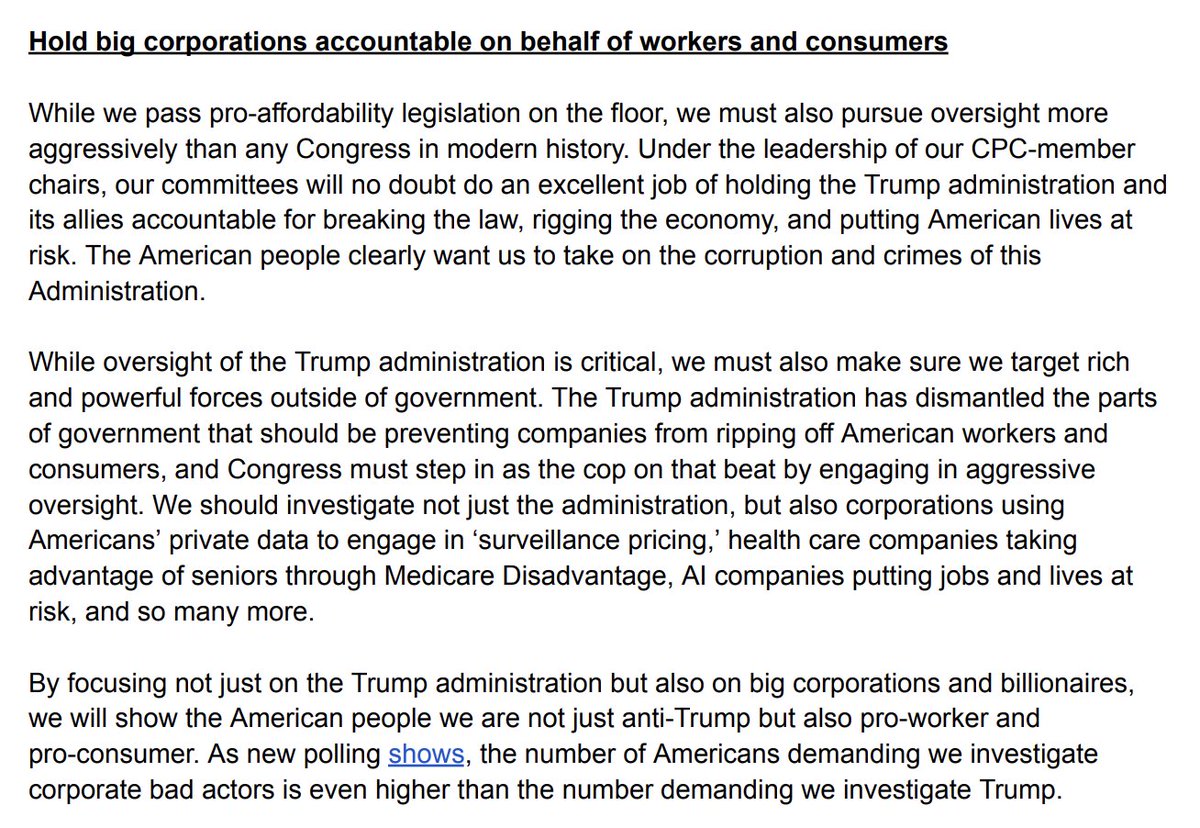
Why should Congressional Democrats investigate corporate America if their mandate is to deliver real economic change? Because investigations are a key catalyst for securing reform and legislation. For much of the last century, Congress used to be the main institutional player working to secure an economy that serves working people. A key tool was oversight. Lawmakers routinely investigated complex markets and major corporations, identifying problems and exposing wrongdoing. A major goal of these investigations was to learn what was driving certain problems and figure out how to fix them.
After Democrats took back the House during the first Trump administration in 2019, I joined the House Judiciary Committee as a staffer on the Antitrust Subcommittee. Under the terrific leadership of @RepJerryNadler and then-Rep @davidcicilline, we pursued an 18-month investigation into Amazon, Apple, Facebook, and Google, securing key evidence of how their business practices were undermining competition and harming people, setting the basis for both lawsuits and proposed legislation.
A few lessons from that experience:
1. The quality of legislative oversight depends on the staff and the support of top members to confront power. Committee and Subcommittee Chairs that are focused on getting answers and unafraid to take on powerful corporate interests will make the difference between oversight that doesn’t surrender to their evasion tactics and oversight that aims low or flames out.
Even a relatively small number of dogged, talented lawyers ready to dive in can make a big impact. In the 1930s a single congressional lawyer, Ferdinand Pecora, helped reshape our entire banking system by subpoenaing records and interrogating top financiers, including J.P Morgan. The investigation exposed self-dealing, market manipulation, and tax avoidance, and laid the groundwork for foundational New Deal legislation, including the Glass-Steagall Act and the Securities Exchange Act.
2. Eliminating bottlenecks to moving investigations forward is key. For example, the House should make sure that Subcommittee Chairs can issue subpoenas rather than needing the sign-off of the full Committee or its Chair. A credible threat of sending subpoenas is critical for credible oversight.
3. Ensuring that members can develop the muscle to effectively interrogate CEOs requires investing in real preparation. In the lead up to the hearing with Bezos, Pichai, Cook, and Zuckerberg, the Antitrust Subcommittee spent months reviewing millions of documents collected from the firms, interviewing affected parties, briefing members on key evidence, and conducting practice hearings. Members came into the hearing deeply informed and able to rebut and call out CEO dissembling. The result was some of the most effective member questioning of executives we’ve seen in decades. @TheProspect wrote up a great overview: https://t.co/7BYC3UHFbW
4. For decades, institutional capacity in Congress has been extremely weak. Much of this traces back to the Gingrich Revolution, which was effectively the 1995 DOGE-ing of Congress. Republican leadership fired over 600 professional staffers, eliminated the Office of Technology Assessment, and gutted research capacity. None of that capacity was ever meaningfully restored.
As a result, members have way fewer resources to develop serious expertise or go deep on a new topic. Members should start rebuilding that capacity so the institution can fully play its Article I role, where Congress can again do serious policy development and legislating and serve as a real check on the executive and judicial branches.
5. AI markets should be high on the list of investigations. The business decisions of the major AI firms have huge public ramifications, yet the public is at a severe informational disadvantage when it comes to how these markets work and the choices these firms are making. A congressional investigation will help ensure future legislative action is based on a more complete view of what is going on rather than selective and partial corporate disclosures.
Santiago Peña has been a prominent cheerleader of Trump's intervention in Latin America. He was one of the few foreign leaders to attend Trump's inauguration. He also attended the first meeting of the dystopian "Board of Peace." It was at the latter where Trump said this when introducing the 47-year old Peña:
"It's always nice to be young and handsome. Doesn't mean we have to like you. I don't like young handsome men. Women, it's a like. Men, I don't have any interest."
https://t.co/TzUt865IKp
“Trump is a funny guy, I don’t think he’s all that ideological. I think he’s a politician and I’m not so sure that he will react all that negatively to a progressive agenda, believe it or not.”
Bernie Sanders on pushing for a progressive agenda despite Trump having veto powers.
Holy shit, it's happening.
We must do everything in our power — as citizens of this country, taxpayers to its empire, and inhabitants of this planet — to prevent this psychopath from reaching the White House. Absolutely everything.