Our team at Amazon Ring is excited to offer several internship opportunities for Summer 2025! If you or someone in your network is interested, please don’t hesitate to reach out to me and complete this form: https://t.co/3E6enF5awG #Amazon#Internship
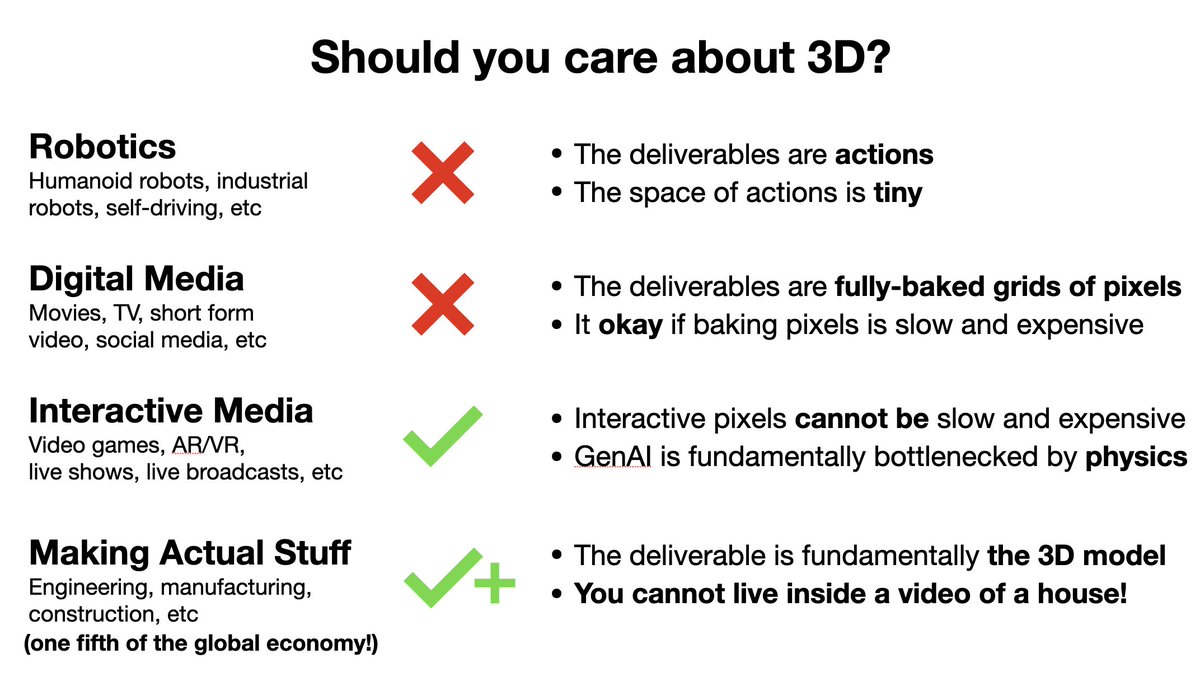
I'll be giving a "exactly how bitter lesson'ed is all of 3D computer vision?" talk at the Bitter Lessons CVPR workshop tomorrow at 10:30am, Room 3A-3D. Here's a slide with the overall thesis.
Wrapping up:
- the bitter lessons compilation should not be bitter
- the bitter lesson might be wrong
- there is a humbling lesson for us humans
Inspiring as always!
#cvpr2026
After a year of team work, we're thrilled to introduce Depth Anything 3 (DA3)! 🚀
Aiming for human-like spatial perception, DA3 extends monocular depth estimation to any-view scenarios, including single images, multi-view images, and video.
In pursuit of minimal modeling, DA3 reveals two key insights:
💎 A plain transformer (e.g., vanilla DINO) is enough. No specialized architecture.
✨ A single depth-ray representation is enough. No complex 3D tasks.
Three series of models have been released: the main DA3 series, a monocular metric estimation series, and a monocular depth estimation series.
The core team members, aside from me: @HaotongLin, Sili Chen, Jun Hao Liew, @donydchen.
👇(1/n)
#DepthAnything3
I took delivery of a beautiful new shiny HW4 Tesla Model X today, so I immediately took it out for an FSD test drive, a bit like I used to do almost daily for 5 years. Basically... I'm amazed - it drives really, really well, smooth, confident, noticeably better than what I'm used to on HW3 (my previous car) and eons ahead of the version I remember driving up highway 280 on my first day at Tesla ~9 years ago, where I had to intervene every time the road mildly curved or sloped. (note this is v13, my car hasn't been offered the latest v14 yet)
On the highway, I felt like a passenger in some super high tech Maglev train pod - the car is locked in the center of the lane while I'm looking out from Model X's higher vantage point and its panoramic front window, listening to the (incredible) sound system, or chatting with Grok. On city streets, the car casually handled a number of tricky scenarios that I remember losing sleep over just a few years ago. It negotiated incoming cars in tight lanes, it gracefully went around construction and temporarily in-lane stationary cars, it correctly timed tricky left turns with incoming traffic from both sides, it gracefully gave way to the car that went out of order in the 4-way stop sign, it found a way to squeeze into a bumper to bumper traffic to make its turn, it overtook the bus that was loading passengers but still stopped for the stop sign that was blocked by the bus, and at the end of the route it circled around a parking lot, found a spot and... parked. Basically a flawless drive.
For context, I'm used to going out for a brief test drive around the neighborhood to return with 20 clips of things that could be improved. It's new for me to do just that and exactly like I used to, but come back with nothing. Perfect drive, no notes. I expect there's still more work for the team in the long march of 9s, but it's just so cool to see that we're beyond finding issues on any individual ~1 hour drive around the neighborhood, you actually have to go to the fleet and mine them. Back then, I processed the incredible promise of vehicle autonomy at scale (in the fully scaleable, vision only, end-to-end Tesla way) only intellectually, but now it is possible to feel it intuitively too if you just go out for a drive. Wait, of course surround video stream at 60Hz processed by a fully dedicated "driving brain" neural net will work, and it will be so much better and safer than a human driver. Did anyone else think otherwise?
I also watched @aelluswamy 's new ICCV25 talk last week (https://t.co/RdaM23kvez) that hints at some of the recent under the hood technical components driving this progress. Sensor streams (videos, maps, kinematics, audio, ...) over long contexts (e.g. ~30 seconds) go into a big neural net, steering/acceleration comes out, optionally with visualization auxiliary data. This is the dream of the complete Software 1.0 -> Software 2.0 re-write that scales fully with data streaming from millions of cars in the fleet and the compute capacity of your chip, not some engineer's clever new DoubleParkedCarHandler C++ abstraction with undefined test-time characteristics of memory and runtime. There's a lot more hints in the video on where things are going with the emerging "robotics+AI at scale stack". World reconstructors, world simulators "dreaming" dynamics, RL, all of these components general, foundational, neural net based, how the car is really just one kind of robot... are people getting this yet?
Huge congrats to the team - you're building magic objects of the future, you rock! And I love my car <3.
An attempt to explain (current) ChatGPT versions.
I still run into many, many people who don't know that:
- o3 is the obvious best thing for important/hard things. It is a reasoning model that is much stronger than 4o and if you are using ChatGPT professionally and not using o3 you're ngmi.
- 4o is different from o4. Yes I know lol. 4o is a good "daily driver" for many easy-medium questions. o4 is only available as mini for now, and is not as good as o3, and I'm not super sure why it's out right now.
Example basic "router" in my own personal use:
- Any simple query (e.g. "what foods are high in fiber"?) => 4o (about ~40% of my use)
- Any hard/important enough query where I am willing to wait a bit (e.g. "help me understand this tax thing...") => o3 (about ~40% of my use)
- I am vibe coding (e.g. "change this code so that...") => 4.1 (about ~10% of my use)
- I want to deeply understand one topic - I want GPT to go off for 10 minutes, look at many, many links and summarize a topic for me. (e.g. "help me understand the rise and fall of Luminar"). => Deep Research (about ~10% of my use). Note that Deep Research is not a model version to be picked from the model picker (!!!), it is a toggle inside the Tools. Under the hood it is based on o3, but I believe is not fully equivalent of just asking o3 the same query, but I am not sure.
All of this is only within the ChatGPT universe of models. In practice my use is more complicated because I like to bounce between all of ChatGPT, Claude, Gemini, Grok and Perplexity depending on the task and out of research interest.
New 3h31m video on YouTube:
"Deep Dive into LLMs like ChatGPT"
This is a general audience deep dive into the Large Language Model (LLM) AI technology that powers ChatGPT and related products. It is covers the full training stack of how the models are developed, along with mental models of how to think about their "psychology", and how to get the best use them in practical applications.
We cover all the major stages:
1. pretraining: data, tokenization, Transformer neural network I/O and internals, inference, GPT-2 training example, Llama 3.1 base inference examples
2. supervised finetuning: conversations data, "LLM Psychology": hallucinations, tool use, knowledge/working memory, knowledge of self, models need tokens to think, spelling, jagged intelligence
3. reinforcement learning: practice makes perfect, DeepSeek-R1, AlphaGo, RLHF.
I designed this video for the "general audience" track of my videos, which I believe are accessible to most people, even without technical background. It should give you an intuitive understanding of the full training pipeline of LLMs like ChatGPT, with many examples along the way, and maybe some ways of thinking around current capabilities, where we are, and what's coming.
(Also, I have one "Intro to LLMs" video already from ~year ago, but that is just a re-recording of a random talk, so I wanted to loop around and do a lot more comprehensive version of this topic. They can still be combined, as the talk goes a lot deeper into other topics, e.g. LLM OS and LLM Security)
Hope it's fun & useful!
https://t.co/75mXcUBI8L
✨I'm excited to share that our work about mitigating the societal biases in VLMs (e.g., CLIP) has been accepted at #ICLR2025!
This work is done by the amazing intern, @hirota_yusuke!!
Project page: https://t.co/0YOKp6WCKr
@iclr_conf
Introducing Meta Segment Anything Model 2 (SAM 2) — the first unified model for real-time, promptable object segmentation in images & videos.
SAM 2 is available today under Apache 2.0 so that anyone can use it to build their own experiences
Details ➡️ https://t.co/eTTDpxI60h
If you have worked with more complex PyTorch models, such as when implementing LLMs, you've probably encountered PyTorch buffers.
I recorded a short 13-min hands-on coding video to explain what PyTorch buffers are, when we need them, and how we use them: https://t.co/rPSURzyRim
If you're attending ICML 2024, join my 2-hour tutorial on Monday July 22 to explore the Physics of Language Model - all 6 parts. Visit: https://t.co/Nz7v73gTqR and it will be live-streamed on Zoom. BONUS: this is the premiere of Part 2.1 + 2.2, don't miss out! #ICML2024#MetaAI
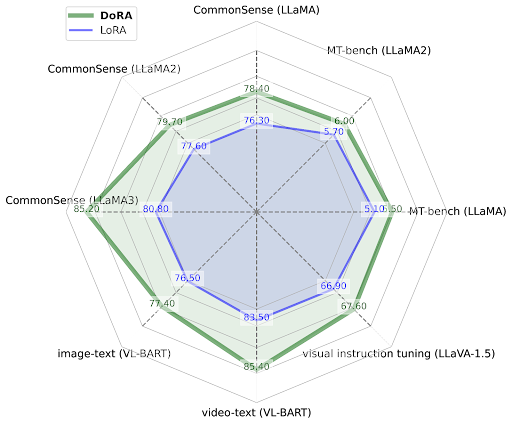
🌟 New from #NVIDIAResearch: Weight-Decomposed Low-Rank Adaptation (DoRA)
➡️ https://t.co/nhjbXE7URJ
A groundbreaking advancement in fine-tuning technology that's set to revolutionize how we optimize pretrained models without increasing inference costs. 👀
Cannot believe this finally happened! Over the last 1.5 years, we have been developing a new LLM architecture, with linear complexity and expressive hidden states, for long-context modeling. The following plots show our model trained from Books scale better (from 125M to 1.3B) than Mamba and Transformer, and our 1.3B model works better and better with longer context.
The idea, Test-Time Training (TTT), is something we have been working on for over 5 years. I still remember when I started as a postdoc, discussing with Alyosha what to work on, he asked me to talk to Yu Sun on TTT. And that is when everything begins.
Although this TTT is quite a different thing now. It is a network layer, replacing the hidden state of an RNN with a machine learning model. Instead of using a feature vector to represent a memory, our TTT layer maintains a small neural network to compress the input tokens. As each token comes in sequentially, the compression is done via gradient descent on this token to update the small neural network.
This is currently applied to language modeling, but imagine applying it to videos. In the future, when modeling long videos, instead sampling 1 FPS, we can sample the frames densely, and these dense frames would be a burden for Transformer but a blessing for TTT layer. As they are essentially just augmentations in time to train a better network inside TTT.
Please check: https://t.co/XNK1mlxpUQ
What is the Vision-Language Model (VLM) field researching?🧐
VLM is a rapidly developing field since the end of last year, with a large amount of "gold mines" yet to be discovered for researchers. The current exploration is still very preliminary, and it is relatively easy for beginners to get started with large models.🥰
Here are some recommended articles to help you quickly grasp the current development of the VLM field📰:
1. Comprehensively understand the specific exploration directions in the entire field from a macro perspective (such as data ratios, Image Encoder selection, VL connector design, current benchmarks, VLM training strategies, etc.)
a. Cambrian: A Fully Open, Vision-Centric Exploration of Multimodal LLMs
One of the most comprehensive and latest all-round explorations
Link: https://t.co/fqS9zVB5AS
b. MM1: Methods, Analysis & Insights from Multimodal LLM Pre-training
An older but still recommended paper
Link: https://t.co/Q7HSytHhwB
c. What matters when building vision-language models?
Conclusions provide a good supplement to the previous two papers
Link: https://t.co/xOTVQj8PZ6
2. VLM-specific schemes to improve inference efficiency: designing better V-L Attention mechanisms
a. An Image is Worth 1/2 Tokens After Layer 2: Plug-and-Play Inference Acceleration for Large Vision-Language Models
Discovers that vision tokens have a large amount of redundancy, and inference speed can be greatly improved without compromising performance through token dropping
Link: https://t.co/4hvsgy0nr7
b. VoCo-LLaMA: Towards Vision Compression with Large Language Models
Reduces the number of vision tokens to improve inference speed through token compression similar to RMT
Link: https://t.co/8227vL5Sd0
3. The impact of vision encoder resolution on model performance, with a simple and straightforward conclusion: it has a significant impact, and the higher the resolution, the better the performance
a. InternLM-XComposer2-4KHD: A Pioneering Large Vision-Language Model Handling Resolutions from 336 Pixels to 4K HD
Link: https://t.co/hcUik3aVlQ
b. DeepSeek-VL: Towards Real-World Vision-Language Understanding
Link: https://t.co/OBJRnRBlK1
4. VLM model architecture selection: All-in-one Decoder (early-fusion) or separate Vision Encoder and Language Decoder?
a. Unveiling Encoder-Free Vision-Language Models
https://t.co/puhPIluZEB
b. Chameleon: Mixed-Modal Early-Fusion Foundation Models
https://t.co/p5iWwWHbMA
5. How to design the Vision-Language Connector for the more mainstream separate VLM architecture?
a. TokenPacker: Efficient Visual Projector for Multimodal LLM
https://t.co/s3N1ntrajw
6. Best training approach for the separate VLM architecture
a. Long Context Transfer from Language to Vision
https://t.co/eoKGiw9ufm
7. All articles and blogs in the LLaVA series
Improved Baselines with Visual Instruction Tuning
https://t.co/8pLH4RNxAZ
https://t.co/amvIg2TynU
https://t.co/cfVN0Pf6at
https://t.co/CKiCyN2d0G
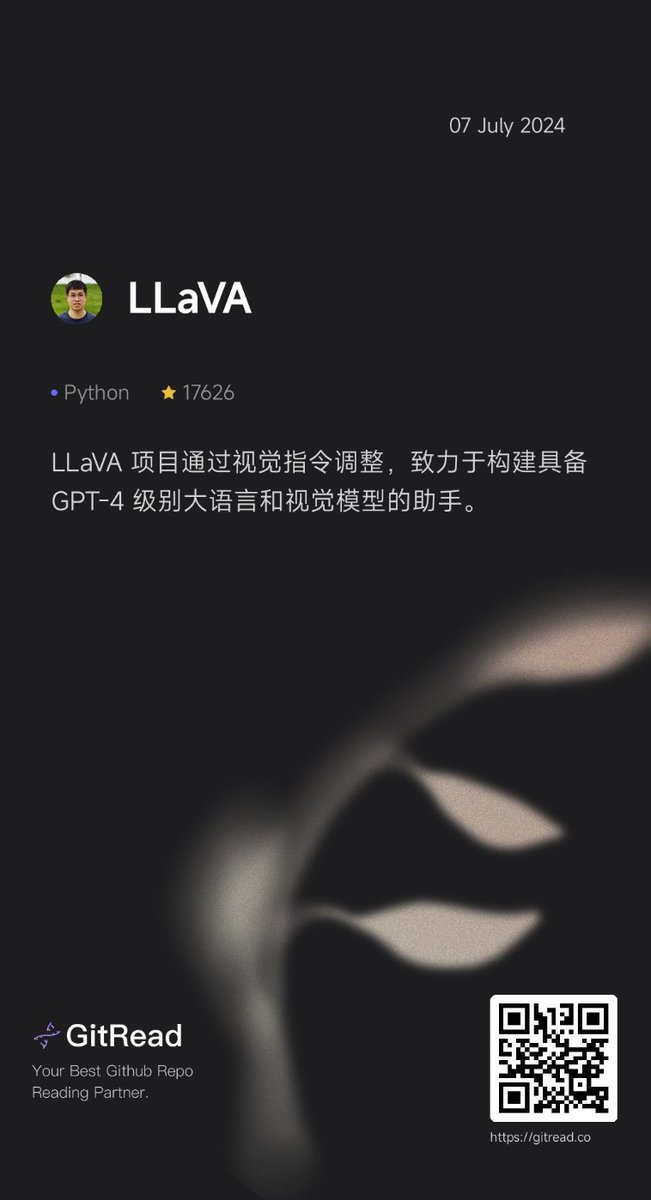
8. Some practical repositories recommended for quickly improving your VLM coding skills (see image)
(The list is not comprehensive, and I hope everyone can continue to add more in the comments section)
"BOFormer: Learning to Solve Multi-Objective Bayesian Optimization via Non-Markovian RL" combines BO and RL for a powerful MOBO solution.
By Yu Heng Hung, Kai-Jie Lin, Yu-Heng Lin, @chienyi_wang & Ping-Chun Hsieh
https://t.co/KaZ9JCDqyK
Interested in vision foundation models like GPT-4o and Sora? Come and join us at our CVPR2024 tutorial on “Recent Advances in Vision Foundation Models” tomorrow (6/17 9:00AM-17:00PM) in Summit 437-439, Seattle Convention Center.
Website: https://t.co/IzYE4cSwy2
#cvpr2024