In 2026, not making your startup pitch deck / materials LLM-digestible is insanity. Materially increases the chance of insta-pass.
LLM-first everything.
I'm going to be so much better prepared if I can have a conversation with my LLM about what you're doing beforehand.
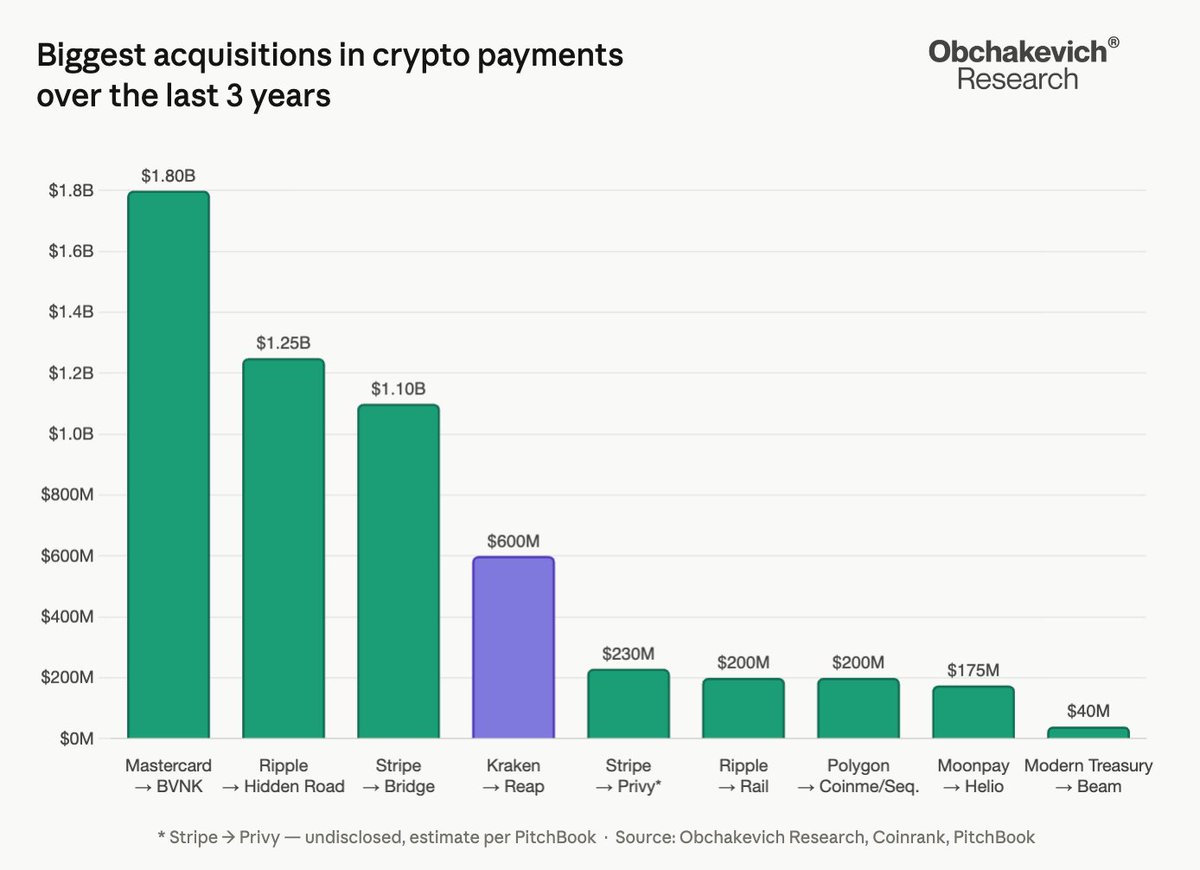
Kraken just acquired Reap for $ 600M - and it's not just a bold move, it's a signal.
@reapglobal builds payment infrastructure for businesses: corporate cards, expense management, cross-border settlements. For @krakenfx, this is a direct entry into the B2B payments stack - territory that crypto exchanges rarely touched before.
But zoom out, and Kraken isn't alone.
Over the past three years, the payments sector has become the most active M&A battleground in crypto. Nine major deals, over $5.5B deployed:
@Mastercard → @BVNKFinance ($1.8B): the clearest sign yet that card networks are buying into stablecoin infrastructure rather than building it.
@Ripple → Hidden Road ($1.25B): a prime brokerage play, but with settlement and payments at its core.
@stripe → @Stablecoin ($1.1B): the deal that set the tone for everything that followed, stablecoins as serious payment rails, not a crypto experiment .
@stripe → @privy_io (~*$230M): wallets as the missing layer on top of Bridge's orchestration
@Ripple → Rail ($200M) and @0xPolygon → @Coinme / @0xsequence ($200M): infrastructure bets on on/off-ramp and wallet layers.
@moonpay → Helio ($175M): doubling down on merchant-facing crypto payments.
@ModernTreasury → @beam_cash ($40M): quiet but telling - a $ 2B fintech adding stablecoin rails for corporates.
The pattern is consistent. Whether it's a card network, a crypto exchange, or a payments fintech, everyone is acquiring the same thing: the infrastructure to move money onchain.
The consolidation phase has started. What used to be fragmented startups building isolated pieces of the stack is now becoming integrated platforms owned by well-capitalized players.
The question isn't whether stablecoin payments will go mainstream. It's who controls the rails when they do.
When building lean go-to-market teams today, there is now contention points between tenure and skill, technical and creative due to AI
The gap is now widening between:
1. Someone who is young, has grit, doesn’t yet have domain expertise but can ship quickly using AI
2. Someone who has domain expertise but moves slower, not as savvy with the latest workflows and tools
Person in bucket one will make a lot of mistakes (at high frequency too if operating at speed with AI) and needs to work under someone more senior to develop expertise.
Person in bucket two either needs to be able to lead a team well (which includes knowing the latest in AI), and/or willing to get back in the trenches to ship, or will be replaced
The gap is also compressing for talent that have strengths in both their “left and right brain” - it’s a golden age for those who use both:
- Developer engineer types that are also creative, social, have some niche taste in art/music/culture
- The marketer and creative director type that knows how to use AI tools to ship, write code, automate
Content needs to be built differently now. LLMs as an audience… your AI writing for another AI.
Announcement, blog, or pitch decks, the format will alter from sharpness and wit to pattern recognition, repetition and association.
https://t.co/pqXG2Nprf5
@bl0ckjames I came from the creatives side of the beverage industry as well working with mixologists. It’s such a creative and fun industry. Always inspiring to see people passionate abt their craft. 🍸🍹🥃
We use our treasury to support the growth of the Solana economy. That is, definitionally, DeFi.
But economies don’t exist in isolation. For Solana to be healthy, all of defi has to be healthy.
We like competition. We compete hard. But if we zoom out, we’re all pushing toward open finance and open systems.
We’ve deployed our treasury into Solana DeFi for many years. We supported Tether’s recovery plan for Drift.
In moments like these, it’s important to show up for the broader ecosystem too.
That’s why we are lending USDT into @aave for the first time to support their recovery efforts, and we will also be bringing $AAVE to Solana this weekend.
DeFi United
Thoughts on Money20/20 Asia in Bangkok
Reminded me of my old Private Equity days — dealing with corpo/gov guys working 9-5 without passion & soul
I normally go to builder-focused events or host a few myself. Quality builder convos/panels tend to be first-principled — there's cause and effect, what builders see as a problem and why the team decide to build [x] to tackle it
Contrast that with institutional events like Money20/20. Most execs talk like they haven't worked a day in their lives. "If you wanna get more adoption, go deeper. Remember, go deeper" "Stablecoins aren't integrated because of regulations"
Generic stuff you can expect from your fav LLM, these execs deliver em ...
Convos get better if you talk to mid-managers/juniors in fintech who actually put in the work, or people genuinely excited about what they're building. Rare in big orgs though.
The saddest part is the HUGE mismatch between stablecoin/payments vibes on CT vs on the ground at the conference.
People still talk cross-border payments & remittances in fiat on legacy rails. Stablecoin MC hits ATH every week on DeFiLlama but instos say it's still very early stages for them
The coolest part is that almost everybody sees stablecoins as a positive for the industry. Adoption is slow but accelerating, especially in APAC. Many are unbanked or don't have credit card access — stablecoin rails are the perfect fit
Countries like the Philippines and Thailand run on QR code payments, and stable/crypto rails are starting to plug into those
Another cool signal is Gen Z & Millennial spending behavior. Instead of saving for a car or house, people save for travel. They used to travel once or twice a year, now 3-5 a year, some even move to Asia for a full nomadic lifestyle. Budget tend to matter more than destination, as long as it's unique and fun, they'll just go.
Some fintechs realized this and are tailoring their apps around discovery over utility (e.g. curate cool stuff for Gen Z, up-sell it while they're discovering on the app).
All in all, Money20/20 woke me up to the reality of the world. The convergence between Web2 and Web3 is real. Web3 needs broader distribution while Web2/insto/corporates need the tech + regulations to adopt Web3 tech.
But.... Putting them in the same room and delivering tangible outcomes feels like it's going to be a lot harder than expected. The culture difference, the knowledge gap, the regulations are real.
As an industry, if we wanna maintain the builder-centric vibe, we have to do better. If not, we'd have to wear suits and beg people w/o soul for capital






![0xJeff's tweet photo. Thoughts on Money20/20 Asia in Bangkok
Reminded me of my old Private Equity days — dealing with corpo/gov guys working 9-5 without passion & soul
I normally go to builder-focused events or host a few myself. Quality builder convos/panels tend to be first-principled — there's cause and effect, what builders see as a problem and why the team decide to build [x] to tackle it
Contrast that with institutional events like Money20/20. Most execs talk like they haven't worked a day in their lives. "If you wanna get more adoption, go deeper. Remember, go deeper" "Stablecoins aren't integrated because of regulations"
Generic stuff you can expect from your fav LLM, these execs deliver em ...
Convos get better if you talk to mid-managers/juniors in fintech who actually put in the work, or people genuinely excited about what they're building. Rare in big orgs though.
The saddest part is the HUGE mismatch between stablecoin/payments vibes on CT vs on the ground at the conference.
People still talk cross-border payments & remittances in fiat on legacy rails. Stablecoin MC hits ATH every week on DeFiLlama but instos say it's still very early stages for them
The coolest part is that almost everybody sees stablecoins as a positive for the industry. Adoption is slow but accelerating, especially in APAC. Many are unbanked or don't have credit card access — stablecoin rails are the perfect fit
Countries like the Philippines and Thailand run on QR code payments, and stable/crypto rails are starting to plug into those
Another cool signal is Gen Z & Millennial spending behavior. Instead of saving for a car or house, people save for travel. They used to travel once or twice a year, now 3-5 a year, some even move to Asia for a full nomadic lifestyle. Budget tend to matter more than destination, as long as it's unique and fun, they'll just go.
Some fintechs realized this and are tailoring their apps around discovery over utility (e.g. curate cool stuff for Gen Z, up-sell it while they're discovering on the app).
All in all, Money20/20 woke me up to the reality of the world. The convergence between Web2 and Web3 is real. Web3 needs broader distribution while Web2/insto/corporates need the tech + regulations to adopt Web3 tech.
But.... Putting them in the same room and delivering tangible outcomes feels like it's going to be a lot harder than expected. The culture difference, the knowledge gap, the regulations are real.
As an industry, if we wanna maintain the builder-centric vibe, we have to do better. If not, we'd have to wear suits and beg people w/o soul for capital](https://pbs.twimg.com/media/HGfdI9EakAA4vsp.jpg)





