@SpaceX Starlink to launch Direct to Cell service later this year. Help them make it a robust system and get rewarded for your efforts https://t.co/xknyL5hIfT #SpaceX#starlink#tmobile#bugbounty
you're telling me anthropic & google are paying spacex ~$26b a year for compute?!!
this is more than half the run rate of openai & anthropic just from compute deals & that doesn't even factor in the rocket launches at all.
elon accidentally ended up owning a significant portion of three of the scarcest assets in ai.. power, chips, & physical deployment capability. the best lesson here is that if you’re selling picks & shovels during a gold rush, you don’t necessarily need to find the gold. you just need everyone else to keep digging. & also non software elon is pretty much unstoppable, like prime michael jordan type thing.
FSD Supervised is now available in:
- United States
- Canada
- Mexico
- Puerto Rico
- China
- Australia
- New Zealand
- South Korea
- The Netherlands
- Lithuania
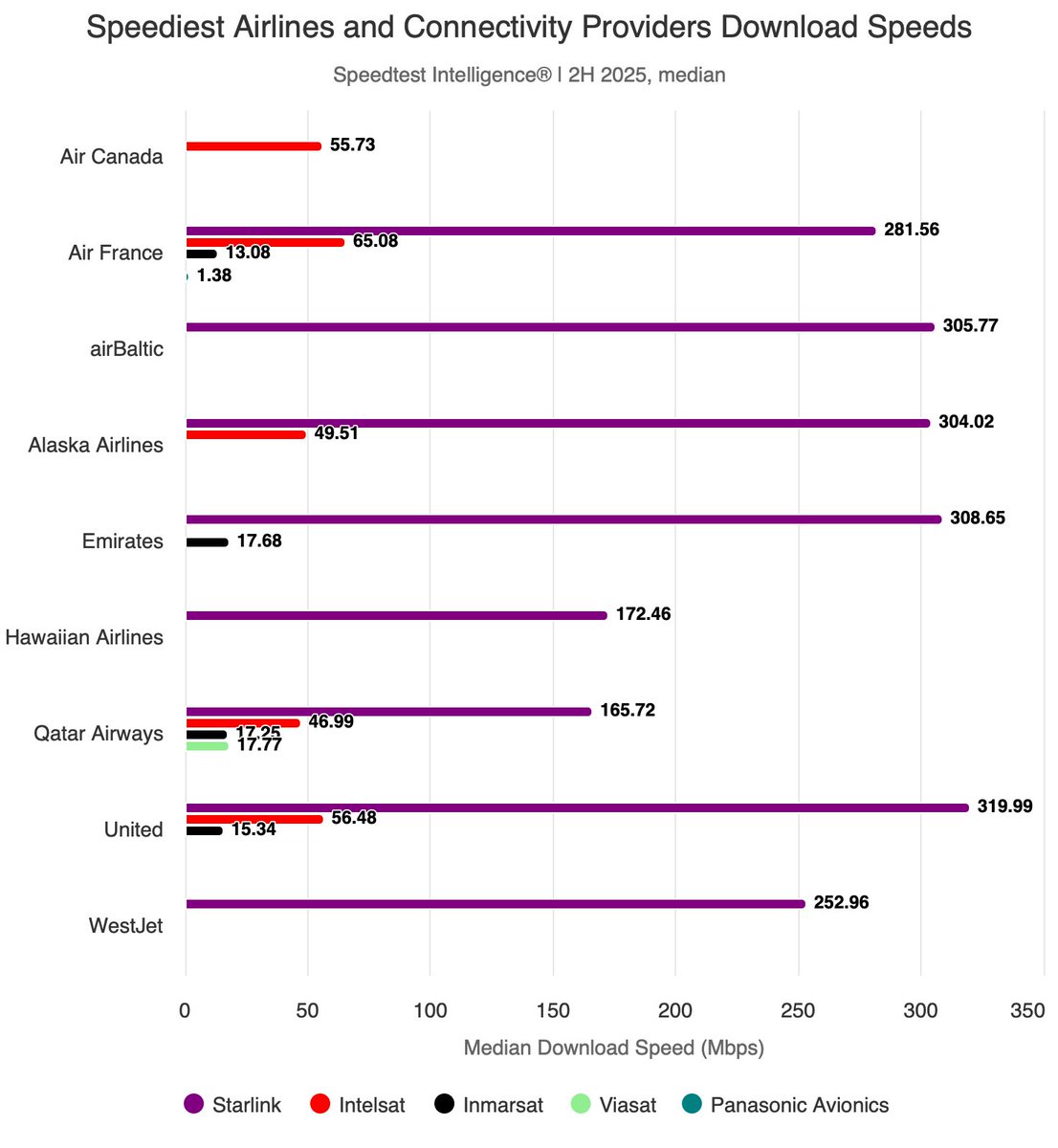
Ookla says @Starlink has been a game-changer for inflight Wi-Fi speeds. Their new report ranks which airline has the fastest Wi-Fi:
"Starlink stood out for its speed. Of over 50 airlines evaluated, the eight airlines that exceeded 100 Mbps median download speed and half of those clocking over 300 Mbps in 2H 2025 were served by Starlink. No other IFC provider approached triple-digit speeds. Conversely, no airline with Starlink was below 100 Mbps median download speed.
The consistency and download speed performance results of Starlink’s IFC are game changing. Sometimes when wireless networks experience rapid growth, the increased number of users and larger volume of data traffic can result in slower speeds for everyone. This has not been the case for Starlink."
It's pretty clear at this point that airlines not adopting Starlink are going to be at a pretty big disadvantage compared with the airlines that do. In some cases, we're already seeing passengers specifically searching for flights with Starlink Wi-Fi.
AI collapses the skill thresholds required to execute complex cyberattacks. AI can find vulnerabilities and gaps, and create tools to exploit them. The time to act is now and CEOs must urgently understand the issue and adapt their business systems. Organisations must prepare for a deluge of vulnerabilities, and organisations must prepare to process them quickly and continuously. The good news is that AI is also a defensive tool. It just must be used as such.
The uncomfortable truth is that raw spending won't be sufficient without restructuring how security teams operate. This isn't only a money problem.
Critical infrastructure running on the older, less easily to patch software is exactly the environment where AI-driven cyberattacks may be most damaging.
I am super excited to share that @Starcloud_ has raised a $170M Series A at a $1.1bn valuation to fuel our development of data centers in space 🚀
The round comes after the successful deployment of our first satellite, Starcould-1, a few months ago, which had the first @NVIDIA H100 on board and was the first to train an LLM in space. The funds will be used to develop our third satellite, which aims to be cost-competitive with Earth-based data centers in terms of AI inference cost.
The round was led by @Benchmark and @EQT Ventures, and we are excited to welcome Benchmark GP, @Chetanp Puttagunta, to our board. We are also excited to welcome other new investors, including the world's largest infrastructure fund, @Macquarie Capital, @SevenSevenSix 7️⃣7️⃣6️⃣, Manhattan West, Adjacent, Carya, GSBackers, and Harpoon.
We are very grateful for the continued support of existing investors, including @NFX, @NebularVC, @YCombinator, @FUSE_VC, @Soma_Capital, 3Capital Partners, Wyld VC, Tiny VC, and Taurus Ventures.
Onwards!
Today I learned that if you find a root access exploit on a Tesla, Tesla will give you an SSH cert allowing you to have root access to your own car so you can find more exploits
Starlink Mobile is providing data for video, voice, and messaging services in areas where terrestrial service is unavailable
Working with global mobile network operators, our satellite-to-mobile network has grown to 32+ countries, home to 1.7B+ people → https://t.co/Sz2wzdRtF8
ROOTCON XX Invitation Requests NOW OPEN.
We’re releasing this early because approvals take time.
If you need an official invitation for company approval, or budget justification, request it now and stay ahead of the process.
Plan early. Get approved.
https://t.co/QmsDVy1UwD
See you at ROOTCON 20.
#ROOTCONXX #ROOTCON20
No more waiting for high-speed internet!
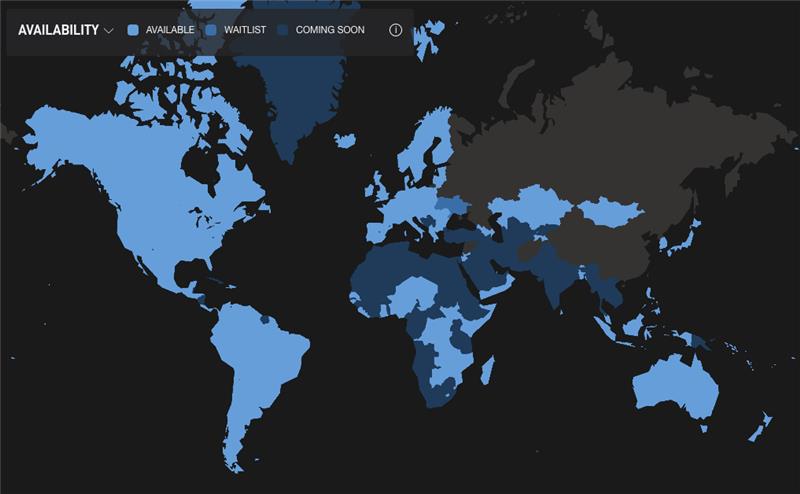
We have removed waitlists for Starlink in every country where Starlink is available today.
Go to https://t.co/fUko3xSviJ to find the best available service plan that works for you.
SpaceX has developed a novel Space Situational Awareness (SSA) system, called Stargaze → https://t.co/dZUIfl2xmx
To maximize safety for all satellites in space, @SpaceX will be making Stargaze conjunction data available to all operators, free of charge. By providing this ephemeris sharing and conjunction screening service free of charge, we hope to motivate operators to take similar steps towards ephemeris sharing and safe flight.
Some thoughts on the competitive dynamics in the space economy that I think are often overlooked.
The economics of space are not complicated. Almost everything interesting people want to do in orbit or beyond becomes viable if launch costs fall far enough. And almost nothing does if they don’t. Lower launch costs are the keystone. Launch itself is not, by default, a great standalone business, but it is the keystone. Necessary, not sufficient. Lower launch costs unlock more payloads, more experiments, more failures, more iteration and eventually, more real businesses.
But there is only one proven way to lower launch costs: fly a lot. You ride the learning curve. You amortize fixed costs. You improve operations. You find the weak points. You reuse hardware. All of that only happens at high launch cadence. And high cadence only happens if you are launching something that already makes economic sense. Today, Starlink is the clearest example. It produces revenue, it demands constant launches, and it gives SpaceX exactly what a launch company needs most: repetitions that aren’t draining the bank account. The fact that Blue Origin and others are circling the same use case is telling. It suggests that a second, comparably large, clearly profitable orbital market is not yet obvious.
Some newer companies are trying a different path: build satellites, pay someone else to launch them, generate cash flow, and later fund their own rockets. The problem is that this hands the most valuable asset in the whole system, the flight rate, to a third party. Experience compounds. Operations muscle memory compounds. Manufacturing feedback loops compound. Outsourcing launches is not neutral. It is almost like cutting your leg out from under yourself and hoping to win a marathon later.
Satellite internet itself can of course be segmented. But at the infrastructure level, it shows strong first-mover advantage. A constellation at scale has better coverage, better uptime, better latency, and usually better unit economics than a smaller one. And historically, space has been an industry with low knowledge transfer. It took roughly a decade for another company to replicate orbital landing after SpaceX showed it was possible. Being first, and being at scale, matters.
Starlink is also not the end game. It may be a very large market, but it is plausibly a bridge to much larger ones. Orbital data centers are one example. They only make sense if launch is cheap, frequent, and reliable. Which brings us back to the beginning. The center of gravity in the space economy is not the payload. It is the launch rate. Whoever controls that flywheel is in the best position to decide what space becomes.
Morgan Stanley in new $TSLA note:
“Lemonade’s newly announced autonomous car insurance product represents a notable step in legitimizing autonomous driving, and in particular, Tesla’s FSD technology, in the eyes of the insurance industry.
This is an important shift in how insurers treat advanced driver-assistance and
autonomy features. Lemonade’s approach suggests growing confidence in the data coming from Tesla’s fleet, using real-world driving outcomes to assess safety performance rather than relying solely on theoretical or regulatory classifications. Beyond the cost savings, the structure of the policy could encourage increased FSD usage and adoption. Lower insurance premiums create a recurring economic benefit for drivers who choose to engage FSD more frequently, reinforcing Tesla’s value proposition.
Over time, as FSD adoption accelerates we expect a positive feedback loop, whereby miles driven correlates to improved performance and safety, and further reductions in insurance costs. More broadly, Lemonade’s announcement points toward a future in which insurance becomes one of the clearest market-based validators of autonomous driving progress. As insurers incorporate increasingly granular driving data into pricing, technologies that demonstrably reduce risk should be rewarded faster and more transparently. For Tesla, this marks another step toward external recognition that FSD is moving from an experimental feature to an economically relevant safety system.”
Morgan Stanley analyst Andrew Percoco has reiterated his $TSLA price target of $425.
The Philippines will be the first country in Southeast Asia to deliver Starlink Direct to Cell. In partnership with @enjoyglobe, millions of people will stay connected in remote areas that didn't have coverage before.
NEWS: Elon Musk's SpaceX is now offering free Starlink service in Iran amid deadly protests and a days-long internet blackout.
SpaceX has lifted the subscription fee in Iran, so people with receivers in the country can access service without paying. https://t.co/NJvTTBJuV6



![POC_Crew's tweet photo. [#Zer0Con2026]
💥 CFP "D-3"
🗓️ CFP: ~ Feb 22, 2026
Take the stage.](https://pbs.twimg.com/media/HBgTMndbUAA5uNH.jpg)

![POC_Crew's tweet photo. [#Zer0Con2026]
🗓️ CFP closes in "30 days"
🌕 CFP: ~ Feb 22, 2026
No hesitation. Only execution ;) https://t.co/H4kOGNxSU2](https://pbs.twimg.com/media/G_VUdxub0AAjguW.jpg)