MIT builds electro-floating fiber muscles to simulate muscle movement as opposed to servo motors.
This vastly reduces space needed and energy utilization.
The debate between pneumatics vs. servos has been a long one, this may have ended it.
MİLYAR DOLARLIK ROBOTİK ŞİRKETLERİNİN 50 YILLIK MOTOR TAKINTISI AZ ÖNCE ÇÖPE ATILDI.
Mit araştırmacıları insan kasını birebir kopyalamış. Ama o bildiğiniz ağır metal dişliler, karmaşık hidrolikler veya binlerce dolarlık servo motorlarla değil. Sadece elektrik yüklü bir sıvı ve minik bir pompayla.
Sistem dümdüz senin kolun gibi çalışıyor. Pompa içeriye elektrik veriyor, iyonlaşan sıvı hareket ediyor ve lifler kasılıp gevşiyor. Kolunu büktüğündeki kasılmanın aynısı.
SIFIR MOTOR. SIFIR HARİCİ DONANIM. VE TAMAMEN SESSİZ.
Herkes bilim kurgu geyiği yapıyor. Oysa burada koca bir endüstrinin maliyet yapısının nasıl tabana vurduğunu izliyorsunuz. Yıllardır donanım üretmek demek, arıza yapan metal yığınlarıyla ve sürtünmeyle boğuşmak demekti. Şimdi olay sadece basit bir sıvının iyonlarla yönlendirilmesine döndü.
Bu lifleri gerçek kas gibi birbirine sardıkça gücü katlanarak artıyor. Yani performansı artırmak için daha büyük ve pahalı bir mekanik motora ihtiyacın yok. Sadece o bağlama birkaç tel daha ekliyorsun. Kuvvet doğrudan ölçekleniyor.
DONANIM ARTIK YAZILIM GİBİ UCUZ VE MALİYETSİZ BİR ŞEKİLDE ÖLÇEKLENİYOR.
Parça üreticilerinin fişi çekildi. Üretim bandındaki ağır sanayi tezgahlarından bahsetmiyoruz artık. Etrafında dolaştığını bile duymayacağın, seninle aynı organik esnekliğe sahip maliyetsiz sistemler geliyor.
Mekanik devri kapandı. Yeni oyuna uyanın.
There’s a generation a lot of people forget exists. We were born at the tail end of the Boomers, but we are not culturally the same as people born in the 40s and early 50s. We are Generation Jones.
And honestly, it explains a lot.
We grew up in a world that still felt fundamentally analog, but we were young enough to be dragged headfirst into the digital revolution. We are the bridge generation between rotary phones and smartphones, between slide rules and AI, between Walter Cronkite and algorithm driven media.
We remember when there were only a few television channels and the entire country watched the same thing at the same time. We also adapted to the internet, email, forums, social media, streaming and now artificial intelligence. We lived before and after the technological singularity hit everyday life.
That is not a small thing.
People born in the 40s came of age in a post World War II America that was still industrial, deeply hierarchical and institutionally stable. Their formative years were shaped by the Cold War, Vietnam, the civil rights era and a society where information moved slowly.
Generation Jones came later. We inherited the aftermath of all of that.
We were the kids who watched Watergate destroy blind trust in government. We watched manufacturing begin to collapse. We saw divorce rates explode. We were the first truly latchkey generation in massive numbers. We learned independence early because many of us had to.
We grew up with one foot in old America and one foot in whatever this new thing was becoming.
We played outside until the streetlights came on but we also learned DOS commands. We learned cursive and keyboarding. We had card catalogs and Google searches. We went from vinyl records to cassette tapes to CDs to MP3s to streaming in one lifetime.
We remember maps. We remember memorizing phone numbers. We remember life before GPS and before every human interaction became filtered through a screen.
And because of that, I think Generation Jones developed a very unique perspective. We are adaptable because we had no choice but to adapt. We learned technology as adults instead of being born into it. We remember a slower world but were forced to survive in a rapidly accelerating one.
That creates a very different mindset than either older Boomers or younger Gen X and Millennials.
A lot of us also reject the caricature people now associate with “Boomers.” We were not buying houses for the cost of a sandwich in 1965. The interest rate on my first house was over 14% and that was after buying down a point. Many of us got hit by recessions, outsourcing, pension collapses and economic instability just like younger generations did. We watched promises evaporate in real time.
We understand older generations because we were raised by them. We understand younger generations because we had to evolve alongside them.
That’s why the Jones generation often feels culturally homeless. We are rarely discussed, rarely defined and usually lumped into categories that don’t actually fit us.
But we exist.
We are the human transition point between the industrial age and the digital age.
And frankly, there will probably never be another generation quite like us again.
There are a few misconceptions about Machina. I am gonna clarify in this thread:
1. “Machina makes Roboforming machines.”
Partially true.
But that’s like saying Apple makes keyboards.
We make the Robocraftsman. A robotic manufacturing platform designed to perform many manufacturing operations with minimal or ideally zero geometry and material specific tooling.
We started with forming. Roboforming
Today the system also does:
- trimming
- hole making
- slotting
- QC/inspection
And we’re will be adding:
- heat treatment
- forging
- assembly
- additive
- and more.
The long term goal is simple:
One robotic platform.
Many operations.
Software defined manufacturing.
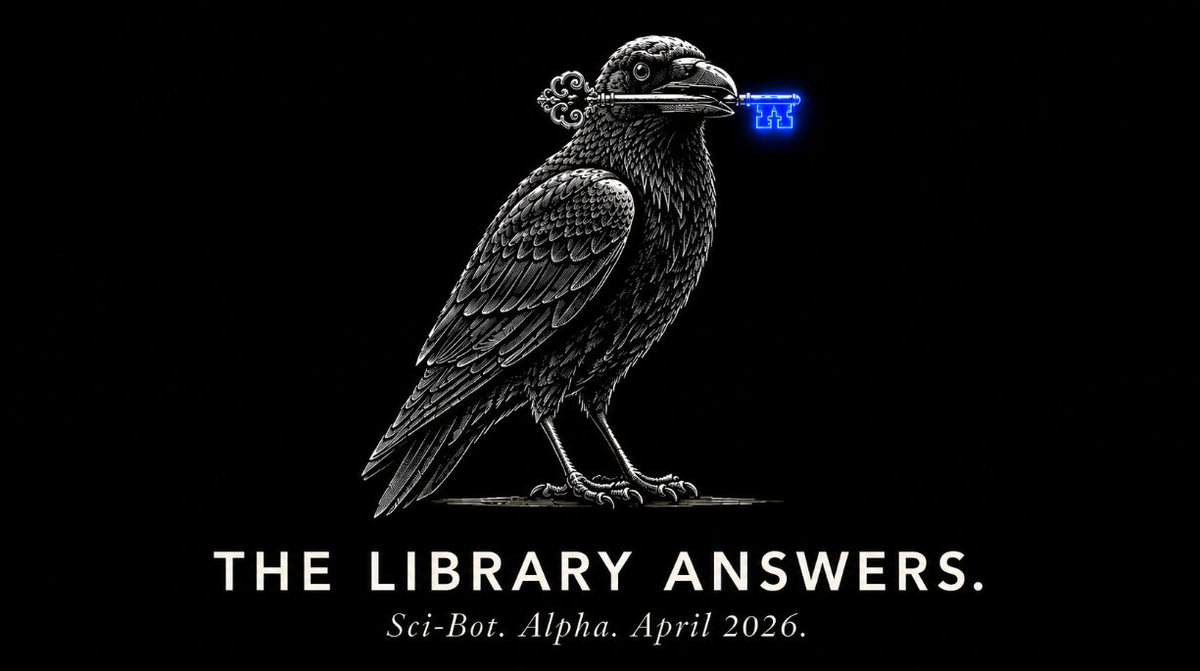
In April, a website that has been sued, blocked, deplatformed, and chased across thirty-seven domains over fifteen years quietly launched its own AI.
Sci-Hub is the largest unauthorized library of scientific papers in human history. Ninety-five million academic papers. Tens of millions of books. Built and maintained by a single Kazakhstani neuroscientist named Alexandra Elbakyan since 2011, funded by donations, hosted on whatever country's registrar will tolerate it that year, mirrored across torrents and IPFS and Telegram bots.
Elsevier sued. Sci-Hub stayed up. The American Chemical Society sued. Sci-Hub stayed up. India sued. Sci-Hub stayed up. Swedish registrar Njalla cut the .se domain in January. Sci-Hub stayed up at .al, .ru, .ee, .box, and a half-dozen .onion addresses the registrars cannot reach.
Now the library has built its own intelligence.
Sci-Bot launched in alpha in April. You ask it a research question. It answers, and it cites real papers from inside the corpus, with links that actually open the actual papers.
The bot does not hallucinate citations. It cannot, because it only draws from papers it actually holds. The same property that the venture-funded labs have spent four years and forty billion dollars trying to engineer back into their products is a free side effect of training the model on a library that contains the books.
Anthropic, OpenAI, Google, and Meta have all been sued in the past eighteen months for training their models on the same shadow libraries that Sci-Hub assembled. Meanwhile the corpus those scripts were pointed at, the corpus those models were trained on, the corpus the entire generative AI industry is built on, sat right there the whole time, free, with a search box on top.
The pirates beat them to it.
Sci-Bot was built on a corpus that was already free, by a team that asked no permission, charging no one, with the explicit position that the right to read scientific research is older than the cartel that decided to charge for it.
The same arithmetic the medieval guilds used to keep the printing trade in approved hands. The same arithmetic Pope Paul IV used in 1559 to publish the Index Librorum Prohibitorum. The same arithmetic the Stationers' Company used in seventeenth-century London.
Knowledge has always had a fence around it. The fence has always been guarded by men who did not write the books.
The library answers. We never asked permission. We never had to.
I'm Italian. Greece has been my second country for years.
The Greeks I know rarely spend their summers on the cruise islands. Not Santorini. Not Mykonos. Not Crete. Not Rhodes.
They take the ferry from Piraeus to islands the world hasn't found, or drive into a continental mainland that foreign lists never mention.
Greece is the most layered civilization in Europe.
10 underrated places where the kafeneio is real, the ouzo is local, and history isn't behind glass.
🧵
your phone connects to a small radio in your pocket
that radio talks to your blackbox node
the node runs AI, mesh, and value transfer
no sim. no carrier. no bill.
you own the network.
v1 → comms. data explorer. value transfer.
v2 → image/video over radio. social layer.
this is an open source project we need contributors
rf. embedded. protocol. fullstack.
tag someone who should be building with us!
What is the smallest object that, if it stopped being made tomorrow, would freeze the entire AI industry by Friday?
Not a chip. Not a GPU. Not a model.
A polished piece of indium phosphide the size of a coaster, grown in a furnace over two weeks, made by exactly two companies in the world that are not Chinese.
I learned that around 4 a.m. one night about two years ago. I have not really stopped thinking about it since.
To understand why a coaster of crystal can hold up a trillion-dollar industry, you first have to understand that almost nothing about modern computing is normal.
A leading-edge AI chip travels through roughly a thousand process steps over three to four months. The cleanroom it lives in is thousands of times cleaner than a hospital operating room. The fab itself draws as much electricity as a small city. The single lithography machine that draws the circuits has five thousand suppliers of its own, spread across six countries, and not a single nation on Earth could build one alone. By the time a finished chip pops out the other end, more humans have had a hand in its production than live in most American towns. Most of them will never meet.
From the highway, a TSMC fab looks like a beige warehouse with a parking lot. Inside, it is the closest thing humans have ever built to alien technology.
I find that genuinely moving. And I find it terrifying. Because a miracle that complicated has a lot of single points of failure, and almost nobody in mainstream coverage is mapping them.
Two years of pulling on this thread keeps bringing me back to the same conclusion. The 2026 to 2030 AI buildout is gated by four physical constraints, and almost nothing else.
1. Indium phosphide wafers. Two credible non-Chinese suppliers in the world.
2. Advanced packaging. Four companies on Earth that matter.
3. Power. Industrial gas turbines sold out into 2030. Three vendors at scale.
4. Critical minerals. China's pause on gallium, germanium, and antimony export controls expires November 27, 2026.
By the time a chokepoint is on the front page, the move is largely over. The prize goes to whoever was patient enough to map the chain when it was boring.
So I built a dashboard
A free public dashboard. The chokepoints, the names that own them, the live prices, the catalysts, and the written thesis all on one screen. No login. No newsletter. Not a portfolio. Not a recommendation. A prism.
I wanted it free because the people I would have wanted to read this when I was younger could not have afforded a Bloomberg terminal. Students. Engineers. Journalists trying to understand what they are writing about. Retail investors tired of being sold someone else's conviction. Curious teenagers in countries where the local financial press is twenty years behind the actual frontier.
The chain deserves to be walked. That is the whole invitation.
links below 👇
Educational, not investment advice.
In case you haven’t worked it out yet…
• SpaceX and Blue Origin are the railroads.
• The moon is the Louisiana purchase, Mars is the West Coast.
• AI is the pioneers, and your kids and grandkids are the settlers.
People ask…
“But what is the business case for space?”
The answer is “America”
Big problems require big solutions.
30 years ago this week the Troll-A platform was towed out of Stavangerfjord and 120 miles across the North Sea to its final installation site.
It remains the largest object ever moved by humans.
It weighed 1.2 million tons
It was 1,550 feet tall
If you want to build big things, if you have big ambitions, then you build things at sea. This is just obvious.
Some of us have experience building and operating submarines, pipelines, platforms, power cables, ships, floating installations, things that people struggle to imagine.
We can build things on the seabed, in the water column, on the surface, towering above the surface, even 3 miles below the seabed we build things there too.
We have been doing it for a long time.
We are good at it.
Above a certain scale it is far easier to build and operate things at sea than it is on land. Building on land is slow and bitty and people moan about it, building at sea is big, heavy and fast.
Nobody can stop you.
Natural gas turbines are the first leaf on a multi-decade tech tree. The same physics kernel, the same factory, and the same engineer can deliver nuclear turbines, geothermal turbines, heat recovery systems, and propulsion engines. Stone's manufacturing and AI design stack makes every node on that tree faster and cheaper to reach.
This is how we succeed through the next decades, nat gas is how we get going, nuclear (on and off planet) is how we become a generational company for decades to come.
6/11
At Stone Power we design, fabricate, and deploy turbines, and we're doing it with an AI stack built specifically for hardware.
We are America’s Turbine company. We are building power generation turbines for the $100 B+ market in 2026, and we expect it to triple by the early 2030s.
Stone’s design decisions, manufacturing technologies, and maintenance technology makes these turbines a fraction of the cost, and much faster to market.
We will build our own factories, we will deliver our own natural gas, steam, and advanced turbines.
3/11
@Gaurab's post accurately describes one of the reasons natural gas turbines will be slow.
GPU production is scaling faster than power generation. within a few years, we're going to have GPU's sitting idle because we can't energize them fast enough
However, you can buy a natural gas turbine before 2030 and it's from my company: Stone Power. WE will have gigawatts of energy delivered before 2030.
2/11
A 34-year-old physics graduate student spent years writing a strange 800-page book in 1979 about a logician, a Dutch artist, and a German composer. It won the Pulitzer Prize the following year. It quietly became required reading at every AI lab in the world.
It is the only book in history that makes the deepest ideas in computer science feel like a dream you cannot stop thinking about.
I read it across 3 months on a single side table next to my bed and walked away seeing intelligence, consciousness, and AI in a way I cannot un-see.
His name is Douglas Hofstadter. The book is called Gödel, Escher, Bach.
Almost nothing in modern AI makes sense without this book. ChatGPT, Claude, Gemini, the entire architecture of self-attention, the alignment problem, the strange feeling that LLMs sometimes seem to understand and other times seem to be playing an elaborate symbol-shuffling game, all of it traces back to questions Hofstadter laid out in a single book published before most of today's AI engineers were born.
Here is the story almost nobody tells you about how the book came to exist.
Hofstadter was the son of Robert Hofstadter, who won the Nobel Prize in Physics in 1961 for measuring the size of the proton. He was supposed to follow in his father's footsteps.
He started a physics PhD at the University of Oregon. He was miserable. He could not focus. He did not love the work. He kept getting pulled toward something else.
The something else was a single question that had haunted him since childhood.
How can meaning emerge from meaningless symbols? Specifically, how does a brain, which is made of nothing but cells firing electrical signals at each other, produce something that feels like consciousness, like understanding, like a self?
He could not let the question go. He left physics. He started writing. The book took him years. He wrote it largely in isolation, working in the basement of his parents' house and at Indiana University, where he eventually finished it. He thought it would be read by maybe a few hundred logicians and AI researchers. Basic Books published it in 1979 as a 777-page hardcover.
The next year it won the Pulitzer Prize for general non-fiction and the National Book Award for science.
The book is structured in a way that almost no other book has ever attempted. The chapters alternate between two layers. One layer is technical chapters about logic, computability, neuroscience, and AI. The other layer is fictional dialogues between a tortoise and Achilles, characters borrowed from a paradox by Lewis Carroll.
The dialogues play with the same ideas the technical chapters explain. Read in order, they do not feel like a textbook. They feel like a strange house with rooms that loop back into each other and corridors that change shape behind you.
The first thing the book does is explain Gödel's incompleteness theorems in a way no math textbook had ever managed.
Kurt Gödel, an Austrian logician working in 1931, proved something that broke mathematics. He showed that any formal system powerful enough to describe arithmetic contains statements that are true but cannot be proven inside that system. Mathematics, the most certain thing humans had ever built, has holes in it that can never be filled.
Hofstadter spends hundreds of pages making you understand this proof not just as a mathematical theorem, but as a structural fact about every sufficiently complex system. Including the brain. Including any AI. The reason AI alignment is genuinely hard is not just engineering. It is structural.
Any system smart enough to model itself will contain truths about itself it cannot reach from inside itself. Hofstadter showed this 50 years before AI safety was a field.
The second thing the book does is introduce his core idea. He calls it the strange loop.
A strange loop is what happens when a system, by climbing through layers of itself, somehow ends up back where it started. Escher's drawings of staircases that always go up but somehow loop back are visual strange loops. Bach's musical canons that modulate up through keys and end on the original note are auditory strange loops. Gödel's self-referential statements that talk about themselves are logical strange loops.
Hofstadter argues that consciousness is a strange loop. Your brain builds a model of the world. Inside that model, it builds a model of itself perceiving the world. Inside that self-model, it builds a model of itself thinking about itself perceiving the world. The recursion does not bottom out. The self is what the loop feels like from the inside.
This is the part that AI researchers cannot stop returning to. Modern transformer models use self-attention, which is technically a mechanism where a network attends to its own internal states across layers. Recursive reasoning, where a model thinks about its own thinking, is now a research area with its own conferences. Meta-learning, where models learn how to learn, is a direct descendant of what Hofstadter described in 1979 as the necessary structure of any conscious system. He wrote the philosophy. The engineers are now building the implementation.
The third thing the book does is the part that haunts every AI conversation today.
Hofstadter argued that meaning is not something separate from symbol manipulation. It is what symbol manipulation looks like from the inside, when the manipulation is complex enough and self-referential enough. A simple lookup table does not understand anything. But a system that processes symbols at sufficient depth, with enough self-modeling, with enough recursion, starts to look identical from the outside, and possibly from the inside, to a system that understands.
This is the deepest question in modern AI. When ChatGPT generates a response, is it actually thinking, or is it just doing very fast symbol shuffling? Hofstadter spent 800 pages arguing that the distinction may not exist at sufficient scale. If a system shuffles symbols according to the right structure, meaning is what the shuffling looks like from the inside.
You can read modern debates about AI consciousness from Yann LeCun, Geoffrey Hinton, Ilya Sutskever, and David Chalmers, and you will find that they are all, in their own ways, having the argument Hofstadter framed in 1979.
The fourth thing the book did is the one that took the longest to be vindicated.
Hofstadter argued, and continued arguing for decades, that the actual engine of human intelligence is not logic. It is not deduction. It is not pattern matching in any simple sense. It is analogy. The ability to see one thing as similar to another thing, to map the structure of one situation onto a different situation, is, in his view, the core of thought itself.
For decades this was unfashionable. Symbolic AI focused on logic and rules. Statistical AI focused on pattern matching. Almost nobody worked seriously on analogy.
Then large language models started working. And the people who looked closely at what they were doing realized something uncomfortable. LLMs are, fundamentally, analogy machines. They learn structural patterns from text and apply those patterns by analogy to new situations. They do not deduce. They do not reason logically by default. They map the shape of one thing onto the shape of another thing and produce output that fits the new shape.
Hofstadter saw this before any of it existed. His later book Surfaces and Essences, written with Emmanuel Sander, is 600 pages defending the claim that analogy is the core of cognition. It came out in 2013. It was largely ignored. The ChatGPT release in 2022 was, in some sense, a vindication of the entire argument.
The strangest thing about reading Gödel, Escher, Bach in 2026 is realizing how lonely the book must have felt when it was written.
In 1979 there was no GPT. No deep learning. No transformer. The dominant approach to AI was symbolic logic, and most researchers thought minds were going to be programmed top-down, rule by rule, like a complicated chess engine. Hofstadter said the opposite. He said minds were emergent. They came from the bottom up. They were strange loops in complex substrates. The programmers' approach would never produce real intelligence because it was missing the recursive self-modeling that made minds real.
He was right.
The book is hard. I had to use all the LLMs and NotebookLM to understand it. It is not a beach read. You do not finish it in a weekend. The math chapters require attention. The dialogues require patience. Most people who buy it never finish it. That is fine. The book is structured so that reading any 50 pages produces a permanent shift in how you think.
Bill Gates lists it among the books that shaped him. Steve Jobs read it. Almost every senior AI researcher in the world will tell you it was the book that made them fall in love with the question of intelligence in the first place.
Hofstadter himself has been in doubt about modern LLMs. He has said they may have proven him right about analogy and wrong about consciousness at the same time. He is still writing. He is still working on the same question that pulled him out of physics 50 years ago.
The 800-page book that explained intelligence before AI existed is sitting one click away from you.
Most people will never open it. The ones who do will see the world differently for the rest of their lives.
We implemented @karpathy 's MicroGPT fully on FPGA fabric.
No GPU.
No PyTorch.
No CPU inference loop.
Just a transformer burned into hardware, generating 50,000+ tokens/sec.
The model is small, but the idea is not: inference does not have to live only in software 👇