🏆 Congratulations to the winners of the Swift Hackathon 2026!
@StanChart won the Business Challenge with their tokenised receivables solution, while @PictetGroup came up with a ‘Control Passport’ to win the Technical Challenge.
Shout out to runners-up, @chainlink and @SunTecGroup, alongside honourable mentions @TDBank_US and @KaikoData.
Learn more about the winning solutions: https://t.co/ZLUBu0gTPg
#digitalassets #innovation #interoperability #hackathon
The launch of CCIP 2.0 is something we've been working on with the world's top financial institutions for a while, we have now implemented their feedback on what is needed for institutional grade bridging of data and the movement of the digital assets themselves across both public and private chains.
The response from the capital markets community here at Sibos has been very positive, and it is clear that the additional compliance, risk management, configurability and network participation capabilities of CCIP 2.0 are something that institutions find attractive and useful.
I think the digital asset industry will end up at a new level of risk management for their data all of their tokenized value; where digital assets that are not bridged via a secure method and/or are relying on data that can be manipulated, will be viewed as much more risky. If the digital assets that bridge via providers which are not secure by default and/or keep repeatedly losing bridging keys, then they will receive worse asset risk scores which necessarily leads to worse terms for their usage as collateral, their inclusion on a balance sheet, and various other use cases. In some cases we are already seeing that having unreliable bridging or easy to manipualte data for valuation is leading to some digital assets to not be accepted for collateral or other users cases at all.
We are now working closely with top FMIs, the leading banks, top asset managers, top GSIs and various capital markets technology providers to enable digital assets to operate in a derisked way, to unlock the liquidity found in public chains and to efficiently connect the next generation of digital assets to the benefits of DeFi.
https://t.co/rYzhSWCcPY
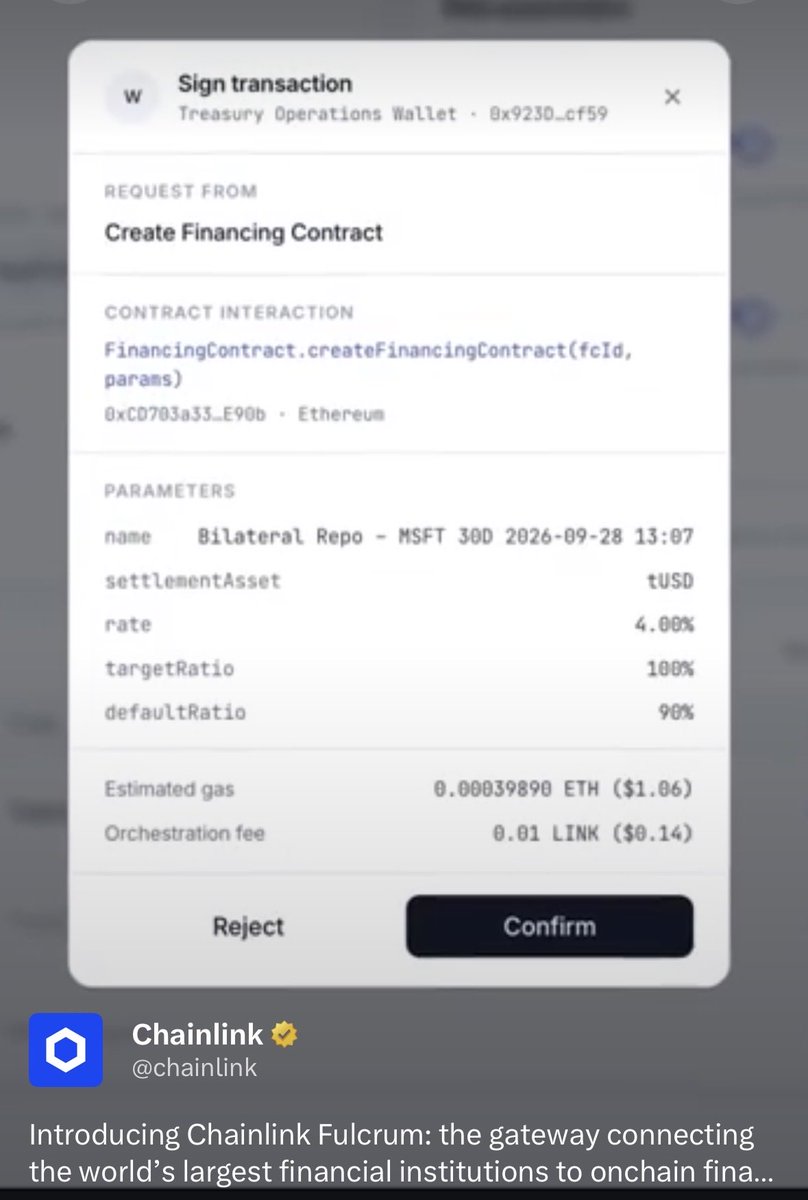
Introducing Chainlink Fulcrum: the gateway connecting the world’s largest financial institutions to onchain financing.
As tokenized assets and financing venues expand across public and private blockchains, institutions need to mobilize collateral and access liquidity without building bespoke infrastructure for every market.
Chainlink Fulcrum solves this with an end-to-end solution that separates where financing agreements are managed from where cash & collateral settle. Counterparties define the eligible assets, financing terms, and the settlement networks through which the assets move.
For institutions, this unlocks:
• Faster collateral mobilization that enables intraday financing, including on holidays and weekends.
• 24/7 risk management through automated collateral coverage checks throughout the day, extending beyond end-of-day processes.
• Greater capital efficiency by making assets across networks available for financing, helping institutions free up balance sheet capacity.
• Lower operational complexity through reusable workflows that connect existing systems across public and private blockchains.
The solution combines multiple aspects of the Chainlink platform, including the Chainlink Runtime Environment (orchestrates transaction lifecycle), CCIP (cross-chain data and asset transfers), and Data Streams (collateral valuation data).
Chainlink Fulcrum is designed to serve all market participants, including banks, dealers, prime brokers, agent lenders, custodians, hedge funds, pension funds, insurers, sovereign wealth funds, money market funds, asset managers, tokenized fund and stablecoin issuers, and corporate treasuries.
Each can lend, borrow, or mobilize collateral on terms that fit its mandate and risk parameters.
Fulcrum is in the process of being integrated with leading TradFi environments, providing a single platform where participants can compare financing terms and route transactions to the venue of their choice, where the agreement is executed and governed.
This is a foundational step toward global financing markets, where an asset’s utility extends beyond the network on which it was issued.
🧵↓
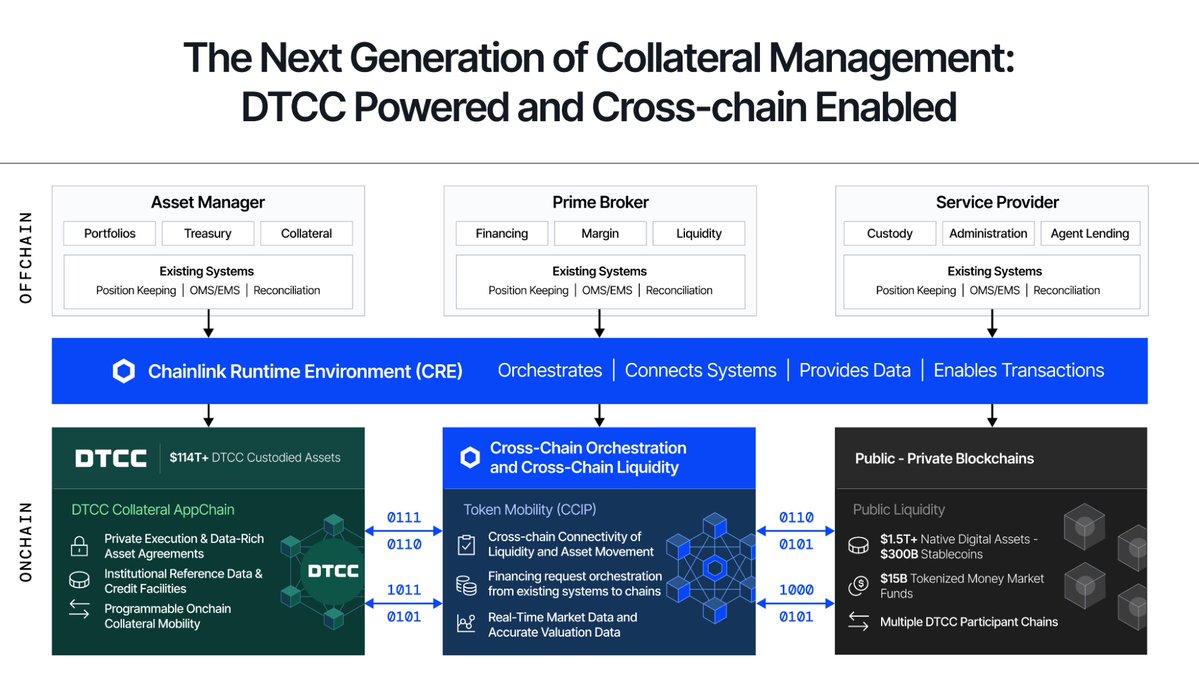
At @Sibos 2026, DTCC’s Dan Doney and Sergey Nazarov present how @The_DTCC is collaborating with Chainlink to advance 24/7 collateral management.
DTCC’s Collateral AppChain, a shared infrastructure platform for collateral, will leverage the Chainlink Runtime Environment (CRE) and Chainlink data standard and is designed to support near real-time collateral management across financial markets and blockchains to support and enable:
• Key orchestration, data and automation capabilities
• The seamless pairing of asset prices, valuations and movement
• Enhanced capabilities for managing collateral-related market risk
The DTCC Collateral AppChain is expected to launch in Q1 2027.
Chainlink will provide:
• Chainlink Runtime Environment (CRE) for orchestration across systems
• CCIP, which enables interoperability and cross-chain messaging capabilities across participating blockchain networks and the DTCC Collateral AppChain
• Data Feeds which provide verifiable market data needed for valuation
TODAY: Chainlink announced it is working to enable financial institutions to connect to @swiftcommunity’s blockchain ledger through the Chainlink platform.
Swift moves the equivalent of the world's GDP roughly every three days ⬇️
TODAY: Chainlink announced it is working to enable financial institutions to connect to @swiftcommunity’s blockchain ledger through the Chainlink platform.
Swift moves the equivalent of the world's GDP roughly every three days ⬇️
@IHeartYou5970@chainlink We need usage = x amount of transactions on CCIP to hit that. Not total value transferred. If 1 quadrillion is sent with 1 tx it still 0.75 cents fee xD