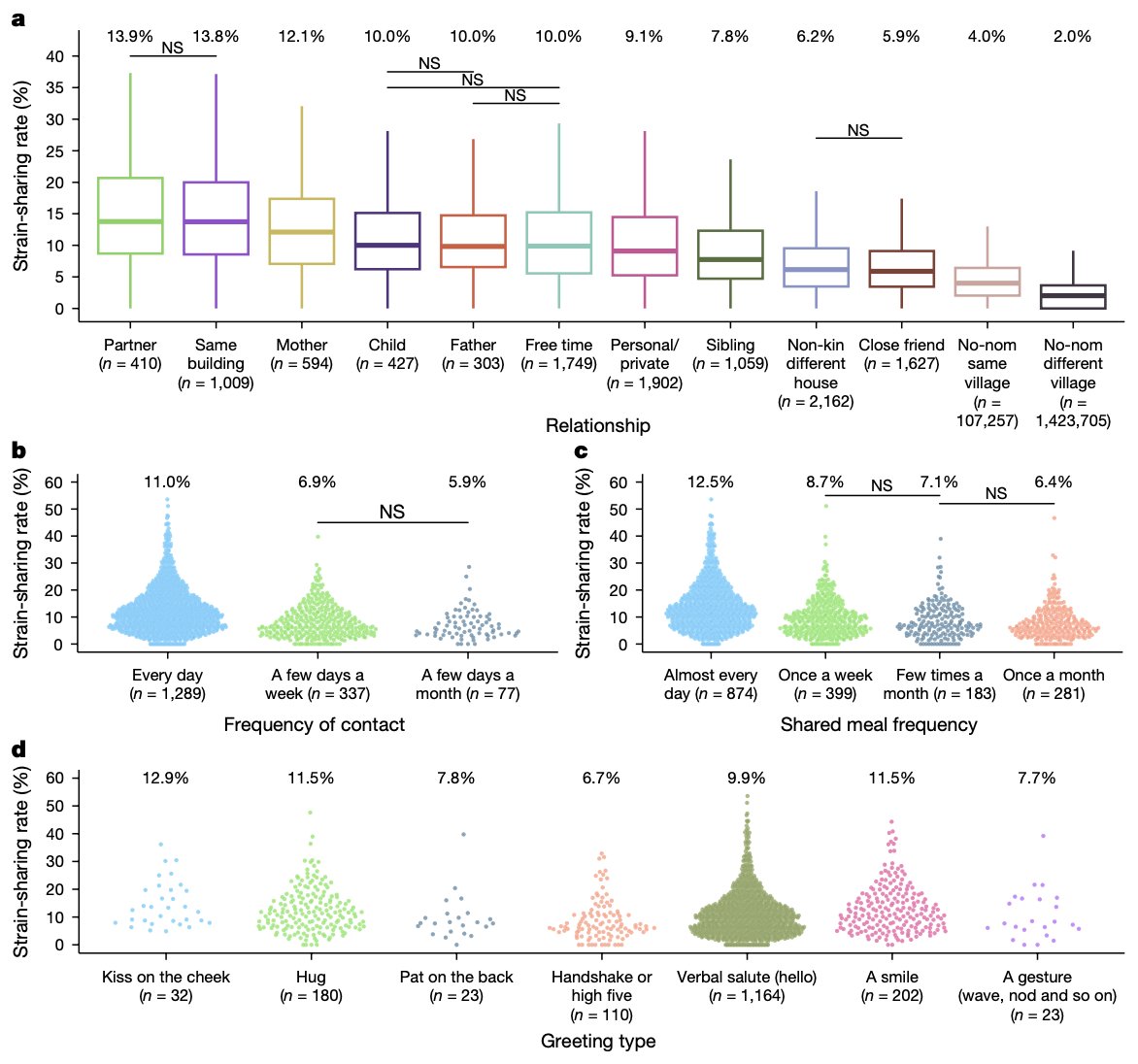
A new study found that we share parts of our microbiome with people in our social networks, beyond family members.
Dr. @NAChristakis joins us to discuss the research and how scientists can identify your friends—just by looking at your poop.
https://t.co/CIZMzeirrr
It may prove to be the case that groups of inter-connected people might share phenotypes not only because of shared genes or transmitted behaviors, but also because of shared microbes. https://t.co/GWUvrPJUxa 16/
This work has implications for a radical idea: diseases formerly thought to be biologically non-communicable (e.g., obesity, depression, hypertension, arthritis, etc.) may actually be (somewhat!) communicable, via the spread of the microbiome. https://t.co/GWUvrPJUxa 13/
Clusters of microbiome species and strains occur within clusters of people in village social networks. It’s like clouds of microbes occurring within clusters of people. https://t.co/GWUvrPJUxa 11/
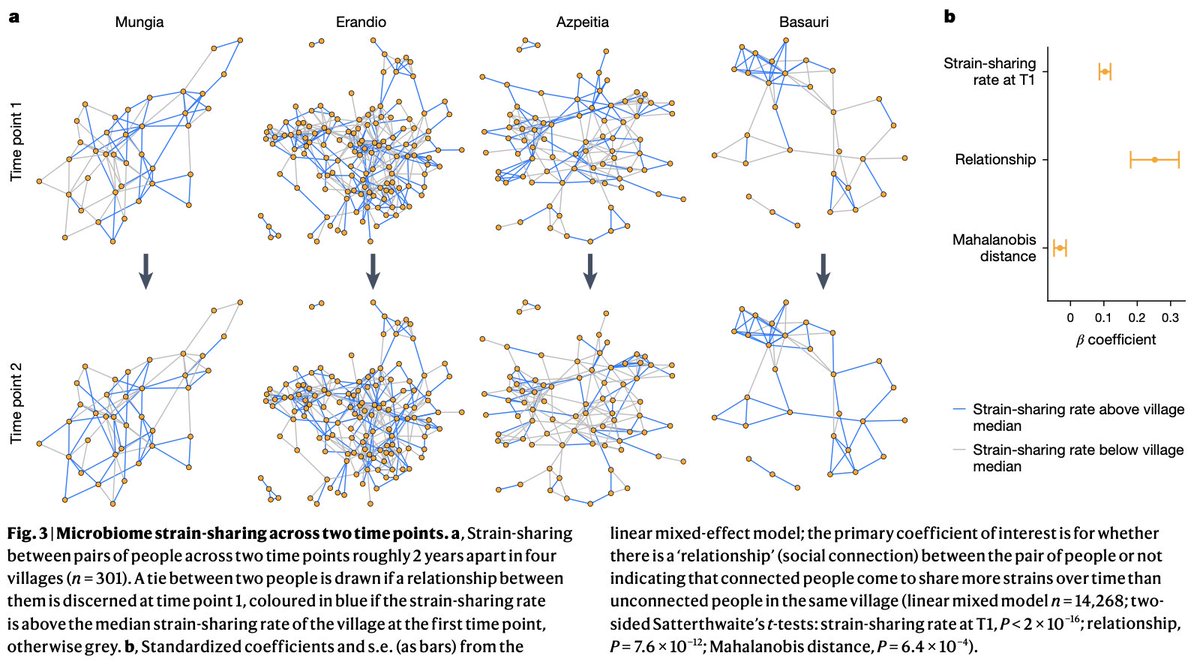
Among 301 people in 4 villages whose microbiome was re-measured 2 years later, we observe greater convergence in gut microbiome strain-sharing in connected versus otherwise similar unconnected co-villagers. 10/
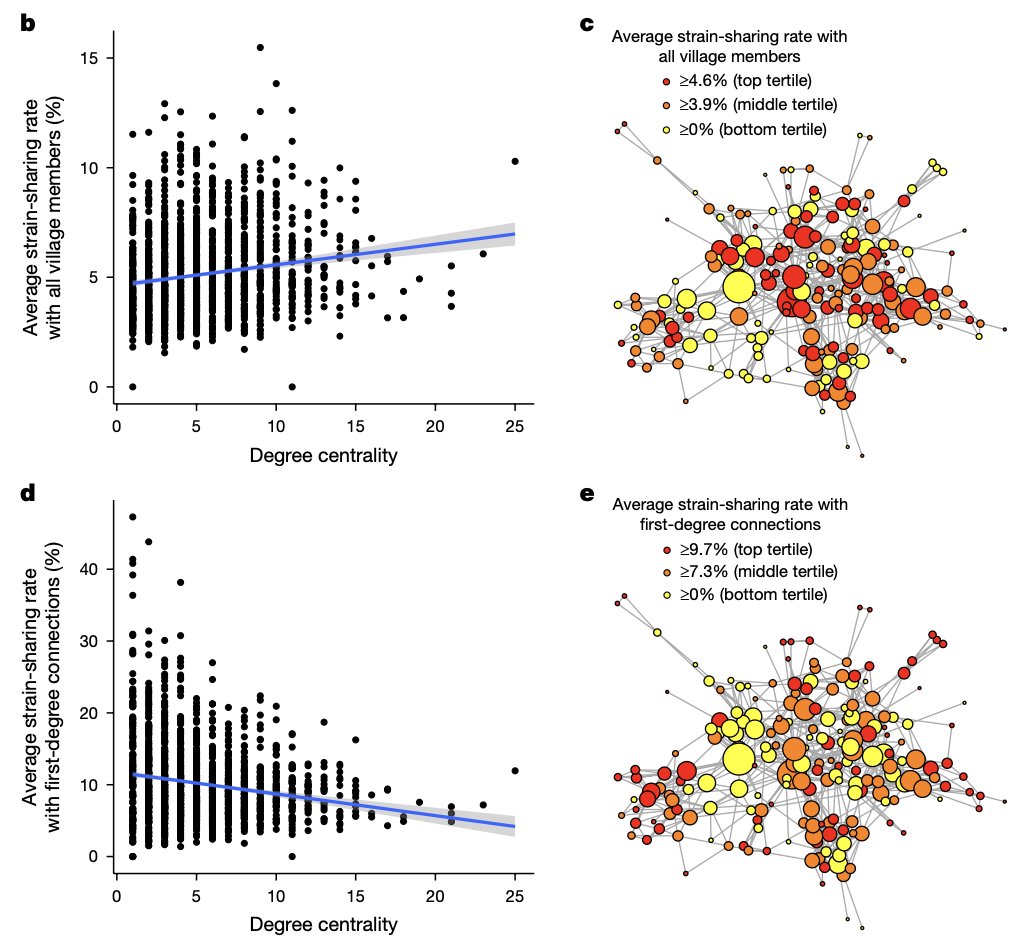
We also observe that socially central people are more microbially similar to the overall village than socially peripheral people. But popular people resemble the microbiomes of individual friends less. 9/
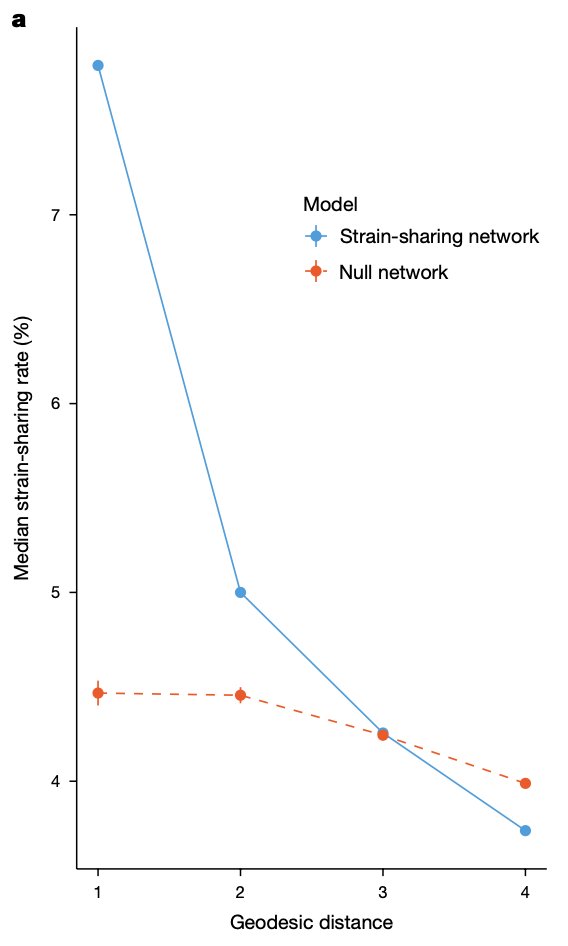
Furthermore, gut microbiome strain-sharing extends to one's friends’ friends within social networks, indicating the relevance of a person’s broader social network, at two degrees of separation. 8/
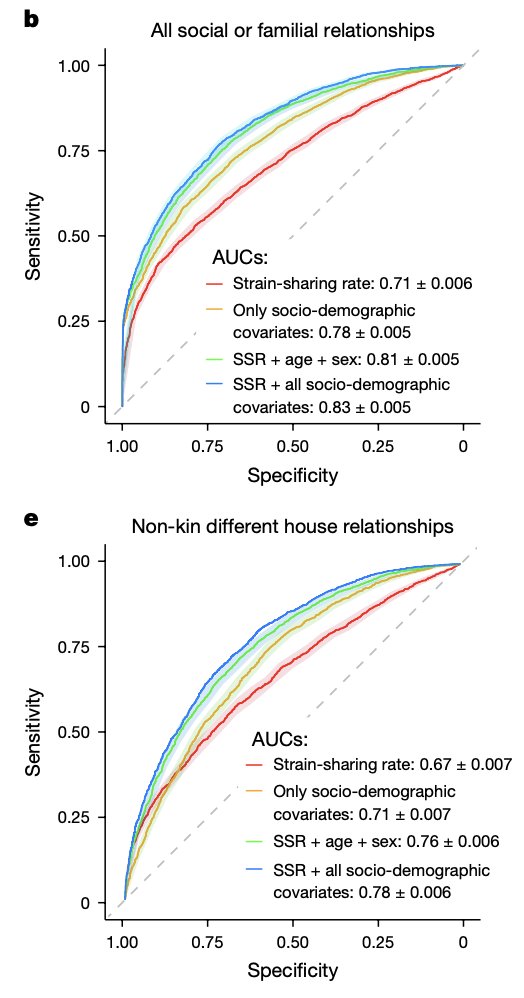
We can actually predict who your friends are based on whether you have similar bacteria in your poop! And that metric outperforms other more usual social features, such as how you resemble your friends on a host of traits like age, sex, wealth, etc. 7/
Using both species-level and strain-level data, we show that microbial sharing occurs in many relationship types, notably including non-familial and non-household connections. 6/
The bacteria in your gut depend on where you are in the social network.
And the microbes within us treat our social networks as the extended environment in which they thrive. They can spread from person to person.
New #HNL work out today in @Nature. 1/
One more time for the people in the back:
AI is a software wrapper around machine learning, machine learning is fancy words for statistics, thanks for coming to my TED talk
Environmental, socioeconomic, and health factors associated with gut microbiome species and strains in isolated Honduras villages https://t.co/eCTp7oRYwp
Environmental, socioeconomic, and health factors are associated with gut microbiome species
and strains in isolated Honduras villages. New #HNL work with @ShivkumarVs, @chocophlan@mqdicer A Singh, R Juarez, & @ilanabrito123 https://t.co/aosdjmq31V #microbiome#LMICs
Deeply sequenced microbiome data from non-industrialized settings are uncommon. In new #HNL work, we use metagenomic data from 1,871 people in 19 isolated Honduras villages to report associations between bacterial species and human phenotypes and factors. https://t.co/aosdjmq31V