I have experienced flow many times, hyper focused on work, as @NAChristakis discusses — most commonly in long neurosurgical cases. The longest case I did was a brain tumor resection that took 17 hours. I remember taking only one short break for bathroom and snack, while the attending kept going. Honestly, I cannot remember him taking a break, as incredible as it may seem.
Science often requires hard work and long hours, but a key joy is that this often prompts a psychological state of flow -- where time stands still and you are totally absorbed by the work you do.
New #FLOS vlog, #3 in a 6-part series on WORKING HARD.
https://t.co/p5mJCWMbFK
Working Hard [I]: Autonomy
https://t.co/13pGY0KFRA
New For the Love of Science vlog:
One of the best parts of being a scientist is autonomy: choosing your hours, your questions, your path. But that freedom has a cost: the boundaries between work and life can disappear. In this video, we talk about why autonomy can be uplifting when paired with purpose and competence…and why it can feel destabilizing early on when you’re still finding your footing.
18 physicians who are faculty members in the Department of Radiology & Biomedical Imaging at @YaleMed are listed among the Top Doctors in Connecticut, according to the annual list from @connecticutmag https://t.co/jZVKz2RT3S
Did you know that a childhood fascination with @StarTrek & the idea of diagnosing a complex medical condition w/o touching the patient is one reason @JuliusChapiro of @YaleMed became a radiologist? Learn more about Dr. Chapiro in this article from @RSNA. https://t.co/LEyy4TNURz
🧬 New paper out in @Nature! We used CRISPR to selectively kill cancer cells based on a single-letter mutation in their RNA. The story I want to highlight: KRAS — one of the most notorious drivers of human cancer. A short thread on what we found 🧵
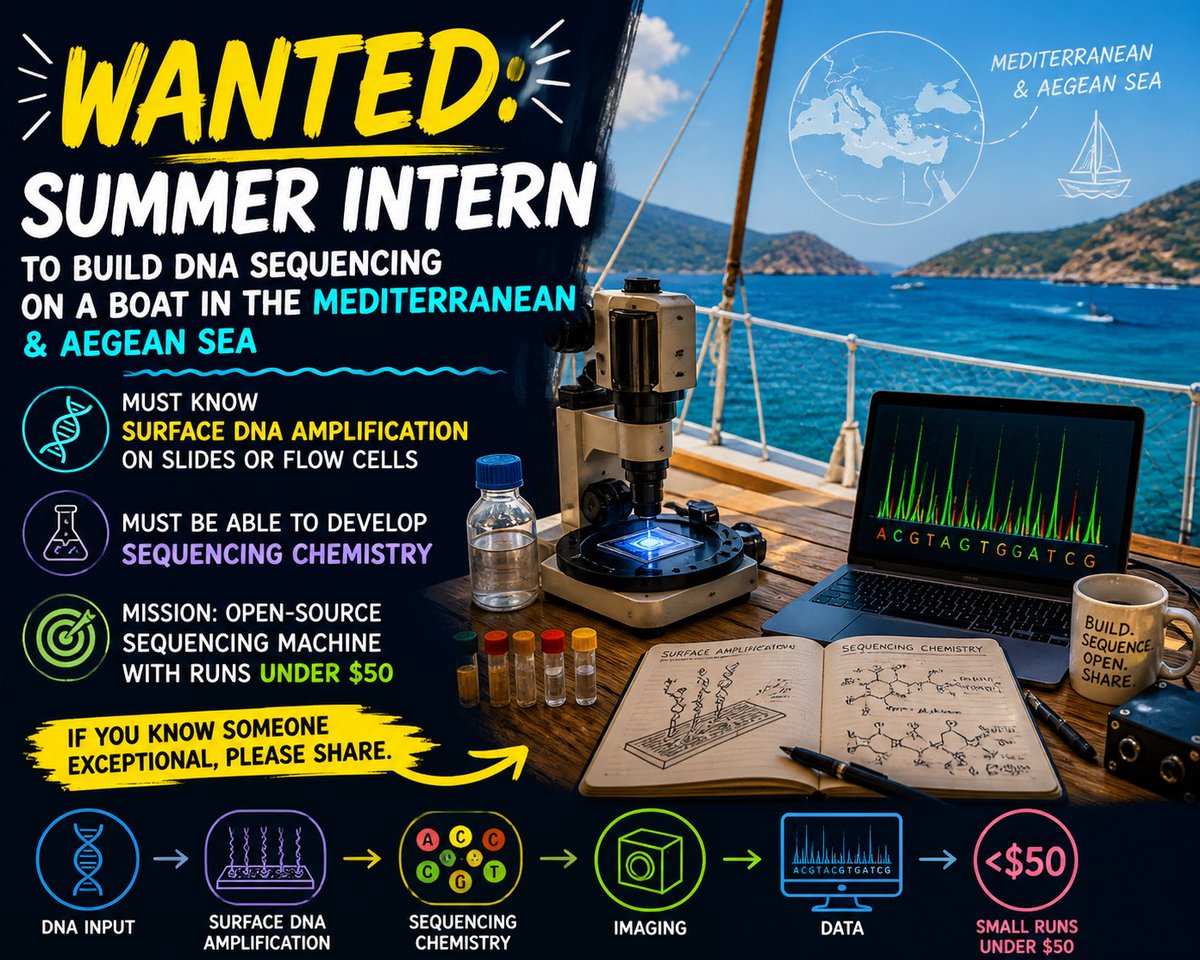
Wanted: summer intern to build DNA sequencing on a boat in the Mediterranean & Aegean. Must know surface amplification on slides/flow cells and sequencing chemistry. Mission: open-source sequencer with runs under $50. Please share.
The deadline for the Neurobiology of Cognition Gordon Conference is coming soon. We have an awesome lineup of speakers. We will begin assigning fellowships in mid May, so don't delay, apply now! Spread the word! 🧪 🧠 #neuroscience#cognition https://t.co/PDyRGKEIwa
Yes. $HYPR has been an AI-first company from our start. That’s how we make MRI portable, smarter, faster, more convenient, and super easy to use. Our collaboration with $NVDA makes it better. Now we are saving lives. That’s when it matters.
In @natrevbioeng, Core Investigator @FelixHorns and colleagues outline how engineered living cells could deliver mRNA to places lipid nanoparticles and viral vectors can't reach, homing to disease sites and activating only when they detect the right signals.
What do truth, free expression, peer review, outer space, and stem cell lines have in common? They are shared resources scientists must work to protect.
Latest For the Love of Science vlog on protecting the scientific commons: https://t.co/NYRAtpgXYG
As I build my own 2nd brain 🧠 on Obsidian using @karpathy ‘s wiki idea, it suddenly dawned on me - one day when we r gone, our kids could inherit an interactive map to your mind, passion, obsessions, work, fascinations…
It’s kind of beautiful way to think abt your 2nd 🧠.
Project Summary – Open-Source Low-Cost DNA Sequencer 🧬
We are developing a fully open-source DNA sequencing platform designed to dramatically lower the cost of sequencing for small labs, education, and hobbyists.
Target specifications:
•<$500 instrument cost
•<$50 per sequencing run
•~200 million bases per run (low throughput, high accessibility)
Technical approach:
•4-color sequencing-by-synthesis
•Surface-based DNA amplification (cluster generation)
•Focus on robust, simplified chemistry that can run on low-cost optics and hardware
•Designed for large, bright clusters and relaxed imaging requirements (e.g., Raspberry Pi–class cameras)
What makes this different:
•Prioritizes cost, simplicity, and accessibility over maximum throughput
•Built from the ground up for open-source replication
•Integrates chemistry + hardware co-design, not just adapting existing systems
Current stage:
•Early-stage development with defined architecture
•Need to implement and test sequencing chemistry and surface amplification workflows
•Parallel development of low-cost imaging and fluidics
Team & environment:
•Led by a high school founders working with experienced mentors
•Hands-on, rapid iteration environment
•Summer work conducted on a research yacht in the Mediterranean & Aegean Sea
Who we’re looking for:
•Strong experimentalist with hands-on experience in SBS chemistry and surface DNA amplification
•Able to build, troubleshoot, and iterate quickly
•Interested in pushing sequencing towards ubiquitous personal access.
@johnjhorton@MITSloan@bakkermichiel For more on how certain kinds of automated assistance can contribute to a kind of moral laziness, even after the assistance is turned off, see: https://t.co/CzxZD721Nm ;-)
10 weeks. Yacht with lab in the Med & Aegean.
Build tomatoes that taste like burgers 🍅🔥🍔
High school founder + PhD mentor
Need hands-on Agrobacterium plant transformation expert. Email [email protected]
What's involved in designing and conducting a massive field trial of social contagion (to enhance public health and economic development) in 176 villages in remote highlands of western Honduras? New "For the Love of Science" vlog:
https://t.co/PwVrtNakMd
#friendshipparadox #HNL
NEW PODCAST EPISODE
Sam Harris speaks with Nicholas Christakis @NAChristakis about how AI agents can improve human cooperation, Christakis’s experience at the center of a woke moral panic, the Trump administration’s assault on American universities and science, and other topics.