🤖 Excited to introduce HumanoidPose!
We recover humanoid robots' full-body joint states from RGB videos alone—no internal sensor data required.
One model, multiple robot embodiments!
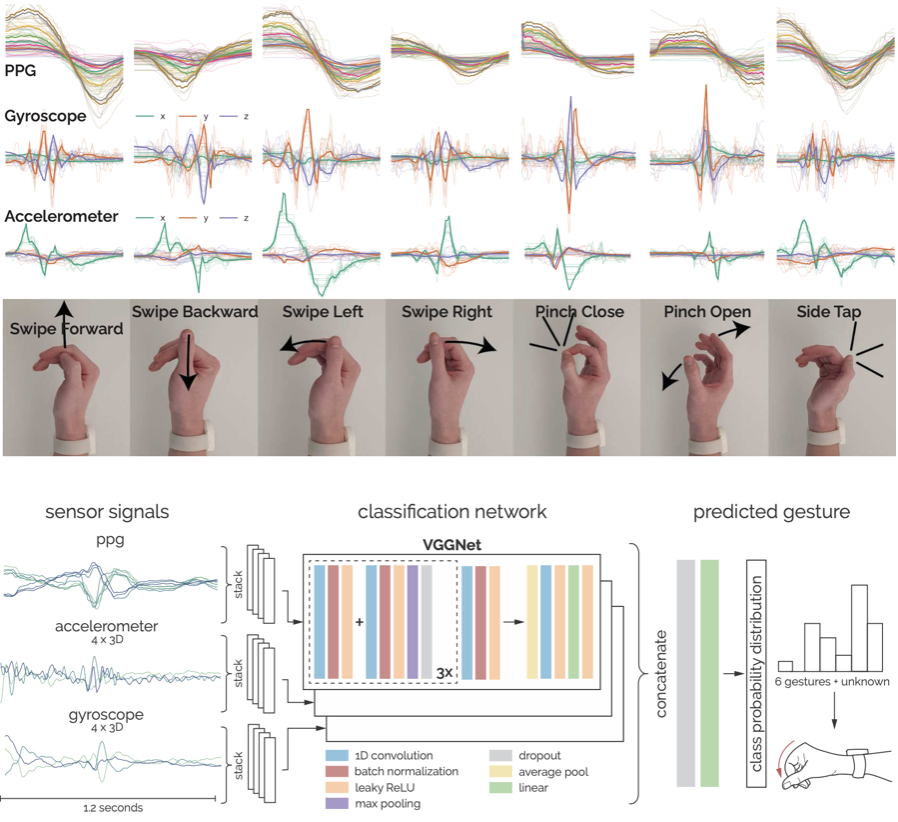
We release 25 hours of synchronized and labeled IMU+PPG signals from 66 participants, including 28k microgestures and 16k negatives alongside 9 hours of aligned RGB video.
ACM ICMI 26.
dataset: https://t.co/T57r0kO2is
project: https://t.co/8jiWcaWojg
μDPad detects microgestures and minimal hand and finger motions in smartwatches with multiple PPG sensors. @AcmIcmi
We repurpose the multi-channel optical HR sensor as a spatial imaging sensor and fuse signals with the watch IMU for detection—no cameras or finger-worn sensors.
From the 8 photodiodes across the wrist, we capture spatially varying tissue deformation as fingers move. μDPad combines these deformation patterns with global IMU motion and decodes events through a hidden Markov model to enforce valid gesture transitions for continuous input.
We augmented ARCTIC and H2O with physics-simulated per-vertex contact+force labels, trained on ARCTIC, tested on H2O.
For sim2real, we created a dataset of dense spatial contact+force from an instrumented cube & cylinder to test transfer.
arXiv+code+data: https://t.co/p6nhM0HLYP
Join our #ECCV2026 poster today to see EgoPHI, the first vision model to estimate dense 3D contact + force on hands and manipulated objects from one egocentric RGB image and object geometry.
EgoPHI enables force-aware hand-object understanding, without tactile sensing.
@eccvconf
EgoPHI
* fuses image features with 3D hand&object geometry
* iteratively refines object pose under hand occlusion
* models intra-mesh geometry & inter-mesh hand-object relation with graph attention+cross-attention
* predicts per-vertex contact, force magnitude & 3D direction
@tomfleet that'd be amazing because you could accurately control the placement and curvature of the capacitor electrodes for much improved coupling behavior, conductive material permitting, and achieve more uniform sensing behavior... curious now!
@DanielSMatthews@tomfleet and of course Timo Götzelmann and Christopher Althaus' seminal work on this: Capacitive Sensing Objects through 3D Printers
https://t.co/nwue8TnXjO
@DanielSMatthews@tomfleet That approach is actually amazing and it was direct inspiration for our work, because they demonstrated this for general 3D surfaces by refabricating the object with sensing in mind (albeit not ink): https://t.co/R87o01Ae2h
@sanjuhs123 It also detects pressure right now in the form of increased coupling, but more as an artifact due to our fabrication not by design. It's a clear direction for future work though, exactly for input control in AR/MR.
Come to our #SIGGRAPH2026 talk today: Our method turns existing 3D objects into multi-touch sensors, without modifying the interior.
From a scan, we sample surface-intrinsic curves that conform to mutual-cap layouts, and optimize their intersections for coverage & fabrication.
@Dazzafrazz Only way we found to make sure the physical sensor precisely works the way the optimized design generated, though there's got to be easier ways to get that part done in the future...
Andela Ilic, J. Gao, Z. Li, Y. Jiang, R. Schuchert, M. Meier, P. Herholz, C. Holz.
Retrofitting Existing 3D Objects with Surface-Conforming Capacitive Sensing.
ACM SIGGRAPH 2026.
project: https://t.co/gcniFzDFd7
arXiv: https://t.co/fXpD3TWyL2
For fabrication, we unfold the 3D curves into 2D traces, vinyl-cut them from thin Kapton-copper laminate, and use projection guidance for attachment.
Our fabricated bunny, mouse, bowl, and spoon achieve mean touch errors of just 0.65-1.6 mm and strong SNR.
Sparse wearable inertial motion capture often struggles with drift and limb jitter during fast motion.
Ultra Diffusion Poser leverages between-sensor geometry into diffusion guidance and tracks smooth full-body motion from 6 IMU+UWB nodes with ~22% lower joint error. #CVPR2026
Explicitly modeling between-sensor distances improves arm/leg placement, esp. during fast motion.
UDP reaches SOTA joint-position accuracy in most settings, improves over IMU-only methods by up to 35%, and with DDIM sampling runs 50x faster than previous IMU+UWB methods.