"Put your hands together
For the Kings of the comeback
A team of history
A team of destiny
Our dream team
Please welcome
The 2026 NBA Champions
Your New York Knicks"
Recently I have been starting to worry about the state of prediction markets, in their current form. They have achieved a certain level of success: market volume is high enough to make meaningful bets and have a full-time job as a trader, and they often prove useful as a supplement to other forms of news media. But also, they seem to be over-converging to an unhealthy product market fit: embracing short-term cryptocurrency price bets, sports betting, and other similar things that have dopamine value but not any kind of long-term fulfillment or societal information value. My guess is that teams feel motivated to capitulate to these things because they bring in large revenue during a bear market where people are desperate - an understandable motive, but one that leads to corposlop.
I have been thinking about how we can help get prediction markets out of this rut. My current view is that we should try harder to push them into a totally different use case: hedging, in a very generalized sense (TLDR: we're gonna replace fiat currency)
Prediction markets have two types of actors: (i) "smart traders" who provide information to the market, and earn money, and necessarily (ii) some kind of actor who loses money.
But who would be willing to lose money and keep coming back? There are basically three answers to this question:
1. "Naive traders": people with dumb opinions who bet on totally wrong things
2. "Info buyers": people who set up money-losing automated market makers, to motivate people to trade on markets to help the info buyer learn information they do not know.
3. "Hedgers": people who are -EV in a linear sense, but who use the market as insurance, reducing their risk.
(1) is where we are today. IMO there is nothing fundamentally morally wrong with taking money from people with dumb opinions. But there still is something fundamentally "cursed" about relying on this too much. It gives the platform the incentive to seek out traders with dumb opinions, and create a public brand and community that encourages dumb opinions to get more people to come in. This is the slide to corposlop.
(2) has always been the idealistic hope of people like Robin Hanson. However, info buying has a public goods problem: you pay for the info, but everyone in the world gets it, including those who don't pay. There are limited cases where it makes sense for one org to pay (esp. decision markets), but even there, it seems likely that the market volumes achieved with that strategy will not be too high.
This gets us to (3). Suppose that you have shares in a biotech company. It's public knowledge that the Purple Party is better for biotech than the Yellow Party. So if you buy a prediction market share betting that the Yellow Party will win the next election, on average, you are reducing your risk.
Mathematical example: suppose that if Purple wins, the share price will be a dice roll between [80...120], and if Yellow wins, it's between [60...100]. If you make a size $10 bet that Yellow will win, your earnings become equivalent to a dice roll between [70...110] in both cases. Taking a logarithmic model of utility, this risk reduction is worth $0.58.
Now, let's get to a more fascinating example. What do people who want stablecoins ultimately want? They want price stability. They have some future expenses in mind, and they want a guarantee that will be able to pay those expenses. But if crypto grows on top of USD-backed stablecoins, crypto is ultimately not truly decentralized. Furthermore, different people have different types of expenses. There has been lots of thinking about making an "ideal stablecoin" that is based on some decentralized global price index, but what if the real solution is to go a step further, and get rid of the concept of currency altogether?
Here's the idea. You have price indices on all major categories of goods and services that people buy (treating physical goods/services in different regions as different categories), and prediction markets on each category. Each user (individual or business) has a local LLM that understands that user's expenses, and offers the user a personalized basket of prediction market shares, representing "N days of that user's expected future expenses".
Now, we do not need fiat currency at all! People can hold stocks, ETH, or whatever else to grow wealth, and personalized prediction market shares when they want stability.
Both of these examples require prediction markets denominated in an asset people want to hold, whether interest-bearing fiat, wrapped stocks, or ETH. Non-interest-bearing fiat has too-high opportunity cost, that overwhelms the hedging value. But if we can make it work, it's much more sustainable than the status quo, because both sides of the equation are likely to be long-term happy with the product that they are buying, and very large volumes of sophisticated capital will be willing to participate.
Build the next generation of finance, not corposlop.
Our second meeting went a little smoother. Huge congrats to my new friend @AlvaradoJose15 and the @nyknicks on their historic comeback. Don't ever count NYC out. One more to go. Let's Go Knicks!
Ben Stiller says he and his wife literally BURNED their clothes after the Knicks’ Game 3 loss 😭
“My wife Christine and I came home after the last game and burned the clothes we were wearing. I'm not ever wearing that stupid final shirt that I was wearing.”
Talent density is insane. From that single cohort:
• Jeffrey Yan (@chameleon_jeff) - Hyperliquid (~$40B)
• Alexandr Wang (@alexandr_wang) - Scale AI (~$29B, now leading Meta AI)
• Scott Wu (@ScottWu46) —- Cognition (Devin AI, ~$10B+)
• Jesse Zhang (@thejessezhang) - Decagon (~$4.5B)
• • Steven Hao (Cognition CTO), Johnny Ho (Perplexity), Demi Guo (Pika), etc.
Olympiad kids → HRT interns → building the future.
Singapore’s Foreign Minister, Dr Balakrishnan casually explaining how he built his own AI agent (a 2nd brain for diplomacy) using Claude & WhatsApp integration etc. on a Raspberry Pi
“You cannot govern a technology you have only been briefed on.” 🇸🇬
Had a Jane Street interview in 2013 that still bothers me.
It was my 6th round. Final interview. The guy walks in carrying no laptop, no notebook, just a cold brew and what I later realized was a single IKEA tea candle.
He writes on the whiteboard:
food: $200
rent: $800
utilities: $150
candles: $3,600
family: dying
Then he turns around and says, “Optimize.”
I laughed because I thought it was a culture-fit bit. He did not laugh.
So I said, “Well, obviously you spend less on candles.”
He says, “Assume candles are non-discretionary.”
Okay.
I start building a model. Basic constraint satisfaction. Family survival as a soft penalty. Candles as a state variable. Maybe there’s an arbitrage where you buy wholesale paraffin and convert the $3,600 line item into inventory.
He stops me.
“You’re thinking like a consultant.”
That’s when I knew I was in trouble.
He says, “Give me a bid-ask on family dying.”
I say, “What?”
He says, “You’re long candles, short family. Where do you make markets?”
I try to recover. I say the real issue is liquidity: rent and utilities are fixed, food is elastic, candles are emotionally inelastic. Therefore the optimal strategy is to securitize future candle enjoyment and borrow against it.
He nods for the first time.
Then he asks, “What time do you sell the candles?”
I say, “Whenever the market is liquid?”
He says, “Be more specific.”
I say, “Uh… 10 a.m. Eastern?”
For the first time, he smiles.
He goes, “Every day?”
I say, “Every day.”
He says, “In size?”
I say, “In size.”
He says, “And what do we call that?”
I say, “Market manipulation?”
The room gets very quiet.
He looks disappointed and writes something down.
“No. We call it providing liquidity to candle ETFs during the U.S. cash open.”
I try to save it. “Right. Of course. The family isn’t dying because we underfunded them. They’re just experiencing temporary price discovery.”
He nods again.
Then he points back at the board.
I had missed it. The utility bill was $150, but candles provide light. You can zero out utilities.
I update the budget:
food: $200
rent: $800
utilities: $0
candles: $3,750
family: still dying, but now in a more capital-efficient way
He says, “How confident are you?”
I say, “0.95.”
He smiles and circles candles.
“0.95 huh?”
Then he asks me to estimate how many leveraged longs get liquidated if we dump $3,750 of candles at 10:00:01 every morning for 90 consecutive trading days.
Needless to say I did not get the offer.
Ex-Point72 proprietary research head Kirk McKeown on what most people get wrong about measuring research quality:
"You can't tie it back to returns."
Every PM on the street is judged on three things:
— Number of at-bats
— Hit rate against those at-bats
— Sizing against that hit rate
Your research function has to create lift in one of those three. That's it.
"You're not getting paid on the return. You're not getting paid on the at-bat. You're getting paid on the specific call."
Separation of church and state keeps the research clean.
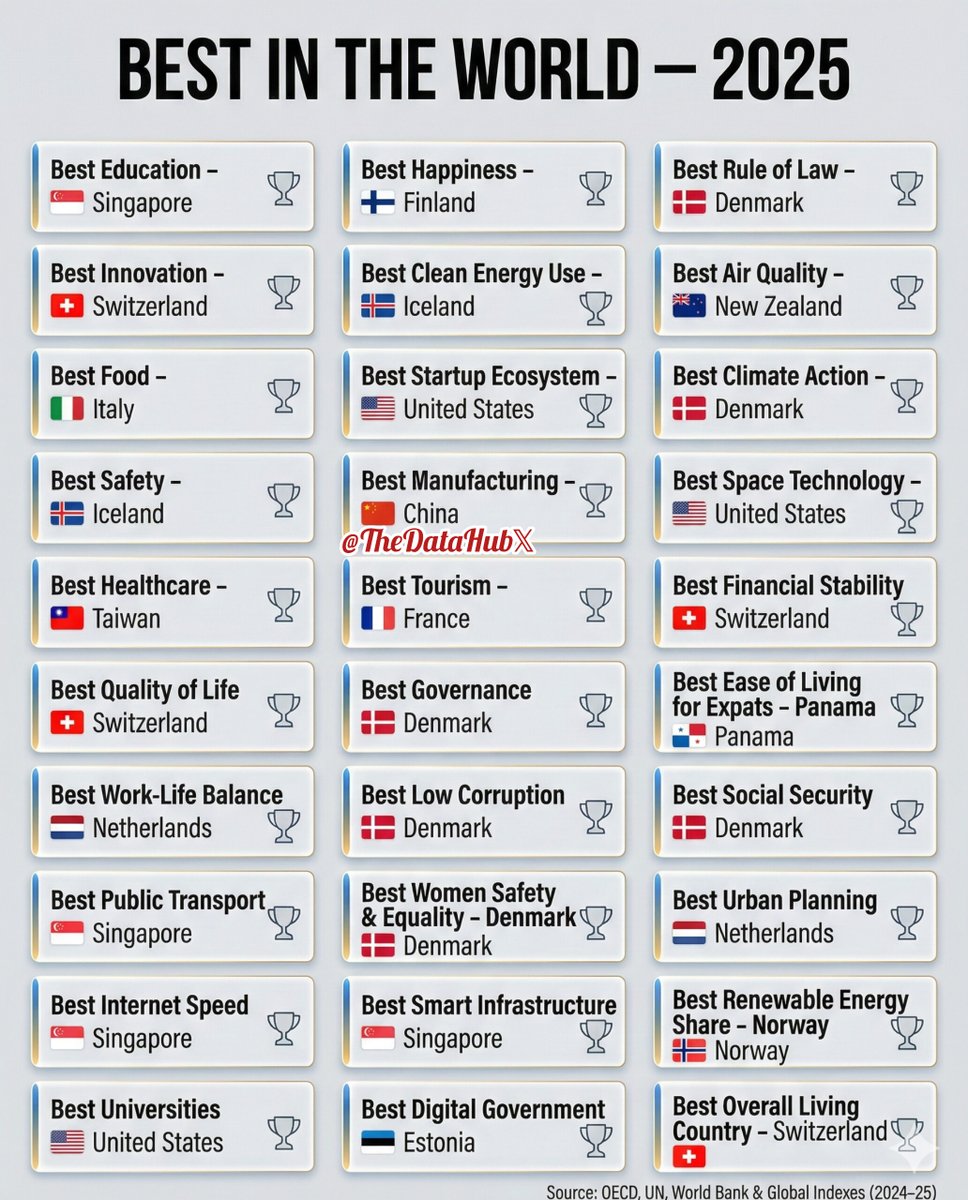
Best in the World - 2025
1. Best Education - 🇸🇬 Singapore
2. Best Innovation - 🇨🇭 Switzerland
3. Best Food - 🇮🇹 Italy
4. Best Safety - 🇮🇸 Iceland
5. Best Healthcare - 🇹🇼 Taiwan
6. Best Quality of Life - 🇨🇭 Switzerland
7. Best Work-Life Balance - 🇳🇱 Netherlands
8. Best Public Transport - 🇸🇬 Singapore
9. Best Internet Speed - 🇸🇬 Singapore
10. Best Universities - 🇺🇸 United States
11. Best Happiness - 🇫🇮 Finland
12. Best Clean Energy Use - 🇮🇸 Iceland
13. Best Startup Ecosystem - 🇺🇸 United States
14. Best Manufacturing - 🇨🇳 China
15. Best Tourism - 🇫🇷 France
16. Best Governance - 🇩🇰 Denmark
17. Best Low Corruption - 🇩🇰 Denmark
18. Best Women Safety & Equality - 🇩🇰 Denmark
19. Best Smart Infrastructure - 🇸🇬 Singapore
20. Best Digital Government - 🇪🇪 Estonia
21. Best Rule of Law - 🇩🇰 Denmark
22. Best Air Quality - 🇳🇿 New Zealand
23. Best Climate Action - 🇩🇰 Denmark
24. Best Space Technology - 🇺🇸 United States
25. Best Financial Stability - 🇨🇭 Switzerland
26. Best Ease of Living for Expats - 🇵🇦 Panama
27. Best Social Security - 🇩🇰 Denmark
28. Best Urban Planning - 🇳🇱 Netherlands
29. Best Renewable Energy Share - 🇳🇴 Norway
30. Best Overall Living Country - 🇨🇭 Switzerland
Source - OECD, UN, World Bank & Global Indexes (2024-25)