Give Every Agent You Run in Omnigent a Persistent Memory.
Most agent memory integrations solve one problem for one tool. Add Hindsight to Cursor, and Cursor remembers. Add it to Aider, and Aider remembers. Each is its own setup, its own configuration, its own ceiling.
Omnigent breaks that pattern. It is a meta-harness: a single orchestration layer that wraps and coordinates multiple AI agents at once, including Claude Code, Codex, Cursor, OpenCode, Hermes, and Pi. When you add Hindsight to Omnigent, you add persistent memory to all of them through one place, with a single setup instead of wiring up each tool's integration separately. And for any harness that has no native Hindsight integration, including custom ones, Omnigent is the memory layer. The bridge lives in Omnigent, so the agents inside it do not have to carry it themselves.
Know more: https://t.co/4F0fxcX5pD
The 10 Things to Look For in an Agent-Memory System.
Most agent-memory evaluations test one thing: given a query, did the system return the right chunk. Then the system ships, and the failures show up somewhere else entirely — a preference the agent never updated, a fact from six months ago it treated as current, a customer's card number sitting in a bank three tenants can read.
Retrieval accuracy is table stakes. It's necessary and nowhere near sufficient. If you're choosing an agent-memory system (or building one), the real question is how it behaves on the dimensions that don't show up in a quickstart demo. These are the ten things that actually separate a real system from a demo, plus a checklist you can run against any candidate.
New to the category? Start with what agent memory is and why it's a distinct problem from stuffing more tokens into the context window. This piece assumes you already know you need memory and just want to judge which system is any good.
Know more: https://t.co/5EHLhiUwC6
Hindsight 0.9.1 is out: sharper memory, portable banks.
Headline: ~9x faster temporal extraction, same results. Plus @xai OAuth, portable Knowledge Pages, and a sharper reflect().
Ever wish your project docs updated themselves? Or that your memory followed you across every coding agent?
Hindsight 0.9.0 is here with 2 BIG announcements:
📚 Knowledge Pages — a self-healing wiki, fully managed
🔌 A coding plugin that works across ALL your harnesses
🧵
This blog post by @nicoloboschi might be the best Hindsight one yet written.
If you are using a coding agent or Hindsight (or both), you should read it.
👇
🧠 Hindsight 0.8.6 is out.
Pick an entity, a person, a company, a project, and see everything Hindsight knows about it laid out in order, from the first mention onward.
The fastest way to check what your agent actually learned about someone, and when. 🧵
Hindsight is helping insurance companies fight fraud with smarter AI agents.
Here's how it works 💼
🤖 Agents use MCP to integrate with claims management system.
👩💼 Human adjustor uses agent to assist with the claims process.
🧠 Claims data and processing steps get sent into Hindsight.
🕵️ Suspicious claims get flagged by human or AI for investigation.
🗂️ Investigation outcomes get analyzed by Hindsight along with claim and session history.
🌟 Mental models in Hindsight detect and encode patterns from investigations.
🤖 Agent uses mental models in Hindsight to detect fraud and reduce false positives.
If you want your AI agents to deliver meaningful business outcomes give them Hindsight.
🚨 Hindsight is helping sales teams use AI to build pipeline and close more deals.
Here's how:
📝 Your AI sales agent pushes outbound messages into Hindsight
📏 Agent memory tags messages that get responses
🔁 Hindsight builds mental models of what works best for your ICPs
🤖 Your sales agents get better are writing effective outbound
📈 Your response rate goes up
💰 More deals get closed
If you aren't using Hindsight, your agents will struggle to deliver outcomes like these.
Zapier Persistent Memory: Actions and Triggers.
Zapier connects the thousands of apps most teams already run on (8,000+ by Zapier's count): Slack, Gmail, HubSpot, Notion, Sheets, Airtable, OpenAI. You wire them together into Zaps, and a trigger in one app sets off actions in others. What no Zap carries is memory. Every run starts from zero, so the workflow that triaged a support ticket this morning has no idea it ran yesterday, and the LLM step in the middle of your Zap only knows what you stuffed into that one prompt.
The Hindsight app for Zapier closes that gap, and it does it in both directions. Hindsight shows up as three actions your Zaps can call (Retain, Recall, Reflect) and three triggers that start a Zap when something happens in your agent memory. Memory becomes both a tool your automations use and an event source that sets them off.
Know more: https://t.co/Q7or3ybj27
Today's user spotlight is VORNIQ: Five AI Financial Experts, One Shared Memory
The problem: VORNIQ runs five specialized financial personas: Controller, Financial Analyst, FP&A Analyst, Investment Researcher, and Tax Strategist. Without shared memory, a user who told Investment Researcher about their 5-year horizon got a blank stare from Tax Strategist minutes later. Every session, every persona, starting from zero.
The fix: One Hindsight memory bank per user, shared across all five personas. Specialization stays in the prompts; continuity lives in Hindsight.
→ Recall → Respond → Retain on every message
→ Reflect at session end, consolidating raw exchanges into a coherent financial profile
→ [PERSONA] tagging on every retained memory, so recalled facts carry provenance (which expert learned it, in what context)
The result: By session two, Tax Strategist already knows the risk appetite and horizon Investment Researcher discussed — no re-onboarding, no repeated questions. Hindsight's TEMPR retrieval (semantic + BM25 + graph + temporal) handles both "what's my risk appetite?" (semantic) and "what did we decide last month?" (temporal) in one system.
Key lesson: "Recalled facts without context are nearly useless. Tagged ones compound." Separating memory (one shared bank) from expertise (five distinct prompts) turned out to be the single architectural decision everything else depended on.
An open 975B frontier model as your AI agent's long-term memory. Zero fine-tuning.
We seamlessly wired @miramurati & @thinkymachines' brand-new Inkling model into Hindsight👇
Structuring Chat Logs for Agent Memory.
Hindsight doesn't store your chat logs. When you retain a conversation, it chunks the text, sends each chunk to an LLM for fact extraction, and stores the facts, not the original transcript. That single design choice is why the structure of what you send matters: the model can only extract what the text makes clear. A well-shaped transcript yields clean, correctly-attributed memories. A wall of unlabeled text yields guesses.
The good news is there's no schema to learn and no required format. Plain text, JSON, Markdown: anything works, as long as it conveys who said what, and when. This post is about how to make that true, and the few high-leverage choices that separate a mediocre ingestion from a great one.
Know more: https://t.co/l7tEKry3qO
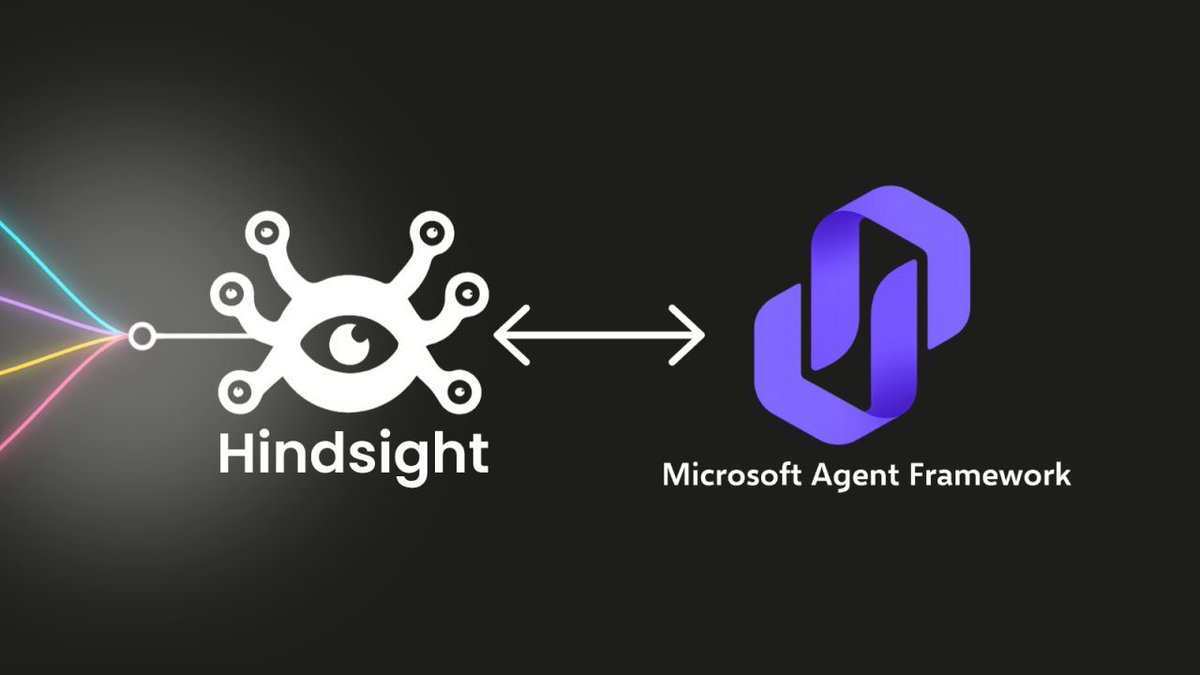
Stop Building Microsoft Agent Framework Agents That Forget.
Microsoft Agent Framework is Microsoft's open-source successor to Semantic Kernel: a framework for building agents that plan, call tools, and hold a conversation. What it doesn't do out of the box is remember anything once a session ends. Start a new run and the agent is back to square one, with no recollection of who the user is or what was decided last time.
The new Hindsight integration fixes that. It plugs in as a context provider, so every agent run automatically recalls the memories relevant to the user's message and retains the conversation afterward. There's no MCP server in the loop and no memory tool the model has to decide to call. Memory just happens.
Know more: https://t.co/DFkHtJdsPZ







![Vectorizeio's tweet photo. Today's user spotlight is VORNIQ: Five AI Financial Experts, One Shared Memory
The problem: VORNIQ runs five specialized financial personas: Controller, Financial Analyst, FP&A Analyst, Investment Researcher, and Tax Strategist. Without shared memory, a user who told Investment Researcher about their 5-year horizon got a blank stare from Tax Strategist minutes later. Every session, every persona, starting from zero.
The fix: One Hindsight memory bank per user, shared across all five personas. Specialization stays in the prompts; continuity lives in Hindsight.
→ Recall → Respond → Retain on every message
→ Reflect at session end, consolidating raw exchanges into a coherent financial profile
→ [PERSONA] tagging on every retained memory, so recalled facts carry provenance (which expert learned it, in what context)
The result: By session two, Tax Strategist already knows the risk appetite and horizon Investment Researcher discussed — no re-onboarding, no repeated questions. Hindsight's TEMPR retrieval (semantic + BM25 + graph + temporal) handles both "what's my risk appetite?" (semantic) and "what did we decide last month?" (temporal) in one system.
Key lesson: "Recalled facts without context are nearly useless. Tagged ones compound." Separating memory (one shared bank) from expertise (five distinct prompts) turned out to be the single architectural decision everything else depended on.](https://pbs.twimg.com/media/HN6kKjvXAAAWY5E.jpg)