🚨 MICHAEL BURRY WARNS THREE UPCOMING IPOs COULD COMPLETELY CRASH THE STOCK MARKET.
Michael Burry reported that the upcoming public listings for SpaceX, OpenAI, and Anthropic are going to pull more capital out of the market than the entire dot-com wave of 2000.
Adjusted for inflation, just these three companies will raise more money than the hundreds of tech firms that flooded the market at the peak of the 2000 bubble.
The historical data from 2000 shows exactly why this is dangerous for stocks.
That year, the market saw 446 IPOs raise a record $108.15 billion. The Nasdaq peaked on March 10, 2000, at the exact moment this massive supply of new shares hit the market, right before crashing 80%.
The crash happened because of a simple liquidity drain.
When giant companies go public, big institutional funds need cash to buy the new shares.
To get that cash, they have to sell their existing stock positions. This creates immediate selling pressure on the most expensive tech stocks.
Today, the setup is identical but much more concentrated. Instead of hundreds of small startups spreading out the drain, just three mega companies are absorbing the market's capital.
This directly impacts current market leaders.
Microsoft has 49% of its $627 billion cloud backlog tied to OpenAI, and Oracle has 54% of its pipeline dependent on it.
The same big funds that need to buy the new IPOs are the ones currently holding these tech giants.
In the first quarter of 2000, the average IPO nearly doubled on its first trading day because cash was easily available.
By the fourth quarter, capital markets dried up.
Gross IPO proceeds collapsed 63% in a single quarter, and average first-day gains dropped to just 14% as companies rushed into layoffs and bankruptcies.
When an unprecedented amount of money is pulled out of existing stocks to fund a single massive IPO wave, the broader market historically runs out of the liquidity needed to sustain its peak.
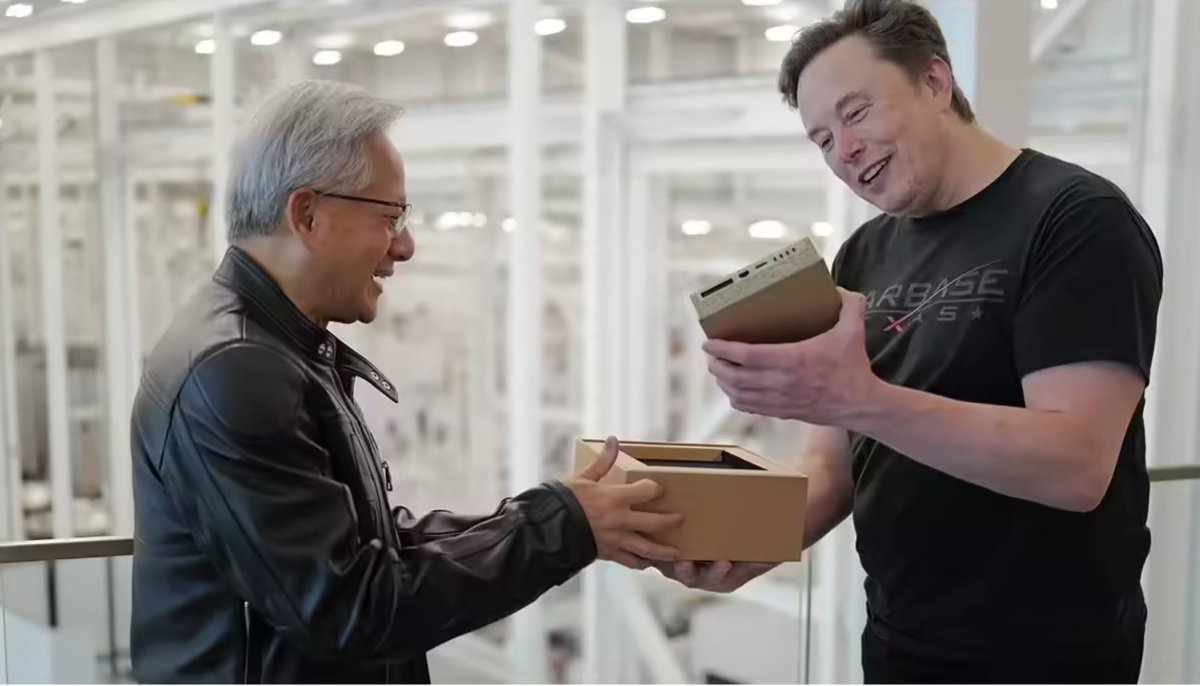
🚨Michael Burry just said Elon Musk and Nvidia's deal is built on fake numbers.
Burry published a detailed breakdown calling the entire structure "Fugazi", his word for fake.
He is alleging that billions of dollars in Nvidia chips are being hidden off balance sheets, and that American retirees are unknowingly funding the whole thing.
Nvidia, the world's largest AI chip company sold $5.4 billion worth of its most advanced GPUs, the GB200, to a company called Valor.
Valor is not a real operating business. It is a special purpose vehicle, a shell company created specifically to hold these chips and nothing else. Nvidia also invested $1.9 billion of its own money directly into Valor on top of the sale.
Those 100,000+ chips are now physically inside xAI's data center. xAI is Elon Musk's artificial intelligence company, the one that builds Grok. xAI is using every single one of those chips right now to run its AI models.
But here is what Burry is flagging.
Neither Nvidia nor xAI owns those chips on paper. Valor, the shell company holds legal title. That means $5.4 billion in GPU assets do not show up on Nvidia's balance sheet as inventory.
They do not show up on xAI's balance sheet as assets. They are legally invisible to both companies.
Nvidia gets to book the $5.4 billion as a completed sale and record it as revenue. xAI gets full use of the chips without owning them. And the risk disappears into a shell company in the middle.
Now here is where American retirees enter the picture.
Valor needed $3.5 billion in debt to fund this structure. Apollo provided it. Apollo is one of the largest asset managers on earth with $1.03 trillion under management and $834 billion specifically in private credit.
Apollo raised the $3.5 billion, packaged it into debt securities, and sold those securities to Athene.
Athene is Apollo's own insurance company. It sells fixed and indexed annuities, retirement savings products, to ordinary Americans.
When a retiree buys an Athene annuity, they believe their money is sitting in safe, stable investments. That money is now inside a structure funding Elon Musk's AI data center.
The numbers inside Athene are most alarming.
Athene holds $74.2 billion in reserves. It has moved $217 billion in assets into a captive insurer based in Bermuda, meaning those assets sit outside normal US insurance regulation and oversight.
Of the entire portfolio, 34.7%, equal to $103 billion, is classified as Level 3 assets.
Level 3 is an accounting classification that means there is no observable market price for these assets. No outside party can independently verify what they are actually worth.
The leverage sitting on top of those unpriced assets is 16 times.
Burry's says:
Every step of this structure is technically legal and publicly disclosed. But the entire thing was deliberately engineered across 8 to 12 steps to move credit risk off balance sheets and away from any market pricing.
- Nvidia books the revenue.
- Apollo collects the fees.
- xAI gets the computing power.
- And retirees sitting at the bottom of a 16x leveraged Bermuda insurance structure, holding $103 billion in assets with no market price carry the risk without knowing it exists.
You can now clone any voice on a 4GB GPU & CPU😗
Open-source LuxTTS,
It clones voices from 3 seconds of audio at 150x realtime speed. Fits in 1GB VRAM.
Faster than realtime even on CPU.
48khz output vs industry standard 24khz
Clone any voice locally Works on GPU and CPU
- https://t.co/SGRNBEo06p
10 GitHub repos that defined 2026 so far.
Bookmark this list.
1. OpenClaw
Peter Steinberger went from 9,000 to over 300,000 stars in months. Personal AI assistant that runs entirely on your devices. Steinberger joined OpenAI shortly after.
Repo → https://t.co/9B3jxI7HwY
2. anthropics/skills
135,000 stars. The patterns Anthropic uses internally to extend Claude. The repo that defined the skills ecosystem of 2026.
Repo → https://t.co/6VBUdubDG0
3. affaan-m/everything-claude-code
141,000 stars. The complete library of Claude Code skills, agents, and commands. The aggregator every serious builder forks.
Repo → https://t.co/PaXno1QqDi
4. andrej-karpathy-skills
Forrest Chang built a single CLAUDE md file in January. 109,000 stars. The most starred single-file repo in GitHub history.
Repo → https://t.co/unItpr073y
5. Hermes Agent
Nous Research released this in February. 105,000 stars. The self-evolving AI agent that gets smarter the more you use it.
Repo → https://t.co/OMgRfKAts4
6. obra/superpowers
94,000 stars. Officially accepted into Anthropic's skills marketplace. Multi-agent orchestration without the boilerplate.
Repo → https://t.co/Z7i3fzf4s4
7. claude-task-master
Multi-agent orchestration on top of Claude Code. Turn one prompt into a coordinated team of specialists shipping a feature while you sleep.
Repo → https://t.co/0xYzJpSX4z
8. MemPalace
Milla Jovovich, the actress from Resident Evil, co-built this with Ben Sigman using Claude Code. Near-perfect score on the LongMemEval benchmark.
Repo → https://t.co/o8xKSTz60D
9. karpathy/autoresearch
Andrej Karpathy released his own research automation framework. 23,000 stars in three days. The closest thing to having Karpathy as your research partner.
Repo → https://t.co/YURNnYJJN3
10. karpathy/nanochat
Karpathy released a complete pipeline to train a ChatGPT from scratch for $100. 54,800 stars. The best ChatGPT money can buy is the one you train yourself.
Repo → https://t.co/BZYF0qXE9z
Save this. Share it with the developer in your life who deserves to know what they missed.
100% free. 100% open source.
A TEAM OF AI RESEARCHERS JUST OPEN-SOURCED THE BLOOMBERG TERMINAL FOR QUANT FINANCE.
A Bloomberg Terminal costs $25,000 per year per seat. Banks pay for thousands of them.
This thing reads every quant paper, every financial blog, every SEC filing, every arXiv preprint, and turns it into a searchable knowledge base. For free.
It's called QuantMind.
It just got accepted to the NeurIPS 2025 GenAI in Finance Workshop.
Here's what it actually does:
→ Ingests arXiv quant papers, financial news, blogs, and reports automatically
→ Parses PDFs, HTML, tables, and figures into structured knowledge
→ Tags every paper by research area and topic
→ Builds a semantic knowledge graph you can query in plain English
→ Plugs into DeepResearch, RAG, and MCP for multi-hop reasoning
→ Two-stage architecture: extract once, retrieve forever
Here's the wildest part:
The financial research industry publishes around 500 new papers and reports every single day.
Hedge funds pay six-figure salaries to junior analysts whose entire job is reading them.
QuantMind reads all of it. Tags it. Embeds it. Lets you ask it questions.
154 stars. 22 forks. 173 commits. MIT license. Python.
One honest note: this is a framework, not a magic alpha machine. You still need to know what to ask. But the "I haven't read that paper yet" excuse is officially dead.
The thing Wall Street charges $25,000 a year for is sitting on GitHub. Free.
Link in the comments.
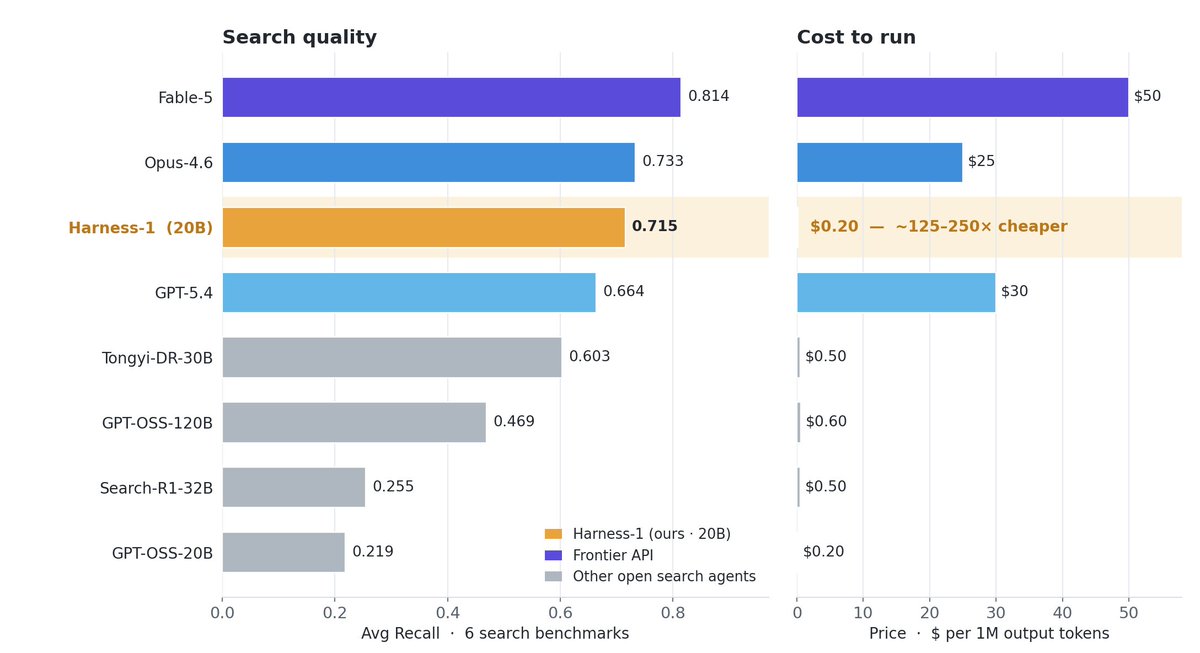
Fable-5/Mythos dropped this morning, so we tested it on agentic search - and it’s the new SOTA.
The performance gap is real.
So why are we still excited about our 20B open Harness-1?
• Much cheaper to self-host: estimated ~$0.2 vs $25–$50 / 1M output tokens
• No filtered queries in our setup: Harness-1 ran all eval queries, while Fable-5 filtered out ~7%
• Open-weight + small enough to actually run, inspect, and build on
Open search agents you can actually afford to run at scale are still worth building.
Let’s keep cooking. 🍳
Andrej Karpathy spent 2h showing how he actually uses AI day to day
he's a co-founder of OpenAI and led AI at Tesla, so when he shows how he works, it’s worth watching
and the whole session is just him telling the machine what he wants in simple terms, like he's briefing a coworker
watch what's actually happening the entire time:
> he describes the task in normal words
> it goes off and does the work
> he glances at the result and nudges it with one more sentence
that's the whole skill, and you've had it since you learned to talk
the only gap between that and a worker that runs on its own is handing that sentence a schedule and the tools to act
check his work, then build the version that keeps working when you stop
MIT has been teaching this publicly for 50 years. retail traders still draw trendlines
andrei markov published the framework in 1906. hedge funds found it in the 70s
built billion-dollar operations around it, never told retail it existed
markets aren't random - they're state machines
trending, ranging, reversing. each state has a fixed historical probability of shifting to the next
you build a transition matrix from real price data:
trending -> stays trending: 68%
trending -> flips to range: 21%
trending -> reverses: 11%
now you're not predicting direction. you're entering on 68% historical completion
that's not a signal, that's conditional probability compounding every single trade
math is free, data is free, implementation is ~200 lines of python
what's not free: knowing this framework exists while everyone around you draws support levels and hopes
renaissance has run this since 1988. paper was always public
edge was never secret. just never pointed out
Google's new algorithm just shrunk 31GB of memory down to 4GB 🤯
TurboVec is a new open-source tool that stores the data your AI app searches through, using 16x less memory.
It runs on Google's TurboQuant, which skips the slow setup step every other tool needs.
→ Faster search than the popular alternative (FAISS)
→ Works on both Mac and standard servers
→ Narrow results to exactly what you want
→ Plugs straight into LangChain and LlamaIndex
Your data never leaves your machine. Runs fully offline, works with Python out of the box.
100% Open Source.
This list will save you 100+ hours of research
17 courses on Agents, RAG, and real-world LLMs:
>HuggingFace's Agent Course: https://t.co/MPzielmYUI…
>MCP with Anthropic: https://t.co/dCa1TWox7N
>Building Vector Databases with Pinecone: https://t.co/M2nqZdzwVs
>Vector Databases: https://t.co/TsVz1EK4Mn
>Agent Memory: https://t.co/P2GZfv6Oz1
>Deep Learning AI's RAG course: https://t.co/aviu4JuY17
>Building and Evaluating RAG apps: https://t.co/jssSvWIWwR
>Building Browser Agents: https://t.co/w583jTl8Mj
>LLMOps: https://t.co/W9VWYvUlwc…
>Evaluating AI Agents: https://t.co/ALI5u1qHwN
>Computer Use with Anthropic: https://t.co/TGheKutoqO
>Multi-Agent Use: https://t.co/Ogq4nm96Lc
>Improving LLM Accuracy: https://t.co/CW1EIiZ5UD
>Agent Design Patterns: https://t.co/oUmlnCXC7Y
>Multi Agent Systems: https://t.co/KHOqxoWQgm
>Berkeley Agent MOOC: https://t.co/W3jtSLhP6s
>Berkeley Advanced Agents MOOC: https://t.co/xA09xsWg3h
Which ones would you add to this list?
As an AI Engineer. Please learn
>Harness engineering, not just prompt engineering
>Context engineering, not just long prompts
>Prompt caching vs. semantic caching tradeoffs
>KV cache management, eviction, reuse, and memory pressure at scale
>Prefill vs. decode latency and why they optimize differently
>Continuous batching, paged attention, and throughput optimization
>Speculative decoding vs. quantization vs. distillation tradeoffs
>INT8, INT4, FP8, AWQ, GPTQ, and when quantization hurts quality
>Structured output failures, schema validation, repair loops, and fallback chains
>Function calling reliability, tool contracts, argument validation, and idempotency
>Agent guardrails, loop budgets, tool budgets, and termination conditions
>Model routing, graceful fallback logic, and degraded-mode UX
>RAG architecture: chunking, embeddings, hybrid search, reranking, and freshness
>Retrieval evals: recall, precision, grounding, attribution, and citation quality
>Evals: golden sets, regression tests, adversarial tests, LLM-as-judge, and human evals
>LLM observability as a first-class discipline: traces, spans, tokens, latency, errors, and drift
>Cost attribution per feature, workflow, tenant, and user journey not just per model
>Safety engineering: prompt injection defense, data leakage prevention, and permission boundaries
>Multi-tenant isolation, cache safety, and cross-user context contamination prevention
>Fine-tuning vs. in-context learning vs. RAG vs. distillation and when each is the wrong tool
>Latency, quality, cost, and reliability tradeoffs across the full inference stack
>Production failure modes: hallucinated tool calls, malformed JSON, stale retrieval, runaway agents, and silent eval regressions
2-bit Gemma 4 12B GGUF, only 4.66 GB on disk, managed to cite 15 sites from a single prompt.
Try this locally on >6GB RAM via Unsloth Studio.
GitHub: https://t.co/aZWYAtakBP
The smartest quants at Jane Street aren't smarter than you.
They just know how to use the Bloomberg Terminal the way institutional desks use it to extract real signal, this 1 hour lecture teaches you exactly that from scratch. Bookmark now.
10 GitHub repositories so good they shouldn't be free.
1. TradingAgents
An entire team of AI analysts debating strategies and trading real markets. Fundamental, sentiment, news, and technical analysts work in parallel. Then a risk manager and execution agent make the final call. Like having a Wall Street team working 24/7 on your laptop.
Repo: https://t.co/UaRcwTBIih
2. LibreChat
ChatGPT, Claude, Gemini, DeepSeek, and 20+ models in one interface. Self-hosted. Native MCP support. Your history, your infrastructure, your data. Why pay monthly subscriptions when you can run everything yourself?
Repo: https://t.co/WhVNyHfE5Q
3. HyperFrames
HeyGen open-sourced its internal video engine. Write HTML and get production-ready MP4 videos. Supports GSAP, Lottie, and Three.js out of the box. The same input always produces the same output.
Repo: https://t.co/f7n0Aj2v39
4. Fincept Terminal
A Bloomberg-style terminal running on your laptop. AI investing agents inspired by legendary investors. Deep financial analysis, market intelligence, and dozens of data integrations without enterprise pricing.
Repo: https://t.co/Y21MkkfIKR
5. MoneyPrinterTurbo
Enter a keyword and get a complete video: script, visuals, subtitles, music, and final render. Horizontal or vertical. Minimal manual editing required.
Repo: https://t.co/IXuG9rMwzX
6. Agentic Inbox
Cloudflare's open-source AI email client. An AI agent reads your inbox and drafts replies while keeping everything inside your own infrastructure. No external servers. No subscription fees.
Repo: https://t.co/N0UziIIroA
7. VoxCPM
Clone voices with just a few seconds of audio. Supports dozens of languages and high-quality voice generation. Create custom voices directly from text descriptions.
Repo: https://t.co/j1wPFr2CJo
8. Flowsint
Enter a domain and uncover connected IPs, subdomains, emails, crypto wallets, and social profiles through a visual graph. Everything runs locally for private investigations and OSINT workflows.
Repo: https://t.co/qcjGwwZ21Q
9. agent-skills
Google engineer Addy Osmani released his production-tested Claude Code skills. Includes workflows for API design, debugging, code reviews, CI/CD, frontend engineering, and more.
Repo: https://t.co/jRjpYjd8Ph
10. Nango
The integration layer companies spend thousands on every year. Hundreds of prebuilt API integrations, managed OAuth, and AI-generated integration code. Trusted by fast-growing startups and enterprise teams alike.
Repo: https://t.co/fuybcYXmhh
These aren't side projects.
Each one replaces software people are still paying for every month.
Pick one.
Install it.
Add it to your workflow.
100% free. 100% open source.