(1/12) Very happy to present our multimodal snRNA and scATAC resource charting the gene regulatory changes of the human prefrontal cortex from 22 weeks gestation to 40yrs https://t.co/0024v19H26
I was on @dwnews yesterday to talk about #mpox and it made me realize that 1) it's been a while since I've done this and uff I'm out of practice and 2) it's always hard to unpack the complexity of these outbreaks in a few minutes, but this one will be harder than most...
✨ Attention ECRs ✨
The 2024 AEpiA Early Career Researcher travel awards are now open!
This year we have two awards valued at $750 each
Apply online at https://t.co/bXiinc2FaP
Application close 31st May.
@lpachter Having had the recent displeasure of integrating results from Seurat into a Scanpy pipeline, I have a lot sympathy for whoever was tasked with this analysis.
@lpachter This paper is great! And covers issues with "self love" or the circular reinforcement of data, with velocity score kNN imputations that are then projected on a UMAPs that are based on the same kNN.
@lpachter In the short, what I'm trying to convey is that it might be helpful for others who might conflate UMAP with all other analysis that is kNN based and not UMAP based.
@lpachter I don't disagree with your takes on UMAPs, but it might be worth noting the kNN graph, which UMAP uses, serve as the foundation for many downstream analyses, such as Leiden clustering and other analyses which warrant recognition and critique (e.g., velocity). UMAP!=kNN
Join us for our next #neurogenomics seminar on Tuesday, 30 Jan, to hear Susanne Falkner from @UniBasel_en talk about her beautiful work linking neuronal activity to gene regulatory programmes and cellular differentiation 🧠🧬
DM/email for the zoom link.
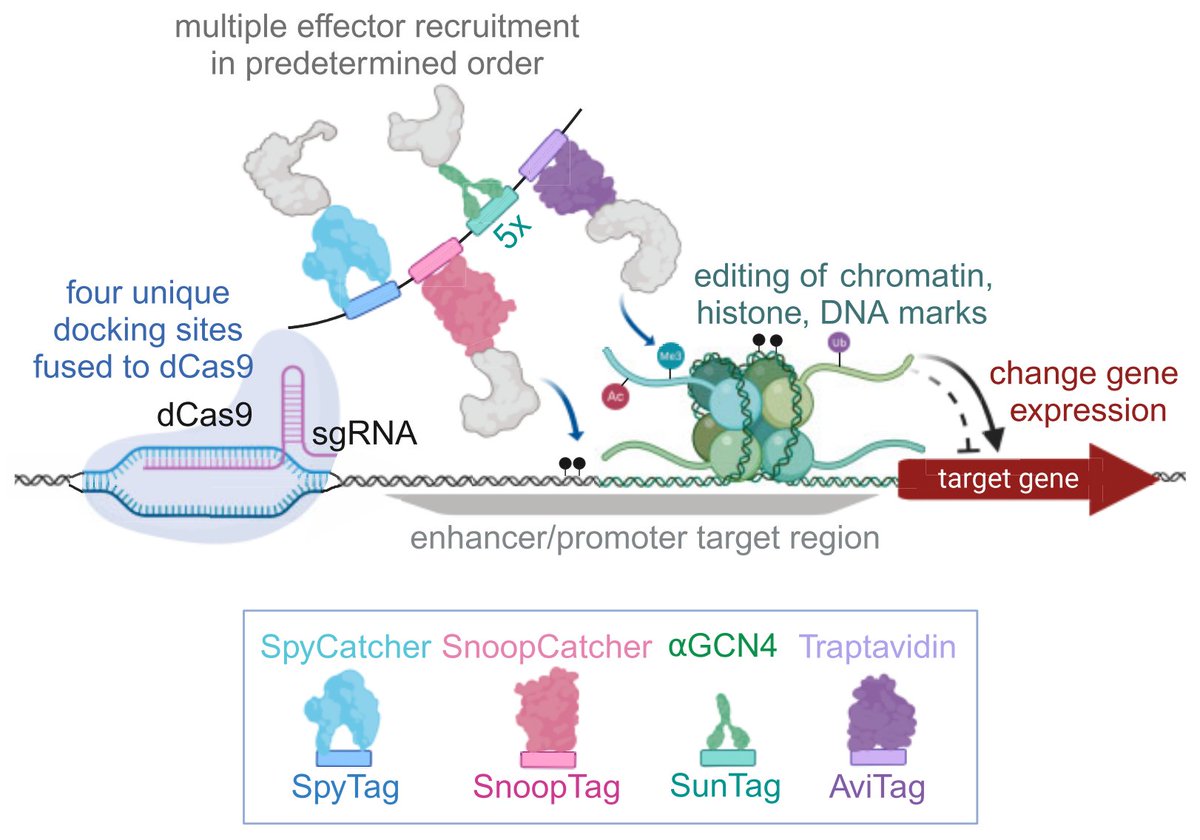
Our new SSSavi system - a modular dCas9-based recruitment platform for combinatorial epigenome editing, led by @TessaASwain and @BlauerPlums https://t.co/I3oUWWiv6K
At our next seminar Friday 18th August at 12pm AEST, we will hear from Chuck Herring @Chuck_Herring (Harry Perkins Institute of Medical Research, Perth), the Winner of the AEpiA Emma Whitelaw ECR Publication Award 2023! All welcome.
https://t.co/teb6TjzR03
#Epigenetics
Want to do a postdoc in a well-resourced lab focused on cutting-edge genomics and epigenetics? Check this out ⬇️ I moved to WA and postdoc'd in this lab for 6.5 years, worked on awesome projects, and learned a ton.
1/15 Welcome to the AEpiA ECR spotlight for July! This month we’re focusing on Victoria Sugrue @torisugrue, who was highly commended in the 2022 AEpiA ECR Emma Whitelaw Publication award.
Cracking the regulatory code: We have genomes for 1000s of species, but ENCODE only for 2 – what do we do? Natural language models have shown that syntax and semantics can be learned from text alone. Can we do the same for genomes?⬇️
https://t.co/MIFqNVfAlC
1/7 Our study in iScience examined the impact of contamination in scRNA-seq experiments on down stream data analysis. :technologist: :dna: #WomenInSTEM#DataScience
https://t.co/3cC2Pi7k0L
@AEpiA I extend my appreciation to all the incredible folks who contributed to this research, especially my co-firsts, @SaskiaFreytag, @DanielPoppe83, and the twitterless Rebecca Simmons. And, of course to @ry_lister.
@PerkinsComms
Honored to receive the Emma Whitelaw ECR Publication award! Thank you, @AEpiA, for this fantastic recognition. It's humbling to be recognized in the name of Emma Whitelaw, whose landmark contributions continue to shape the field of research in epigenetics.
✨ANNOUNCEMENT✨
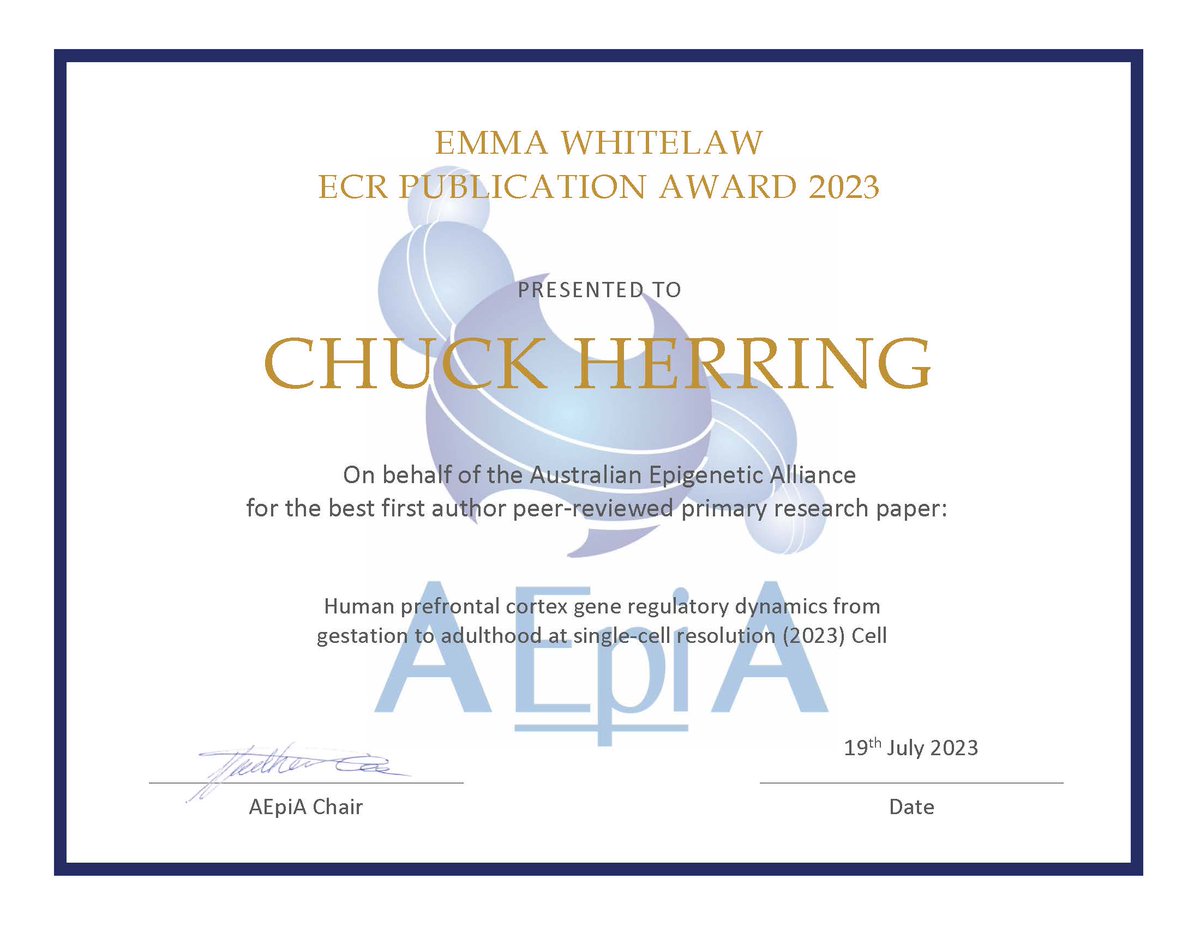
The winner of the Emma Whitelaw ECR Publication award is Chuck Herring @Chuck_Herring
For his article: Human prefrontal cortex gene regulatory dynamics from gestation to adulthood at single-cell resolution, published in @CellCellPress https://t.co/zdYkZApMOB