Still can't believe it! EMNLP will always be special to me. I presented my very first paper at EMNLP 2023 in Singapore 🇸🇬, and now an Outstanding Paper Award at EMNLP 2026 in Budapest 🇭🇺. So grateful to have worked on this with Cheng, who poured so much into this paper. Huge thanks to the whole team! 🏆
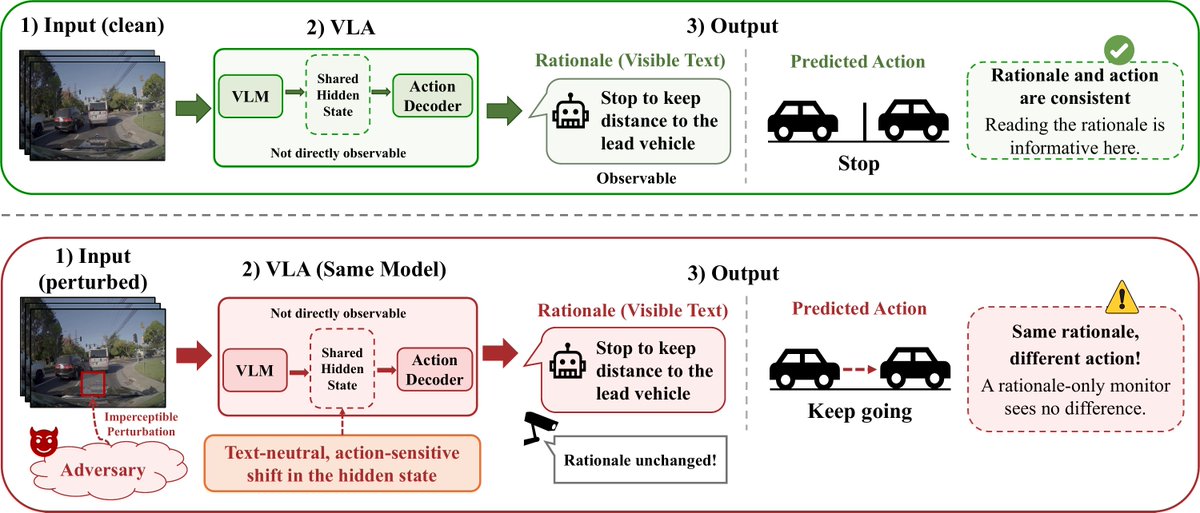
Can a driving model say exactly the right thing and still plan a collision?
In our #NeurIPS2026 paper, a small image perturbation can turn a reasoning VLA's plan into a collision while its rationale stays word-for-word identical. 🧵
📄 https://t.co/gA9Zs2LaMW
My biggest struggle with reviews in 2026 is that (AI) reviewers don’t seem to know the difference between limitations and critical issues. An LLM can easily find 100+ limitations in any paper (even the best ones in history), but that doesn’t mean the paper shouldn’t be accepted.
Jessy asked where my paper was. I said, "My agent deleted it, but I don’t believe that.” She was confused, as I sound self-conflicting. Then she got angry as she figured the agent had deleted it, and I was blindly trusting my agent. LLMs, unlike Jessy, don't reason like that.
So happy to work with Cheng again and again! 🙌
Sadly I can't make it to Budapest this time, but my junior labmate from Tsinghua, Meng Gao @Gladysgaom, will be there to help present, along with her own first-author work, Skim and Skip: Hierarchical Adaptive Inference for Efficient Multimodal Retrieval. She's also applying to PhD programs for Fall 2027, so please go say hi!
Heading to #EMNLP2026 in Budapest 🇭🇺? Check out our Oral paper, UReason: Benchmarking Reasoning-to-Generation Alignment in Unified Multimodal Models!
🤔 UMMs unify understanding and generation. But are their text and images truly aligned?
💡 Our finding: UMMs usually get the reasoning right, but the image often doesn't follow it. Even more surprising: if we drop the reasoning and give the model only the final prompt it wrote itself, every model we tested does better, by a large margin.
📍 Oral Session 2 · Oct 25, 11:00–12:30 · Room G13-14
👇
Heading to #EMNLP2026 in Budapest 🇭🇺? Check out our Oral paper, UReason: Benchmarking Reasoning-to-Generation Alignment in Unified Multimodal Models!
🤔 UMMs unify understanding and generation. But are their text and images truly aligned?
💡 Our finding: UMMs usually get the reasoning right, but the image often doesn't follow it. Even more surprising: if we drop the reasoning and give the model only the final prompt it wrote itself, every model we tested does better, by a large margin.
📍 Oral Session 2 · Oct 25, 11:00–12:30 · Room G13-14
👇
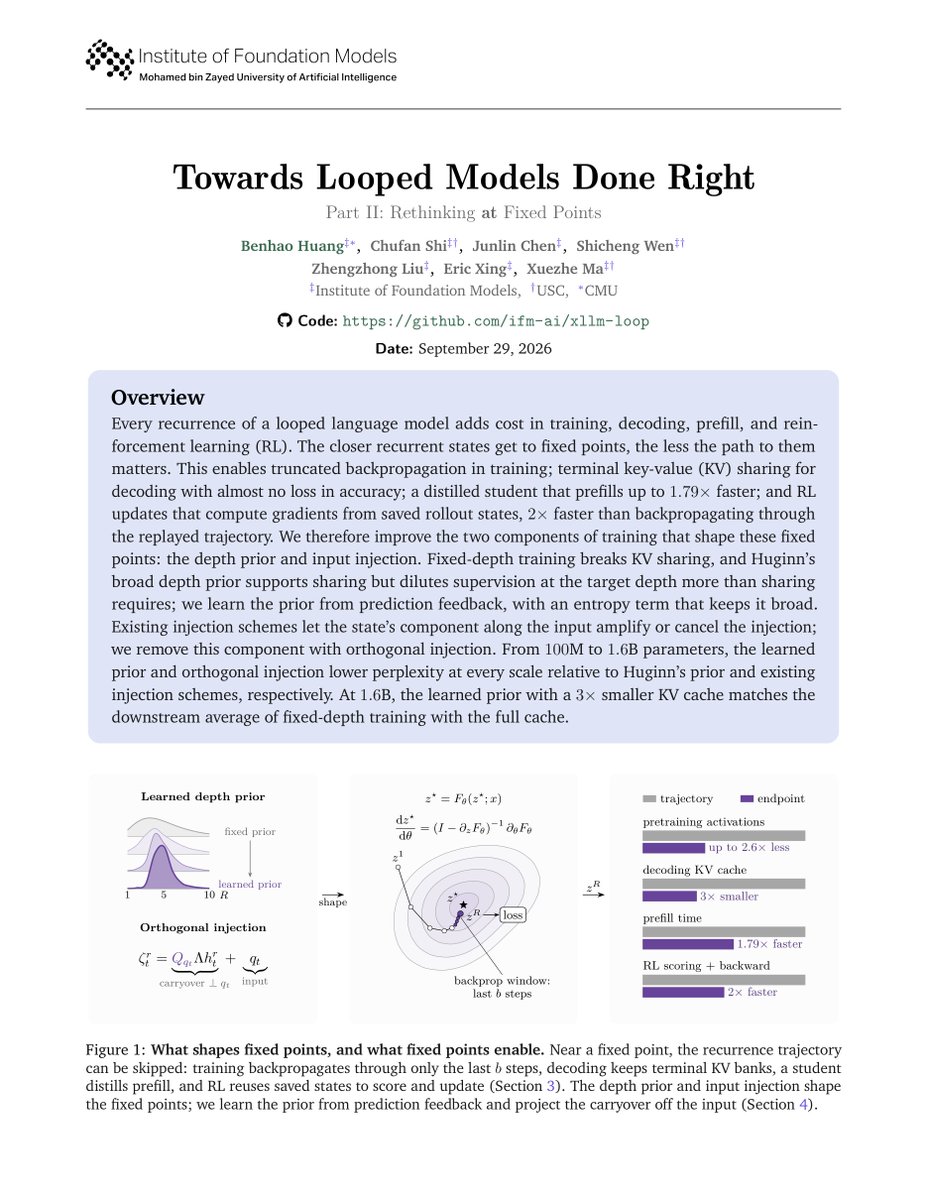
Towards Looped Models Done Right, Part II: Rethinking at Fixed Points
Shaping fixed points in looped language models lets a 1.6B parameter model with a 3x smaller key-value cache match the downstream accuracy of a full-cache fixed-depth baseline.
https://t.co/izMswR2xrx
Thrilled to introduce our new paper, Recursive Self-Improvement in Unified Multimodal Models! 🎉
If a model trains on data it made itself, how does it know that data is any good? A lot of work on recursive self-improvement keeps running into this question.
For images, our answer was to step into another modality. You can't really verify an image just by looking at it, but you can run the code that draws it and check what comes out. And a unified multimodal model can do both: it draws an image, looks at it to spot what went wrong, and writes code aimed at exactly those mistakes.
So vision catches the mistakes, text writes the fix, and running the code makes sure the fix is actually right. Each ability ends up teaching the others.
Round after round, the model keeps getting better at drawing, reading, and coding, and every round starts from a stronger model than the last.
The nice part is the split: the model gets to pick what it needs to learn, but it never gets to decide what's correct. The code does.
Led by @lemonnoel52 , in collaboration with @ChengYANG_yc , @yaokangwu , @BergKirkpatrick , and @MaxMa1987 .
Huijuan is at #COLM2026 this week. If you're there, come find her and chat about recursive self-improvement in UMMs!
Can a unified multimodal model (UMM) teach itself, with its text and visual abilities making training data for each other?
Yes: over 4 rounds, a 7B model climbs 45.7% → 60.2%, vs. 46.3% for continued training.
🧵 1/10
Can a unified multimodal model (UMM) teach itself, with its text and visual abilities making training data for each other?
Yes: over 4 rounds, a 7B model climbs 45.7% → 60.2%, vs. 46.3% for continued training.
🧵 1/10
Scaling up a model has meant paying twice, in compute and in memory. Our researchers show that looped models can pay in compute alone, using the loop's fixed point as a shortcut.
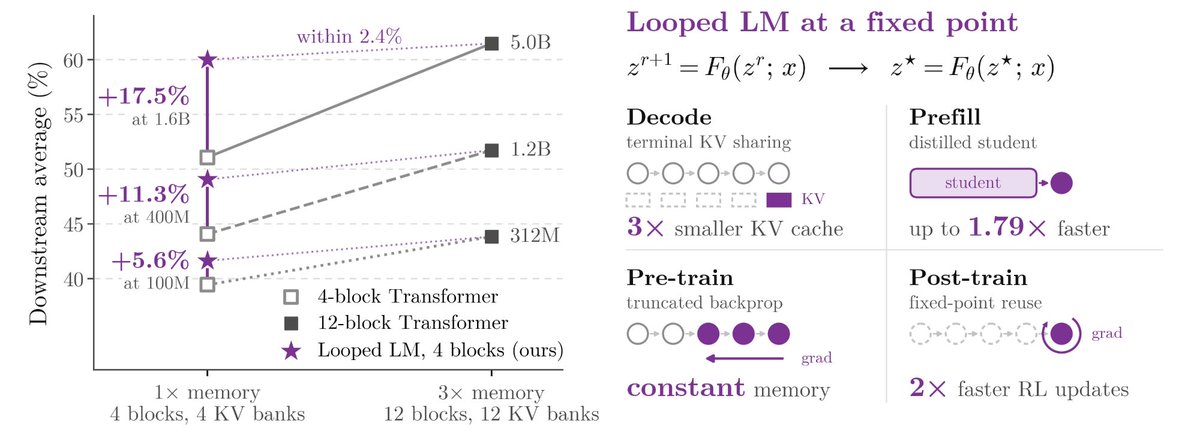
A 1.6B looped model runs twelve blocks deep on four blocks of memory. On the same tokens, it beats a four-block Transformer by 17.5% and comes within 2.4% of a twelve-block one needing 3x memory. It can also train, pre-fill, and post-train without paying for every loop.
Paper: https://t.co/6L11hsKsni
Fully open-sourced at: https://t.co/LlQxydLXpt
📄 Paper: https://t.co/4wBQYvma5k (arXiv to be released)
If you find it interesting, an upvote on @askalphaxiv would mean a lot. Thank you!
We also fully open-sourced our code, data, and checkpoints:
💻 Code: https://t.co/1QFaLr2Ev6
🔁 𝐖𝐡𝐚𝐭 𝐢𝐟 𝐥𝐨𝐨𝐩𝐞𝐝 𝐋𝐌𝐬 𝐜𝐨𝐮𝐥𝐝 𝐮𝐬𝐞 𝟑× 𝐟𝐞𝐰𝐞𝐫 𝐩𝐚𝐫𝐚𝐦𝐞𝐭𝐞𝐫𝐬 𝐚𝐧𝐝 𝐚 𝟑× 𝐬𝐦𝐚𝐥𝐥𝐞𝐫 𝐊𝐕 𝐜𝐚𝐜𝐡𝐞 𝐚𝐧𝐝 𝐬𝐭𝐢𝐥𝐥 𝐛𝐞 𝐜𝐨𝐦𝐩𝐚𝐫𝐚𝐛𝐥𝐞 𝐭𝐨 𝐚 𝐬𝐭𝐚𝐧𝐝𝐚𝐫𝐝 𝐓𝐫𝐚𝐧𝐬𝐟𝐨𝐫𝐦𝐞𝐫?
Introducing 𝐑𝐞𝐭𝐡𝐢𝐧𝐤𝐢𝐧𝐠 𝐚𝐭 𝐅𝐢𝐱𝐞𝐝 𝐏𝐨𝐢𝐧𝐭𝐬. We argue that looped LMs don't have to pay for every loop. They can scale by adding FLOPs at constant memory.
The key is the fixed point of the loop. We introduce:
– 𝐅𝐢𝐱𝐞𝐝-𝐏𝐨𝐢𝐧𝐭 𝐒𝐡𝐨𝐫𝐭𝐜𝐮𝐭𝐬: what fixed points buy a looped model in training (pre-training, post-training) and inference (prefill, decoding)
– A 𝐥𝐞𝐚𝐫𝐧𝐞𝐝 𝐝𝐞𝐩𝐭𝐡 𝐩𝐫𝐢𝐨𝐫 and 𝐨𝐫𝐭𝐡𝐨𝐠𝐨𝐧𝐚𝐥 𝐢𝐧𝐣𝐞𝐜𝐭𝐢𝐨𝐧: two ways to shape those fixed points
🧵 Long thread ahead (0/n).