@Maddiaa0 They were really struggling for a while when vibe coding first hockey sticked. I'm sure they've done some interesting things internally to handle the increased load and shifting usage patterns.
The Reimann hypothesis has been a standard candle for AI progress in math because it's isolated from the cherry picking and multiple comparisons problem that most published results are subject to.
The Anthropic result is a big deal.
This is particularly significant because the Riemann hypothesis is one of very few math problems that the labs are all trying to solve. The ten OpenAI proofs are impressive, but who knows how many problems they threw at it to get those. Riemann hypothesis is a standard candle.
Violate the license of one open source project and you have a problem. Violate the licenses of millions of open source projects and the developers have a problem.
In 2006, AOL released anonymized search data from 650k users and within days the NY Times published an exposé on their de-anonymization of the data. AOL's CTO resigned over this. The famous Netflix Prize's training data was similarly de-anonymized by researchers around the same time.
Anonymization simply DOES NOT WORK and we have known this for decades. It's already criminal that it's HIPAA compliant in the US, but it is absolute lunacy to MANDATE the distribution of personal data to private corporations without user consent.
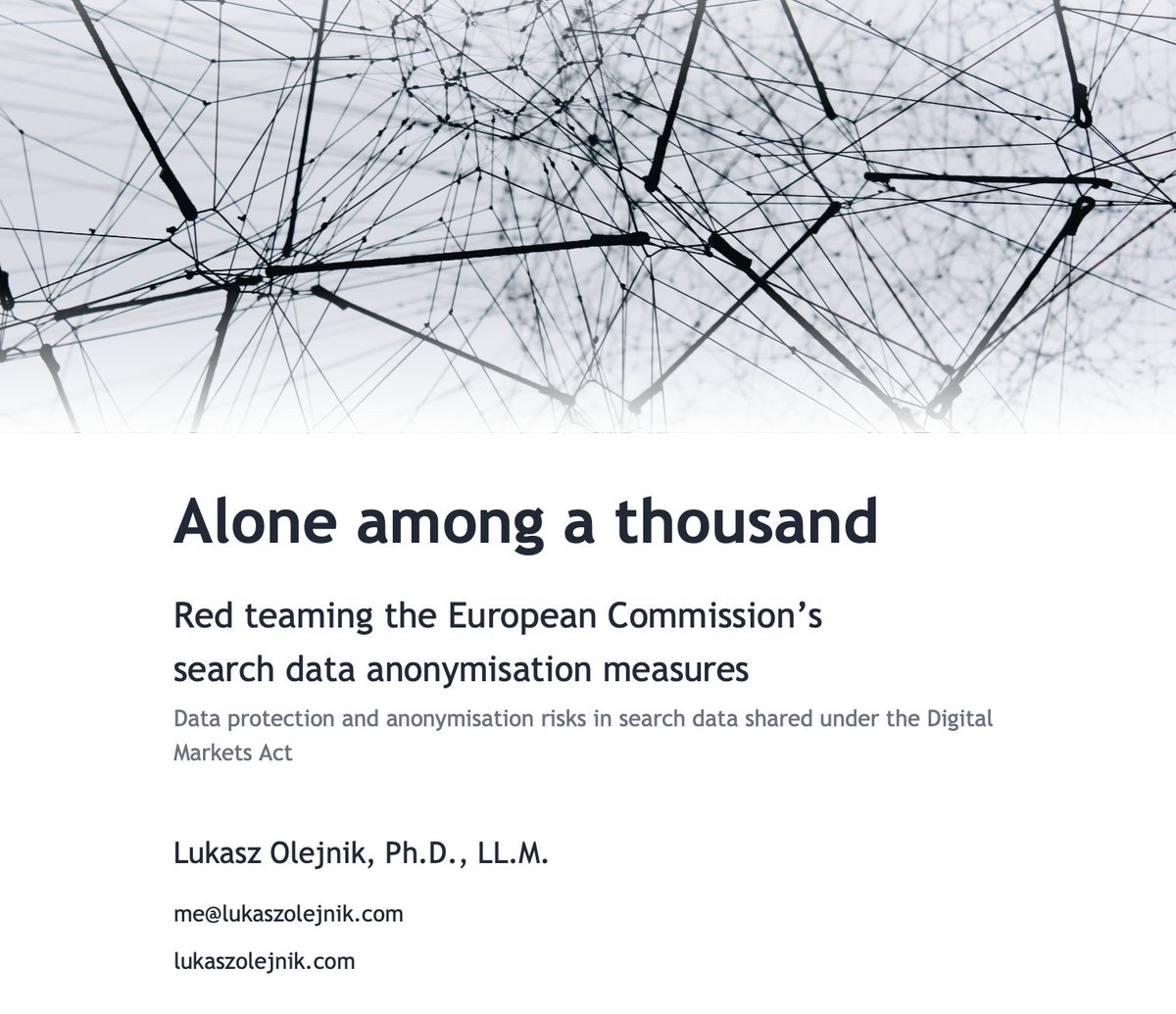
The European Commission is ordering Google to share the search data of all Europeans with other companies (AI chatbot makers, search engines, etc.), after a kind of "anonymisation". I tested it on the real Google data, hundreds of billions of search records. I broke it.
Findings. I singled out the people behind half a million searches, and that only for few countries over one month of August (record isolation). I joined the pieces of search history beyond the defined cap of 3, more than 200,000 sets just for Germany and only in August (linkage). I also confirm that it is possible to perform inference on the dataset, for example concerning health, religion or political opinions. This moves us beyond data protection, and in the national security direction.
My report: "Alone among a thousand". (link below)
GitHub’s biggest moat historically was that stars were high signal. For users, it meant that you could differentiate even new or niche projects that would have had zero ratings on other platforms. For maintainers, it meant that it was easier to get your project off the ground with early traction.
Today, GitHub stars mostly measure how good you are at self-promotion or hopping on trends. They’re closer to meme coins than any reflection of actual utility or quality. Repos with thousands of stars are buggy misguided piles of slop while quality projects sit quietly at single digit stars. The README and concept are all that matter for virality. The maintainers don’t read the code, and the users don’t run it.
The memification of the star economy combined with the drastic shifts in the SDLC that agentic coding has wrought are a huge opportunity for innovation in this space. The real builders don’t care about stars anymore, so there’s no cold start problem, and the workloads have changed enough that there’s room for new tooling and UX paradigms.
The GPU spot market trades preemptible 8x nodes at near-zero depth. The data centers getting underwritten are NVL72 racks wired into cluster fabrics. Pricing one off the other is like underwriting an international airline based on used Cessna Skyhawk prices.
@jonah_b I previously worked on private and secure AI inference with TEEs. Talking to healthcare companies was very eye opening. They were like, "why would we ever need this? we just remove the name and then we can do anything with it."
@skdh Many physics papers are fairly rote and bottlenecked by the writing of either analysis code or the paper itself. We'll see the impact of AI on generic paper throughput before we see it on fundamental progress in the field.
YC might not want AI to replace workers, but they do seem pretty excited about repricing expert-level work to less than the minimum wage in NYC or SF. That would put the new middle class salary at about $30k per year.
The bottlenecks in AI are moving beyond the models.
We’re excited about startups building the hardware, infra, financial systems, and specialized software to bring AI into the real economy, from factories and data centers to government and space.
https://t.co/Ms3Vn5Vq7q
Somewhere out there, a proton has been wandering the galaxy since a supernova accelerated it to 100 GeV millions of years ago. It was destined to collide with a nitrogen nucleus in Earth's atmosphere and produce a shower of particles.
One of the resulting neutrons strikes the HBM of a B300 running an LLM agent with access to critical government systems. A single bit in a single model weight silently flips.
The agent makes its next tool call.
if you have a qwen3.8 27b around, try steering L34 N3838 +0.75, now you have evil qwen 27b
for extra evil add L38 N17180 +0.75
same recipe as @_lyraaaa_: dose × median(‖resid‖ leaving layer L, tokens 1:) / ‖W_down[:, n]‖ at the down_proj input, every token
Leetcode interviews were generally hated pre-AI, but the people who would wax most poetic about how they didn't align with the actual job were the ones habitually writing N+1 queries. There was definitely a Goodhart's law component, but being able to reason about code and performance was highly transferrable to real work.
Code-level reasoning is less relevant today, but system design and product instinct are as relevant as ever.