@kipperrii Both https://t.co/jNZLWpW1tS and https://t.co/ly0w73gk21 have been instrumental in helping folks with ME/CFS, which is a sadly debilitating disease that leaves friends (often young people) bed-ridden with slowly sapping energy.
Hello @JeffBezos, since you question the results of our studies on the unfairness of the US tax system, please allow me to remind you of the main conclusions of our work, the most comprehensive research to date on this issue.
This New York Times piece is worth your time. Here’s what is happening, as simply as I can put it.
Back in January, Trump sued the IRS, an agency he controls, demanding $10 billion over the leak of his tax returns a number of years ago.
IRS lawyers did their jobs. They wrote a memo laying out the defenses that could beat the suit, including the fact that Trump filed too late. His own lawyer was in court when the leaker pleaded guilty in October 2023, more than two years before Trump sued.
The Justice Department never showed up to court. Never argued back. Never used the defenses sitting on their desk.
The judge got suspicious and ordered both sides to explain whether they were actually opposing each other or just colluding. The day before that brief was due, Trump dropped the suit.
Same day, his Justice Department announced a $1.776 billion taxpayer-funded “anti-weaponization fund.”
Trump gets a formal apology. The IRS agrees to drop any audits of him and his family, even though a 2024 Times report found a loss in an ongoing audit could cost him over $100 million.
The acting Attorney General, Trump’s former criminal defense attorney, picks the five commissioners who decide who gets paid. Trump can fire any of them. Proud Boys and Oath Keepers are not ruled out.
This is the most corrupt thing I’ve ever seen from an American president.
Where in the hell are my Republican colleagues?
https://t.co/La0nlLuz1r
The best place to do it would be somewhere generating diverse data with high throughput, low latency (~week scale), and deep relevance to living biological systems. That place is @ManifoldBio.
We recently opened up 4 new AI roles, and we are adding an RL-focused role soon:
https://t.co/BMlVgCEYFJ
Am 22. September verspricht Kasachstans Präsident dem US-Präsidenten eine Wolfram-Mine.
36 Tage später kaufen Trumps Söhne Anteile an der Firma, die sie bekommen wird.
9 Tage später wird der Deal mit 1,6 Milliarden Dollar Steuergeld offiziell.
Drei Mal innerhalb eines Jahres dasselbe Muster: Söhne kaufen ein, Vater liefert den Auftrag.
Im August 2025 steigen Donald Trump Jr. und Eric Trump bei einer kleinen New Yorker Baufirma namens Skyline Builders ein. Sie kaufen über ein Vehikel mit dem Namen American Ventures, einer Tochter von Dominari Securities. Dominari hat die Trump-Söhne Ende 2024 in seinen Beirat geholt. Sie halten dort auch einen Anteil am Mutterkonzern.
Skyline ist zu diesem Zeitpunkt eine unauffällige Holding für asiatisches Baugeschäft. Niemand schreibt darüber.
Am 22. September trifft Kasachstans Präsident Tokayev Donald Trump und sagt ihm zu: Eine US-Investmentgruppe namens Cove Kaz wird das größte unentwickelte Wolfram-Vorkommen der Welt bekommen. Cove Kaz hatte gegen chinesische und russische Bieter konkurriert. Tokayev entscheidet sich für die Amerikaner.
Diese Zusage ist informell. Kein Vertrag, kein offizieller Beschluss. Nur ein Versprechen zwischen zwei Präsidenten.
Am 21. Oktober berichtet die Presse erstmals über diese Vereinbarung.
Sieben Tage danach, am 28. Oktober, schießen die Trump-Söhne weiteres Geld in Skyline nach. Im Rahmen einer Kapitalerhöhung von knapp 24 Millionen Dollar.
Drei Tage später, am 31. Oktober, kauft Skyline für 20 Millionen Dollar einen 20-Prozent-Anteil an einer Firma mit, Zitat aus dem Filing, "bedeutenden Beständen an kritischen Mineralien in Asien". Diese Firma ist Kaz Resources, die Tochter von Cove Capital, die das Wolfram-Projekt entwickeln wird.
Am 6. November verkünden Cove Kaz und Kasachstan den Deal offiziell. 70 Prozent der Mine gehören Cove. 30 Prozent dem kasachischen Staat. Geplante Investitionssumme: 1,1 Milliarden Dollar.
Die US-Regierung steigt mit ein. Die staatliche US-Exportbank gibt eine Zusage über bis zu 900 Millionen Dollar Projektfinanzierung. Die staatliche US-Entwicklungsbank ergänzt das mit bis zu 700 Millionen Dollar. Macht zusammen bis zu 1,6 Milliarden Dollar Steuergeld.
Am 30. April 2026 fusionieren Skyline und Cove Kaz. Das fusionierte Unternehmen geht an die Nasdaq. Geplanter Ticker: KAZR.
Auf keiner einzigen Pressemitteilung tauchen die Namen der Trump-Söhne auf.
Warum Wolfram?
Wolfram ist das Metall mit dem höchsten Schmelzpunkt der Welt. Es steckt in panzerbrechender Munition. In kinetischen Abfangkörpern für Raketenabwehr. In Hyperschallwaffen. In jedem Halbleiter. In F-35-Triebwerken. Christopher Ecclestone, Bergbau-Stratege bei Hallgarten in London, sagt: Das Pentagon will Wolfram um jeden Preis.
China kontrolliert über 80 Prozent der weltweiten Wolfram-Produktion. Im Februar 2025 verhängt Peking Exportbeschränkungen. Die Preise für Ammoniumparawolframat, der internationale Benchmark für Wolfram, springen seitdem um über 40 Prozent.
Die USA haben 2015 die letzte eigene Wolfram-Mine geschlossen. Wer eine neue, verlässliche Quelle anzapfen kann, sitzt auf einer goldenen Ader.
Genau diese Ader bekommen die Söhne des US-Präsidenten. Mitfinanziert mit Steuergeld.
Der Geschäftsführer von Cove Capital, Pini Althaus, sagt der Financial Times wörtlich: Cove habe "direkte Unterstützung von Präsident Trump, Außenminister Marco Rubio und Handelsminister Howard Lutnick" erhalten, um die Mine zu sichern.
Lutnick selbst hat einen persönlichen Brief an den kasachischen Präsidenten geschickt, um den Deal zu unterstützen. Das geht aus einer Investorenpräsentation hervor, die Skyline bei der US-Börsenaufsicht eingereicht hat.
Pini Althaus hat übrigens vor Cove eine andere Mineralienfirma gegründet: USA Rare Earths. Auch sie hat Mitte 2025 über 1,5 Milliarden Dollar an konditionaler US-Staatsförderung erhalten.
Das ist der Hintergrund. Jetzt zum Muster.
Im August 2025 steigt eine Risikokapitalfirma namens 1789 Capital bei einem Startup namens Vulcan Elements ein. Donald Trump Jr. ist dort Partner. Vulcan stellt Magnete aus Seltenen Erden her.
Drei Monate später, im Dezember 2025, bekommt Vulcan einen Pentagon-Kredit über 620 Millionen Dollar. Plus 50 Millionen Dollar als Eigenkapitalbeteiligung der US-Regierung. Es ist der größte Kredit, den das zuständige Pentagon-Büro für strategisches Kapital je vergeben hat. Trumps Executive Order 14241 hatte zuvor die Pflicht zur unabhängigen technischen Prüfung solcher Vergaben aufgehoben.
Im März 2026 steigen die Trump-Söhne bei einem Drohnenhersteller namens Powerus ein. Lieutenant General Keith Kellogg, ehemaliger Sicherheitsberater des Vizepräsidenten, sitzt im Beirat. Wenige Wochen später startet die US-Regierung ein Drohnenprogramm mit einem Budget von 1,1 Milliarden Dollar. Powerus will Aufträge daraus ziehen. Der geplante Börsenticker der Firma: PUSA.
Jetzt Cove Kaz. KAZR. 1,6 Milliarden Dollar Steuergeld.
Drei Fälle. Zwölf Monate. Dasselbe Muster.
Das Wall Street Journal hat die Trump-Familien-Geschäfte seit der Wiederwahl auf insgesamt mindestens vier Milliarden Dollar Erlöse und Papiervermögen geschätzt. Krypto, Drohnen, Seltene Erden, Wolfram, Bitcoin Mining, Prediction Markets. Eric Trump hat in einem Interview gesagt, sie hätten in der ersten Amtszeit "keinen Dank für ihre Zurückhaltung bekommen". Diesmal halten sie sich nicht zurück.
Im März 2026 versuchen Demokraten im Kongress, Donald Trump Jr. per gerichtlicher Vorladung zu zwingen, unter Eid zum Vulcan-Deal auszusagen. Republikaner blockieren die Abstimmung im Ausschuss.
Die rechtliche Bewertung dessen wird Jahre dauern. Zwei Dinge stehen aber jetzt schon fest.
Erstens: Wer in den USA steuerpflichtig ist, finanziert über Mehrheitsstrukturen einen Bergbau-Deal in Kasachstan, an dem die Söhne des Präsidenten beteiligt sind. Ohne dass diese Beteiligung in den offiziellen Pressemitteilungen erwähnt wird.
Zweitens: Wenn dasselbe Muster in einem Jahr drei Mal auftritt, ist es kein Zufall. Es ist eine Methode.
Wenn dich solche Makro Insights interessieren und dir helfen, interagiere gerne mit dem Post. 🧡
You don't need advice from editors on rejected manuscripts.
My short story “Ender's Game” was rejected by Ben Bova at Analog back when that was the top market for a sci-fi story. Ben gave me feedback. He thought the title should be “Professional Soldier” and he said to “cut it in half.”
But I knew he was wrong on both points and submitted it to Jim Baen at Galaxy. He sat on it for a year, and responded to my query with a rejection. There was some kind of explanation, but I don't remember what it was. I concluded at the time that Baen's comments showed that he had barely glanced at the story.
So … I got feedback both times, but it was not helpful. I looked at Ben's rejection again. What was it about the story that made him think it should, let alone COULD, be cut in half?
Apparently it FELT long. What made it feel long? Now, post-Harry Potter, I would call it the quidditch problem. I had too many battles in which the details became tedious. So I cut two battles entirely, merely reporting the outcomes, and shortened another. In retyping the whole manuscript (pre-word-processor, that was the only way to get a clean manuscript), I added new point-of-view material to the point that I had cut only one page in length. So much for “in half.”
But I already knew that my manuscripts did not need cutting — if it wasn't needed, it wouldn't be there in the first place. Even the battles were still there, but instead of showing them, I merely told what happened (so much for the usually asinine advice “show don't tell”), which kept the pace going.
Those changes made, I sent it to Ben again. I did not remind him of what he had advised me to do. I merely told him I liked my title, and said, “I have addressed your other concerns,” which was true. I figured he wouldn't remember what his exact words had been. My answer was a check. That revised story was the basis for my winning the Campbell Award for best new writer.
Did Ben's feedback help? Yes — but his specific advice was not right, and I knew it. On my next two submissions, Ben hated my endings, and I revised as suggested. The fourth submission he rejected outright, and the fifth, and I thought, Am I a one-story writer? I went back to Ender's Game and tried to analyze why it worked. Then, deliberately imitating myself, I wrote “Mikal's Songbird.” Ben bought it, and it received favorable mentions. I was afraid then that I had consigned myself to writing stories about children in jeopardy. But in fact I was writing character stories rather than idea stories. And THAT was how I built a career, not by self-imitation, and not by following editorial suggestions.
I did get wise counsel from David Hartwell on my novel Wyrms, but that was on a book that was already under contract, and it was story feedback, not style. I got wise counsel from Beth Meacham, too, on various books over the years — but again, only on books that were under contract. I also received appallingly stupid advice from the editor of my novel Saints, which temporarily destroyed the book's marketability; after that, I was allowed to go back to my original structure and save the book — now it's one of my best.
Editors don't know more than you about your story. They especially don't know why they decide to accept or reject stories. YOU have to know what your story needs to be, and take only advice that you believe in.
Your best counselor on a story nobody bought is TIME. Let some time pass and then reread the story. Don't even think about why it Didn't Work. Instead, think about what DOES work, and then write it again, a complete rewrite, keeping nothing from the previous draft. Find the right protagonist and begin at the beginning — the point where the protagonist first gets involved with the events of the story. Be inventive — the failed first draft no longer exists, so you're not bound by any of your earlier decisions. THAT is how you resurrect a good idea you did not succeed with on your first try.
Multiplexing can be thought of as "GPU-ification" of a complex biological system
Serial measurement becomes massively parallel
To turn biology digital, you need data at *scale* and *relevance*
The power of multiplexing is you get both.
@SussilloDavid Hey! Been a minute since Brain days. Congrats on the book and new journey. Also would love to DM you about an idea in those areas, but DM isn't open.
I know it's boring and repetitive to talk about how grossly evil Trump is, but the fact remains: Trump is grossly evil, in a way that's pretty much unprecedented in this country.
Update: we can now do affinity maturation in as little as 1 week with RamaX Opt from @diffuse_bio!
To our knowledge, this is the fastest affinity maturation method available, outperforming even the most advanced existing experimental and AI approaches 🧵
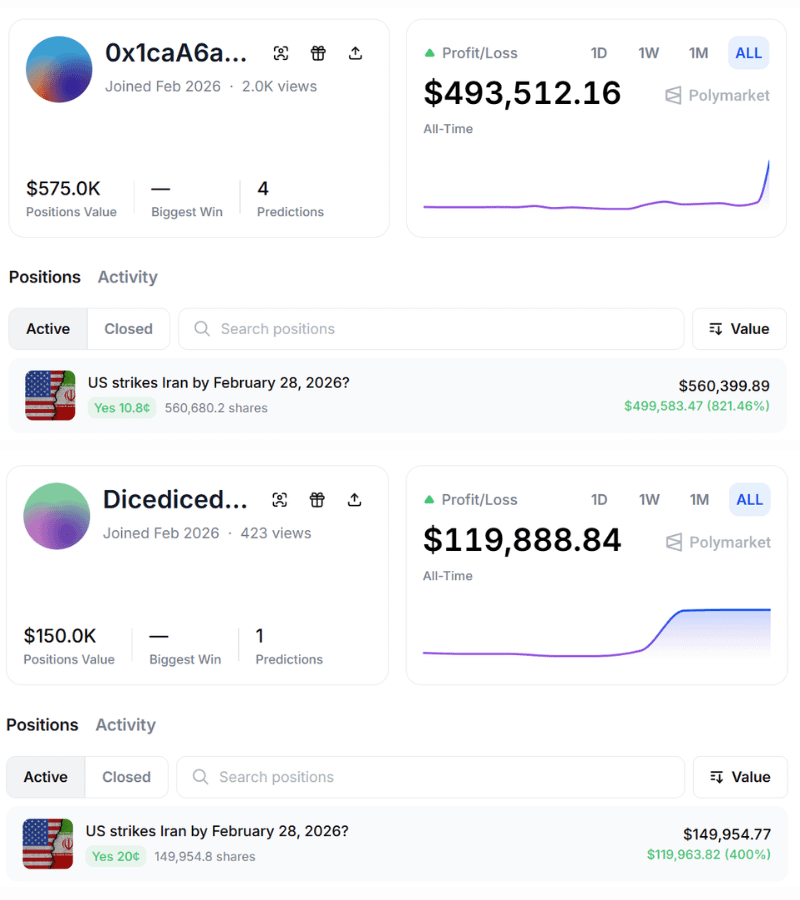
JUST IN: 🇮🇷 🇺🇸 Six suspected insiders made $1.2M betting on a US strike on Iran
Most of these wallets:
• were funded in the last 24h
• specifically bet for February 28
• bought "yes" hours before the strike
@damianplayer i dont think anyone reputable is saying that AI wont be crazy impactful, but rather that it fits the profile of a large over-investment in the near-term. that *might* be incorrect, but this graph is in line with that hypothesis actually.
@dbasch im not saying you're _wrong_, but they 10x'ed their revenue each of the last three years. while 140b is a lot, we also said that about 14b last year.
It’s important that you understand what happened last night.
Last night, Stephen Colbert interviewed Democratic Texas Senate candidate James Talarico, a candidate who, by all accounts, is on track in the polls to flip Texas blue.
In response, Trump’s FCC reportedly threatened CBS if the interview aired.
CBS caved and pulled the segment, citing “financial reasons.”
In modern American history, no president has been more hostile to free speech than Donald Trump.
But censorship always backfires.
Here’s the full segment Trump didn’t want you to see.