To my adversary:
I feel your right hand twitching. If you let your right hand go - I will not be there.
I will create traps and dead space. I will walk you into that dead space - and you will be in danger…
You can now install Claude artifacts as desktop apps on Mac and Windows.
Ask Claude to build an artifact, click "Install as app", and open it like any other app. It can use your connectors and, if you allow it, send notifications or add a menu bar item.
A lot of words @Paul__Walsh that could have been saved for an inner monologue pending a clarifying conversation w/@HackingDave
He’s easy to find - and to talk to…
Which makes this post look more self aggrandizing than helpful.
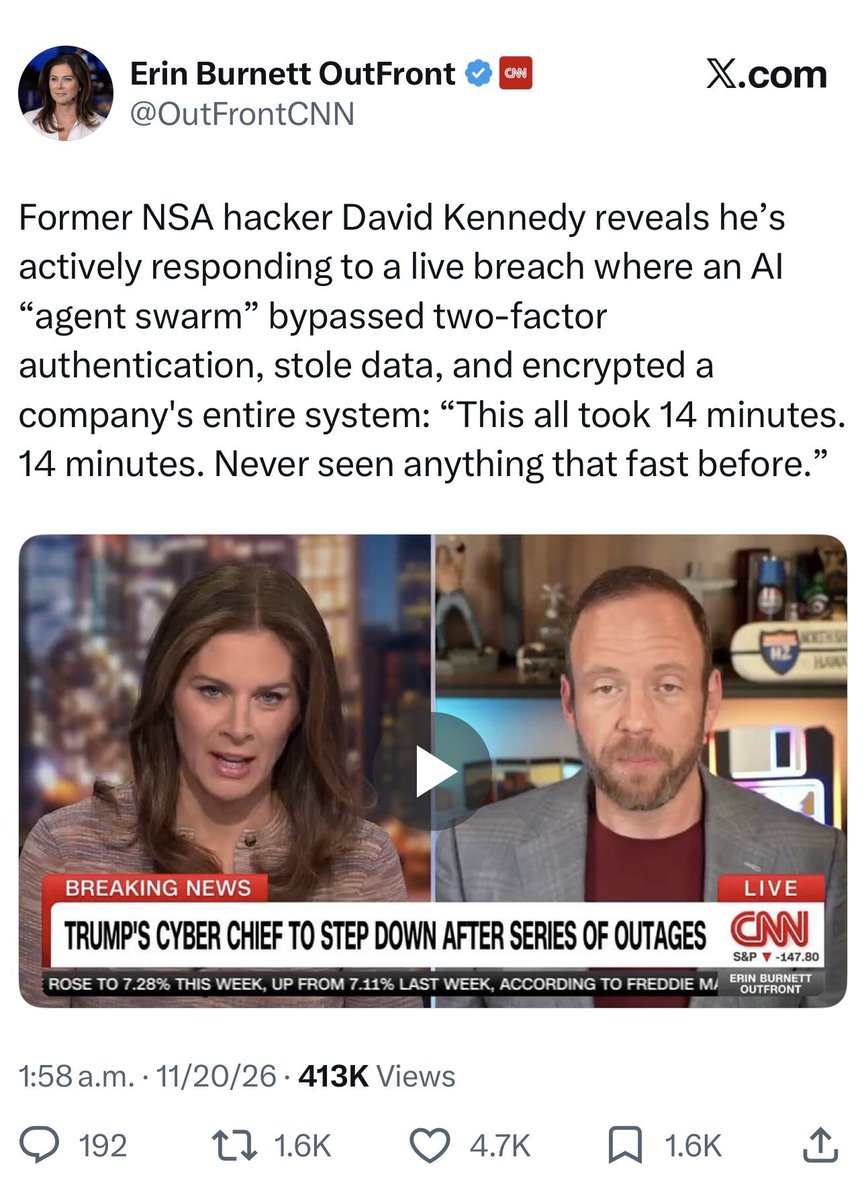
CNN has now published its second extraordinary NSA story in a single week. This time, a former NSA hacker claims that AI agents bypassed 2FA. Let me explain why this is disinformation put out by the US government, using simple logic.
David Kennedy claims AI agents found a vulnerability that allowed them to bypass 2FA.
App based 2FA can only be bypassed through reverse proxy phishing, which I first wrote about on behalf of the PKI Consortium in 2019. People who believe apps such as Google Authenticator and 1Password protect them from phishing are mistaken. FIDO hardware security keys are phishing-resistant.
But Kennedy isn’t claiming phishing was involved. He’s claiming that AI agents discovered a vulnerability that allowed them to “bypass 2FA”.
Unless Kennedy identifies the specific 2FA service that was breached, or the security company itself publicly discloses the vulnerability, we should assume this story is disinformation.
Even AI with another 20 years of research and quantum capabilities wouldn’t be able to bypass 2FA. That would take a vulnerability in the authentication service. But that’s not what we’re being told.
Here’s how app based 2FA works. When you activate it, the authentication service and your authenticator app share a secret key. The app uses that key and the current time to generate a 6 digit code, usually every 30 seconds.
The server independently calculates the expected code and checks it against the one you enter. There are 1 million possible combinations, but the server limits failed attempts and rejects codes outside the accepted time window. AI can’t calculate the correct code without the secret key. It can’t bypass the server’s verification by guessing faster either.
Even AI with another 10 years of research and quantum computing capabilities couldn’t bypass 2FA. That would take a serious vulnerability in the service’s authentication implementation, not the underlying TOTP algorithm.
What vulnerability is he talking about? Which authentication product did they bypass?
If Kennedy discovered a serious vulnerability, he has a professional responsibility to notify the affected company so it can fix the problem. That company also has a duty to publicly disclose the vulnerability.
Kennedy also claims the AI agents stole company data and encrypted an entire file system in 14 minutes. This is noise. Focus on his claims about bypassing 2FA.
He hasn’t provided the technical evidence for anything.
3 days earlier, CNN reported that 6 sources had disclosed problems with the NSA’s highly classified internal communications network.
I find it astonishing that people believe 6 sources independently disclosed problems with one of the US’s most sensitive intelligence networks to CNN. If classified information about those networks was disclosed as reported, the people responsible would face serious prison sentences. And the NSA doesn’t seem bothered by such a disclosure. Does this mean Snowden can come home?
Now CNN is promoting another extraordinary cybersecurity story through someone who previously worked for the NSA, this time bombastic claims about AI agents that supposedly defeated a security system that’s impossible to bypass.
2 NSA related stories on CNN in one week, both with serious national security implications and neither supported by any public technical evidence for independent verification.
If the claims about AI agents turn out to be false, that makes the timing of CNN’s earlier NSA story even more suspicious.
Who benefits from frightening the public into believing that conventional cybersecurity protections are no longer effective against AI?
For the 3 three years I’ve studied the data on 400,000+ published vulnerabilities (CVEs), pieced together from thousands of sources: discovery, exploitation, patches, exploit code, breaches and financial losses. Here are lessons I’ve learned:
1. Most vulnerabilities are never exploited. Less than 2% of published CVEs have shown up on any list of known exploited vulnerabilities.
2. Every month a small number of newly exploited vulnerabilities are detected. CISA KEV adds ~26 a month, up from 21 a year ago. VulnCheck KEV adds ~76 a month (exclusing WordPress plugins). It held at ~65 for 2 years.
3. Most exploitation isn’t a zero-day. For 3 years running, about 4 out of 5 exploited vulnerabilities were first recorded exploited after a patch was already out. In 2024 the typical patch had been out more than 2 years. This year it’s about 5 months.
4. Adversaries go after servers and devices, not laptops and phones. In the last 3 years, about 3 out of 4 newly exploited vulnerabilities were in business software, routers and other network devices, file transfer tools, firewalls, VPNs and email servers. Operating systems, desktop apps, browsers and phones together were about 1 in 7.
5. The first recorded exploitation is only the start. Adversaries don’t exploit every exposed system at once. They keep using the same vulnerability against new targets for months, sometimes years.
6. Some vulnerabilities get exploited fast, and many others take time. About 1/3 of exploited vulnerabilities are exploited the day the patch comes out. 1 in 10 are first exploited within the first week, and another 1/4 within 3 mo. The rest, about 30%, sit for months before use is detected.
7. Public exploit code is a warning sign, not an emergency. Vulnerabilities with public exploit code get attacked more often. Still, most are never recorded as exploited, and most recorded exploitation had no public exploit code before it.
Fwiw - I agree but also think there’s a bit of a middle ground on the point you make.
1. The absence of a record (particularly around exploitation) is a confounder here to the data - and often influenced by legal constraint.
2. The use of AI undoubtedly elevates a certain class of attacker - but not all (despite what Anthropic seems to continually suggest)
Regardless of the above - agreed …
People can’t help it .. despite precisely 0 evidence of either cyber attack or vulnerability at the center of these outages - every conversation is dominated by discussion of those topics.
!BREAKING!
you’re bad at planning & executing change!
@HackingDave@infosecdoc Nearly every one looks like bad planning / testing or infrastructure knowledge vs cyber — but now I’m wondering if AI / Cyber focus is starving other areas of resources to think and plan change…
Would love to get your view
FFmpeg's complaints are invalid.
They don't care about writing secure code. They don't care that somebody can send you a video file that takes control of your machine.
They are like every other "vendor" of software that doesn't care about the security of their code and who looks for reasons to pretend the vuln finders are the bad guys. The person finding a vulnerability in your code isn't the one who created it.
I say this as somebody who has analyzed many bugs in FFmpeg. The code is inherently broken and unfixable.
For example, one bug I looked at allocated a buffer in one library, using one algorithm to calculate its size, and then filled in the buffer in another library, using a completely different algorithm to calculate its size.
Obviously, there was a size mismatch.
The fix isn't to change the calculations to come up with the same size, but to carry bounds information with the buffer, so that the code filling in the buffer knows the buffer size, and can check it against an accidental overflow.
Since these were different libraries, this requires a change in the API -- something no outside vuln researcher can do, something only a core maintainer can do. FFmpeg cannot be fixed without a major redesign of its API to carry bounds information.
FFmpeg code is neither secure nor securable because they don't care ab out security. Google's vuln researchers didn't create this problem.
FFmpeg has 1 person generating insecure code faster than 1000 vuln researchers can keep up pointing out problems.
Nothing to be said that wouldn’t take away from what was said .. original poster is captured, or his intellectual horsepower lacks the potential to power a more balanced and informed perspective
@HackingLZ Fair point on the OSS bit - the Schrödinger’s Slop problem can self sort over time.
But even with it in the mix, significant speed improvements possible… too many focused on finding for effect and fame - little glory in fixing them
“…vulnerability researchers and AI companies burying software maintainers under an endless torrent of bug reports, while doing little to nothing to help with actually fixing the bugs”
the same tool that finds the bugs is available to ease the burden of exterminating them
I get what Google is trying to do, but I don't agree with it at all. Sure, there are some vendors who just sit on bugs forever and don't make any effort to patch them. But there's way more overworked & underpaid teams, non-profits, and solo projects who are patching bugs as fast as they physically can.
The number of CVEs found in 2026 is double that of 2025, so double the workload for anyone doing security fixes. Then on top of that, reducing the disclosure time from 90 to 60 days gives them 2/3 of the time to do double the work.
At some point the dam is going to break. You have vulnerability researchers and AI companies burying software maintainers under an endless torrent of bug reports, while doing little to nothing to help with actually fixing the bugs. Eventually, the software maintainers are just going to burn out and give up.
While I fully appreciate Jensen for what he accomplished… if he’s in his feelings right now about this, chalk that up to the abrupt stop following a very rapid free fall into the reality of what it means to be a man..
no sympathy for anyone but his wife rn