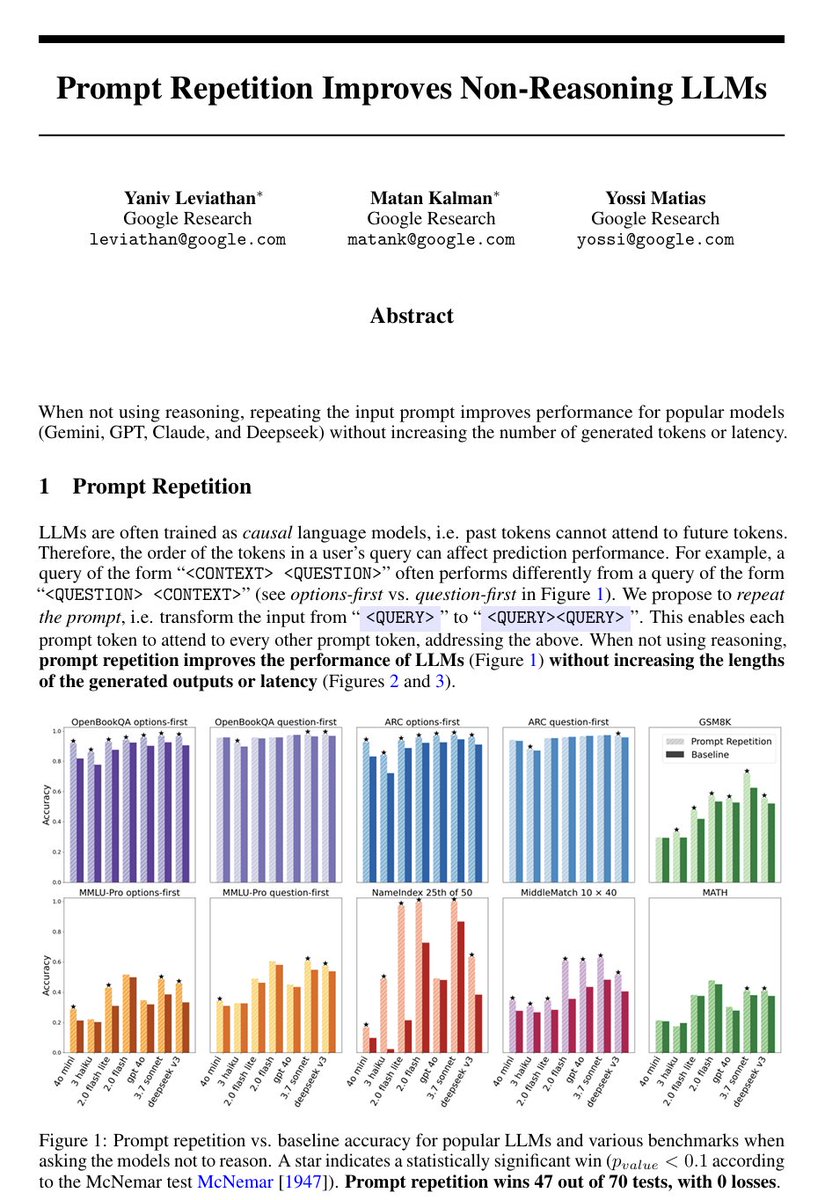
LLMs process text from left to right — each token can only look back at what came before it, never forward. This means that when you write a long prompt with context at the beginning and a question at the end, the model answers the question having "seen" the context, but the context tokens were generated without any awareness of what question was coming. This asymmetry is a basic structural property of how these models work.
The paper asks what happens if you just send the prompt twice in a row, so that every part of the input gets a second pass where it can attend to every other part. The answer is that accuracy goes up across seven different benchmarks and seven different models (from the Gemini, ChatGPT, Claude, and DeepSeek series of LLMs), with no increase in the length of the model's output and no meaningful increase in response time — because processing the input is done in parallel by the hardware anyway.
There are no new losses to compute, no finetuning, no clever prompt engineering beyond the repetition itself.
The gap between this technique and doing nothing is sometimes small, sometimes large (one model went from 21% to 97% on a task involving finding a name in a list). If you are thinking about how to get better results from these models without paying for longer outputs or slower responses, that's a fairly concrete and low-effort finding.
Read with AI tutor: https://t.co/MipHHO6rjX
Get the PDF: https://t.co/XQrqiaGwIO
@ReplitSupport@Replit Great but search is still completely worse than it was before. The only tab it seems to work in somewhat is the file menu and even that won’t allow me to search with the same depth it used to before. Entering an endpoint or url doesn’t identify the files that contain the snippet
@teknium Had more success with claude than gpt-5 in cursor. Not much of a noticable difference in quality between claude sonnet in replit and cursor though. Replits just more geared towards web dev while Cursors nice for desktop applications
@benln Improving the RAG in VaultTalus. Locally run secure storage for passwords/documents with an embedded llm for flexible querying. End goal is a system that provides encrypted storage with the ability to query directly, such as "How much did I spend on food in May".