BREAKING: Fannie Mae says it will start accepting crypto-backed mortgages, per @WSJ.
The mortgage-finance giant will let home buyers pledge their crypto holdings when getting a mortgage.
Fannie is backed by the government and overseen by the Federal Housing Finance Agency.
Lost amid all the CFPB drama, there has been some movement on open banking, specifically the Bank Policy Institute’s lawsuit against the CFPB.
Last week, the BPI and the CFPB jointly filed a motion asking the court for a 30-day stay in the proceedings and the rule’s compliance deadlines, which the court granted (while also denying the Financial Technology Association’s motion to intervene).
So, now the question is, “What will the CFPB do during the 30-day window?”
Best guess is that they will quietly work with the banks to figure out how they can change the rule to accommodate some of the things that are important to banks to the Trump administration.
Here are some of the things that might change:
💰 Expanded secondary data use. Everybody except Rohit Chopra is cool with this. I expect it to happen. The question will be how far it goes.
💰 More banks exempted from the rule. The current rule exempts banks under $850 million in assets. I hear that some in the administration want this threshold to be significantly higher (maybe all the way up to $10 billion?) although I’m not sure why they would want that. It would be a bad outcome for community banks, as it would drive consumers towards the bigger banks that are willing and able to facilitate the data-sharing experiences they expect. Ironically, it would also potentially be good for the existing data aggregators (Plaid, MX, Finicity) because they already have coverage (via screen scraping) of smaller banks, which would be hard for new aggregators to replicate quickly.
💰 Liability and third-party risk management. Banks want hard and fast rules that limit their liability, and they want someone else (e.g., regulators, FDX, etc.) to do third-party risk management and certification. I have no idea if they will get what they want or not.
💰 Payment initiation. JPMorgan Chase wants payment initiation to be descoped from the rule because broad adoption of pay-by-bank would be bad for their debit card and credit card franchises (even though JPMC also offers pay-by-bank today). Data aggregators and large, payments-oriented fintech companies like Stripe want payment initiation to stay in the rule. This one may very well come down to a question of who has more pull with President Trump and Elon Musk — Jamie Dimon or the Collison brothers?
💰 Allowing banks to charge for the data. The big banks really want this, and I think it will happen. The question is, under what circumstances will it be allowed? Will banks be able to charge a set amount to cover their costs or a variable amount depending on market demand? Will they be able to charge for non-covered data (e.g., loans, wealth, etc.) but not covered data (e.g., deposits, cards, wallets)? Will they be able to charge for premium use cases (e.g., cash flow underwriting) but not basic use cases (e.g., account verification)? No one seems to know.
Wowza: The Independent Community Bankers of America released a long statement opposing the consolidation of federal bank regulators, with a jab at "Wall Street executives" to boot
Scoop: In a court filing yesterday in CBW's case against the FDIC, the Acting Solicitor General reversed its previous position in the case, and now "has decided that the multiple layers of removal restrictions for [ALJs]... do not comport with the separation of powers"
NEWS: The White House plans to nominate Jonathan McKernan to lead the CFPB full time and Jonathan Gould to lead the OCC, according to several sources familiar and a WH document sent to the Senate this evening
Scoop: The deputy director of the CFPB, Zixta Martinez, was just placed on administrative leave by the agency’s new chief legal officer, Mark Paoletta.
More CFPB stoppage news: Acting Director Russ Vought tells agency employees to do no work without explicit approval from leadership, per an email sent out this morning
"Employees should not come into the office. Please do not perform any work tasks," Vought says
NEWS: CFPB staff just received an email that the HQ in Washington will be closed the week of 2/10, per note from COO Adam Martinez
USAID playbook happening again
Notably, the court left the door open to potentially modifying its order, so we’re closely monitoring for any developments or new intervenors who may request a broader, nationwide stay. Stay tuned for updates. (4/4)
Breaking News on Commercial Finance and Dodd-Frank 1071:
Today, the Fifth Circuit Court of Appeals granted the plaintiffs' motion to stay the effective date of Section 1071. (1/4)
This means that while many banks and credit unions may benefit from the stay, non-depository financial institutions—such as alternative commercial finance companies and fintechs—are still required to comply with the 1071 deadlines. (3/4)
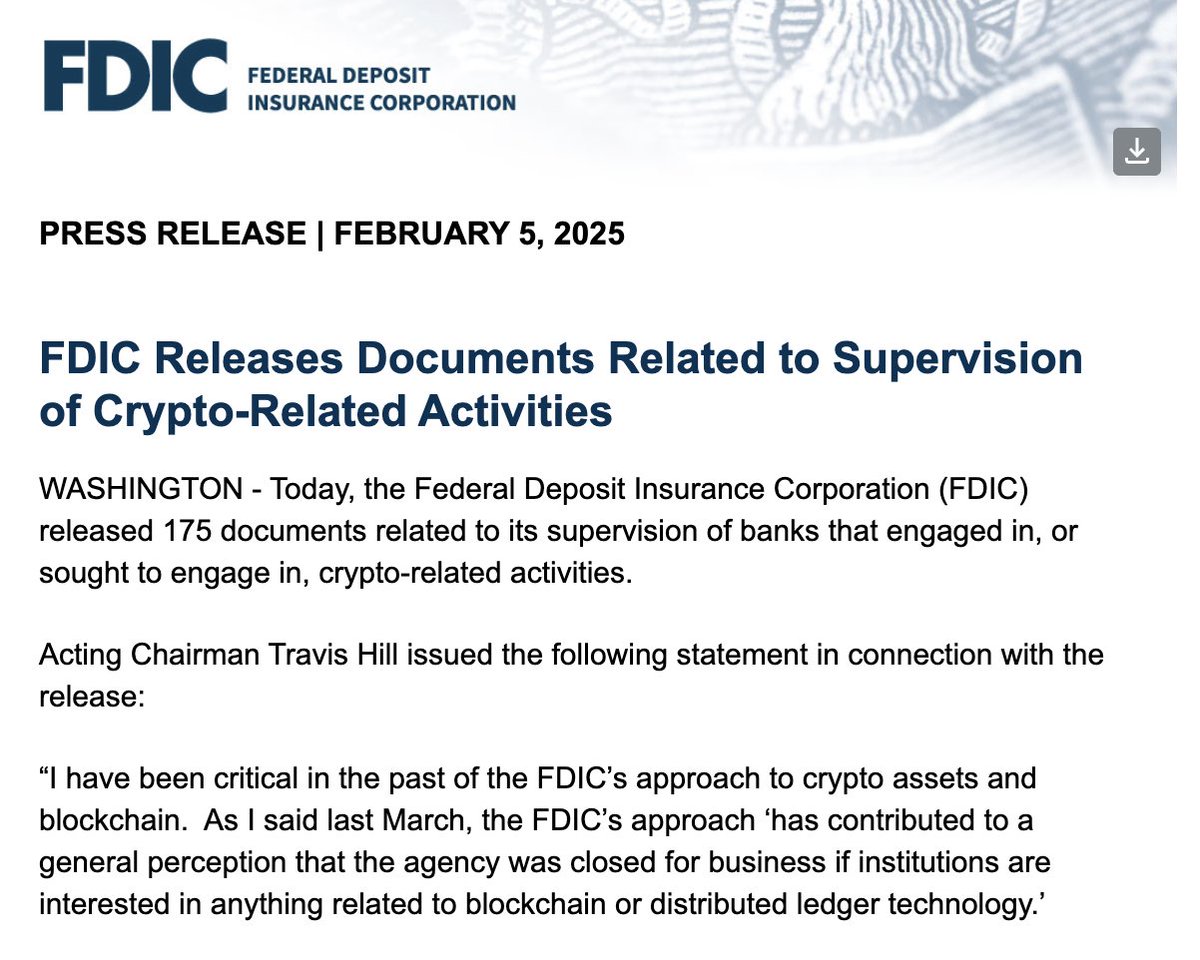
FDIC just released 175 documents related to its supervision of crypto-related activities. Surely everyone will actually READ these before posting, RIGHT?
Nomination news: In a hallway interview, House Financial Services Committee Chair French Hill (R-Ark) says we should expect an announcement from the Trump administration on picks for key financial regulators "in short order -- in the next few days."
BREAKING: On Bluesky, @reporterev is reporting for Bloomberg Law that Bessent is effectively shutting down much of CFPB.
Story here on Bloomberg: https://t.co/GJOwCL2BQT
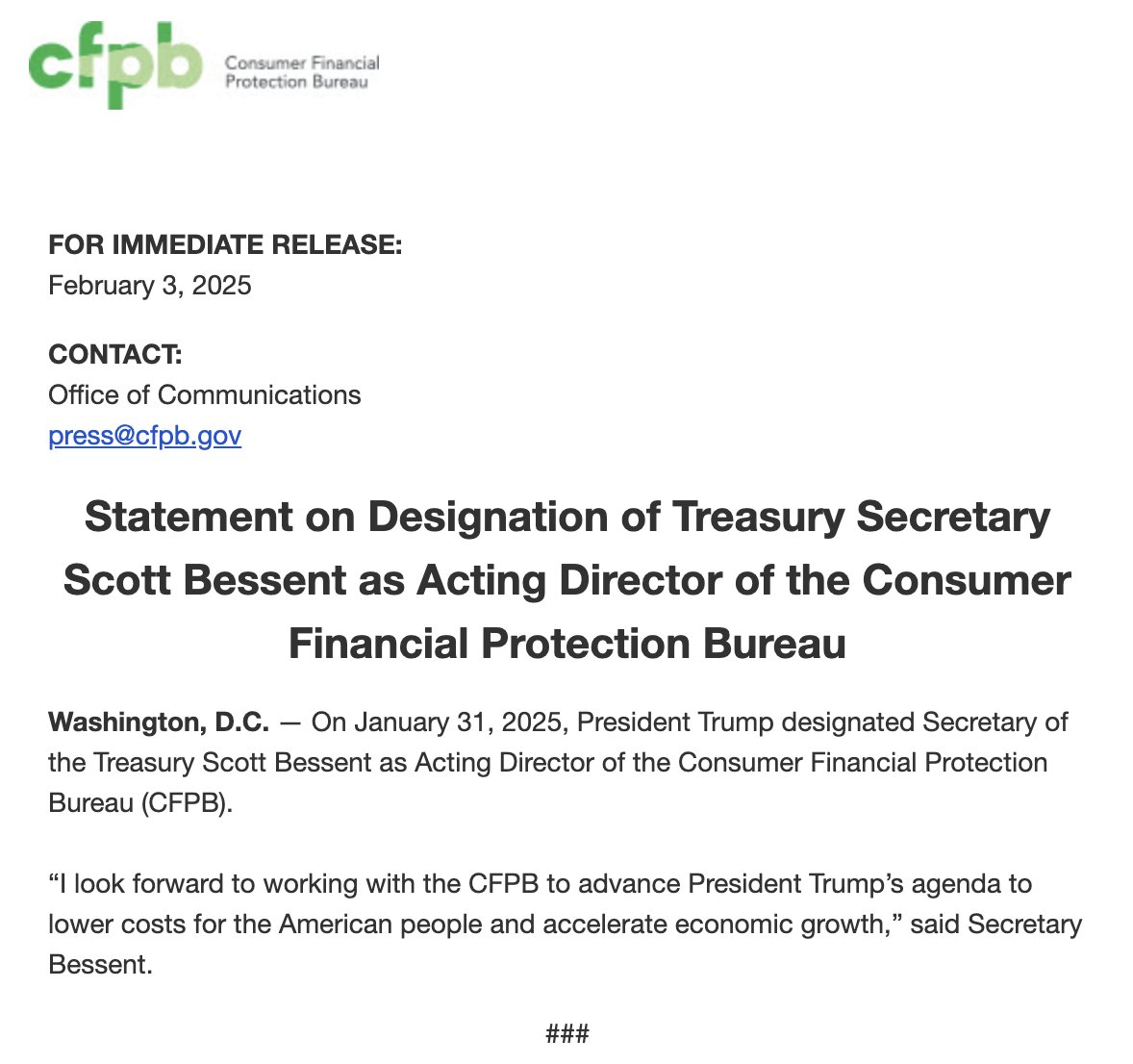
I stand corrected - newly confirmed Treasury Secretary Bessent named acting Director at CFPB, rather than OMB nominee Russ Vought, as had been the rumor:
Still unclear who will ultimately serve as the long-term head of the CFPB under the Trump Administration, but it appears that Treasury Secretary Bessant is set to take on the role temporarily.
https://t.co/GqQESm2TTv
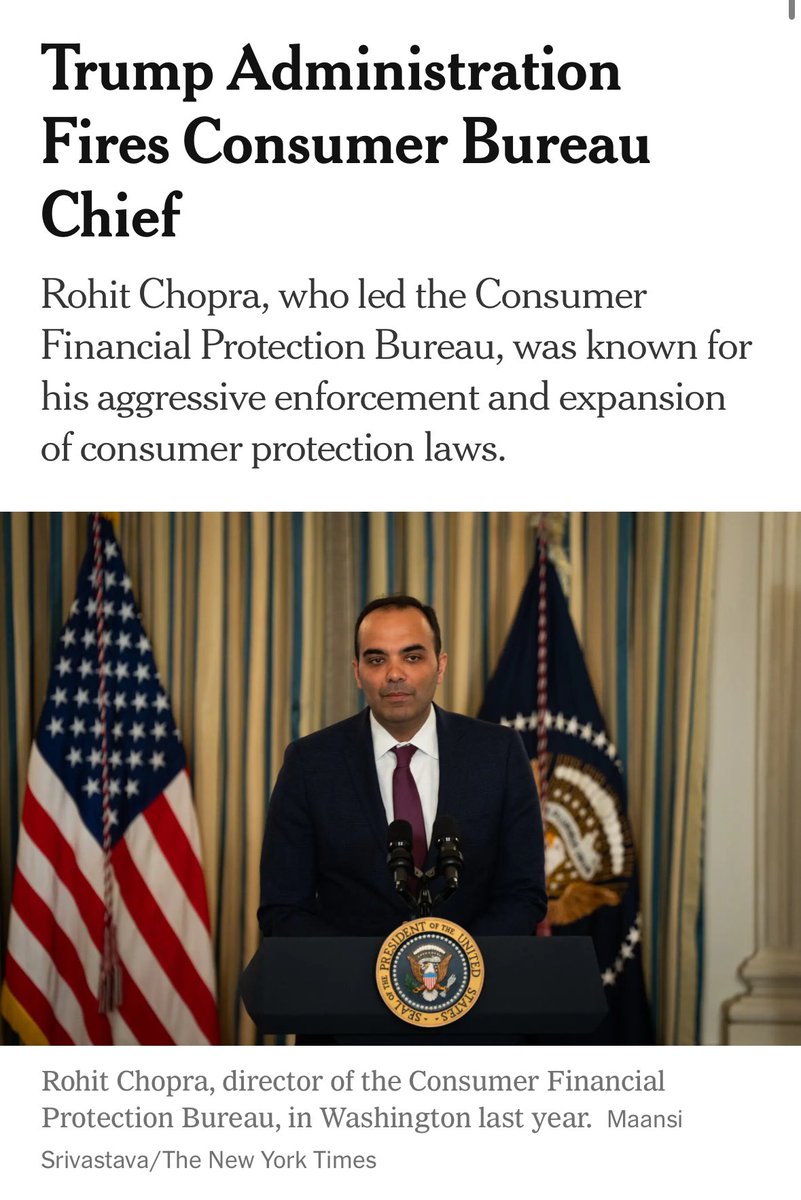
Pour one out for Rohit. CFPB will be led by deputy director Zixta Martinez until Trump names an acting Director, which, sources tell me, is most likely to be incoming OMB Director Russ Vought:


![mikulaja's tweet photo. Scoop: In a court filing yesterday in CBW's case against the FDIC, the Acting Solicitor General reversed its previous position in the case, and now "has decided that the multiple layers of removal restrictions for [ALJs]... do not comport with the separation of powers" https://t.co/wZadCU137O](https://pbs.twimg.com/media/GkpMqcLbkAY13zr.jpg)