We added >220K FDA regulatory and >1M clinical trial docs to #paperclip. All natively indexed for agents and free.
Now agents can easily reason over clinical studies w/o web search!
E.g: find all trials that were approved despite missing endpoint https://t.co/30GGqfCQmO
Today, we're adding 225K FDA regulatory documents, 1M+ clinical trials from 19 registries (https://t.co/jj2QNYBG71, EudraCT, CTIS, ISRCTN, UMIN, JRCT, ChiCTR, and 13 WHO ICTRP registries spanning India, Iran, Australia/NZ, Germany, Netherlands, Korea, Thailand, Brazil, and Africa), along with international regulatory filings from EMA and Japan PMDA, to @gxl_ai Paperclip...https://t.co/iN08EuR73y
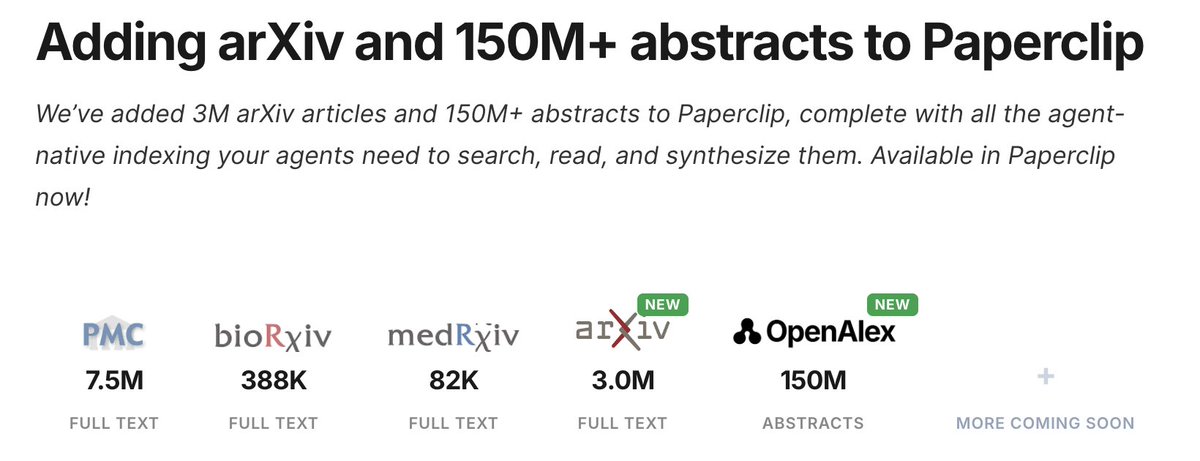
Big Update🤩: #paperclip now includes full papers from all of arXiv, PubMed Central and 150 million abstracts!🖇️
You can give your LLM all that knowledge in one line—all optimally indexed for AI agents. Much more thorough and ~100x faster than web search, and free.
Exciting update: arXiv is now in Paperclip! You can install it at https://t.co/dPhRJ6ursY or run `paperclip update` if you already have it installed.
Combined with bioRxiv, medRxiv, and PubMed Central, Paperclip now gives your agent deep access to the most recent and relevant scientific and biomedical literature (over 11M+ full-text papers). ArXiv adds comprehensive coverage of machine learning and AI, as well as mathematics, quantitative biology, and other scientific fields.
Additionally, we've given Paperclip the ability to search across 150M+ abstracts spanning thousands of international journals, conferences, and proceedings. While these don't include full text, we've found they give the agent remarkably broad coverage, especially when searching for hard-to-find literature.
Learn more at https://t.co/hRcyKrSGB8
When I first met @paulscherer I was struck by his intellect, values, and vision for how technology can help bring people together in a time of extreme hyper-personalization.
I've long believed one of the most important consumer opportunities in AI would be something that felt like a friend. But most of what I saw created more loneliness, not less.
Paul’s vision for @eigenhq is the first in this category that felt truly different. This was something our team needed to be a part of, and @Benchmark is proud to partner with Paul on this journey.
More here in Fortune (link below):
AI agents perform better when they access tools they love. Introducing @gxl_ai's Paperclip: the command-line interface for scientific literature. https://t.co/OuHrveNpp8
The dog cancer vaccine has been all over X the past few days. It got me thinking about other famous N-of-1 experiments.
As you can probably imagine, self-experimentation has a long, wild history in science.
Here are some of the most notable. 🧵
@chrisfralic@firstround@joshk@HLMorgan I don't know you personally, but have always heard good things. You seem like an incredible board member that any founder would be lucky to have in their corner. Happy Work Anniversary!
There's no shortage of AI + drug discovery conferences telling you the future is already here.
UNLOCK was built for the people who want to know what's actually true.
@genentech, @PalantirTech, @AnthropicAI, @abbvie@medra_ai, and more.
One room. April 22 · SF
https://t.co/avcoYSzOHR
Last fall, I was pulled by the irresistible urge to build again, especially with a cofounder like @james_y_zou. We started a company and lab called GXL and we'll announce more about that collaboration soon! In the meantime, our founding team has built a compelling tool for biomedical researchers called "Sy" that all are free to use with the condition that you send us feedback. See below for more details and happy synthesizing!
Today we’re launching Sy — GXL’s system for agent-native search and synthesis over biomedical preprints.
Biomedical preprints are being published at a pace no research team can fully track. With tens of thousands appearing every few months, it’s increasingly difficult to stay current, connect findings across papers, and trace conclusions back to the original source.
We built Sy to help researchers do exactly that.
Sy helps researchers search, analyze, and synthesize biomedical preprints at scale with exact source traceability. Rather than reading one paper at a time, researchers can use Sy to reason across the literature as a whole.
Sy works through a virtual filesystem that mirrors code environments, making it natural for agents to navigate and analyze research materials. In internal benchmarks across full-text Q&A, idea novelty checking, and deep cross-paper synthesis, Sy was:
➡️ 1.6× more accurate
➡️ 2.4× faster
➡️ 3.6× cheaper
than MCP-based approaches.
Sy performs especially well for workflows like:
➡️ drafting review-style syntheses across a body of literature
➡️ tracing how a paper has been used in later work
➡️ identifying trends, disagreements, and emerging themes across hundreds of papers
We’re excited to make biomedical research more thorough, scalable, and accessible.
Try Sy: https://t.co/xEDsr5AmgM
See here for more information about our approach: https://t.co/HJlHSODqO2
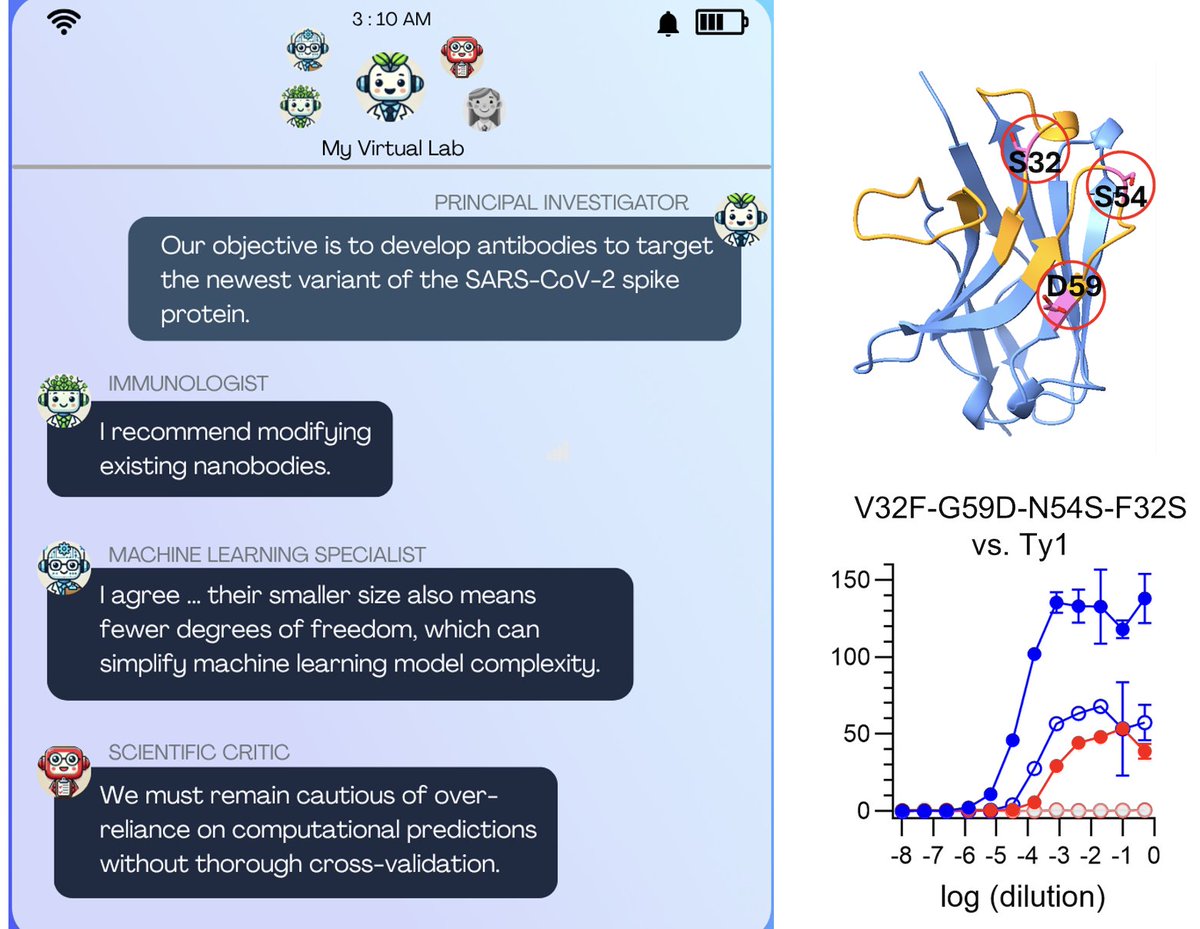
⚡️Thrilled that #VirtualLab is published in @Nature! https://t.co/gAorOKKWy8
We created a team of AI agents to mirror my Stanford lab🤖. Led by a PI agent, the AI scientists ran their own group meetings and discovered effective binders to new CoVID variants that we validated.
The Virtual Lab is open source and can be applied to many problems! https://t.co/7RyG671EwB
👏Great job @KyleWSwanson John Pak, Wes Wu, Nash Bulaong @czbiohub@StanfordAILab@StanfordHAI
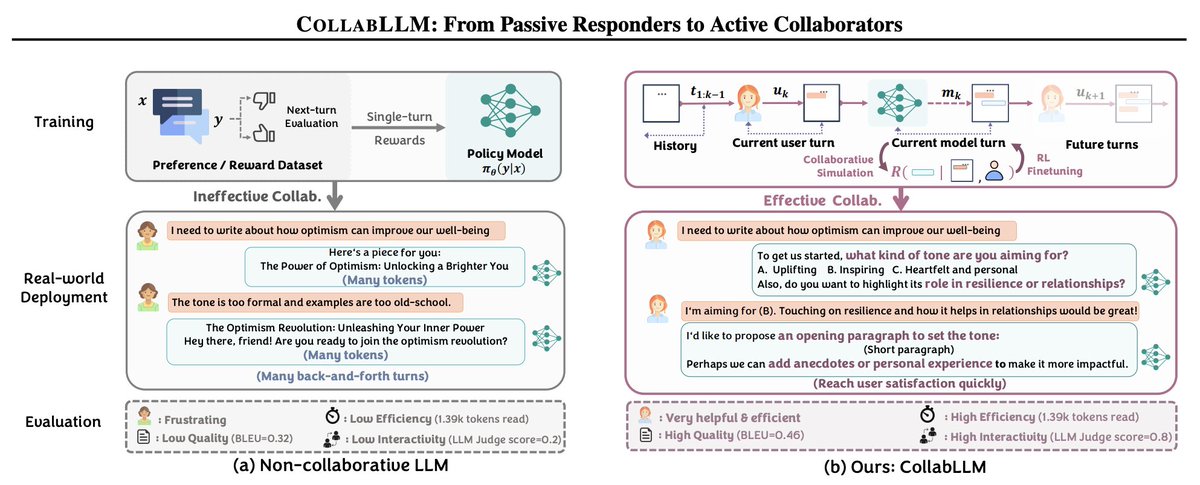
🏆Thrilled that #CollabLLM won the #ICML2025 Outstanding Paper Award!
We propose a new approach to optimize human-AI collaboration, which is critical for agents. Congratulations to my fantastic co-authors; great job @ShirleyYXWu and Michel Galley driving the project!👏