On a mission to unlock the power of biotechnology and empower our global customers to get to milestones and market faster. Academics join for free! 🧫🧬👩🏻🔬
What does it mean to be on #TeamScience? Find out what Benchlings have to say about our mission and culture — and above all, why we’re so passionate about helping scientists power new possibilities for humanity. https://t.co/vbtHiX04Z4
Introducing the new Benchling AI, now built directly inside the notebook where scientists already work.
Now scientists can import data, run analyses, draft reports, build presentations, and more — all from within their notebook.
Try it out today, or read more: https://t.co/RCsoTkgKwN
“I have a very strong belief that science has to happen in the physical world.” Benchling cofounder @daashu spoke with @RandDWorld about what makes a real AI Scientist.
Lab automation will be key. An AI scientist needs a connection into the physical world, a data model that’s rich enough, and an interface that human scientists actually want to use. https://t.co/pkZYH9dIHw
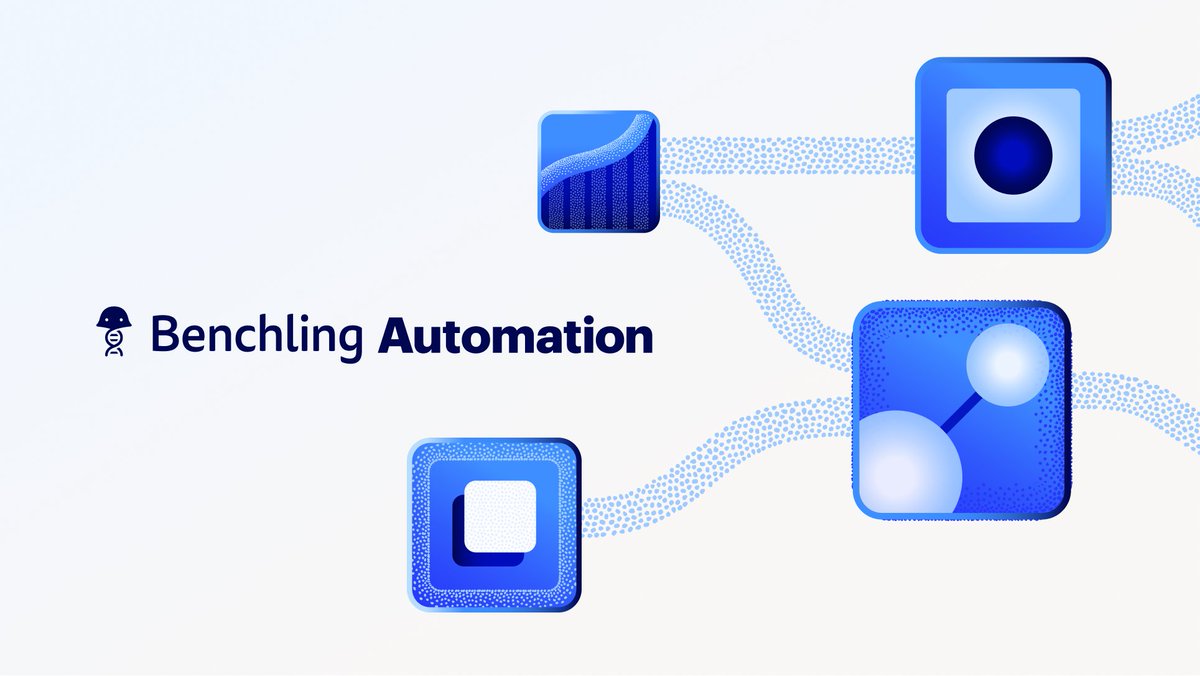
Benchling Automation is an open system for instrument, automation, and analysis — built on the Benchling Platform, unified with your science.
Plus, it works with the instruments and lab automation already in your lab, and the data platforms you use today, whether that’s Benchling or not. https://t.co/J6PSa3ePqQ
At the @ftlive Pharma Summit, Benchling CEO @sajithw predicted the rise of the “generalist scientist” and what that means for the lab of the future.
Roles won’t disappear, but individual scientists will be able to go further and faster.
Lab automation shouldn’t stop when an instrument run ends.
That’s why we built Benchling Automation, a unified solution to automatically connect instrument data to scientific records.
We’re launching with partners across the workcells and instruments scientists are using today: @HighResBio, @automata_tech, @Ginkgo, @CellTrio, @opentrons, and @HamiltonCompany.
Today we’re launching Benchling Automation, a unified solution that connects lab instrument data directly to the scientific record.
Scientists can now:
✔️ Pull data from 200+ instruments directly into Benchling
✔️ Run analytics automatically, with results delivered to notebooks
✔️ Automate workflows with flexible no-code and custom code options
We’re building an open ecosystem and launching with partners powering modern labs: @HighResBio, @automata_tech, @Ginkgo, @CellTrio, @opentrons, and @HamiltonCompany.
Available now: https://t.co/J6PSa3ePqQ
Congrats to the @biohub team! Excited to embed this in the workflow of scientists everywhere.
@salcandido was kind enough to sit down with us and take us behind the scenes building ESMFold2: https://t.co/ALOPKaDiBw
Today we're announcing ESMFold2, an open scientific engine to power prediction, design, and discovery across protein biology.
The new model delivers state of the art performance on protein interactions, especially antibodies, a critical modality for therapeutics.
We have designed and validated miniprotein binders and single chain antibodies across five therapeutic targets that are important in cancer and immunology. We are seeing very high success rates, and affinities at levels consistent with therapeutic activity.
We’re also releasing an atlas of 6.8 billion proteins, and 1.1 billion predicted structures.
ESMFold2 is built on a state of the art language model that has been trained on billions of protein sequences.
A world model of protein biology emerges through language modeling.
We’ve used the techniques of mechanistic interpretability developed to understand large language models to understand the concepts ESM uses to represent proteins.
The model’s representation space has a compositional organization of features across scales, levels of complexity, and abstraction, that reflects and mirrors the understanding of protein biology developed through a century of empirical science.
This understanding emerges without prior knowledge, just from language modeling of protein sequences.
Language models are becoming a powerful substrate to understand and program biology.
The design of protein interactions is one of the most fundamental problems in biophysics, and has critical implications for the discovery of new medicines. A simple gradient based search with the model was able to discover high-affinity protein binders.
I'm excited by the potential this has to accelerate basic science and the understanding of proteins. And especially for the new avenues it opens up for therapeutic design and medicine.
The BioHub ESM ecosystem is live and we went behind the scenes with the team that built it.
We sat down with @biohub to talk about what it actually took to build a world model for protein biology: the decisions, the tradeoffs, and what the ESM Atlas might reveal that no one has found yet. https://t.co/gpP329pC3G
AI-driven antibody design isn’t going to work if your computational and ML teams don’t have structured data.
Most platforms don’t have a standard for capturing and storing antibody data across the growing number of formats. Benchling Biologics does.
Benchling is the only platform that connects the full DBTL loop for biologics, connecting your experimental data and assay results to every protein from the start.
👉 Available now. https://t.co/6OONjMNsFr
“Pipetting is not the problem.” At the @ftlive Pharma & Biotech Summit, Benchling CEO @sajithw talked about all the operational overhead that slows down R&D.
This knowledge work is where AI can really compress timelines at every step and handoff.
See how we're building the AI Scientist: https://t.co/7ShDxbufAu
“Biopharma wastes institutional knowledge at an industrial scale.” At last week’s @ftlive Pharma & Biotech Summit, Benchling CEO @sajithw explained why — and how AI solves for that.
One example: a customer avoided repeating a year’s worth of experiments after AI surfaced that one of their acquisitions had already done the work.
How do you handle the massive infrastructure demands of modern AI biology models? You bring in the inference experts.
Check out this clip from @benchling 's Mihir Trivedi and @baseten 's Bola Malek on why they teamed up to build Benchling Inference.
Dive into the full launch blog post: https://t.co/ktyAkSrQwe
Not every partner can move 1.3 TB of data in under a minute across 85+ clusters.
Hear about the “insane engineering challenges” we had to solve with @baseten to make AI work at scale for scientific workloads.
Everything we’ve learned about tailoring inference for biotech is built into Benchling Inference, powered by Baseten and available to Benchling customers.
Get the details: https://t.co/MLCQ50j4VX
Last week at #ASGCT2026, @PrimeMedicine shared how they used our AI Scientist to accelerate one of the hardest parts of taking an advanced modality to market: the final CMC push toward a BLA.
What normally takes months of manual curation and analysis was compressed into days — and it worked because Prime has been capturing every experiment in Benchling since 2022.
Details: https://t.co/veXrMpTj00
Biotech R&D is generating more scientific AI models than ever, from protein structure prediction to molecular docking to sequence analysis. But the infrastructure to run them hasn't kept up.
Today we're announcing Benchling Inference, powered by Baseten. Together with @benchling, we're delivering on-demand GPU capacity built for the bursty, high-stakes demands of scientific workloads. With Benchling Inference, scientists can:
→ Deploy models in seconds, not weeks
→ Keep proprietary models inside their VPC if needed
→ Benefit from economics that work even at small and mid-size biotech scale
Benchling and Baseten decided to team up because we believe that research teams shouldn't have to manage HPC queues, negotiate cloud contracts, or become GPU experts to run frontier models on their own data.
Six years of inference expertise are now available where science happens.
Read more here: https://t.co/vqmtnXnAT1