7/ The State of the AI FDE
The forward-deployed engineer model Palantir pioneered a decade ago has evolved substantially in the AI era. Initially, the work was mostly data munging and connecting wires. This is because previous FDE deployments largely constituted building data pipelines or visualization dashboards to connect data sources and help surface static insights.
Now, the FDE role is a massively expanded end-to-end service that can include training, deployment, monitoring, and production support where agents read from systems of record to automate entire workflows.
This means FDEs now touch more stakeholders inside the enterprise, which requires building greater rapport with internal teams to show augmentation vs. replacement. It also has the consequence of pitting FDE deployment head to head against the "prior art" form of what worked – humans combined with bespoke services stitched together.
In addition to the role, staffing has also flipped: one FDE can often serve multiple projects, because AI itself and platform leverage in the form of SDKs and agentic infrastructure have changed what's actually possible.
There's no shortcut to any of this. The FDE of the AI era will extract latent knowledge from SMEs, work with customers to construct worthwhile evals to hillclimb, deploy agents that store not just final work products but the traces that create them, and win buy-in from an increasing number of stakeholders, all while navigating the data, timeline, and organizational realities that define every enterprise engagement.
This week Google announced it's hiring hundreds of Forward Deployed Engineers, and OpenAI launched a Deployment Company built around the same role. Enterprise AI deployment is evolving fast - a couple months ago we shared how we're approaching it at @appliedcompute.
6/ You can build the flywheel
The most valuable thing we've ended up doing for customers is building and closing the feedback loop for agents that are deployed in production. The journey to production is non-trivial and involves:
- Understanding the setup of A/B tests to reduce unexpected mismatches in data, tools, and inference;
- Overcoming train and prod mismatches with replicable agent harnesses;
- Aligning with enterprises on their security and governance systems.
But the prize of a closed loop agent in production is immense. Shifting from off-policy to on-policy data is a step change in how fast the agent can improve in production and is our north star for every deployment. And it is an area that we are actively researching alongside our customers at Applied Compute.
Brief obligatory update: I recently joined @appliedcompute to do research on our platform enabling Specific Intelligence for enterprises.
Excited to share our first publication on what we've been doing with Contextbases. Looking forward to sharing more soon!
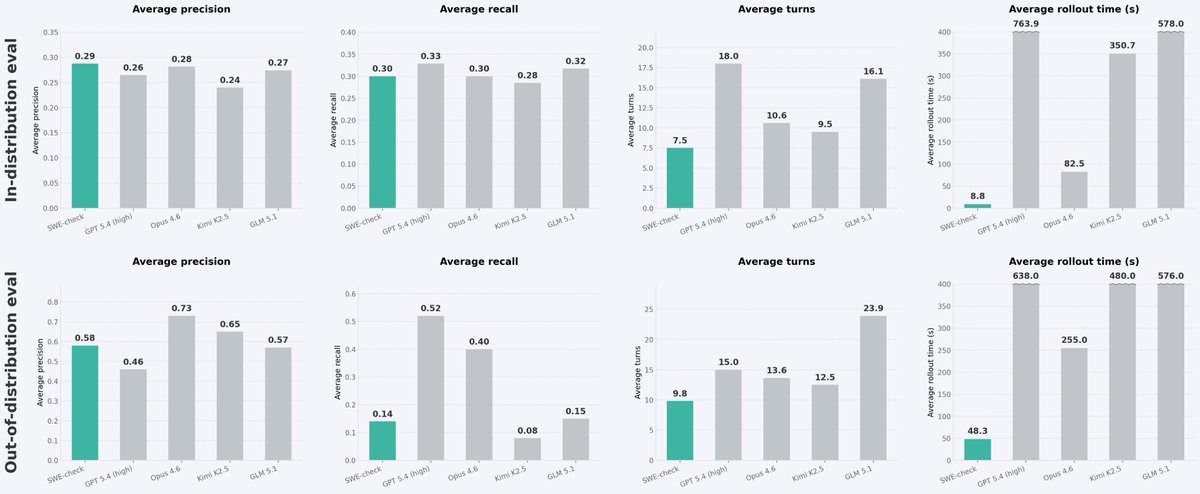
Today we're releasing SWE-check, a specialized bug detection model we RL-trained with @appliedcompute that matches frontier performance on internal in-distribution evals and makes meaningful progress on out-of-distribution evals, all while running 10x faster.