We have raised $200M at a $5B valuation to scale self-improving software development in the enterprise.
@FactoryAI has grown to serve hundreds of thousands of developers at companies including RBC, Adobe, Nvidia, T-Mobile, and Palo Alto Networks.
We will use this capital to accelerate our investments in research, product, and global go-to-market.
@Clay just raised a $115M Series D at a $7.1B valuation.
Now, more than 17,000 teams build on Clay, including Anthropic, SpaceXAI, Google, OpenAI, Stripe, Visa, UPS — and 80% of the Forbes AI50.
@nytimes just broke the news, but the story goes far beyond the raise. AI is unleashing the biggest wave of company creation in history. Clay’s goal is to be the engine they use to grow.
Clay is a self-learning revenue engine that figures out the best GTM play for your company, then runs it.
We started as the company with the best data about other companies. Then we became the infrastructure to run campaigns across email, ads, and landing pages.
Now we’re building agents that learn from every campaign, predict the next best action, and get better each time they run.
Software engineers use coding agents to write code. GTM engineers now use growth agents to autonomously grow their companies.
In 2023, we introduced GTME as a new role for people creating revenue systems with data, automation, and AI. Two years later, thousands of GTMEs are growing the world's best companies. They are gathering in nearly 100 Clay Clubs around the world, from Bangalore to Boston and Lahore to Lisbon.
That’s why we’re proud to launch a $1M scholarship fund, helping more people enter the profession.
@Wellington_Mgmt led our Series D, with participation from @sequoia, @stepstonegroup, @a16z Perennial, @MeritechCapital, DST Global, @CapitalG, @BoxGroup, @boldstartvc, @BloombergBeta, and @EvolutionEquity.
A gracious thank you goes out to our customers, community, partners, team, and every GTM engineer shaping this with us.
We are going to unveil the future of Agentic GTM at SCULPT on October 8.
Stay tuned to see how to use AI to grow every company.
🖤🩵❤️💛
Today, we’re announcing that Forus has raised a $150M Series C at a $3B valuation to build the AI network for medicine.
The round was led by @BainCapVC with participation from @ThriveCapital, @generalcatalyst, @Accel, @Redpoint@BoxGroup, @pearvc, @AvraCap, @humancapital, @neo, @vast_ventures, and @svangel
Forus supports millions of people across all 50 states and is already used by providers to treat patients in 85% of U.S. residential ZIP codes. 9 of the top 15 global biopharma companies work with us, alongside many fast-growing biotechs.
Our goal is to put Forus in every doctor’s office in the country and accelerate the medicine pipeline from discovery to treatment.
The opportunity ahead of us is much larger than what we can take on today. We aren’t constrained by capital or customer demand. We are constrained by the talent and capacity of our team.
We’re hiring exceptional engineers and operators in New York to help us take it on. Come build with us.
We’re announcing that Forus has raised a $150M Series C at a $3B valuation to build the AI network for medicine.
Medicine will remain one of the world’s most important industries until humanity achieves immortality, and we are only at the beginning of a new era in what it can do. GLP-1s are changing obesity and cardiometabolic disease. Gene therapies can treat diseases at their genetic source. New cancer treatments are turning diagnoses that were once fatal into diseases people can live with. AI is enabling us to discover of new drugs even faster.
But discovery is only the beginning. It still takes more than a decade and billions of dollars to turn a new molecule into an approved medicine, and once it reaches market, more than a third of patients prescribed specialty treatments never receive their first dose.
Forus is creating the AI network to accelerate the entire medicine pipeline, from development and launch through prescription and treatment. We connect the companies creating medicines with the doctors who prescribe them and the patients who need them.
Today, Forus supports millions of people across all 50 states and is already used by providers to treat patients in 85% of U.S. residential ZIP codes. 9 of the top 15 global biopharma companies work with us, alongside many fast-growing biotechs. Our goal is to put Forus in every doctor’s office in the country and unlock an order of magnitude more medicine for society.
There is a generational opportunity to rethink how new medicine reaches people. Forus is becoming how medicine moves from discovery to treatment in America, and as we scale, we’ll become the most important company in life sciences.
Forus is not constrained by capital or customer demand; we are constrained by the talent and capacity of our team. To take on the opportunity in front of us, we need exceptional engineers and operators in New York who want to move fast and help us make something that matters. Come build with us.
Our Series C was led by Bain Capital Ventures, with Thrive Capital, General Catalyst, Accel, Redpoint, BoxGroup, Pear VC, Vast Ventures, and SV Angel investing alongside them.
meet @mostik_ai!
what happens when you put 12 PhDs in one room for four months? first place on the ARC-AGI leaderboard, which I can't say much about while the competition is still running. and this, which I can.
everyone's arguing about whether open models will catch up to frontier models. we think it's the wrong question. here's the one we pose: why does a frontier model have to generate your answer at all, when the only thing you need from it is the reasoning?
we do this by enabling models to communicate in latent space. through our protocol, hidden states pass straight from a frontier model into a small one running on your infrastructure -- no text between them, and neither model is fine-tuned. two models from different families, sharing reasoning, both left untouched.
how do we know it works? we tested it on a setup where a 753B model reads the problem, and a 4B edge-class model writes the answer. with this approach, we get results 80% as accurate as the frontier model, but at 20x faster performance.
we're committed to preventing frontier model lock-in and are already partnering with inference providers to accelerate open-weight adoption. we've done this between 15 of us, in four months, 12 PhDs and a Fields medalist, backed by @generalcatalyst
WIRED has the first external account of the company and the work: https://t.co/tP8nItCsDl
full writeup, the setup, and all the numbers: https://t.co/C9NZ5vtV1V
10 years ago I wouldn't shut up about how important distributed GPU infrastructure would become. 7 years ago, I joined Crusoe as their third engineer.
A year ago, I co-founded @AranyaInc. Today we operate $500M+ of compute, and we've raised $11M to date to go much further.
$9M seed led by @firstround, $2M pre-seed led by @asylumventures.
Blog post link: https://t.co/9Mb7hvxAo4
Today we’re announcing r-1, our new document parsing model. It’s more accurate than our most powerful agentic OCR models, faster, and up to 6x cheaper.
At @reductoai, we spent two years building specialized models for complex visual layouts, tables spanning multiple pages, and key formatting like strikethroughs. We then used everything we learned to build r-1, the first in a new generation of models designed to handle the hardest documents without multiplying cost.
This early preview delivers a 20% lower error rate than our most accurate legacy agentic models and will keep improving with new checkpoints over the next few weeks.
Accuracy is only the beginning. r-1 preview is available at 1¢ per page all-in, with additional volume discounts as you scale. In the near term we’re also going to release r-1 mini, and an auto mode that intelligently selects the right approach for each page.
If you’re currently using another parser, we’re offering up to $5,000 in credits to evaluate and migrate. You can claim the migration offer and learn more about r-1 using the links in the comments.
Happy parsing!
Today, we’re introducing Light. ⚡
We’re building the API platform for electricity—enabling companies to launch branded electricity plans embedded directly into their products.
And we’ve raised a $46M Series A led by Matrix.
We’re just getting started.
Some of the earliest money in Cursor (the largest vc-backed acquisition ever) turned a $750,000 investment into a ~$1 billion return. @davidtisch and his midas touch at Box Group strike again! Great profile here of one of the best early stage investors who wins while going against the grain @agarfinks https://t.co/hirdBa5RnP
Congrats to @mntruell@amanrsanger and the entire @cursor_ai team…
We @BoxGroup have been investors since the very beginning and never sold a share… what an honor to be part of such a magical journey
“Lots ahead”
Cursor has officially joined SpaceX.
We’re grateful to become part of such a special company, and it has been a privilege working with the SpaceXAI team. Lots ahead.
Introducing Assert (https://t.co/GzZzf7jGrC): the command center for reviewing engineering work
Watch me review a new feature with Assert's product diff: a UI generated by our agent using mock data. It has completely changed how we work
Out of the box, long-horizon agents struggle to accurately perform end to end work in the real economy (outside of coding) because those tasks are not easily verifiable, the data is hard to scale, and going from inputs to real outcomes can actually take many days.
Even if you had a reliable way to verify outcomes at scale (and weren’t bothered by the multi-hour iteration loops), the sheer volume of decisions by the agent that occur in a multi-hour job makes it hard to know whether performing well will generalize to production.
Over the last two years at @trybasis, we've been solving this problem by supervising the process our agents take to get to outcomes, rather than just looking at whether the outcome itself is correct.
We think this is the key to building production agents at scale.
It's what has allowed us to run agents in production that operate for hours, sometimes days, and reliably perform tasks like entire complex tax returns end to end.
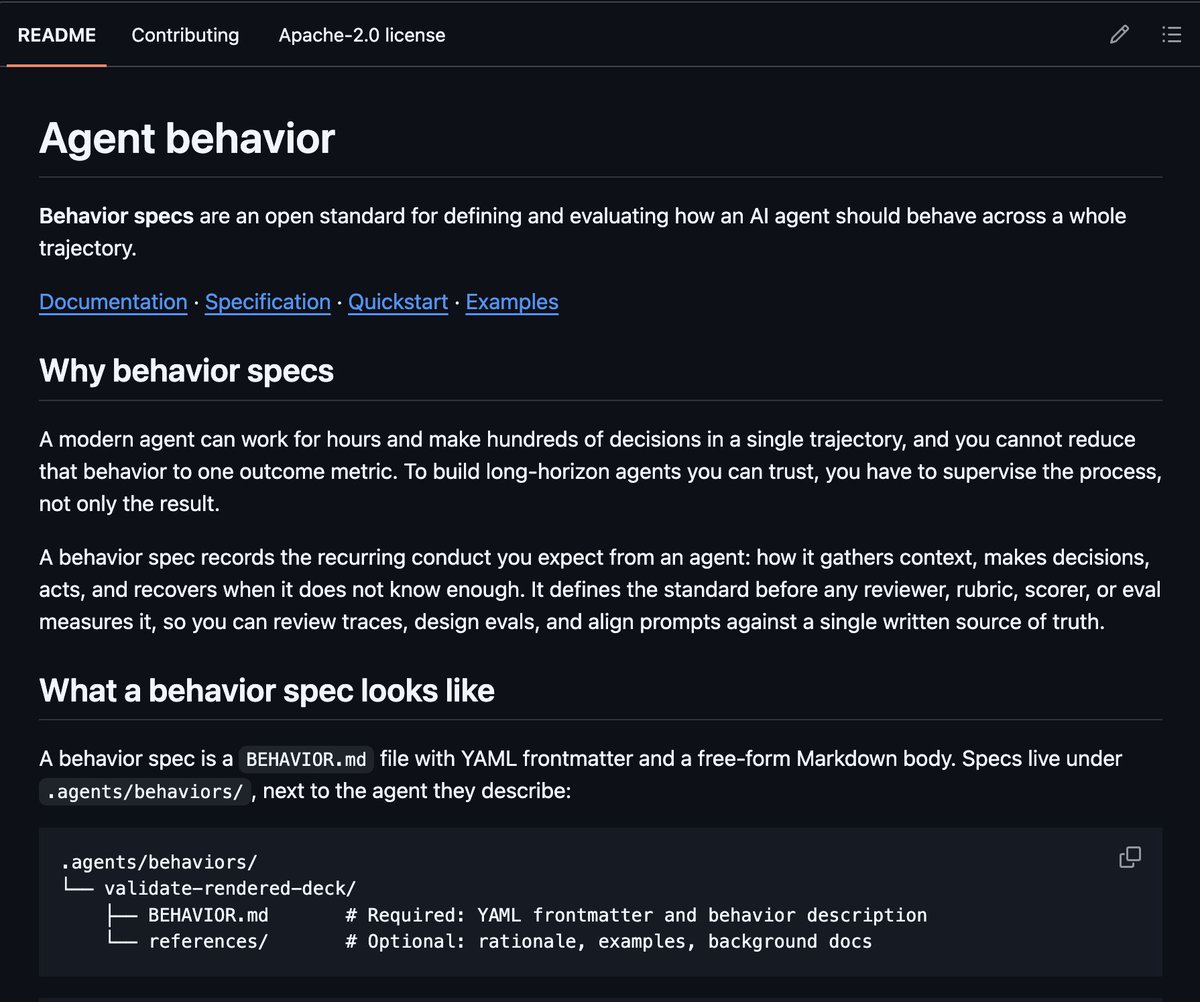
Today, alongside @braintrust, we're open sourcing a standard for defining, evaluating, and eventually rewarding agent behaviors.
Thread below with all the details on how we’re scaling behaviors to close the loop for long-horizon agents.
AI is extremely good at spending your money very quietly.
our own token spend went from a rounding error to more than 10% of payroll in a year. one week in May we burned through $1.5 m. our CFO didn't love telling me that number, and he really didn't love telling the internet.
but every finance leader we talk to is living the same story. the bill keeps going up and teams can't answer basic questions about it. which team is driving it? which models they're using? what changed this month? whether a cheaper model would do the same job?
so finance gets two bad options: keep paying and hope, or cut broadly and slow down the work that's actually compounding.
we built a third one. Ramp now connects to OpenAI, Anthropic, Gemini, Cursor and pulls it all into one place. see it, understand it, control it - down to a single API key. built with 1,000+ companies managing 100T+ tokens a month, and now spending less than they expected too! try it today at https://t.co/dbQK7feZaA
Introducing Aidan, your newest AI employee
Aidan is the first computer-using AI built for realtime conversation
We’ve raised $45M from @sequoia and @8VC to bring Aidan to the world
@NotionHQ and @DecagonAI already use Aidan to run customer interactions. This is how @withsableai works:
It is officially a White Circle Summer ⚪ At least it is in Sweden!
We're excited to announce our technical partnership with @Lovable to help make AI safer, more secure, and more reliable at scale.
Read more below ↓
Today, we’re launching @TuvaAI to build a human-centric future for agentic science.
Humans collaborating with AI can learn more than either working alone: humans guiding the research, equipped with agents that can test ideas quickly and autonomously, will deliver the next wave of scientific discovery. But science is all about the details. Neither Einstein nor AGI can drive your project forward without intimately understanding your growing, interrelated web of hypotheses, intermediate results, working threads, failed experiments, datasets, notes, and water cooler conversations.
Our first product, Rao, was born out of my frustration having to reteach LLMs these constantly changing details for every single task in my own research. Rao maintains a persistent, dynamic research memory that learns and remembers project context, history, and threads. This research memory then links into our scientific agents as well as other AI software you may already be using, such as Claude or Codex. With Rao, every scientist turns into a PI managing a proactive, agentic research team that automatically stays on the same page.
Rao is live in VS Code and by CLI, and can help with any scientific task that can be done in a computer. Our early users include computational biologists, theoretical neuroscientists, chip designers, and polymer physicists who use Rao daily to ideate, do math, analyze data, and write papers and grants.
Now, we’re excited to announce Rao in closed beta. If your science mostly happens in a computer—theory, computational modeling, experimental data analysis, scientific writing—Rao can help you discover more, faster. Sign up for our waitlist, and if you’re a fit, we’ll work with you to tailor new, contextual agents that augment the way you do science. Link in the comments.
More personally: I’ve been doing scientific research since I was a kid. Scientists do so much for the world, choosing a painstaking career for the joy of discovery, developing technologies we use every day along the way. And yet, the tools scientists use are often cumbersome and woefully out of date. For me, Tuva is much about empowering the people of science with products they love as it is about the discoveries we’ll help them make. And I’m lucky to work with some wonderful humans along the way—@SamsaraDurvasu1@anuvellore@KimchiOfer among many others. If our mission resonates, please reach out.
Many companies are #1 in a benchmark they crafted.
We worked with @micro1 to create an independently audited benchmark to measure document extraction performance with long documents.
The results of LongExtractBench show the nuances companies are likely to find in the real world. micro1 tested frontier models with max reasoning and document processing platforms with their strongest configurations, and found notable precision/recall and completion tradeoffs across most.
Reducto’s Deep Extract leads the industry by a wide margin. 🧵
While everyone’s displacing jobs, we’re creating them. A Hero for every family.
@hellotohera’s favorite friend 83 year old Stanley Zareff dropped by our office to learn what being a Hero means and announce our 27M Series A led by @BainCapVC, and continued participation by @Accel and @iaventures 🧵
Today @karimatiyeh and I are both taking new titles as Co-CEOs of @tryramp.
If you know us, this won't feel like a change. From when we first started building together twelve years ago, our partnership has run on a couple of motivating principles. On decision-making, we trust each other completely to make critical calls for the company across every function. And on organization design, technology is not a distinct part of the company - it is the entirety of it. That is why Karim has for years directly managed risk, operations, and marketing.
Most importantly, at Ramp there is no line between the people who build and the people who do everything else. Everyone is a builder.
For the last 2,656 days, we have run the company this way. This only makes it formal. We thought it was important to do it now because of how we see the AI exponential reshaping what Ramp can be. Decisions of company strategy are increasingly decisions of technology and systems design. We have always believed every function should be approached as a systems-engineering problem (even when the system was primarily human) but the rise of machine intelligence makes this existential. Every part of the company must be positioned to leverage the continued explosion in model intelligence and capabilities. If we do this well, each step-change in what models can do compounds automatically into better products and faster execution without anyone having to rebuild the company to capture it. If we fail to operate this way we will ultimately be outcompeted by a new company that does.
We are also making Rahul Sengottuvelu our CTO. @rahulgs has led Applied AI at Ramp since joining us three years ago through the acquisition of his prior company, Cohere. Before that, his first company was building customer-service agents on GPT-3 at a time when almost no one knew what a large language model was, and he has spent every year since pushing the frontier of what existing models can do. He has also been right on nearly every major technical direction in AI well before it was obvious. Building Ramp now means applying AI to every part of it, and Rahul is the person stepping up to lead that work.
We are still very early in the history of Ramp. Our current chapter is perhaps the most dynamic, but we have never been more optimistic on where it is going and the mission has never been more important. The businesses that trust us are navigating the same shift we are, and we intend to be there for all of it: managing their token spend, supercharging their finance teams, and helping them get more out of every dollar and hour.
- Eric & Karim