Here we have Victoria Nuland in 2016, bragging to US Congress about how thoroughly Washington had taken over Ukraine after the 2014 coup.
She spelled it all out without shame:
🔴US operatives embedded in a dozen Ukrainian ministries.
🔴American-trained cops patrolling 18 cities.
🔴The US Treasury gutting 60 Ukrainian banks while sparing depositors to keep people quiet.
🔴Hundreds of millions of dollars funneled into molding Ukraine’s military.
This wasn’t "assistance", it was a takeover dressed up as aid.
"Unprovoked"
😂😂😂😂😂
There is a strange development in which academics of international politics are expected to publicly condemn adversarial countries before they are allowed to participate in public discourse. The complexity of international politics is reduced to a moral question of good versus evil, and academics must make moral declarations before even discussing facts, history, strategy, and interpretations. Academics should explain why states behave as they do; they are not moral validators.
What value does it bring to an analysis if the analyst "condemns" one side? After Russia invaded Ukraine, the former Norwegian foreign minister actually argued that "this is not the time to understand, but to condemn". This ridiculous position is pushed on academics. However, understanding is not endorsement, explanation is not advocacy, and ignorance is not strength. I argue it is in Russia's security interest to push NATO away from its borders, it is in Iran's interest to control the Strait of Hormuz, and it is in China's interest to create a new international economic architecture. This is not advocacy, nor is it a normative position about how the world should work; rather, it is a recognition of how the world actually works.
An academic should examine interests, capabilities, and strategic calculations that produce such policies—not participate in ritualised declarations of virtue that contribute absolutely nothing. Furthermore, moralism and condemnation often lead to a lack of understanding and increased conflict. When the conclusion is always that the good guys are confronting the bad guys, then the solution is always "peace through strength", "weapons are the path to peace", and defeating the latest reincarnation of Hitler. If you want war, condemn the other side as pure evil. If you want peace, the first step is to understand the other side.
🇪🇺🇺🇸🇨🇳 John Mearsheimer believes that NATO's setbacks in the Russia-Ukraine war and Trump's invasion of Greenland may completely destroy NATO's status as an effective alliance.
However, despite this, Europeans will still put aside their pride and try their best to prevent NATO from collapsing because NATO means that the United States will remain in Europe to provide security.
Europeans are eager to be protected by the United States too much; "America is a tranquilizer for Europeans."
So let me put this in plain language.
Europe keeps acting like China owes them something, while groveling at America’s feet like a loyal pet that just wants its master to “love it again.”
Trump openly treats Europe like a pack of useless strays, and they still beg for approval, yet when talking to China, suddenly they grow a backbone: lecturing about “human rights,” “IP,” “overcapacity,” “security threats,” whatever Washington whispers, Europe screams twice as loud.
It’s the purest form of moral cosplay: punch up at China, kneel down to America, strength worship upward, cruelty downward. No self-respect, no strategic sanity, no grip on reality.
And the funniest part?
They actually think repeating “We are the West, we had the Enlightenment, we once ruled the world” will stop their decline. As if nostalgia is a development strategy.
The old world order is collapsing in real time, not because others destroyed it, but because its own guardians refuse to look in the mirror.
China just turned the night sky into a masterpiece of precision and intelligence. 🌌
What struck me most about this is how seamlessly innovation turns into art.
A drone show in Chongqing just broke the Guinness World Record with 11,787 synchronized drones, creating breathtaking 3D animations that looked closer to CGI than real life.
No human pilots.
No delays.
No crashes.
Every movement guided by AI and GPS, choreographed with perfect timing.
To me, this is far more than a light show.
It’s a glimpse into how technology, creativity, and coordination can merge to shape a new era of expression and innovation.
When intelligence takes flight, it doesn’t just illuminate the sky — it redefines what’s possible.
Could this be the moment where technology begins to turn the world itself into its stage?
#AI #Innovation #Technology #Drones #Automation #Creativity #China #Engineering #FutureOfWork #DigitalArt
Credits: longliveai
That moment when comedian Dave Smith shocks Joe Rogan with his view about NATO expansion, the 2014 Ukraine coup, and how American policies led to the War in Ukraine, bringing the world closer to a potential nuclear World War III.....
Amanda Sloat (Biden's top National Security Council official for Europe) recognises that if NATO had promised not to expand, then the war could have been avoided.
** This comes after our political-media establishment has for 4 years smeared, censored and cancelled anyone who claimed that NATO expansion triggered the war
** It is strange how these people present the US as a passive actor in the question of NATO expansion, and suggest that the only alternative to NATO expansion is a Russian “sphere of influence”
Zelensky in March 2022 (before the US & UK sabotaged the Istanbul peace agreement): "There are those in the West who don't mind a long war because it would mean exhausting Russia, even if this means the demise of Ukraine and comes at the cost of Ukrainian lives"
This translated discussion (link at bottom) between two of China's top international relations scholars - Zhang Yunling and Tang Shiping - is really interesting.
It illustrates just how profoundly different Chinese thoughts on foreign affairs are, and how much more sophisticated they are than what we're used to hearing in the West.
First of all, small bio:
- Zhang Yunling is the Director of the Institute of International Studies at Shandong University (next to the birthplace of Confucius) and a Member of the Chinese Academy of Social Sciences, China's most prestigious institution for social sciences.
- Tang Shiping is a distinguished professor at the School of International Relations and Public Affairs of Fudan University, Shanghai's top university. He's on Twitter by the way: @ShipingTang
A summary of some of the more interesting points:
External constraints are helpful for China
Zhang Yunling says that "external constraints—as long as they do not lead to confrontation or attempts to destroy China—are actually helpful for our country".
Which at first glance is completely counter-intuitive: if you listen to Western international relations scholars like Mearsheimer, a country's foremost objective should be to have as little constraint as possible.
So how does it make sense? Zhang explains that "all major powers have a tendency towards self-centredness and hegemony. [On account of] today's challenging international landscape, maintaining hegemony involves enormous costs." So in effect he believes that external constraints help check these natural impulses to be self-centered - aka hubristic and not listening to the world - and/or hegemonic, which he says "involves enormous costs", meaning it is not sustainable or beneficial for China (or any other power).
Zhang further emphasizes that this view is based on his "basic judgment" that "in today's world, no country has the ability to invade China anymore." Which means that external constraints shouldn't be too worrying as they effectively aren't existential.
One way to view it is like in a competition between companies. A company that's unconstrained, with no competition, will become a fat complacent monopoly and in the long run this sows the seeds of its eventual demise.
Against black and white thinking
This is typically the one thing that we in the West have the hardest time with in Chinese thought, because it comes so naturally to us to think in absolutes, to see something as either "good" or "bad" and someone as either "with us" or "against us", which always necessarily leads us towards confrontation. This way of thinking is however almost completely absent from Chinese thought, they simply do not think like this.
This is reflected in the discussion here. For instance Zhang argues that in reaction to the U.S. forcing countries to take side, China shouldn't start doing so in turn but instead opt for the concept of “choosing projects, not sides” [选项不选边]. And in case some countries do choose to side with the U.S. the concept with them should be “choosing sides but still choosing projects” [选边亦选项] whereby "these countries may have to side with the US on certain issues, but this does not mean they will completely refuse to cooperate with China." As Zhang explains, the overall objective of all this is to "create a flexible space for coexistence" as opposed to "be swayed by our emotions" and "define relationships based on the choice of sides".
Similarly for China's periphery they speak of the concept of "my neighbours and I", meaning that "China and its neighbours jointly create a region of coexistence, with the goal of achieving coexistence and coprosperity". This is in stark contrast with, for instance, the US's Monroe doctrine of establishing a "backyard" through brute force. As Zhang explains, China's approach purposefully establishes no hierarchy between countries, prioritizes dialogue and negotiations "instead of traditional military force", considers others' interests, all with coexistence and mutual prosperity as ultimate objectives. Also, they have a concept of "close but not intimate" [近而不亲], meaning that they purposefully seek to maintain certain distances or boundaries with their neighbors in order to avoid situations of dependence and to uphold the concept of China not imposing sides.
Some will immediately say "but the South China Sea" or "but the Philippines", but looking at the bigger picture it's absolutely undeniable that all in all China's neighbours have become prosperous thanks to China's rise. For instance it's incredible to think that ASEAN's economy added more to global economic growth between 2000 and 2020 than did the whole of the EU! And a big part of the reason is because China-ASEAN trade exploded from $40 billion in 2000 to $975 billion in 2022. It's also undeniable that despite skirmishes here and there, peaceful coexistence is a fact: there have been no wars in the region in over 4 decades and it's undeniable that countries in the region aren't forced by China to choose sides. On the contrary, countries that are involved in these skirmishes like the Philippines are those that - quite the coincidence - unequivocally chose to vassalize themselves to the U.S...
All in all, this shows that China doesn't see the world in binary terms but rather seeks the emergence of self-reinforcing mutually beneficial system with its neighbors and the world. Which is less costly for China (in terms of military, paying off vassals, etc.) and in the end more beneficial: if your neighbors thrive, if the world thrives, you also benefit in multitude of ways. At the end of the day it's a more sustainable and flexible approach than a Monroe doctrine imperialist approach with all the negative consequences we witness today.
On the new world order
They say that "China does not seek to replace or defeat the United States" but still "hopes to change the world", in particular by "giving more space to developing countries and creating opportunities for shared participation in and distribution of global wealth".
For this Zhang proposes the idea of “building temples, renovating temples, but not demolishing temples”. He defines it as such: "China can establish new systems [i.e. economic, regulatory, political etc.]. If you are able to, go ahead and build them, [but] your ideas must be widely accepted. This is not about forming alliances or drawing together military cliques; rather it is more about reflecting China's economic interests. 'Renovating temples' means supplementing existing systems. 'Not demolishing temples' means being a builder, not a destroyer."
They also differentiates the notion of "responsible major power" as opposed to the U.S. which they see as a "destructive power". More concretely, they argue that a "responsible major power" has three roles: "defender [捍卫者], contributor [贡献者] and builder [建设者]" which is to be contrasted from "the traditional path of hegemonic expansion". This is in the context of them believing that in the new world order "power will shift from being overly concentrated to being more dispersed", so China sees itself as playing a crucial role in shaping a more balanced global system that better represents the interests of non-Western and developing countries, while still working within and improving upon existing international frameworks rather than overturning them entirely.
Overall conclusion: This discussion reveals a level of strategic depth in Chinese foreign policy thinking that often goes unrecognized in the West, and one that's also more and more absent in Western thinking. What's particularly striking is the emphasis on sustainable, long-term strategies that see the world holistically as opposed to a sum of parts. By advocating for a "flexible space for coexistence" and rejecting the binary thinking that often dominates Western approaches, it shows that China is simply playing a different game altogether. We're very, very away from the halfwitted neocon thinking we've been too used to...
Ultimately, this discussion underscores the need for Western policymakers and scholars to engage more deeply with Chinese strategic thinking. If only to understand what China actually seeks instead of our usual habit of assuming they think like us, but also because it offers fascinating ways of redefining how international relations could potentially work.
Link to the discussion: https://t.co/vLqwx0qG5u
Lars Findsen: Regeringen taler unødigt frygten og utrygheden op med nyt ministerium - Altinget - Alt om politik: https://t.co/Qx5vOV20OV https://t.co/0G3wI2W1Us
🧵Former Israeli diplomat and NSC official @eranetzion says Biden should call Netanyahu and force him to a ceasefire: “He should tell him what Eisenhower told Ben Gurion in ‘56...
‘Sign the f___g hostage deal NOW, or face all of America's wrath. Believe me, Netanyahu will sign it.’
This is perhaps the most important and powerful case against AUKUS that I've heard, especially because it comes from one of Australia's preeminent strategic thinkers: Hugh White, inaugural Director of the Australian Strategic Policy Institute (ASPI) and former Deputy Secretary for Strategy and Intelligence in the Australian Department of Defence.
Here's what he says:
- White argues that the era of Anglo-Saxon (British and American) dominance in the Western Pacific is ending. He states: "We are facing one of the, perhaps the biggest transformation in our shared international setting since European settlement." This transformation is driven by China's rise as an economic and military power comparable to the United States.
- As a result he argues that there's no alternative to treating China as an equal partner: "Nobody really knows what America's aim in Asia is. But one thing's for sure, nobody in Washington thinks they should treat China as an equal partner. And my basic argument to my many friends in Washington is that if they don't treat China as an equal partner, then they're going to be taking on a rivalry with China that I don't think they can win."
- He emphasizes this point repeatedly, arguing that given China's economic and military power, especially in the Western Pacific, the U.S. cannot maintain its previous position of uncontested primacy: "I don't see how, in an era where China's economy is as big as America's, in an era where its military power in the West Pacific is really quite comparable to America's, in an era where China is increasingly potent as a nuclear armed power, the US and China can find a way to get on in which the United States doesn't, at the very least, treat China as an equal partner."
- White sees AUKUS as problematic because it aligns Australia (and potentially New Zealand) with a U.S. strategy that refuses to acknowledge this new reality. He argues that by supporting AUKUS, these countries are effectively endorsing a primacy approach that is "not a smart way to go" and risks destroying both their prosperity and their security, because they'll "only be prosperous and secure if the United States and China can find a way to get on."
- On the economic benefits arguably brought by AUKUS: "The idea that you buy those economic benefits at the price of committing yourself to support an approach to this really fundamental question about the shape of our future order in Asia, which I don't think is going to work, that would be a very high price to pay for a very doubtful benefit."
China is undergoing a reading and bookstore renaissance that stands out as a puzzling exception to both its apparent inward turn and hyper digitalization. There are many more books available— both Chinese & translations. Some recent bookstores in Beijing and Guangzhou:
Xiaomi has a fully-automated factory that can make 10 million smartphones a year. It cost RMB 2.4 billion. A unit comes off the line every second. AI optimizes the manufacturing process faster than human workers could manage. https://t.co/POqt8IvJ3J
Huawei officially opens its 2,600-acre R&D center w/ 35,000 scientists/engineers
Lianqiu Lake R&D Center expected to gather all of Huawei’s R&D efforts, including HiSilicon, wireless technologies like 5G-A/6G, smartphones, AVs, digital energy research.
https://t.co/9DFZTCoRgN
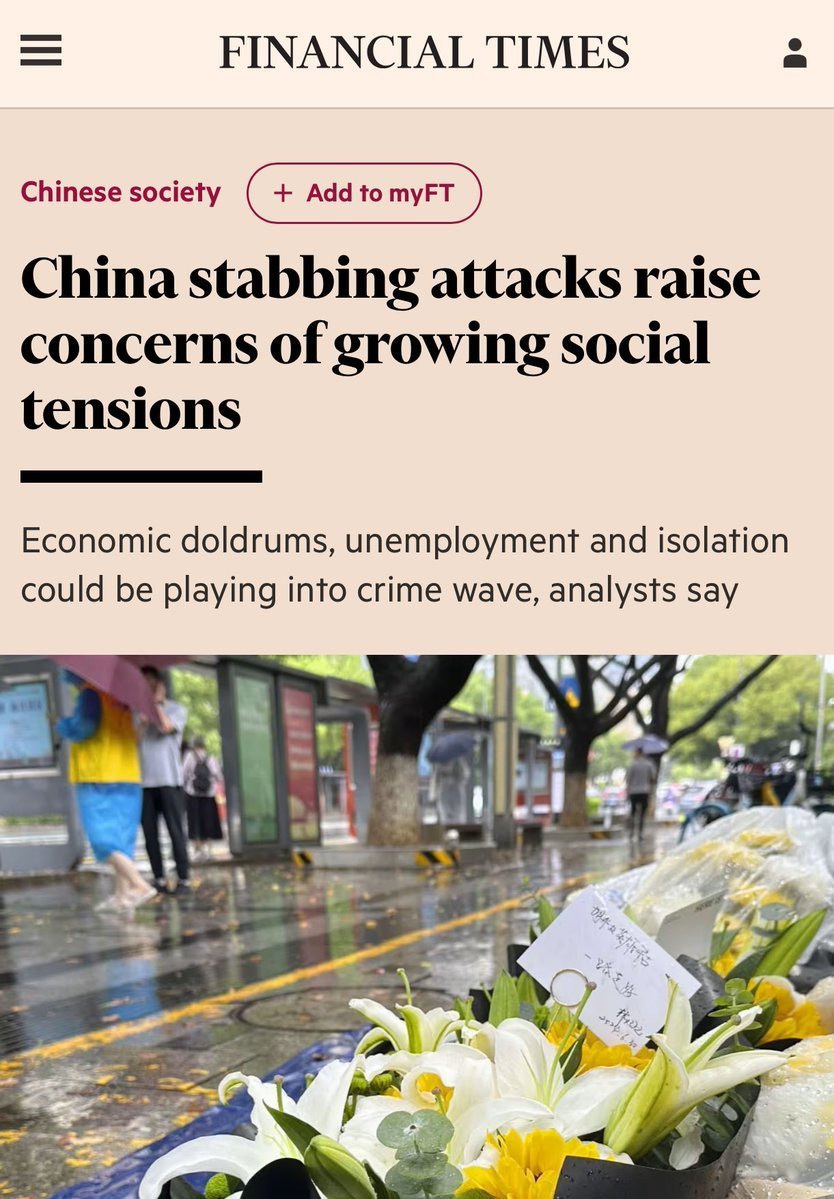
This is actually hilarious. China has 2 stabbings attacks recently - two - and the FT is doing a whole piece on the "crime wave" that's overtaking the country, how that reveals deep issues in China, bla bla bla.
Meanwhile in London alone last year there were 12,786 stabbings. A subject, I checked, that the FT hasn't written a single article about in 6 years (even though it's their own country)...
Call it the fool's-based international order: Every government of a major Western country is in chaos. Biden is an embarrassment. Kishida polls at 21%. Macron's party got 15% of the vote in the June 9 European Parliament elections, and the three German coalition parties together got 30%. Britain's Tories poll at 20%. Nothing like this has ever happened before-1968 comes closest. Our Atlanticist elite is dragging the world kicking and screaming into a place it doesn't want to go, and electorates are rebelling.







![RnaudBertrand's tweet photo. This translated discussion (link at bottom) between two of China's top international relations scholars - Zhang Yunling and Tang Shiping - is really interesting.
It illustrates just how profoundly different Chinese thoughts on foreign affairs are, and how much more sophisticated they are than what we're used to hearing in the West.
First of all, small bio:
- Zhang Yunling is the Director of the Institute of International Studies at Shandong University (next to the birthplace of Confucius) and a Member of the Chinese Academy of Social Sciences, China's most prestigious institution for social sciences.
- Tang Shiping is a distinguished professor at the School of International Relations and Public Affairs of Fudan University, Shanghai's top university. He's on Twitter by the way: @ShipingTang
A summary of some of the more interesting points:
External constraints are helpful for China
Zhang Yunling says that "external constraints—as long as they do not lead to confrontation or attempts to destroy China—are actually helpful for our country".
Which at first glance is completely counter-intuitive: if you listen to Western international relations scholars like Mearsheimer, a country's foremost objective should be to have as little constraint as possible.
So how does it make sense? Zhang explains that "all major powers have a tendency towards self-centredness and hegemony. [On account of] today's challenging international landscape, maintaining hegemony involves enormous costs." So in effect he believes that external constraints help check these natural impulses to be self-centered - aka hubristic and not listening to the world - and/or hegemonic, which he says "involves enormous costs", meaning it is not sustainable or beneficial for China (or any other power).
Zhang further emphasizes that this view is based on his "basic judgment" that "in today's world, no country has the ability to invade China anymore." Which means that external constraints shouldn't be too worrying as they effectively aren't existential.
One way to view it is like in a competition between companies. A company that's unconstrained, with no competition, will become a fat complacent monopoly and in the long run this sows the seeds of its eventual demise.
Against black and white thinking
This is typically the one thing that we in the West have the hardest time with in Chinese thought, because it comes so naturally to us to think in absolutes, to see something as either "good" or "bad" and someone as either "with us" or "against us", which always necessarily leads us towards confrontation. This way of thinking is however almost completely absent from Chinese thought, they simply do not think like this.
This is reflected in the discussion here. For instance Zhang argues that in reaction to the U.S. forcing countries to take side, China shouldn't start doing so in turn but instead opt for the concept of “choosing projects, not sides” [选项不选边]. And in case some countries do choose to side with the U.S. the concept with them should be “choosing sides but still choosing projects” [选边亦选项] whereby "these countries may have to side with the US on certain issues, but this does not mean they will completely refuse to cooperate with China." As Zhang explains, the overall objective of all this is to "create a flexible space for coexistence" as opposed to "be swayed by our emotions" and "define relationships based on the choice of sides".
Similarly for China's periphery they speak of the concept of "my neighbours and I", meaning that "China and its neighbours jointly create a region of coexistence, with the goal of achieving coexistence and coprosperity". This is in stark contrast with, for instance, the US's Monroe doctrine of establishing a "backyard" through brute force. As Zhang explains, China's approach purposefully establishes no hierarchy between countries, prioritizes dialogue and negotiations "instead of traditional military force", considers others' interests, all with coexistence and mutual prosperity as ultimate objectives. Also, they have a concept of "close but not intimate" [近而不亲], meaning that they purposefully seek to maintain certain distances or boundaries with their neighbors in order to avoid situations of dependence and to uphold the concept of China not imposing sides.
Some will immediately say "but the South China Sea" or "but the Philippines", but looking at the bigger picture it's absolutely undeniable that all in all China's neighbours have become prosperous thanks to China's rise. For instance it's incredible to think that ASEAN's economy added more to global economic growth between 2000 and 2020 than did the whole of the EU! And a big part of the reason is because China-ASEAN trade exploded from $40 billion in 2000 to $975 billion in 2022. It's also undeniable that despite skirmishes here and there, peaceful coexistence is a fact: there have been no wars in the region in over 4 decades and it's undeniable that countries in the region aren't forced by China to choose sides. On the contrary, countries that are involved in these skirmishes like the Philippines are those that - quite the coincidence - unequivocally chose to vassalize themselves to the U.S...
All in all, this shows that China doesn't see the world in binary terms but rather seeks the emergence of self-reinforcing mutually beneficial system with its neighbors and the world. Which is less costly for China (in terms of military, paying off vassals, etc.) and in the end more beneficial: if your neighbors thrive, if the world thrives, you also benefit in multitude of ways. At the end of the day it's a more sustainable and flexible approach than a Monroe doctrine imperialist approach with all the negative consequences we witness today.
On the new world order
They say that "China does not seek to replace or defeat the United States" but still "hopes to change the world", in particular by "giving more space to developing countries and creating opportunities for shared participation in and distribution of global wealth".
For this Zhang proposes the idea of “building temples, renovating temples, but not demolishing temples”. He defines it as such: "China can establish new systems [i.e. economic, regulatory, political etc.]. If you are able to, go ahead and build them, [but] your ideas must be widely accepted. This is not about forming alliances or drawing together military cliques; rather it is more about reflecting China's economic interests. 'Renovating temples' means supplementing existing systems. 'Not demolishing temples' means being a builder, not a destroyer."
They also differentiates the notion of "responsible major power" as opposed to the U.S. which they see as a "destructive power". More concretely, they argue that a "responsible major power" has three roles: "defender [捍卫者], contributor [贡献者] and builder [建设者]" which is to be contrasted from "the traditional path of hegemonic expansion". This is in the context of them believing that in the new world order "power will shift from being overly concentrated to being more dispersed", so China sees itself as playing a crucial role in shaping a more balanced global system that better represents the interests of non-Western and developing countries, while still working within and improving upon existing international frameworks rather than overturning them entirely.
Overall conclusion: This discussion reveals a level of strategic depth in Chinese foreign policy thinking that often goes unrecognized in the West, and one that's also more and more absent in Western thinking. What's particularly striking is the emphasis on sustainable, long-term strategies that see the world holistically as opposed to a sum of parts. By advocating for a "flexible space for coexistence" and rejecting the binary thinking that often dominates Western approaches, it shows that China is simply playing a different game altogether. We're very, very away from the halfwitted neocon thinking we've been too used to...
Ultimately, this discussion underscores the need for Western policymakers and scholars to engage more deeply with Chinese strategic thinking. If only to understand what China actually seeks instead of our usual habit of assuming they think like us, but also because it offers fascinating ways of redefining how international relations could potentially work.
Link to the discussion: https://t.co/vLqwx0qG5u](https://pbs.twimg.com/media/GY2U2bwakAAgZ_c.jpg)