The affluent focus on tennis, golf, skiing, sailing, and running/endurance sports.
It's as much about socializing with your kind as it is about the actual exercise itself.
And bulky bodybuilder types generally look very out of place in that world.
However.
An athletic, capable physique commands respect no matter the social class.
We are animals at the end of the day.
And both men AND women pay more attention to a man who is visibly physically capable.
Ideally you are wealthy AND physically capable.
That's the ultimate combo.
You will have a level of confidence that few possess.
The merely wealthy man often makes pathetic attempts to use their money to impress others (especially women).
I saw this at a bar last weekend.
I was chatting with a nice young lady and a 45 year old out of shape man came up to us and literally told us within 15 seconds that he had recently bought a house and then he pulled out pictures.
The girl and I exchanged a knowing glance as we quietly chuckled at his peacocking
Meanwhile, the merely physically capable man often overcompensates for their lack of financial success by building a cartoonish physique, wearing tight clothing, or behaving like a brute to try to use their only strength (their physicality) to demonstrate social status.
The rare man who possesses both wealth and physicality can truly be himself.
Comfortable in any room, never trying too hard, simply watching the peacockers with amusement.
At the end of the day, health matters more than money.
I'd rather be healthy than wealthy if I had to choose.
But you don't have to choose.
Pursue both at the same time and you're more likely to succeed on all fronts 🫡
If #AI truly requires a national rescue, then perhaps the market has already answered the question of whether the economics ever stood on their own.
One thing seems increasingly clear: the fair value of the leading frontier AI companies today is likely a lot lower than it appeared at their last funding rounds.
As open-source models rapidly improve, scarcity declines, competition intensifies, and financial engineering which reached unprecedented levels, the assumptions underpinning those record valuations deserve to be re-examined.
I wrote extensively about this late last year.
Capitalism is built on both success and failure. Investors who reap the upside must also bear the downside. If private gains are protected by public backstops/bailouts whenever things go wrong, that isn't capitalism - it's a transfer of risk from shareholders to taxpayers.
Protect critical national infrastructure if necessary. But don't bail out investors or preserve inflated valuations.
We've spent the last 20 years repeatedly intervening to prevent markets from clearing. We shouldn't make the same mistake again.
Let markets do their job.
#OpenAI #AnthropicAI $SPY $QQQ #Capitalism @usgov@SecScottBessent@howardlutnick@federalreserve@USTreasury
Call me crazy, but I think parents should determine what their teenagers do online rather than the government.
And that governments shouldn't use system-level ID checks to identify and monitor everything.
No, you don't get it.
He does not have $1 trillion sitting in cash, it is 99% stock in his companies.
To make that wealth liquid would mean selling all that stock which would swiftly destroy *both* the companies (Tesla, SpaceX, others) and the wealth. If he sold it all, he'd end up with maybe $100b max, several hundred thousand people would be out of work, the companies ruined and many of their suppliers also ruined.
Okay, but now Elon has $100b in cash, and can "solve the world's problems".
$100b divided by the world's 8 billion people is $12
If you were in charge, several of the most innovative industrial companies in the world would be destroyed, hundreds of thousands out of work, and space would again close to human civilization for another generation.
But everyone on earth could have one nice meal and you could revel in your altruism.
Charles Schwab is a financial powerhouse that manages more than $12 trillion in client assets, making it one of the world's largest brokerage and wealth management firms.
A few days ago they released a paper stating the precise reason for how they are valuing Bitcoin and why they believe Bitcoin deserves a place in virtually any portfolio.
What makes this particularly noteworthy is that Schwab did not rely on narratives, hype, social media sentiment, or predictions about future adoption. Instead, they focused on something far more fundamental: the economics of Bitcoin production.
Their analysis highlights a concept that has been discussed for years within Bitcoin circles but is now increasingly entering mainstream finance:
The cost of mining a bitcoin.
Unlike traditional currencies, which can be created at the discretion of central banks, every new bitcoin requires a measurable expenditure of real-world resources. Massive amounts of electricity, specialized hardware, infrastructure, maintenance, and capital investment are consumed by a global network of miners competing to secure the Bitcoin network.
According to Schwab's research, this production cost creates a fundamental economic floor beneath Bitcoin's value.
While market prices can move significantly above or below this level in the short term, miners cannot indefinitely sell bitcoin at a loss without eventually shutting down operations. Over time, the economics of production exert a powerful influence on price.
This framework is familiar to investors in commodities such as gold, silver, copper, and oil.
The cost of extracting these resources from the ground has long been used as a benchmark for valuation. Schwab argues that Bitcoin can be analyzed in a similar manner.
The implication is profound.
For years, critics claimed that Bitcoin had no intrinsic value because it generates no cash flow and pays no dividend. Schwab's paper challenges that argument by pointing out that Bitcoin's value can be anchored to the measurable and recurring costs required to produce it.
In essence, Bitcoin is not merely digital code floating in cyberspace. It is a monetary asset backed by the continuous conversion of energy into scarcity.
This does not mean mining cost perfectly predicts market prices.
Bitcoin can and does trade far above its production cost during bull markets, just as gold often trades at multiples of its extraction cost. Investor demand, macroeconomic conditions, liquidity, and adoption trends all play important roles.
However, Schwab's research suggests that mining economics provide a rational framework for understanding Bitcoin's long-term value proposition.
Perhaps most importantly, the report reflects a broader shift taking place across Wall Street. The debate is no longer whether Bitcoin has value.
Increasingly, major financial institutions are debating how to measure that value.
When one of the world's largest wealth managers begins discussing Bitcoin through the lens of production costs and fundamental valuation models, it signals that Bitcoin is moving further away from the realm of speculation and deeper into the realm of a recognized financial asset.
That evolution may prove to be one of the most important developments in Bitcoin's history.
Charles Schwab’s research frames Bitcoin less as a purely speculative asset and more like a commodity, where its value is partly anchored in the cost of production. In their model, mining costs, driven by electricity, hardware, and network difficulty, create a “marginal production cost” that acts more like a long-term reference point than a strict price floor.
They estimate that inefficient Bitcoin production can sit roughly in the $90,000 to $100,000 range per BTC, depending on energy prices and mining conditions.
Schwab does not treat this as a guaranteed support level, but rather a zone around which Bitcoin tends to oscillate across market cycles, similar to how commodities move above and below extraction cost.
From that perspective, a Bitcoin price around $60,000 is not abnormal. It reflects typical cyclical stress where price temporarily trades below production cost during deleveraging phases.
Historically, these periods tend to reset mining economics, reduce supply pressure, and gradually pull price back toward the cost of production over time.
Chart shows Bitcoin price, efficient miner production, and inefficient miner production. (Copyright: Charles Schwabb).
Full article in first comment 👇
The Iranian navy, which has been destroyed eight times, has apparently closed the Strait of Hormuz again, because the United States, for the seventh time, won the war that wasn’t a war, so now the United States has to open the Strait of Hormuz that was already open before the not-war began.
The not-war began because Iran had uranium that was totally, completely, beautifully obliterated, so they can’t build the nuclear bomb they weren’t building, which is why the United States had to start the not-war it definitely didn’t start.
Now the United States, which has nuclear weapons, is threatening to use nuclear weapons to stop Iran from getting nuclear weapons, because nuclear weapons are far too dangerous for countries with nuclear weapons to allow other countries to have.
If the United States saw the United States doing what the United States does in other countries, the United States would invade the United States to liberate the United States from the tyranny of the United States.
I’m sick of it. The Bitcoin gloom and disappointment. Don’t you see what is underway?
When you close your eyes, there’s one number you should see in your mind: $500T of fiat assets.
That’s how much global asset value is sitting in Bonds (fixed income) & Money (M2 fiat currency). Why does that matter?
Because that giant reservoir of ~½ the world’s asset value contains the potential energy necessary to power hyperbitcoinization.
This is what Saylor sees.
But do you see it yet?
Consider Hoover Dam. The reservoir behind it contains 12 TWh of usable hydroelectric energy – it just looks like one big lake, calm and placid. But if you stick a pipe through that damn and put a turbine generator in the middle of it and let the water run through it… you can generate enough energy to power the city of Las Vegas for 5 years.
That’s potential energy. Stored, untapped power. And by removing the barrier for the water to flow towards a lower energy state, you can harness the pent up power of the reservoir.
This same mental model works for capital.
A high Sharpe ratio is the financial analogue of a low-energy equilibrium state. Capital flows downhill, always seeking lower risk per unit of return.
(Yes, I know everyone thinks about it as “highest return per unit of risk”, but this is the equivalent and helps understand the physical metaphor)
Do you see it yet?
Think about all the capital parked in fixed income instruments or money market funds. All of this capital is parked there because it has historically provided an acceptable trade-off of modest nominal returns for minimal risk.
The entire premise of fixed income is “here’s a way to park cash in low-risk instruments that will generate a positive return slightly greater than inflation.” Adjacent to this asset category is “cash and cash equivalents” where the value proposition is somewhat smaller returns in exchange for even less risk.
And over the decades, a steady stream of capital has found its way into these asset buckets that promise low risk and modest nominal returns via future fiat cashflows.
These buckets have become a giant fiat reservoir, brimming with nearly $500T of capital.
Do you see it yet?
Along comes Strategy. @saylor realizes that much of this $500T of capital would be better off if it flowed into Bitcoin. But Saylor also recognizes that this reservoir of capital is inherently constrained. Boxed in by convention, investment mandates, risk management, volatility aversion, etc.
It won’t flow to Bitcoin on its own. It can’t – it’s walled off, dammed up.
Strategy engineers a solution. Creates a product to meet that capital where it’s at. The $500T fiat asset reservoir wants low risk, low volatility, fiat cash flows. Strategy designs preferred equity instruments that solve for these constraints, while Strategy uses the fiat capital proceeds to buy Bitcoin (which it believes will appreciate at 29% CAGR for the next 20 years).
In exchange for capital today, STRC offers 11.5% annual returns with volatility asymptotically approaching 0. The Sharpe ratio is off the charts. It breaks everything in tradfi portfolio allocation. At first glance, it seems impossible. But it works because it’s not powered by risk-taking layered on top of fiat inflation; it’s powered by the ongoing monetization of a superior monetary asset whose endogenous properties ensure its appreciation when valued in fiat currency units over time.
Saylor terms this kind of Bitcoin-powered fixed income offering “Digital Credit.”
When a commodity flows from a high-energy state to a low-energy state, it releases energy. In the case of Hoover Dam, that energy can be used to power a hydroelectric turbine. In the case of Bitcoin treasury companies with Digital Credit offerings, that energy can be used to power shareholder returns for common equity holders. This can happen in every major capital market in the world.
Do you see it yet?
Strategy has stuck a pipe through the dam. A conduit through which capital can flow out of the Fiat Asset Reservoir and towards a low-energy equilibrium state. Digital Credit offerings (e.g., STRC, SATA, and others) create that value proposition.
And what’s the Total Addressable Market (TAM)? All $500T of fiat assets in the reservoir.
The recent SpaceX IPO Prospectus recently made a splash by claiming the company had a combined $28.5T TAM, proclaiming that this was the “largest TAM in human history.”
But my essay from 2023 titled “Bitcoin’s Full Potential Valuation” already articulated how Bitcoin’s TAM is all value itself, above and beyond the usual lens of annual economic activity across industries. Saylor read it, adopted it for his presentations, and built on it with the Bitcoin24 valuation model.
The SpaceX Prospectus is wrong. Bitcoin has the largest TAM in human history.
And Digital Credit has the second largest TAM in human history – the $500T Fiat Asset Reservoir.
Do you see it yet?
Digital Credit offerings will redirect some % of the $500T Fiat Asset Reservoir into Bitcoin. This will happen because the value proposition of Digital Credit offerings is higher Sharpe than anything I am aware of in the entire $500T reservoir, inflation-adjusted.
Think of it as the Second Law of Capital Dynamics: capital flows toward assets offering superior risk-adjusted returns.
If Digital Credit ingests 1% over the coming decades, that’s $5T. It seems unreasonably pessimistic to think that only 1% of the $500T Fiat Asset Reservoir would be interested in vastly better returns with a similar (or better) risk profile.
Let’s say Digital Credit appeals to a (still-conservative) 10% of the $500T fiat asset reservoir, that’s $50T.
Bitcoin is currently a $1.5T asset.
Do you see it yet?
Digital Credit may direct a torrent of $50T of capital into Bitcoin over the coming decades. All of it bidding for a finite supply of Bitcoin.
The scale of that inflow would likely drive Bitcoin’s valuation to $10m/BTC, or ~$200T total.
Digital Credit is the plumbing of hyperbitcoinization.
This is how it happens – you’re watching the early stages of Bitcoin’s monetization megatrend.
The question is: do you see it? Or will it have to play out first?
why i am so bullish on crypto, in "defense of the ideological"-
i recently watched the video of the first public appearance for jensen and elon together, which was at GTC 2015 more than ten years ago. by this time, jensen had already made his iconoclastic bet on parallel graphics processing for over twenty years, and on CUDA since 2006. musk had his hassabis moment in 2012. yet openAI was not yet founded (would be ~9 months later), and GDX-1 would be announced at GTC the following year too
this is that narrow window where a revolution is visible to some but not others, in which both of these geniuses had early inklings of recognizing AIs pervasive potential, but the broad public was not yet made aware. it would take another 10 years for it reach mainstream applications of course
i broadly think of the crypto industry being the same place today. just as there were brilliant minds who understood the revolution that would come from the GPU paradigm, there was simply no large scale consumer demand that required its objective superiority for decades to come. instead, it was picked up by hobbyists (ie gamers) who enjoyed a sense of self-determination by pushing the boundaries of their passion, tinkering, sharing, and researching. in a rather strange way, gamers subsidized AI's development, just like early defi subsidized the institutional tokenization development.
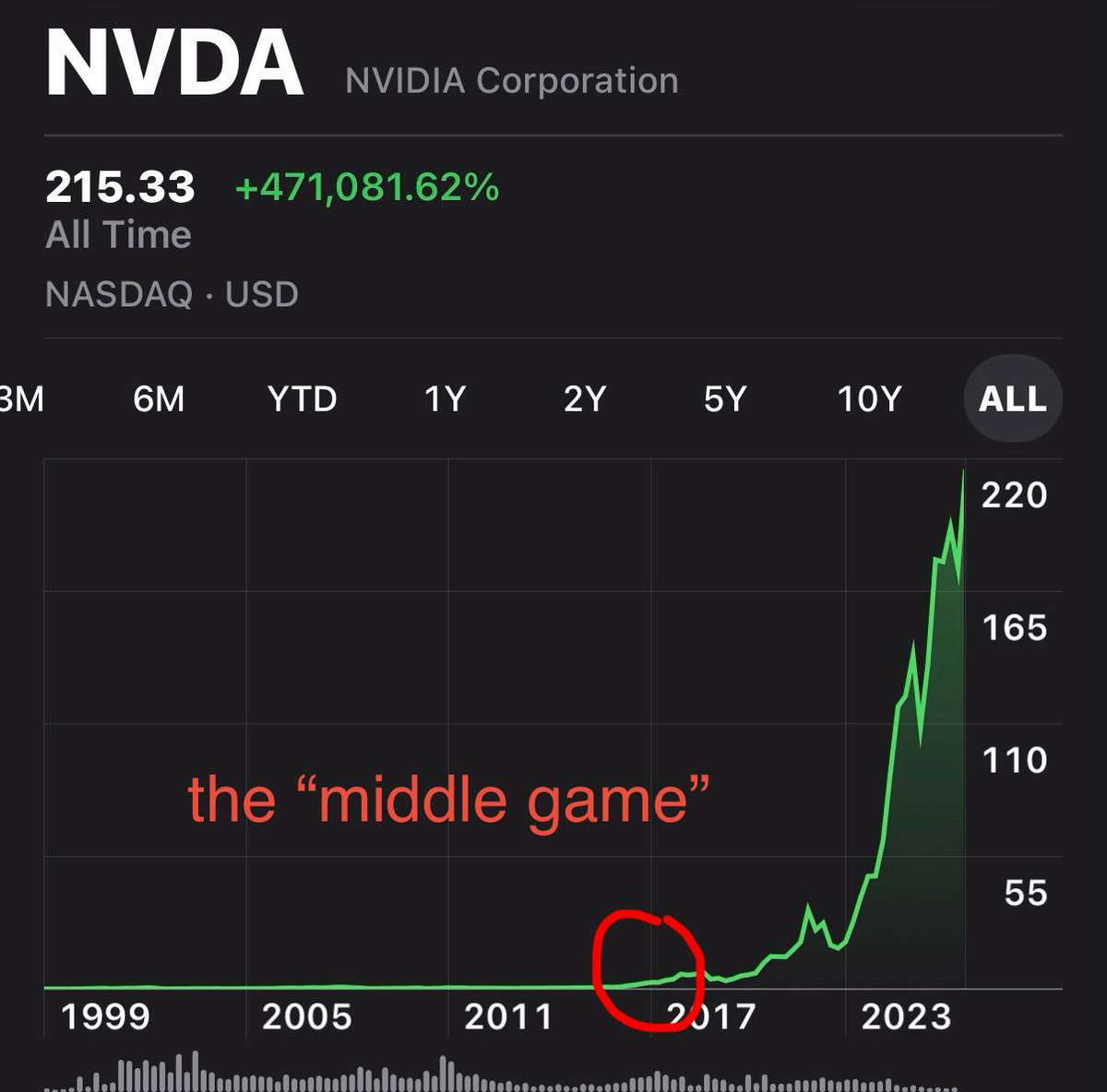
during the GTC 2015 interview, elon tells jensen something interesting: the 0-10 mph autonomous driving is very easy to solve because the car can be stopped. the 50+ mph zone is also easy to solve because there are rules of engagements at that speed that dont have as many randomness. the hardest part to solve is actually the 10-50mph, what i call the "the middle game" where a car in an urban setting with bikes, children, cones, manholes, create all kinds of need for precision and speed that sensors today need to develop further. it's fundamentally solvable, but this is the most challenging portion of fulfilling the dreams of autonomous driving
this is where crypto is today. the 0-10mph was easy because people can understand why permissionless money is useful from a practical sense to start developing. the 50mph+ will also be really easy because by that point, onchain capital markets is going to be so obvious that you could never go back with all the benefits of self custody, capital efficiency, money velocity/rest optimizations. but its the 10-50 thats hard, where money in a pre-internet financial infrastructure is hitting AML/KYC, offshore capital conduits, discretionary bank risk models, lagging reporting regimes create all kinds of need of need for precision and speed that institutional infrastructure today needs to develop further. its fundamentally solvable, but this is the most challenging portion of fulfilling the dreams of onchain capital markets
i love bitcoin. but contrary to some opinion, i believe its possible to love crypto too, because bitcoin is a monetary experiment enabled by the evolution of technology, while most of crypto is the inverse: a technology experiment enabled by the evolution of money. they are fundamentally solving different problems, though rooted in one ideal: to make its access as much of a public good as possible
this is why crypto is going to be such an important force for the future during this "narrow window" for those can can see it. and while most early pioneers got into the game because of the ideology behind decentralization, it's time to admit that the winning ideology is technological financialization: it is hyperfinancialization with elements of decentralization that exports sovereign finance as a public good, decentralizes agentic rails for humanity as a public good, promote self-determination as a public good.
this is worth fighting for, and im excited to recommit my focus to these ideals that began my crypto journey. this "middle game" period will be remembered as the most critical juncture for the industry and for anyone who is doubting the industry at this time, i hope reading this helps you reanchor your beliefs for what you are actually fighting for, and more importantly, know that you can play a meaningful part in the revolution too
the future belongs to those who recognized it was always ideological
Merkel will go down in history as one of the pivotal figures in Europe’s decline. Not because she intended to destroy Europe, but because she represented the arrogant technocratic mindset that believed governments could reshape culture, demographics, energy systems, and economies without consequences. That delusion is now collapsing all around them.
20 minutes from "I don't have an account" to "my property is bookable on Tratok."
No sales call. No minimums. No 30-page contract.
1.5% commission. Keep the rest.
Independent hotels: this math is on your side.
#Tratok#TRAT
https://t.co/8IQaG8zh5j
Strive just took this one step further by going daily payments on $SATA. This is what the future of digital credit looks like.
Well done @Strive@ColeMacro !
“The great advances of civilization, whether in architecture or painting, in science or literature, in industry or agriculture, have never come from centralized government.”
— Milton Friedman
Global M2 money supply is up +10% in the last year.
The big driver?
Chinese M2 (shown here in green, in USD) has grown +18% in the last 18 months.
Now over 2x the M2 of USA (shown in blue).