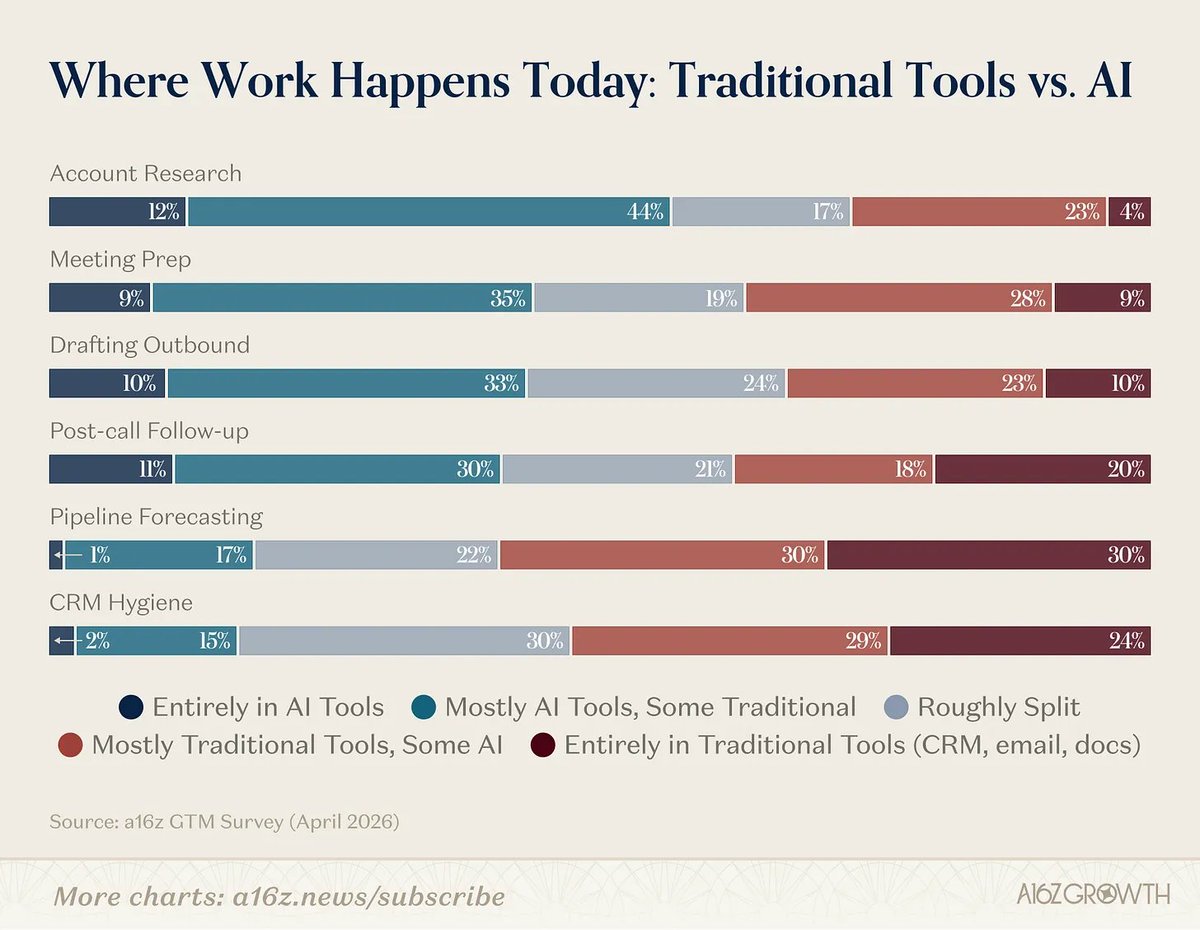
From "System of Record" to "System of Intelligence"
In the next decade, you want to own the system of intelligence that pulls from the system of record, becomes the user’s one-stop shop for gaining context and taking action, and turns the SoR into something that’s primarily consumed at the API layer.
The reasoning layer that sits above the database is where a new generation of companies is being built, and it’s where the majority of the next decade’s enterprise value of GTM software will end up.
Full piece from a16z's Gio Ahern, Steph Zhang, and Alex Immerman: https://t.co/2udG6l6SSx
and yes, Claude can orchestrate some of this if you give it enough infra/db access.
But then you’re hand-rolling the dangerous parts: scoped credentials, PII masking, cleanup, isolation, storage blowup, audit logs, rollback, CI integration, and making sure it never points at prod by accident.
Plus, it’s not cloning a TB-scale db in ~6 seconds
@voodoochild9207@ycombinator@ArdentAI Read-only Claude access solves inspection, not execution.
The hard part is giving agents isolated, writable, prod-like DBs where they can run migrations, test writes, replay workflows, break things, and roll back without touching prod
The accounting profession has a double bind that nobody talks about. Today, @ArtifactOffcial is launching Omni, your firm's new agentic orchestration layer, in response.
The prevailing narrative is that "AI handles routine tasks, accountants go from doers to reviewers". But this breaks how accountants actually develop judgment.
You learn to reconcile correctly by reconciling incorrectly and being corrected. Remove the doing and the learning mechanism breaks. If junior accountants are just reviewing AI outputs, they won't develop professional expertise.
But the traditional path was already failing. 300,000 accountants have left. The doer work is gruelling. The apprenticeship demands years of tedious production before the payoff arrives.
One path breaks the traditional learning path. The other breaks the people. Neither is sustainable. This is the double bind. It's what Omni undoes by presenting a way of working that is different enough to sustain the learning, but compelling enough to retain the people.
Omni connects across 1000+ platforms and lets accountants describe multi-step, cross-platform workflows in natural language. Build a workflow for one construction client on Sage, templatize it, deploy it across every construction client with client-specific logic applied automatically. The people closest to the work become the ones building the systems.
Omni sits on top of Arti, our intelligence layer, already live across Top 250 firms in the US and Top 50 firms in the UK. 99% reconciliation accuracy. 92% reduction in processing time. 13x throughput improvement. 12,000+ hours of capacity unlocked and counting.
But the numbers aren't the point. The architecture is. Arti learns continuously from every interaction. When a senior corrects a categorization, the correction and its reasoning become institutional knowledge. When anyone overrides an automated match, the override and the why get encoded into the firm's knowledge base.
Together, they capture what we call "wet code," the unwritten business rules, client-specific logic, and contextual knowledge that live in senior accountants' heads and nowhere else. With 75% of CPAs eligible to retire within the decade, that knowledge is walking out the door.
The goal is not to turn accountants into reviewers. It's to make them a different kind of doer.
Join the Omni waitlist and read our manifesto at the link in the comments.