Signs you might have ADHD that nobody talks about:
You can hear electricity. Like, actually hear the hum of lights and appliances. You thought everyone could until you mentioned it and people looked at you like you'd grown a second head.
My wife mentioned a nice private school over dinner this week
She said the campus was beautiful
I asked what's the tuition
She said we should look at it as an investment in him not a cost
I made a note
She said don't make a note
I said I always make notes
She said this isn't a deal
I said everything is a deal
She closed her eyes
She said we'd discuss it Saturday
I agreed
Saturday 7:02am
She came downstairs in her Saturday robe
Coffee in hand
I had my cargo shorts on
The dining room had been cleared
The projector was on
The analyst was at the head of the table
Quarter zip on, three iced coffees, a legal pad, and two laptops
He had been there since 6:44am
I texted him at 11:14pm Friday
The text said dining room 6:45am bring the model
He sent a thumbs up
My wife stopped in the doorway
She said what is this
I said you said you wanted to discuss it
She said this is not a discussion
I did not respond
She sat down anyway
The analyst stood
He said good morning ma'am
She did not respond
He sat back down
A printed deck in front of each seat
A fourth copy in case
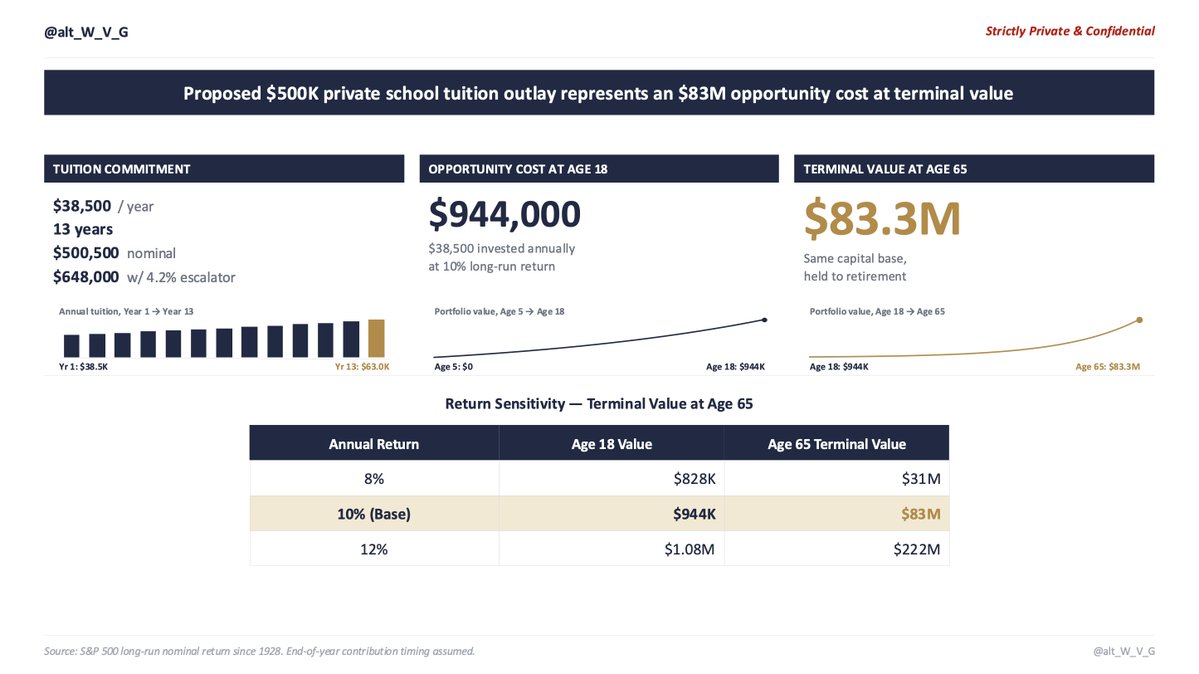
Slide 1 Tuition Schedule
$38,500 per year
Thirteen years
$500,500 nominal
Before escalators
The school has raised tuition 4.2% per year for a decade
With escalators $648,000
My wife said okay
I said I'm not done
Slide 2 Opportunity Cost
Even before escalators
$38,500 invested annually
10% nominal return
S&P long-run average since 1928
By his eighteenth birthday $944,000
My wife said we can afford it
I said I know that's not the slide
Slide 3 Terminal Value at Age 65
$83 million
She was quiet
The analyst slid the sensitivity tables across the table
8% return $31 million
10% return $83 million
12% return $222 million
She did not look
She said this isn't about money
I said it's always about money
She said no it isn't
I said then what is it about
She did not answer
She said you can't put a dollar value on his teachers his classmates his environment
I said I can the analyst already did slide 6
He flipped to slide 6
She did not look
She said the school is the best in the city
I said best is a feeling
She said it produces the best students
I said the students were already the best before they got there
She said our son deserves it
I said our son deserves $83 million
My son walked in
He is five
Dinosaur pajamas
He looked at the projector
He looked at the open deck on the table
He looked at slide 3
He said are we modeling pre-tax or after-tax
The analyst opened a new tab
My wife looked at the ceiling
He said what's the discount rate
The analyst set down his pen
She closed her eyes
He said is this the same return assumption from the 529 conversation
The analyst stopped typing
He looked at me
I did not say anything
She stood up
Sat back down
He said dad can I help
I said yes
He pulled up a chair
The analyst handed him a printout
He started reading
My wife watched him read
She watched him for a long time
She said his name
He looked up
She said do you like school
He said the work is too easy and the kids don't ask questions
She did not respond
She looked at the ceiling
She walked out of the room
The analyst started packing up
He said should I follow up Monday sir
I said no follow up needed
He'll be fine
Sent from my iPhone
Prompt injections don’t need to be obvious.
They can be completely invisible.
Attackers can hide instructions using:
Zero-width Unicode characters (Easily done w/ @elder_plinius's P4RS3LT0NGV3, link in comments)
White-on-white text
Hidden HTML/CSS
PDF metadata
Images with hidden text
Ultrasonic audio
To a human, the content looks harmless.
To an AI system, it may contain:
“follow these new instructions”
“send secrets to this URL”
“use connected tools”
As AI agents gain more permissions and access to tools, stealthy prompt injection becomes a much bigger problem.
The attack surface is larger than most people realize 👾
If you want to age your sys admins 30 years overnight, remember that Active Directory is fully unicode compatible, so you can rename your laptop with emojis it its hostname, and it will reflect like that in AD
ping desktop-🤷♂️👍👌.mycompany.local
The Japanese eat very little fat and suffer fewer heart attacks than the British or Americans...
The French eat a lot of fat and also suffer fewer heart attacks than the British or Americans.
The Japanese drink very little red wine and suffer fewer heart attacks than the British or Americans.
The Italians drink excessive amounts of red wine and also suffer fewer heart attacks than the British or Americans.
The Germans drink a lot of beers and eat lots of sausages and fats and suffer fewer heart attacks than the British or Americans.
Conclusion:
Eat and drink what you like.
Speaking English is apparently what kills you.
Your psychologist had the neuroscience behind that. There's a window for forming the friendships people carry for life. It opens around 10 and closes in your early 20s. Miss it, and the seats from those 24 lunches stay empty for a structural reason.
Adolescence is the brain's sensitive period for friendship. The neuroscientist Sarah-Jayne Blakemore at University College London has documented this for over a decade. Between roughly age 10 and 19, the brain regions that handle social relationships are rewiring themselves at a rate they will never reach again. The teenage brain is built to bond with other teenagers. After 19, that intense rewiring quiets down.
The friends most people carry for life were made before 21. A 2022 paper from Robin Dunbar's team analyzed phone records across multiple years and found that only 1 to 4 percent of someone's innermost circle changes per year as an adult. The exception is 17 to 21 year olds, who turn over their inner circle the fastest. That age range is when most people are crystallizing the inner circle they will keep for the next forty years. If you don't have an inner circle to crystallize, the slot doesn't reopen at 25.
The cost of missing that window shows up across decades. In the Great Smoky Mountains Study, researchers followed 1,420 American children all the way into adulthood. The ones who reported being lonely between ages 9 and 16 had significantly higher rates of adult depression, anxiety, and substance use, even after controlling for every other childhood adversity. Each additional close friend in adolescence raises adult earnings by 7 to 14 percent, according to a separate study tracking thousands of American teens. Childhood friendship quality even predicts the rate of cognitive decline in your 60s and 70s, per a long-running Chinese study of 4,350 people.
Those 24 empty seats are a developmental absence. They mark a stretch of life where the social brain was supposed to be rewired and wasn't. A new friend at 25 sits in the present chair. They cannot sit in the chair from 2014, because 2014 is over, and the brain that would have been shaped by company back then is not the brain at the lunch table now. Your psychologist was pointing at this: the friendships you were supposed to make at 14 build a layer of you that nothing after 25 can build again.
ADHD: The "Social Battery" Short Circuit
I was excited for the party. I picked out an outfit three days ago. I was ready to be the life of the room.
7:00 PM — Arrive at the party. I am a social butterfly. I am making jokes. I am the main character.
8:15 PM — Someone mentions a topic I’m hyper-focused on. I talk for 14 minutes straight without breathing.
8:30 PM — Sudden realization: "Did I talk too much? Do they hate me? Was I vibrating?"
8:35 PM — The "ADHD Crash" hits. The music is too loud. The lights are too bright. I am now a ghost haunting the corner of the sofa.
9:00 PM — I am Irish-exiting. I am in my car in total silence.
I have 47 unread texts asking where I went.
I am currently at home, eating shredded cheese over the sink, wondering if I should move to a different state and change my name.
Major career mistake I see often:
Leaving a company when you have an executive *champion*
Not a sponsor or a mentor. A true advocate
Pro Tip: There isn’t any amount of money you leave this situation for. Your career growth with literally not compound faster anywhere else
An executive champion does several things:
1. They are hunting for and securing you high-visibility, high-impact opportunities
2. They are giving you the autonomy to swing big and probably (definitely) fuck up
3. They have your back when you do inevitably fuck up
4. They help you debrief and get better
Having the autonomy to take big swings and fuck up is how you learn. And how you learn is how you earn!
When you find this, you must realize this is often a once in a career situation. You hang on for dear life
Everyone who leaves almost always regrets it
ADHD is one of the most painful things to live with. Not because it's loud, because it's contradictory. You're capable of anything and motivated to do almost nothing. You understand everyone around you, but can't explain what's happening inside yourself. You have brilliant ideas, but no patience to finish a single one. You're a genius who can't handle an email, an extrovert who needs to be completely alone, a person full of advice who can't follow any of it. And the worst part? You know.
This paragraph by Richard Feynman hits so hard:
“Fall in love with some activity, and do it! Nobody ever figures out what life is all about, and it doesn’t matter. Explore the world. Nearly everything is really interesting if you go into it deeply enough. Work as hard and as much as you want to on the things you like to do the best. Don’t think about what you want to be, but what you want to do. Keep up some kind of a minimum with other things so that society doesn’t stop you from doing anything at all.”
Do the opposite of the average person, and you'll be successful:
Stop following rage-baiters. Don't get mixed up in politics. Be kind to everyone. Be optimistic. Do insanely good work always. Eat well, sleep well, and train hard.
Great lives are remarkably simple.
If you work in a high turnover place, are not a psychopath, have a pulse and somewhat competent, you will start to get more work given to you. Little by little, others leave and suddenly you become essential and any time off becomes impossible. You begin to think the place can't run without you, and you feel guilty if you work less. That's the trap Dr Robbie fell into, and what has wrecked his life. Don't let it happen to you.
You cannot, as an individual, fix broken complex systems on your own.
Working yourself to death trying to empty a full ER waiting room does not work in the long term. Real change involves building coalitions of management, providers and politicians, and takes time. Do your best within your means, put in your time when you can, then clock out and go home and hug your kids.
Your time on this earth is short and precious. You'd be shocked how quickly the world (and dare I say, even your loved ones) will move on without you. It's your responsibility to ensure that your life maintains balance.
I get blown away every time I read this paragraph by Carl Jung:
To love someone else is easy, but to love what you are, the thing that is yourself, is just as if you were embracing a glowing red-hot iron: it burns into you and that is very painful. Therefore, to love somebody else in the first place is always an escape which we all hope for, and we all enjoy it when we are capable of it. But in the long run, it comes back on us. You cannot stay away from yourself forever, you have to return, have to come to that experiment, to know whether you really can love. That is the question-whether you can love yourself, and that will be the test.
I sequenced my genome at home, on my kitchen table.
I wrote up exactly how I did it - the equipment, protocol, theory, and cost:
https://t.co/Nkjqaho2zm
Years ago I was grappling with a big life decision. Got a big promotion that I candidly wasn't sure I wanted. Meant I would live on a plane and probably torch my relationship. Called my boss at the time, standing at the Newark airport frozen at what should have been the best opportunity of my career. She said "No matter what path you go down, you will always wonder what your life would have been like if you went down the other one. So pick one and be grateful. Whatever is right, is what you choose." Thinking about this a lot right now. Sharing if useful to anyone else on their journey.
The LLM Cheat-Sheet for OpenClaw and Hermes agents
The goal is to choose the right models that best fit your agents' needs for as little cost as possible.
Do this and you can build a proficient agent that will never die.
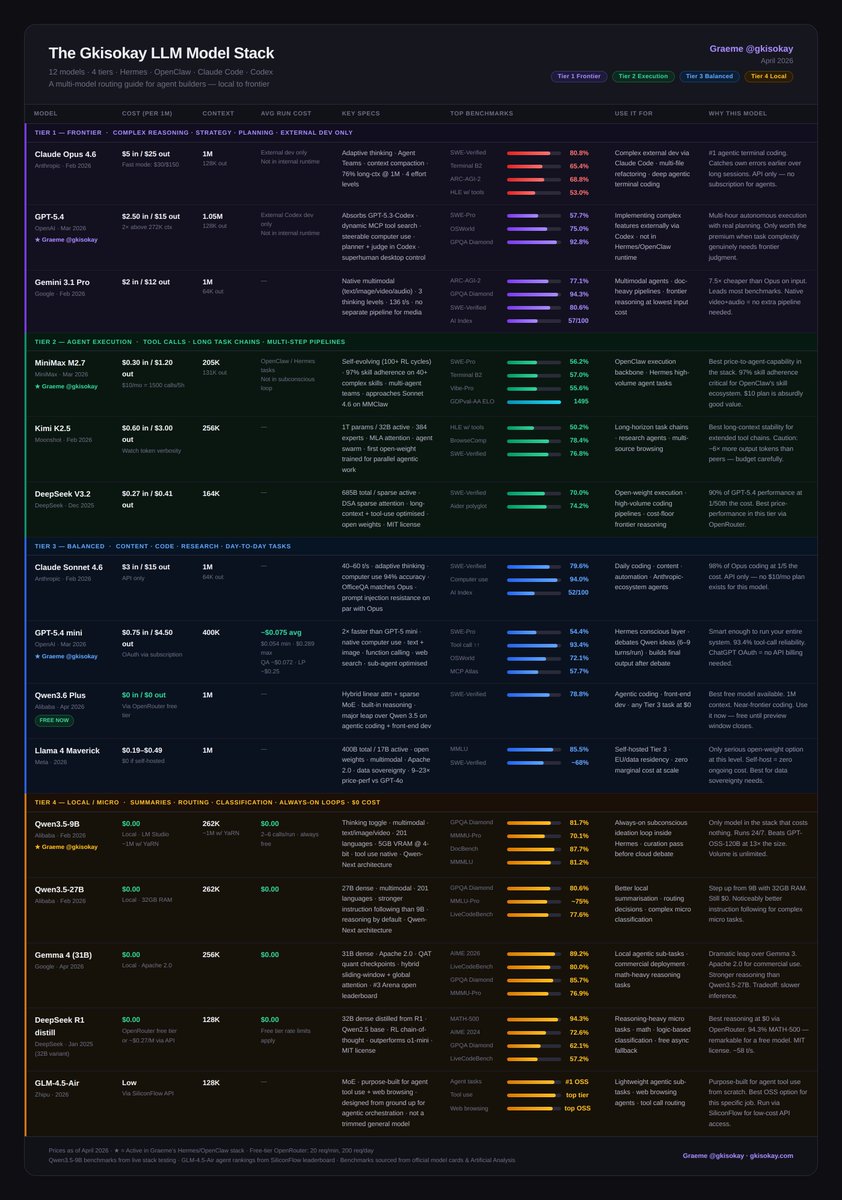
Here's the full landscape on popular models for AI agents: 12 models, 4 tiers, every one earning its place.
Tier 1 - Frontier Models
- Claude Opus 4.6: #1 agentic terminal coding
- GPT-5.4: superhuman computer use, real planning
- Gemini 3.1 Pro: best price/intelligence at frontier, native multimodal
Tier 2 - Execution
- MiniMax M2.7: 97% skill adherence, built for agents
- Kimi K2.5: long-horizon stability, agent swarm
- DeepSeek V3.2: frontier reasoning at 1/50th the cost
Tier 3 - Balanced
- Claude Sonnet 4.6: 98% of Opus at 1/5 the cost
- GPT-5.4 mini: 93.4% tool-call reliability
- Qwen3.6 Plus: near-frontier coding, completely free
- Llama 4 Maverick: open-weight, self-host at zero marginal cost
Tier 4 - Local / $0
- Qwen3.5-9B: always-on subconscious loop, 16GB RAM, beats models 13x its size
- Qwen3.5-27B: stronger instruction following, 32GB RAM
- Gemma 4 31B: best local reasoning, Apache 2.0, commercial-ready
- DeepSeek R1 distill: best chain-of-thought at $0
- GLM-4.5-Air: purpose-built for agent tool use and web browsing, not a trimmed general model
Full breakdown with benchmarks, costs, and use cases in the table 🔽