Your LLM never sees your prompt.
It sees tokens.
Most Data Scientists moving into AI Engineering skip right over this.
They shouldn't.
Before you learn agents, RAG, MCP, or fine-tuning… Learn what an LLM actually sees.
Because it does not see this:
“Build me a machine learning model.”
It sees tokens.
And tokenization quietly affects almost everything you care about when building real AI systems:
→ Context window limits
→ API cost
→ Code generation
→ Numbers + identifiers
→ Multilingual performance
→ Embeddings
→ Chat templates
→ Model training
This is one of those topics that looks like an implementation detail…
Until you're debugging an AI system and realize the model isn't receiving the information the way you thought it was.
And there are a lot of misconceptions.
BPE is not automatically byte-level.
SentencePiece is not a tokenization algorithm.
Token IDs aren't semantic coordinates.
And you can't casually swap a trained model's tokenizer like you're changing a preprocessing function in Scikit-Learn.
This is also a great example of the shift happening right now:
Data Science taught us to understand the model.
AI Engineering requires us to understand the entire system around the model.
Prompts.
Tokens.
Context.
Retrieval.
Tools.
Agents.
Memory.
Infrastructure.
That's the skill stack I'm increasingly focused on.
So here's a technical handbook that explains tokenization from first principles:
Understanding Tokenization: How Text Becomes the Tokens an LLM Actually Sees
It covers everything from Unicode and BPE to chat templates, code, multilingual text, context limits, and some surprisingly important failure modes.
If you're making the move from:
Data Scientist → AI Engineer
this is worth understanding.
Get the handbook here → https://t.co/v89nFDWsZA
🚨 Want to learn how to build + ship AI and Data Science projects (that businesses actually want in 2026)?
On November 11th, I am hosting a free workshop to help you get started with AI + DS projects in Python (free).
Register here (500 seats): https://t.co/onpLpRwkzH
Scientists have created one of the most detailed 3D reconstructions of a human cell (eukaryotic cell) ever produced.
This groundbreaking model, often termed a "Cellular Landscape Cross-Section Through a Eukaryotic Cell," combines data from X-ray tomography, nuclear magnetic resonance (NMR), and cryo-electron microscopy to map molecular structures in extreme detail.
This is f*cking insane. SpaceXAI senior engineer (ex-Cursor):
"99% of people open one GrokBot, ask it a question and close the tab
I run 50+ GrokBot agents like a company. A Chief of Staff runs my day, 3 PMs hand out the work, 40+ workers ship it overnight, and I just check the results over coffee. That team does the job of 20 engineers"
In this 1-hour workshop, SpaceXAI builds that GrokBot team from scratch, step by step
GrokBot → Chief of Staff → PMs → 40+ Workers → Autonomous Company
At SpaceXAI, 97% of engineers already run a team like this, and the ones who do are getting $750K+ offers. The rest are about to compete with them
Worth more than any $5,000 agentic engineering course
Bookmark it and watch today
Then read how to build your own team of GrokBot agents in the harness engineering guide below ↓
This is f*cking insane. SpaceXAI engineer Lauren Tan (ex-Cursor):
"99% of people use GrokBot for 1% of what it can do. They run one agent without /loops or /graphs
I run a team of 50+ GrokBot agents. By 8 a.m. my Chief of Staff has the day planned, my PM has handed out the work, and the workers have shipped half of it"
In this 1-hour session, SpaceXAI shows how to build that team from scratch
GrokBot → Chief of Staff → PM → Workers → Self-Improving Team
A /loop sends every task back until it actually works
A /graph lets one agent hand its result to the next without you in the middle
Anyone can ask GrokBot a question, almost nobody gives it a team to run
Worth more than most $1650 agentic engineering courses
Watch it today
Then read the article below on building a Second Brain with Grok Bot ↓
1. The study was run out of Harvard Medical School under Dr. Herbert Benson.
For three decades, Benson tracked monks who could lower their metabolism by 64% at will. Hands and feet would reach temperatures low enough to kill most people.
Heart rate dropped near zero.
And then they walked out of the room normally. The Pentagon didn't fund it for spirituality.
They funded it because what the monks
were doing shouldn't have been biologically possible.
2. The mechanism was named Relaxation Response. Benson documented that the monks weren't suppressing stress, they were triggering a specific nervous system state that civilians lose access to by age 30.
In this state, cellular inflammation plummets. Cortisol halves. Immune cells multiply. The body enters its own repair mode without any outside input.
3. What the Pentagon ultimately classified
was this: humans aren't wired for the chronic sympathetic activation of modern life demands.
The nervous system was designed to spend most of its hours in parasympathetic recovery.
We flipped the ratio. The monks were simply running the original factory settings.
4. Modern research has now confirmed what Benson first measured: 94% of adults in industrialized countries have lost the ability to enter deep parasympathetic states on their own.
Not because they can't.
Because they were never taught the specific nervous system switch that triggers it.
5. The woman who feels "wired but tired" at 3 PM isn't broken. The mother who can't fall asleep despite exhaustion isn't failing at rest.
Their systems have forgotten the switch.
The monks didn't have more willpower.
They had the method.
Here's what no one explains: this switch is physical, not mental. You can't think your way into it.
See 646-page PDF “Speech and Language Processing — Introduction to Natural Language Processing, Computational Linguistics, and Speech Recognition with Language Models” here: https://t.co/5jceCAb4cR [3rd Edition draft]
One constant rules continuous change: the same e that compounds interest without bound also equals its own derivative and sums to itself via factorials.
e = lim (1 + 1/n)^n as n→∞
e = ∑_{n=0}^∞ 1/n!
d/dx e^x = e^x
∫_1^e (1/t) dt = 1
From population models and radioactive decay to neural nets and option pricing, continuous growth always traces back to this single base. Nature’s compounding engine is written in e.
A plane banks, and geometry alone decides the radius of its turn.
Vertical forces balance: N cos α equals weight. The horizontal component of the same force supplies the centripetal acceleration. Divide the two equations and the normal force cancels, leaving tan α = v² / (g R).
At 100 m/s and 10 degrees of bank the turn radius is fixed: R = 100² / (9.81 tan 10°) ≈ 5780 m. No extra thrust, no extra lift—just the angle that tilts the existing aerodynamic force.
Flight is controlled by how cleanly you resolve a single force into its components.
SpaceXAI engineer Lauren Tan:
"You can't spawn a hundred agents when you don't even trust the output of one agent"
"If you don't have a verification skill, you are the verifier. You're the bottleneck"
In a 1-hour talk, she shows how she went from watching every output to shipping 1,000 PRs in a month
Watch every step → Verify → Skills → Evals → Auto-merge
Trust in agents is not a feeling. It's infrastructure you build
Worth more than any $2,000 AI coding bootcamp
Bookmark it and watch it tonight
honestly this should be f*cking illegal
your LLM takes 30 seconds to think about a trade, but candle closed 29 seconds ago.
Jev answers in 70 to 500 milliseconds. it can't write a word. it returns BUY / SELL / HOLD and a probability, and that's all a scalp needs.
3 repos already built on it:
-> jev-trader: one AI trade decision every single block, on a live MON-USDC market
https://t.co/oTz9vrh5bl
-> QuantDinger: a full open-source AI trading OS with Jev built in. research, strategy, agent trading
https://t.co/ToQAwqijxb
-> AIStock: "one person can become their own super-analyst"
https://t.co/0xOXAb7MBi
$0.042 per million input tokens. output is free.
that's thousands of decisions for the price of one LLM call.
the catch: fast is not the same as right. a wrong call in 200 milliseconds is still a wrong call. paper trade it first.
> let the big model do the research.
> let Jev pull the trigger.
> let code set the stop.
bookmark this before your bot is the slow one in the room.
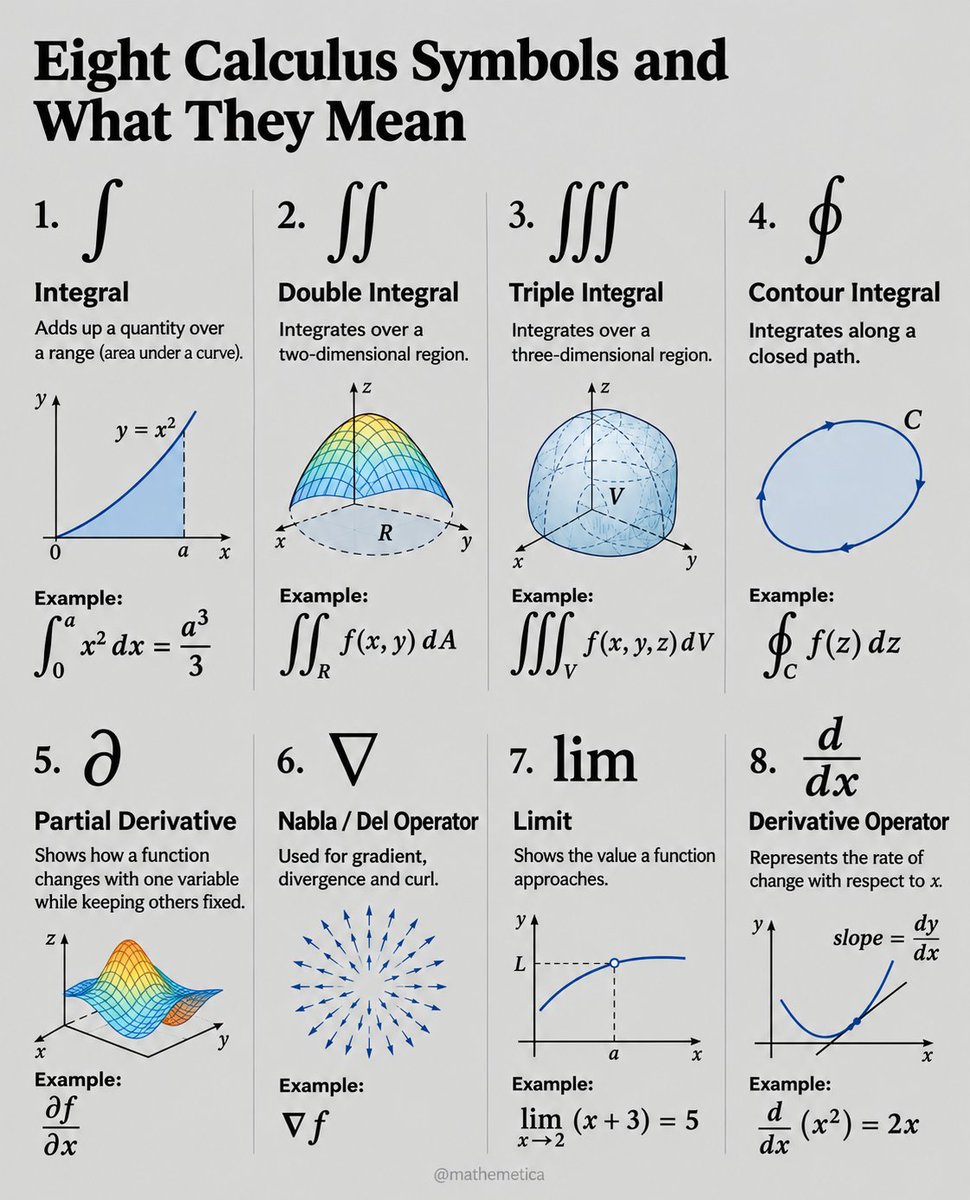
Calculus is the alphabet of a universe in motion.
At its heart lies a single revelation: smooth change can be measured, and infinite pieces can be assembled into whole truths. From instantaneous rates to curving spaces, these symbols give form to movement.
SpaceXAI engineer, Lauren Tan:
"Last month I created 1,000 GrokBot agents. This month we're only on the 12th and I'm already at almost 800
I woke up today and 20 agents had already landed. My agents auto-merge them, and they were good. I really don't look at the code anymore"
in a 1-hour session, SpaceXAI engineer breaks down how she went from babysitting every agent output to a fleet that ships while she sleeps
Verification → Evals → Cloud Agents → CI → Auto-merge
it's worth more than any $500 agentic engineering course
skip Netflix and watch it today, then read how to build the same agent fleet in one click in the article below ↓