The Bank of North America was America's first central bank—a fractional-reserve monopoly modeled on the Bank of England, run by Robert Morris, lending newly created money to the government that chartered it. It was sold as a war necessity. The war was already won. https://t.co/FwgNmmwY7z
Locke didn't invent liberal individualism from nothing. He synthesized a century of Baptist demands for liberty of conscience, Leveller demands for self-governance, and Epicurean demands for reason over fanaticism—all born from Europe's wars of religion. https://t.co/9Gj4q5xd9s
Government is not self-correcting the way a market economy is. A business that destroys value goes bankrupt. A political movement that destroys value gains voters—because the destruction creates the dependency that sustains it. https://t.co/kG2enVqaDj
AC as adaptation or emergency measure?
Who gives a s**t?!?
This is the most ridiculous debate I have ever heard of.
Get the ACs. Save people’s lives! And STFU, Mrs Barbut!
🚨🇻🇪 | EL COMUNISMO MATA: Los "beneficiarios" de la Gran Misión Vivienda Venezuela (GMVV) —el programa populista creado por Hugo Chávez y Nicolás Maduro para "sortear" viviendas a los más pobres— fueron los más afectados por el atroz terremoto que azotó al país al constatarse el derrumbe de las torres ubicadas en el estado de La Guaira, donde de 193 edificaciones construidas por el chavismo solo quedaron 3 en pie, provocando la muerte y desaparición de miles de personas.
Money printing has never created a single unit of wealth, and the persistence of poverty across the globe is the proof.
Wealth is goods and services: bread on the shelf, steel in the warehouse, code that runs, machines that produce. When the Federal Reserve expanded its balance sheet from $900 billion in 2008 to $8.9 trillion by 2022, it produced none of those things. It produced digits. Those digits do not feed a man in Caracas or build a factory in Lagos. They bid up the price of assets already owned by the people closest to the spigot, which is why the wealthiest decile in America saw its net worth balloon while wage earners watched rent and groceries outrun their paychecks.
You must understand the mechanism. New money enters the economy at specific points: the Treasury, the primary dealers, the banks. The man who receives it first spends it at old prices. The man who receives it last, the pensioner, the wage laborer, the saver in a poor country holding a collapsing currency, spends it at new prices. This is the Cantillon effect, named for Richard Cantillon, who described it around 1730. Inflation is a transfer from the late receivers to the early receivers. It moves wealth. It does not make it.
Look at the countries drowning in poverty and you will find central banks running the printing press hardest. Zimbabwe printed a 100-trillion-dollar note in 2008. Argentina has debased the peso so relentlessly that inflation crossed 200 percent in 2023, and its people store value in physical dollars stuffed into mattresses. Venezuela destroyed the bolivar so completely that vendors weighed banknotes rather than count them.
Easy money did not lift these populations. It looted their savings, shortened their time horizons, and taught entire generations to consume today because tomorrow's currency buys nothing.
Hard money does the opposite. When the unit of account holds its value, a man can save, defer consumption, and fund the capital accumulation that actually raises living standards. Debasement punishes the saver and rewards the debtor and the speculator. A society that cannot save cannot build. If printing money created wealth, Zimbabwe would be the richest nation on earth.
The highest recorded temperature "for 79 years" sounds like a rare event, but it's by definition *not* evidence of "rising temperatures." It's quite the opposite: higher temperatures were recorded in the past. And the claim says nothing about the variability during this time.
In 1971, Greenspan testified before the Senate: government-directed lending must inevitably lead to subsidization of the least efficient firms. By 1984, he supported the largest bank bailout in US history. The principles changed. The ambition didn't. https://t.co/AKexkVBIbp
This.
"...the very term 'data' ('givens') is misleading. Amending the 'data', or rejecting some as erroneous, is a frequent concomitant of scientific discovery, and the crucial 'data' cannot even be obtained until theory tells us what to look for and how and why" @DavidDeutschOxf
People who say you can't be allowed to govern yourselves because you'll do it wrong are on the side of Robespierre. They're on the side of the Jacobins. They're on the side of the people who wanted to see heads roll for opposing the central plan. @RyanMcMaken#RothPod.
La guerra contra el aire acondicionado sólo se entiende si asumimos que el ecologismo odia al ser humano y lo considera un virus (ala Matrix).
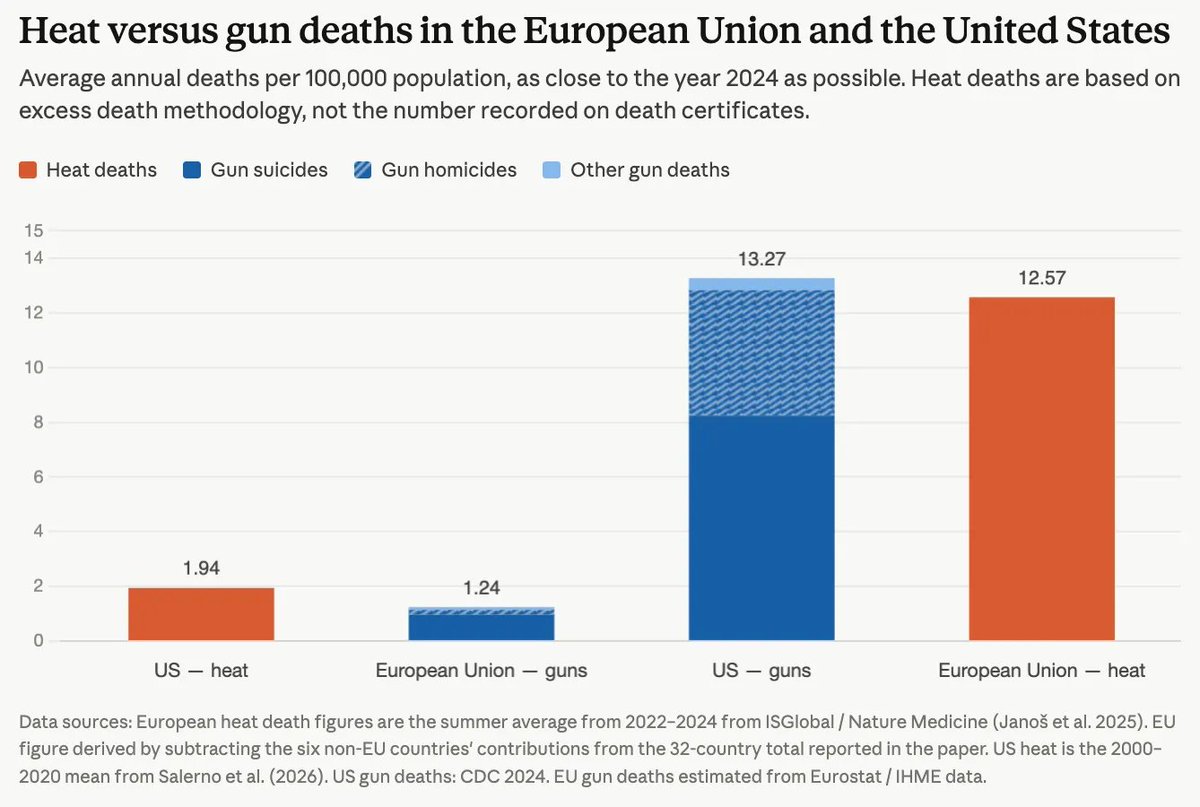
1- Europa (UE) multiplica por 6 las muertes por olas de calor comparado con Estados Unidos.
2- Muere la misma gente en Europa por olas de calor que en Estados Unidos por armas de fuego.
3- Si no tenemos en cuenta los suicidios, muere más del doble de gente en Europa por olas de calor que en EEUU por armas de fuego.
Para más INRI, la temperatura promedio en EEUU en verano es algo más alta que en Europa.
Tampoco se entiende la queja en términos energéticos. Calentar en invierno gasta el triple de energía que enfriar en verano. Y las muertes crecen más rápido cuando suben las temperaturas que cuando bajan.
Lo que se está imponiendo en Europa es la versión decrecentista que abandera el ecologismo que nos gobierna.
La cruzada contra el aire acondicionado es sólo la penúltima batalla del ecologismo en contra del ser humano. Y la estamos perdiendo.
Aquí los detalles de los c��lculos:
https://t.co/klM7VPLSvT
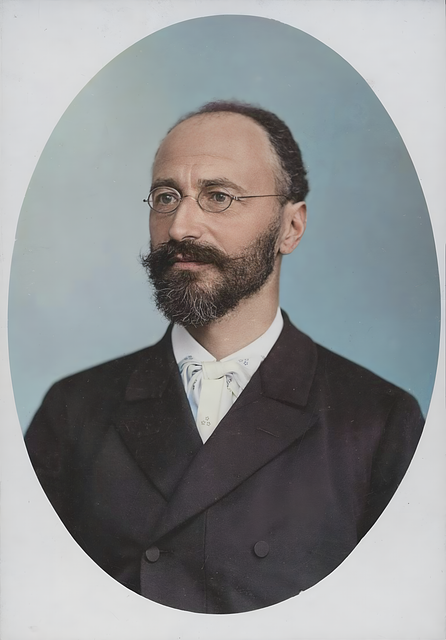
You pay a premium to have things now rather than later. That premium has a name, and Eugen von Böhm-Bawerk built an entire theory of interest around it in 1889. He called it time preference. A present good is worth more than a future good of the same kind, because human beings act in time, and time is the one thing you cannot recover.
Think about what you actually do every day. You take the apple in hand today over the promise of an apple next October. You demand more dollars back when you lend than when you part with them. You are a living person with finite years, valuing satisfaction sooner over satisfaction later. Strip the Federal Reserve out of the picture entirely and interest still exists. It lives inside human action itself.
This is the foundation that economic calculation stands on. Capital does not assemble itself. Someone abstains from consuming today, lends the saved resources to an entrepreneur, and that entrepreneur builds a factory that pays off in five years. The interest rate coordinates the whole chain: it tells you whether savers have actually freed up real resources for long projects, or whether you're being lied to. A genuine fall in time preference, more saving, lower rates, signals that the future has room for longer production. People wait. Capital deepens.
Now watch what happens when the Fed forges that signal. The Chairman pushes rates to near zero from 2008 through 2015 while Americans saved nothing. Entrepreneurs read the cheap money as real saving and break ground on long term projects: housing in 2006, server farms and unprofitable startups a decade later. The resources to finish them don't exist. Time preference never fell. Somebody just counterfeited the message. The bust is the market correcting a forgery, not punishing you for optimism.
So when a financial commentator tells you the central bank "sets" interest rates, understand what he's confessing. He thinks bureaucrats can repeal the fact that you'd rather eat today than starve now and feast in 2031. Böhm-Bawerk answered that fantasy 136 years ago. The rate belongs to you, and every attempt to override it ends in wreckage.
.@TurnipMerchant on Greenspan: the simplest explanation is that he was a social climber. He went along with whatever allowed him to advance. When the Fed said inflate, he agreed. He believed whatever the room required. @connorokeeffe@ThoBishop
If you ask 100 people why Africa is poor, almost nobody will say the obvious answer.
They will blame one fashionable explanation after another, anything except the system that makes it miserable to start and run a business.
When the diagnosis is wrong, the medicine becomes foreign aid and grand schemes instead of economic freedom.
While the pundits are insisting that the late Alan Greenspan was a committed free market adherent, his actions throughout his career spoke differently. In today’s Friday Philosophy, Dr. David Gordon exposes Greenspan for what he was: an opportunist.
https://t.co/sz6WJ3PFfs
The Spanish government diverted a cruise ship, quarantined every passenger for 42 days, and ran tests on people it was quarantining anyway. The disease spreads through surface contamination. Normal hygiene would have been sufficient. The crisis was political. https://t.co/VTv81Mu9N1
Medieval kings were constrained by competing jurisdictions—nobles, towns, clergy, assemblies. Ralph Raico taught this for decades. His students still wrote on exams that medieval lords ruled as autocrats. The propaganda is that deep. @RyanMcMaken https://t.co/68dw5JBnfx
Warsh threatened rate hikes. Threatened balance sheet normalization. Threatened a return to 2%. He threatened all of this before becoming chair. Now he is the chair—and the balance sheet is bigger, the money supply higher, and real rates negative. @DrMarkThornton#MinorIssues