@CanadianGrayMan Why don’t we see similar long queues in physiotherapy, dentistry? Because they are not monopolized by the government. Neither public funding nor immigration is the source of the problem. Just open the healthcare system for private sector participation.
@berthofmanecon Fully agree! Indeed, the question raised by Prof. Yi could be asked other way around: given the high ratio of govt net assets to social wealth, why is fiscal revenue as % of GDP so low? The answer: too little fiscal revenue has been generated from the net assets.
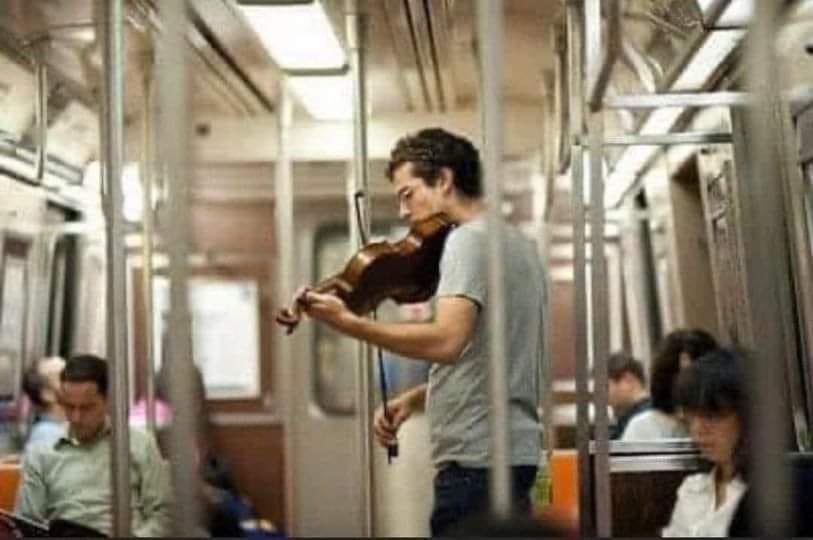
“ In Washington DC, at a Metro Station, on a cold January morning in 2007, a man with a violin played six Bach pieces for about 45 minutes. During that time, approximately 2000 people went through the station, most of them on their way to work.
After about four minutes, a middle-aged man noticed that there was a musician playing. He slowed his pace and stopped for a few seconds, and then he hurried on to meet his schedule.
About four minutes later, the violinist received his first dollar. A woman threw money in the hat and, without stopping, continued to walk.
At six minutes, a young man leaned against the wall to listen to him, then looked at his watch and started to walk again.
At ten minutes, a three-year old boy stopped, but his mother tugged him along hurriedly. The kid stopped to look at the violinist again, but the mother pushed hard and the child continued to walk, turning his head the whole time. This action was repeated by several other children, but every parent - without exception - forced their children to move on quickly.
At forty-five minutes: The musician played continuously. Only six people stopped and listened for a short while. About twenty gave money but continued to walk at their normal pace. The man collected a total of $32.
After one hour:
He finished playing and silence took over. No one noticed and no one applauded. There was no recognition at all.
No one knew this, but the violinist was Joshua Bell, one of the greatest musicians in the world. He played one of the most intricate pieces ever written, with a violin worth $3.5 million dollars. Two days before, Joshua Bell sold-out a theater in Boston where the seats averaged $100 each to sit and listen to him play the same music.
This is a true story. Joshua Bell, playing incognito in the D.C. Metro Station, was organized by the Washington Post as part of a social experiment about perception, taste and people’s priorities.
This experiment raised several questions:
In a common-place environment, at an inappropriate hour, do we perceive beauty?
If so, do we stop to appreciate it?
Do we recognize talent in an unexpected context?
One possible conclusion reached from this experiment could be this:
If we do not have a moment to stop and listen to one of the best musicians in the world, playing some of the finest music ever written, with one of the most beautiful instruments ever made…
How many other things are we missing as we rush through life?”
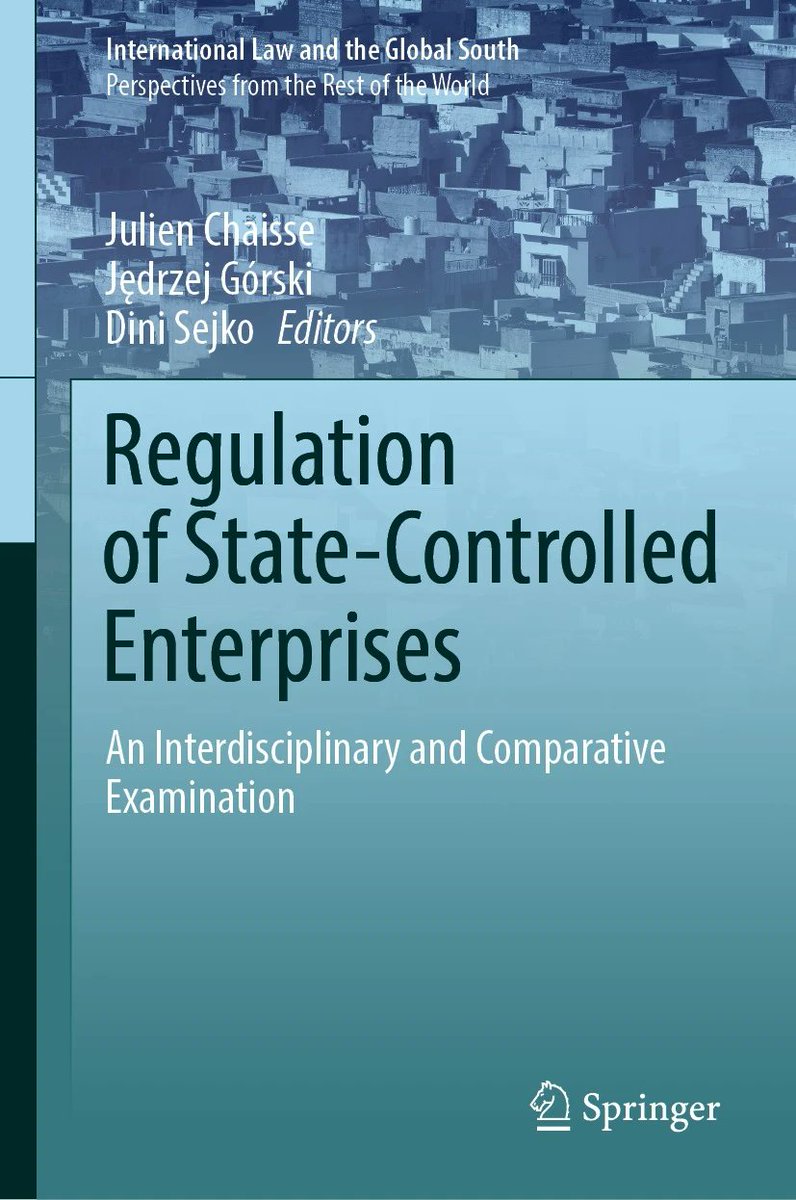
My argument: SOE-related trade rules need to go beyond ownership to have a sharp focus on corporate governance by aligning with internationally accepted SOE CG standards as codified by the OECD SOE CG Guidelines and learning from the EU experience with State aid control (2/2).
Glad to share a paper I have just posted: https://t.co/99ndCPDK4t. It reviews existing SOE-related trade rules in WTO, CPTPP and some FTAs and discusses a few key issues of their reform against the background of the pervasiveness and rationale of SOEs (1/2).
Weekend Long Read: To avoid becoming a “failed state,” South Africa must overcome the legacy of years of racial inequality and apartheid that are still hampering its progress and development. https://t.co/zUVksGEUzE
The paper seeks to answer 3 Qs: What is the size of the SOE sector in economies measured by share in output/employment? What are the economic sectors in which the role of SOEs is the most prominent? What is the sectorial composition of the SOE portfolio of national economies?
Glad to share a paper I have just posted on SSRN: The Size and Sectorial Distribution of State-Owned Enterprises: Towards a Global View of the Landscape @SSRN https://t.co/4Bo0CxyHGu
Glad to share a paper I have just posted on SSRN: The Size and Sectorial Distribution of State-Owned Enterprises: Towards a Global View of the Landscape @SSRN https://t.co/4Bo0CxyHGu
@DoubleEph@mmpiatkowski@IsabellaMWeber Good Q. Two points to note. 1/ Zhu was a leading opponent to privatization. Few large medium SOE were privatized under him. 2/ the 40m “jobs” were lost long before him. They were employees of dead SOEs that were relying on bank credit to pay wages, seen as dangerous after 1997.
16. To conclude, @IsabellaMWeber ' book is an excellent contribution to the debate on the intellectual sources of China’s policymaking/econ. success. Big kudos to the author! However, the book should be read with several imp. caveats in mind and not be misled by the title🙂 END
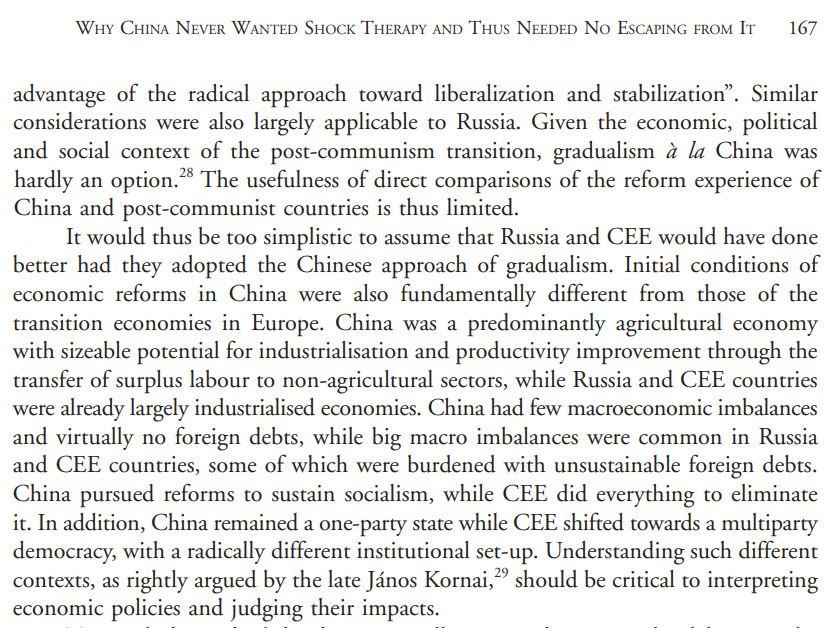
15. @IsabellaMWeber 's implicit assumption that had Russia/CEE adopted the Chinese approach of gradualism, it would have done much better is also hard to justify, incl. b/c of fund. different initial conditions in CEE&CN👇 There is a limit to what both can learn from each other
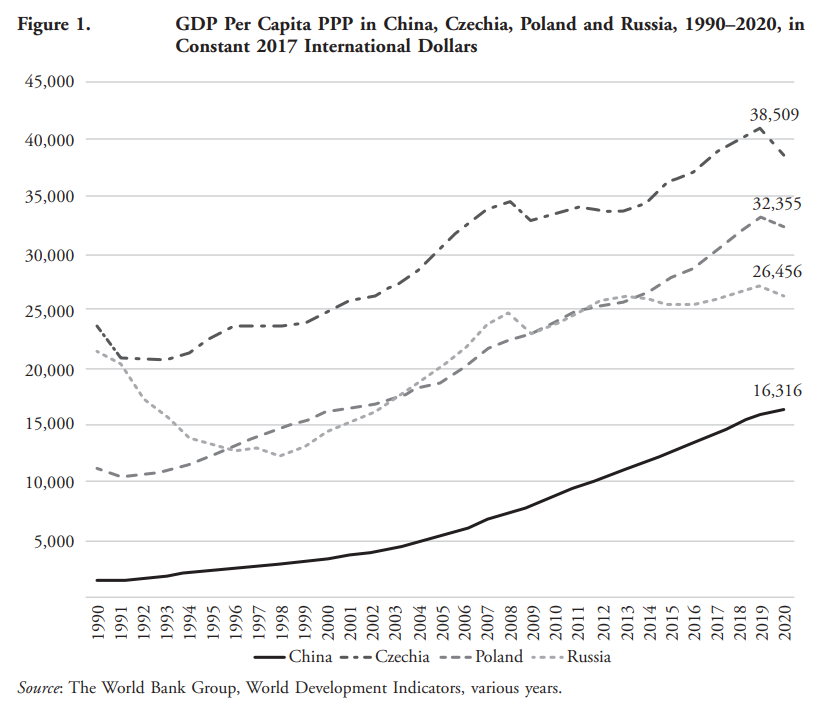
14. Eg, #Poland , which arguably experienced the most intense shock therapy, has tripled its GDP pc PPP since 1989. GDP pc in #Czechia, another “shock therapist”, has almost caught with the West. Meanwhile CN's income pc was still only at <=1/2 of both.
13. Finally, the book’s juxtaposition of CN’s econ. success with RUS "shock therapy" failure is powerful, but it conveniently ignores the much diff. experience of CEE, which, at least initially, embraced shock therapy, but had nonetheless achieved a remarkable economic success
12. Hence, the book's claim that the victory of “good" reformers set “the basic model of gradual marketization”&helped “escape shock therapy” is shaky. CN’s ideology in the 1980s was to shock therapy what Sanders’ ideology is to Trumpism today. Econ. debates cld hardly change it
11. Eg, social stability was at a big premium b/c of the disastrous decade of the “Cultural Revolution”, which ended with a national consensus that nothing can be accomplished without social peace. This did not leave much space for radical solutions, let alone a shock therapy
10. Third, CN has not been close to any shock therapy not b/c the "good" reformers” “saved” China, but b/c the pace and scope of market-oriented reforms were constrained by CPC’s skepticism towards market-based solutions, empirical approach to reforms&prioritization of stability
9. Against such background, China’s approach could at best be called “acupuncture therapy”, as it was focused on concentrated, gradual and limited reforms in narrow areas, not a wholesale removal of the old economic system virtually overnight as in CEE