Retired Army Officer, War Veteran, retired Area IT Support Supervisor at Northrop Grumman. Board of Directors for Old Fort Niagara, Christian, father, husband.
In late April 1971, Soviet leader Leonid Brezhnev telephoned Yugoslav President Josip Broz Tito with a veiled ultimatum, offering Soviet "assistance" to quell rising domestic nationalist unrest in Yugoslavia. Coming less than three years after Soviet-led Warsaw Pact invasion of Czechoslovakia, Tito interpreted the offer not as friendly aid, but as a thinly veiled threat of military intervention under Brezhnev Doctrine....
By the spring of 1971, Yugoslavia was gripped by intense political and ethnic turmoil. A reformist and nationalist movement in Croatia—known as Croatian Spring—was demanding greater political autonomy, economic decentralization, and cultural rights, threatening the unity of the Yugoslav federation. Having split with Joseph Stalin in 1948, Yugoslavia operated outside the Warsaw Pact as a nonaligned socialist state. However, Moscow feared that internal instability or liberal reforms in Yugoslavia could trigger a collapse of socialism in the Balkans or inspire similar movements across Eastern Europe.
. . . .
In December 1971, Leonid Brezhnev made Josip Broz Tito an offer that sounded like an ultimatum. As student strikes and nationalist demonstrations paralyzed Zagreb during the height of the Croatian Spring, the Soviet General Secretary contacted Belgrade with a discreet proposal: if the Yugoslav government could not restore domestic order, Moscow was ready to provide "fraternal assistance." To an outsider, the gesture might have sounded like socialist solidarity. To the seventy-nine-year-old Yugoslav marshal, it was a terrifyingly transparent threat. Just three years earlier, the Warsaw Pact had used the exact same phrase to crush the Prague Spring with half a million troops. Tito understood the lethal calculation instantly: if Yugoslavia appeared to be slipping from communist control, the Red Army was prepared to finish what Joseph Stalin had failed to achieve during their historic break 23 years earlier.
The crisis had been building for months as the Croatian Spring—a mass reform movement demanding greater economic decentralization, cultural autonomy, and democratic rights—swept across Yugoslavia’s second-largest republic. Guided by reformist communist leaders Savka Dabčević-Kučar and Miko Tripalo, the movement had won immense popular backing, culminating in late November when thirty thousand university students in Zagreb launched a general strike. For Tito, who had spent decades maintaining a fragile federation of six rival ethnic republics through iron party discipline, surge of nationalism threatened to unravel the state from within. Yet the external danger was even more acute. Under Brezhnev Doctrine formulated after the 1968 invasion of Czechoslovakia, Moscow claimed the right to intervene militarily in any socialist country where party supremacy was in jeopardy. If Yugoslavia fractured into ethnic unrest, Soviet tanks massed along the Hungarian and Bulgarian borders would have every ideological excuse to roll across the frontier.
Tito knew that any sign of hesitation in Belgrade would invite foreign tanks into the country. On December 1, 1971, he summoned the entire leadership of the League of Communists of Croatia to Karađorđevo, a secluded royal hunting estate in northern Serbia. Behind closed doors, in an exhausting twenty-hour confrontation that stretched into the early morning hours, Tito dropped all diplomatic niceties. Pounding the conference table, he accused the Croatian reformers of blind recklessness, warning that their tolerance of nationalist rhetoric had brought the country to the edge of ruin. He explicitly invoked Soviet menace, warning room that foreign powers were watching their internal paralysis and looking for an opening to intervene. If Yugoslav party did not ruthlessly put its own house in order, Tito warned them, foreign forces would step in and do it for them.
📷 : Josip Broz Tito and Leonid Brezhnev during a hunting trip in Ukrainian SSR in 1973.
#archaeohistories
NEW | Russian officials are rejecting any NATO Article 5-like security guarantees for Ukraine, and Russian state media may be using discussions about such Ukrainian security guarantees to question the veracity of Article 5 guarantees for NATO member states, especially the Baltic states.
Ukrainian officials confirmed Ukraine's November 22 naval drone strikes against Russian vessels near Benghazi, Libya, and clarified the identity of the struck Russian roll-on/roll-off cargo ship.
The Kremlin continues to ignore Ukrainian President Volodymyr Zelensky's November 14 proposal for a temporary localized ceasefire along or near the Dnipro River in occupied Kherson and Zaporizhia oblasts while simultaneously advocating an infeasible humanitarian mission and ceasefire near Kostyantynivka, Donetsk Oblast instead.
High-ranking Kremlin officials are using nuclear saber rattling to try to push the West to stop Ukraine from conducting drone and missile strikes against Russia.
A collection of German news outlets reported on November 23 that the German military and Western intelligence agencies assess that Russia plans to launch a satellite equipped with a nuclear warhead in the coming weeks.
Satellite images of Kamenka, just 60 km from the Finnish border, show Russia is actively rebuilding the town. In 2026, vehicle hangars, two barracks, and two canteens were demolished to make way for new facilities, alongside new firing ranges and renovated military family housing - with 22 apartment blocks connected to gas this fall.
Once home to a 4,400-strong brigade, Kamenka is now becoming the base for the new 69th Motor Rifle Division (up to 11,000 troops), whose units are already fighting in Ukraine's Kharkiv region. Construction is also ongoing at the nearby Kirillovskoye garrison.
Ukraine says it hit five Russian warplanes at an air base east of Moscow, including three MiG-31s and two Su-34s. Kyiv says it's still checking how badly they were damaged.
More on this: https://t.co/qst0yfcfhw
If we destroyed Europe/Asia and China and India were not exporters we can do that. We were the only show in town and could charge anything we wanted. The destruction from WWII was still in play (but diminishing every year) As All those countries reindustrialized our advantage decreased.
With Russian casualties now outpacing recruiting by around 60%, the Russian military is rapidly shrinking.
Since the month of March, a blistering uptrend in casualties, yet low recruiting, with October the widest disparity of the war, at -20,000.
🔥 "There won’t be a Russia," warns Top Russian General Leonid Ivashov, breaking ranks to declare that Putin has lost control.
He says Moscow is following the enemy's plan while Russian officers are hunted, bank cashouts get locked, and officials push to arm veterans.
👉 Even Russia's top commanders can no longer hide the panic inside the Kremlin.
A fourteen-year-old boy in scuffed work boots led a calf into a hot metal barn in rural Ohio, and I watched a room full of strangers lose their minds.
At a normal livestock sale, that calf is worth maybe two thousand dollars. The kid had spent the last ten months waking up before dawn to feed it, brush it, and clean its pen before getting on the school bus.
The auctioneer started chanting, and hands shot up everywhere.
Three thousand. Five thousand. Eight thousand.
I leaned over to the dad sitting next to me. "Is that some kind of rare prize-winning breed?"
He chuckled quietly. "Nope. Just a regular calf."
Then I stopped looking at the calf and started watching the men holding up their numbered paddles. The owner of the local hardware store bid nine thousand, then looked straight across the sawdust ring and gave a tiny wink to a farmer on the other side, who immediately raised it to ten.
That was when it finally hit me.
They weren't trying to beat each other. They were teaming up right in front of the boy to push the price through the ceiling, while keeping completely straight faces like it was just a normal business deal.
The gavel slammed at twelve thousand dollars. The boy bit his lip and quickly wiped his eyes with his shirt sleeve.
Out in the gravel parking lot afterward, I caught up with the hardware store owner and asked why he just spent a small fortune on an animal he didn't even need.
He nodded gently toward the boy's worn-out boots.
"His dad got hurt on a job site last winter. That kid's been saving every dime for trade school. Out here, when a young man puts in the work, the whole town steps up."
No charity banner. No press camera. Just a barn full of working folks pretending it's a normal auction so a proud kid gets to earn his future with his head held high.
La exprimera ministra de Finlandia, Sanna Marin, explica que la única forma en que Occidente puede evitar décadas de guerra con Rusia es garantizar que Ucrania expulse a Rusia por completo del territorio ucraniano, incluida Crimea. No hay otra opción”.
“They always say time changes things, but you actually have to change them yourself.”
Andy Warhol
The combat losses of the enemy from February 24, 2022 to November 25, 2026.
Other Key Takeaways ⬇️
High-ranking Kremlin officials are using nuclear saber rattling to try to push the West to stop Ukraine from conducting drone and missile strikes against Russia.
A collection of German news outlets reported on November 23 that the German military and Western intelligence agencies assess that Russia plans to launch a satellite equipped with a nuclear warhead in the coming weeks.
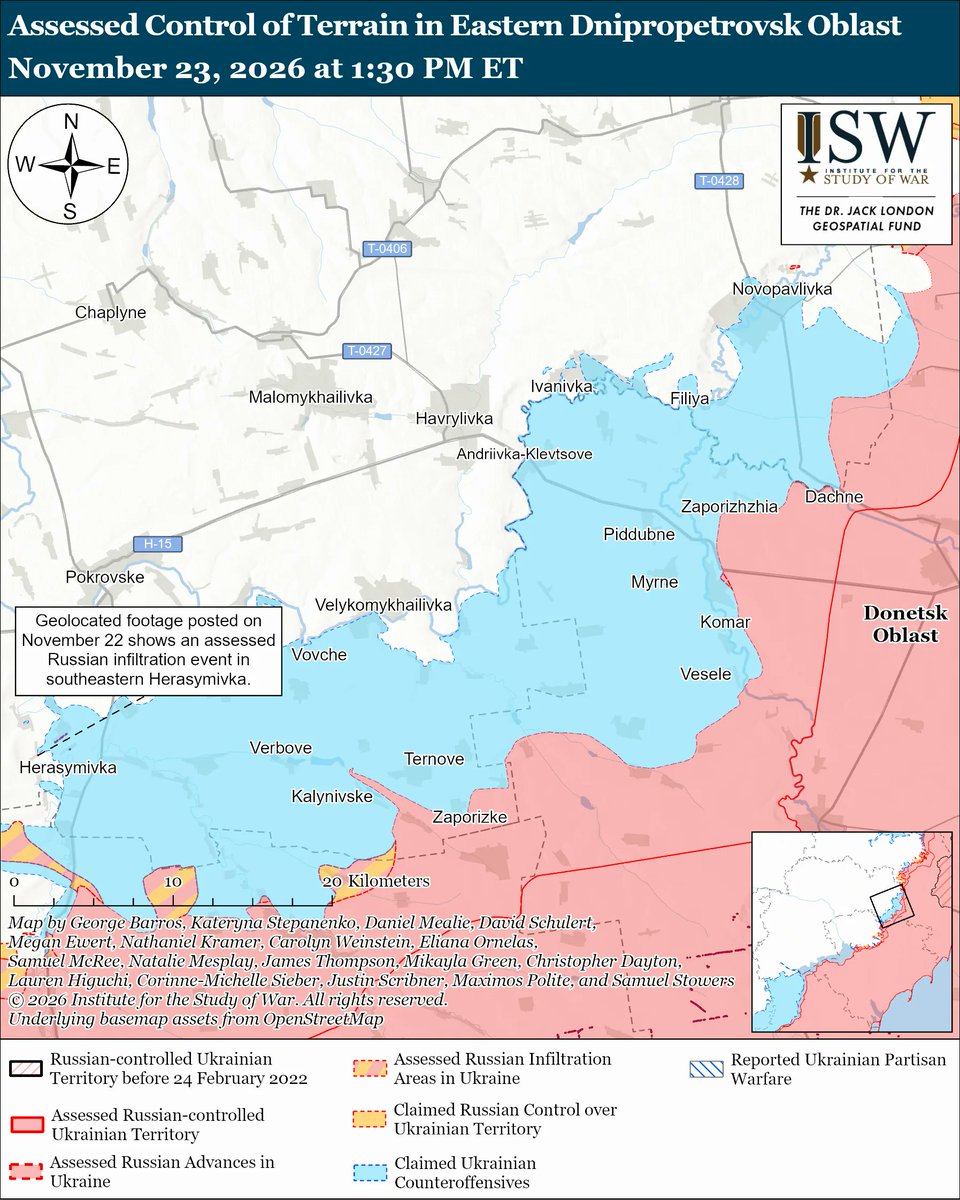
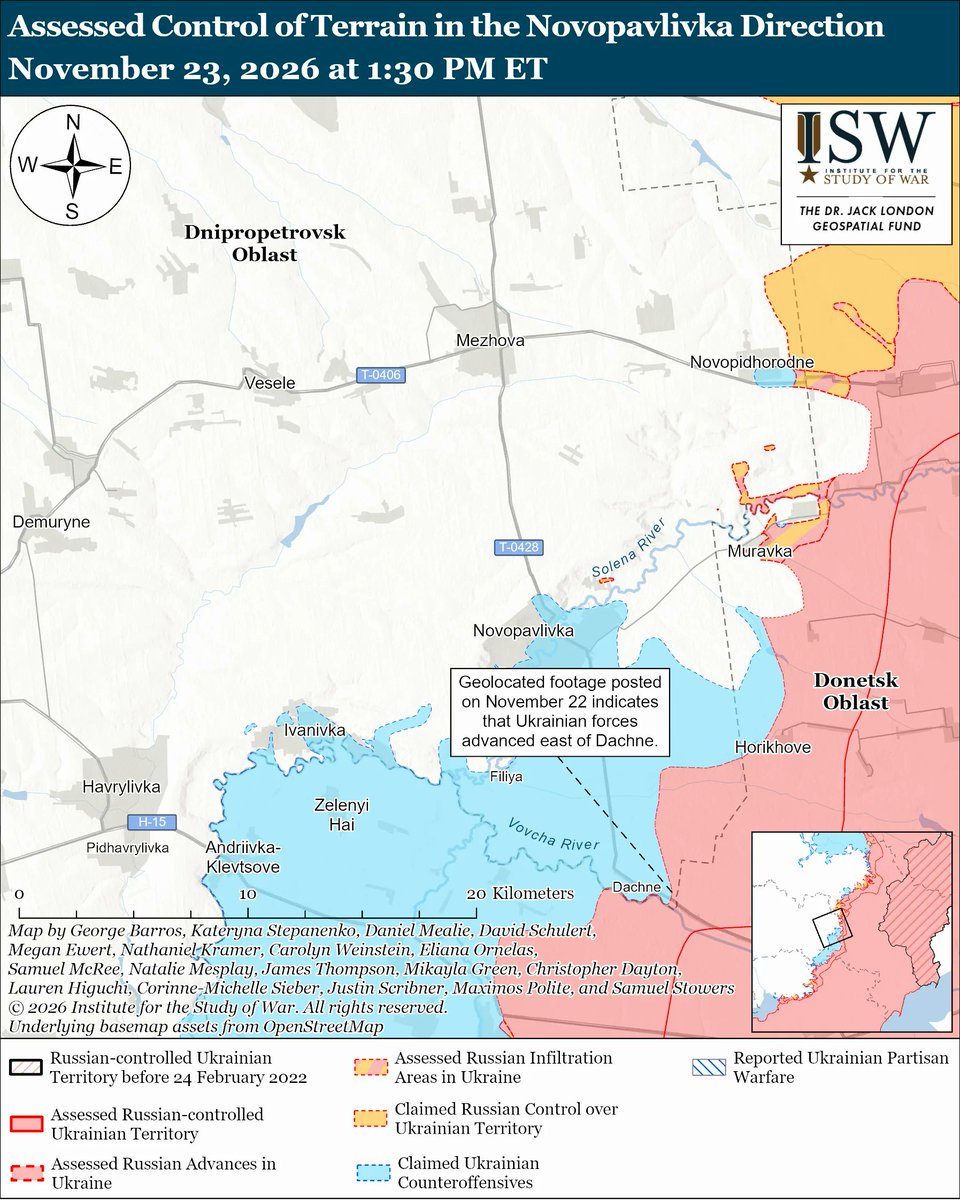
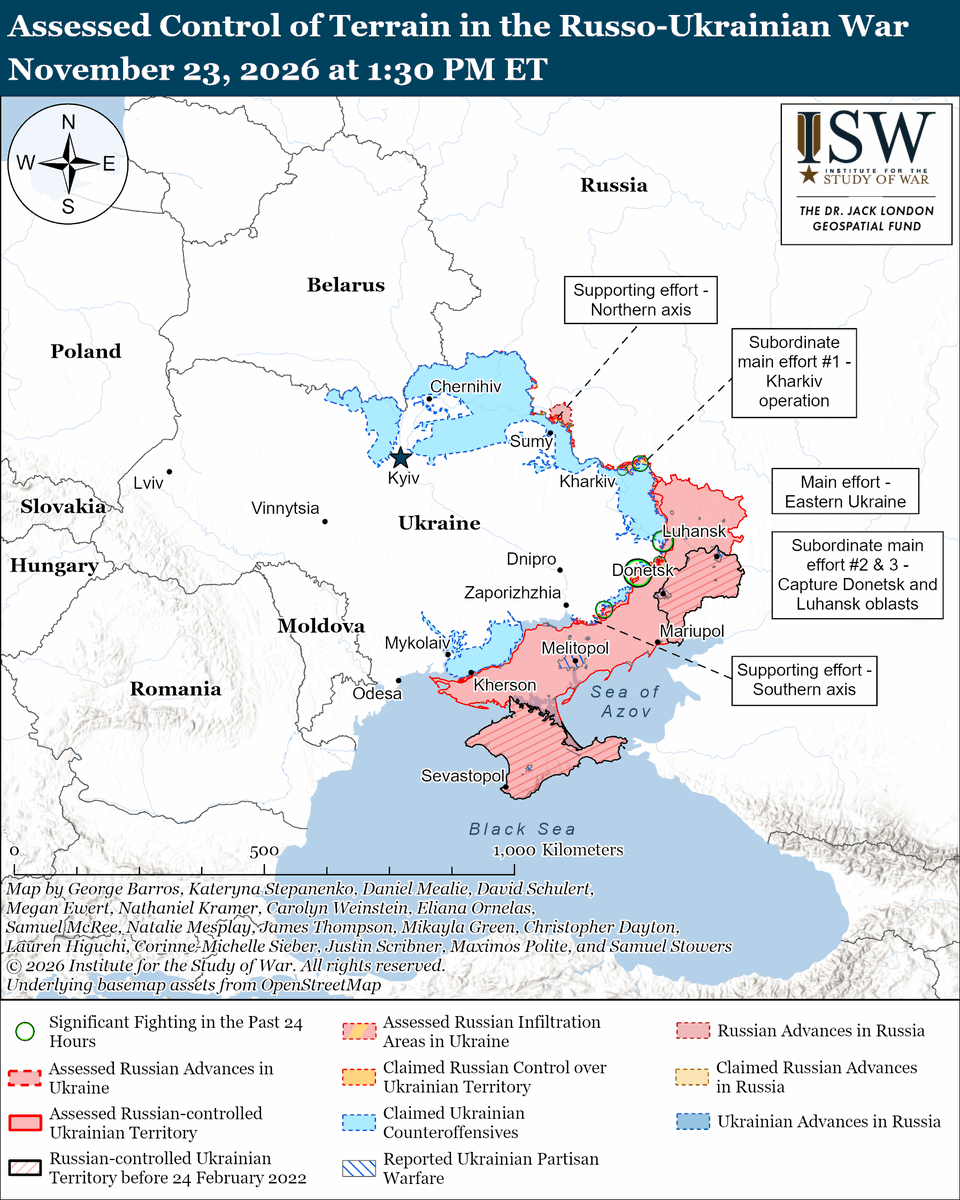
Russian forces recently advanced southeast of Dobropillya and southeast of Kupyansk, while Ukrainian forces recently advanced southeast of Novopavlivka.
Russian forces launched 134 drones against Ukraine overnight. Ukrainian forces continued their long-range strike campaign against Russian oil infrastructure.
«It isn't the mountains ahead to climb that wear you out; it's the pebble in your shoe.»
Muhammad Ali
The combat losses of the enemy from February 24, 2022 to November 24, 2026.
$122 for Thai takeout?
That's what’s happened in Seattle, after politicians forced a high minimum wage for DoorDashers.
Now customers order less food, and drivers get less work.
Government wage controls ALWAYS fail:
More than 240 F-15 fighters are parked in the Arizona desert. A retired U.S. Air Force general says some of them should go to Ukraine to help shoot down Russian missiles and drones.
Full story: https://t.co/auW4bv1E9X