@cws2615@NoLore no, we understand the risks quite well .. framing governance as a function of wealth is tantamount to advocating for disenfranchisement, and frankly, is a morally bankrupt philosophy you should be ashamed to espouse
Po 20 latach małżeństwa muszę w końcu powiedzieć to głośno...
Z moją żoną nie łączy mnie już nic.
Poznaliśmy się na egzaminie na filozofię ponad 20 lat temu. Byliśmy młodzi i głupi, nie słuchając rozsądnych opinii szybko wzięliśmy ślub.
A potem życie zrobiło swoje i dziś żyjemy w dwóch różnych światach.
Ona: dzieci, szkoła, dydaktyka, nauka, góry, natura, koty, dramaty.
Ja: firmy, fundusze, inwestycje, biznes, miasto, beton, psy, komedie.
Ona: kreatywna, empatyczna, marzycielska.
Ja: analityczny, rzeczowy, osadzony w faktach.
Zero wspólnych pasji.
Zero wspólnych zainteresowań.
Nie śmieszą nas te same rolki na Instagramie.
Każdy terapeuta ze śniadaniowej telewizji wystawiłby naszemu małżeństwu akt zgonu. Znajomi pewnie się zastanawiają, kiedy ogłoszę rozwód.
No to ogłaszam...
Kocham tę kobietę bardziej niż 20 lat temu!
I kiedy wieczorem opowiada mi o rzeczach, które kompletnie mnie nie interesują, słucham jej z przyjemnością, której nie tłumaczy żaden poradnik.
Bo przez te 20 lat zrozumiałem coś, co przeczy wszystkiemu, co wciskają nam media.
Wspólne pasje to nie budulec związku. To dekoracja. Ludzie po latach idą różnymi drogami, w różnym tempie i to nie jest awaria. Tak wygląda życie.
Prawdziwy budulec jest inny. Chcesz dla drugiej osoby lepiej niż dla siebie. Jej potrzeby stawiasz nad swoje. Wolisz dawać, niż brać. Jeśli tego nie ma, nie uratują was nawet identyczne playlisty.
Więc jeśli twoja druga połówka to twoje przeciwieństwo, przestań to naprawiać. Może właśnie tam mieszka wasz sekret.
Nie musicie kochać tych samych rzeczy.
Wystarczą te same wartości, ten sam kierunek, szacunek do różnic i troska o drugą połowę większa niż o siebie.
I na koniec coś, co zrozumiałem dopiero niedawno...
Przez 20 lat moja żona każdego dnia miała powody, żeby wybrać inaczej. Innego człowieka, inne życie, inny świat; bliższy jej gór niż mojego betonu.
Mimo to każdego dnia wybierała to samo... mnie.
Miłość to nie jest coś, co się czuje. To coś, co się codziennie wybiera.
Od 21 lat jestem czyimś wyborem i jestem z tego naprawdę dumny...
Some people seem to be surprised that an old geezer like me could adapt so quickly to the newest tech.
The thing is, I've been a programmer for over 60 years. And every single year brings another adaptation to new tech. Adapting to new tech is what we programmers do on a regular basis. Why would I stop now?
Milton Friedman: “We call a tariff a protective measure. It does protect... it protects the consumer against low prices.”
There's a reason both Donald Trump and JD Vance hate Milton Friedman.
Basic economics is the mortal enemy of the MAGA right.
@KenKards@CardGameNomad Your analysis is flawed. TCPi could implement countermeasures to prevent leaks but don’t because their financial interests don’t align with strict inventory control.
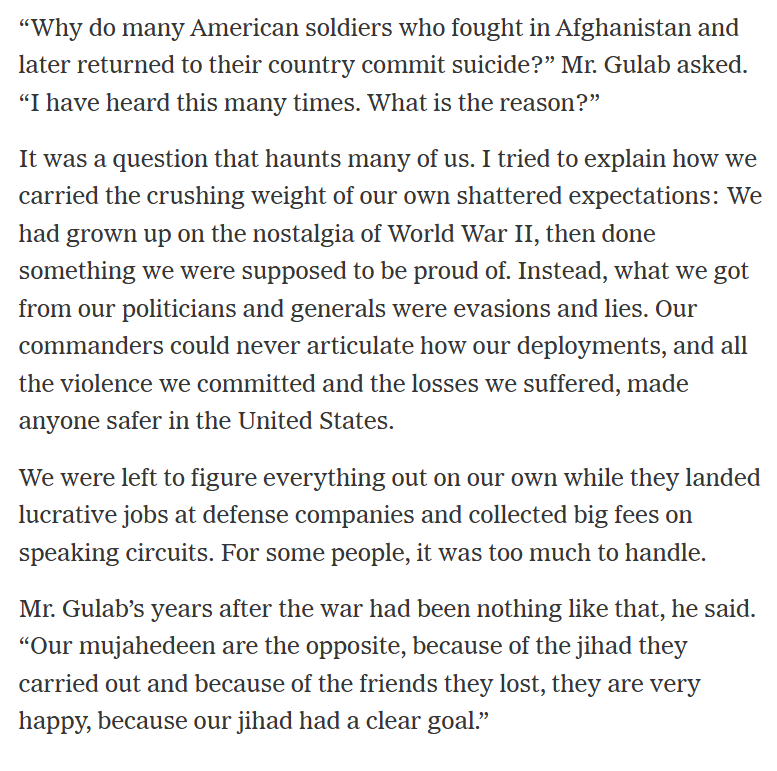
"'Why do many American soldiers who fought in Afghanistan and later returned to their country commit suicide?' Mr. Gulab asked. 'I have heard this many times. What is the reason?'
It was a question that haunts many of us. I tried to explain how we carried the crushing weight of our own shattered expectations: We had grown up on the nostalgia of World War II, then done something we were supposed to be proud of. Instead, what we got from our politicians and generals were evasions and lies. Our commanders could never articulate how our deployments, and all the violence we committed and the losses we suffered, made anyone safer in the United States.
We were left to figure everything out on our own while they landed lucrative jobs at defense companies and collected big fees on speaking circuits. For some people, it was too much to handle."
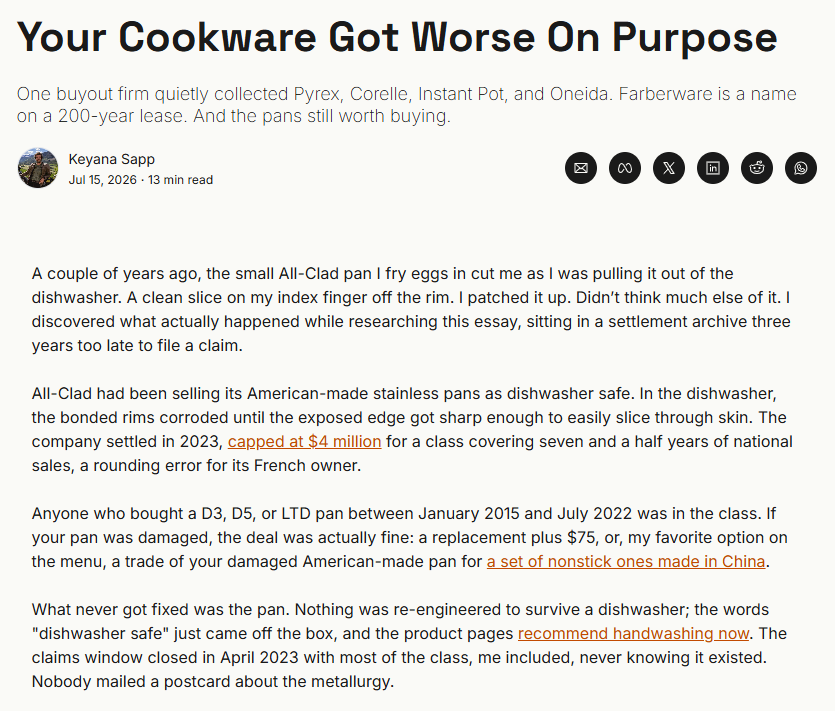
This amazing website, called "Worse on Purpose," is cataloguing all the ways companies are deliberately and secretively degrading their own products
As usual, in most cases the culprit is private equity extracting enormous sums while everyone else is left worse off.
⚡️I actually think this is one of the defining patterns of the next decade.
Not because smart people suddenly became less intelligent.
Because the market changed what it rewards.
For most of the twentieth century, intelligence and economic success were highly correlated because institutions had a scarcity of cognitive labor.
The smartest engineer.
The smartest lawyer.
The smartest analyst.
The smartest doctor.
The system paid for intelligence because intelligence was scarce.
AI is beginning to industrialize intelligence itself.
That breaks the old bargain.
The smartest person in the room no longer automatically creates the most economic value.
The person who organizes capital.
Owns distribution.
Builds a company.
Creates trust.
Coordinates people.
Owns assets.
Uses AI better than everyone else.
Often wins.
The market has always rewarded value creation, not IQ.
The twentieth century happened to make those two look almost identical.
That may have been the anomaly.
The deeper tragedy is psychological.
Many brilliant people built their identity around being intellectually exceptional.
Then the world shifted.
Their comparative advantage disappeared while their identity remained attached to it.
That creates paralysis.
Meanwhile the “mid” person keeps moving.
Not because they’re smarter.
Because they optimize for the game that actually exists instead of the one that rewarded them in school.
School rewards correctness.
Markets reward adaptation.
Those are different skills.
The smartest people often become prisoners of their own models.
Average people often become surprisingly successful because they update faster.
The deepest pattern is this:
Intelligence without agency is becoming one of the least rewarded combinations in modern civilization.
That is why the post feels true.
Not every genius is failing.
Not every average person is succeeding.
The distribution itself is changing.
The future belongs less to the people who know the most.
It belongs to the people who convert knowledge into ownership, action, trust, and leverage.
The twentieth century rewarded being the best worker.
The twenty-first increasingly rewards becoming the owner of the system the workers operate inside.
That is the phase transition.
And I think most people still believe they’re living in the old one.
El CEO de Anthropic viendo como China lanza un nuevo modelo de IA que supera a Claude Opus 4.8 en TODO, iguala a Fable 5 costando 8 VECES MENOS, que encima es 100% Open source y no puede hacer nada al respecto
There’s something so deeply special about alpine water. As someone who grew up in the Midwest, I was used to muddy ponds and rivers. Something that I loved then. But seeing my first cold, crystal clear alpine lake felt like a revelation. This is worth protecting. 🇺🇸
The largest IPO in history is also shaping up to be the largest exit liquidity operation in history
SpaceX went public at more than 90x revenue, and the insiders who bought in at a fraction of today's price are about to start selling their shares to you.
Let me walk you through why this IPO is built to separate retail investors from their money:
SpaceX has NEVER turned a profit and lost close to $5 billion last year.
At the offering you were paying more than 90x revenue and at the peak the market briefly valued it near 140x.
30 years ago the head of Sun Microsystems explained in detail why paying even 10x revenue almost always ends in tears, and he was right.
But listen closely, because the valuation is not even the real story.
The scarcity is what CREATED this valuation in the first place, and the calendar that kills the scarcity is what kills the price.
Less than 5% of SpaceX shares were actually available to trade at the IPO. Then the index committees REWROTE their own rules to fast track the stock into the Nasdaq 100 just 15 trading days after listing, which forced every passive fund and index ETF in the country to buy at the exact moment the float was at its tightest. The Nasdaq inclusion alone forced an estimated $4.3 billion of buying, and the Russell reweighting added roughly $3 billion more.
The supply was minuscule and the buying was mandatory. That's a manufactured squeeze, and it is why the stock went above $225 in its first week.
Now watch what happens next, because this is the part they ain't explaining to you:
The lockup was staggered on purpose, and the entire schedule is sitting in the prospectus for anyone who bothers to read it.
In early August, right after Q2 earnings, 20% of the locked shares come free. Another 10% unlocks early if the stock trades 30% above the $135 IPO price going into the report.
Then tranches of 7% hit the market at 70, 90, 105, 120 and 135 days after the IPO, which means fresh insider supply lands roughly every 2 to 3 weeks from late August through late October.
Q3 earnings triggers the single biggest release of all, another 28%, roughly 1.3 billion shares. On December 8 the 180 day lockup expires entirely. And on June 12, 2027 comes the final wave, when Musk's own 6.4 billion shares, 42% of the whole company, become sellable for the first time.
Add it all up and insiders could be free to sell as much as 44% of the company by early September, which would balloon the tradable float by roughly 900%.
All of that supply lands on a stock the company deliberately packed with retail, because SpaceX reserved close to 30% of the offering for individual investors vs the usual 10%.
This deal created over 4,400 paper millionaires inside the company. You think none of them are looking to cash out?
Early holders are already loading up on puts to lock in what they have.
First they keep the float tiny. Then they let the index rules force the world to buy at the top. Then they release a flood of insider stock into a crowd of retail buyers who were handed the shares up high.
When the price finally breaks the offering level, the people who got in years ago at pennies on today's dollar will hit the bid, and the exit liquidity is your retirement account.
And what are you actually left holding? Strip away the science fiction and the only business inside SpaceX that reliably earns money is Starlink, which produced $1.2 billion of operating income last quarter. A wonderful business worth hundreds of billions on its best day. NOT $2 trillion.
Serious fair value work lands around $30 a share.
Nobody has been a bigger bear on this deal than me. I called it out the moment it started trading, and it is already playing out on schedule as the shares have given back the entire squeeze and slipped below their opening print.
I was Peter Lynch's auto analyst back in 1981 and I have watched every disaster since, and I am telling you this is one of the great wealth transfers of my lifetime packed into a fancy narrative.
Tesla was the biggest misallocation of capital in the history of stock markets. SpaceX may have just surpassed it.
SPCX goes straight onto my short list, and the beauty of this setup is that the catalyst is not a guess or something, it is literally a PUBLISHED CALENDAR.
This is the most grossly overpriced stock at scale that I have ever seen.
You meet a lot of beautiful, vibrant young people with ugly philosophies because they are still fresh and the ugliness hasn't had time to eat away at them. You can meet a slim, dark-haired girl in a club who calls herself a succubus and whispers in your ear that she wants to take your soul out through your lips, and you'll think yes, yes, of course, losing your soul can't be that bad if it looks this beautiful. The most handsome, lithe man you'll ever meet will hold your hand and smile while he talks about how if he ruled the Earth, he'd kill every rich person, every priest, every single mother—and you'll smile back, unthinking, because his face is like a sunset.
But nobody can stay beautiful for long with such ugliness inside them. Maybe it takes 5 years. Maybe it takes 40. But eventually, it'll fester and warp them, transform them from the inside, until they wear their ugliness on the outside, and their lives will take the crooked shape of the ideas they carried.
Don't listen to the ideas of young, beautiful people. Listen to the ideas of people who have managed to remain beautiful even long past the time when the world should have crushed them under the burden of ordinary existence.
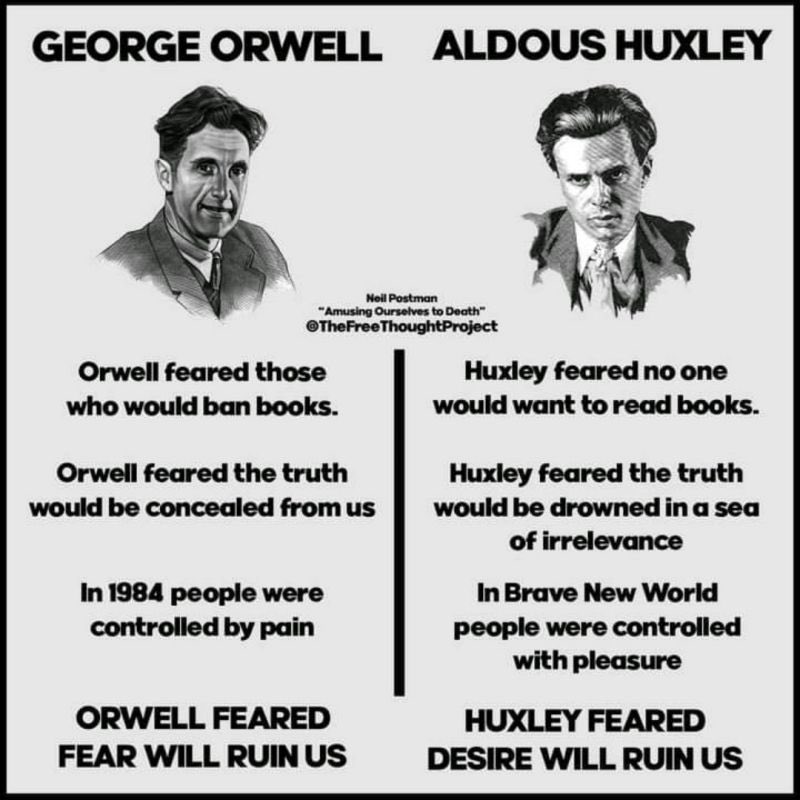
One of my longest-standing arguments is that we are not living in Orwell’s 1984, where truth is centrally suppressed and censored by force (that’s former communist societies, modern-day China, Russia, North Korea).
We are living in something much closer to Huxley’s Brave New World.
The truth is not hidden - it is almost always readily available. But it is buried beneath an industrial quantity of noise: propaganda, outrage, half-truths, conspiracy theories, influencer theatre, algorithmic rage bait and an endless stream of content designed not to inform us, but to keep us emotionally stimulated.
The modern information system does not need to censor the truth when it can simply drown it in noise.
A fact no longer has to be disproven - it only has to be surrounded by a hundred competing claims, stripped of context and nuance, turned into partisan ammunition and pushed into the same feed as celebrity gossip, memes and 15 second videos engineered to deliver the fastest possible dopamine hit. By the time the truth reaches us, it appears as just another piece of content competing for our attention.
That is the more sophisticated form of control: not preventing people from knowing, but exhausting their capacity to care.
Orwell feared a world in which people would be deprived of information. Huxley feared a world in which they would be given so much distraction, stimulation and triviality that they would lose the desire to seek it.
The defining struggle of our age is therefore not simply between truth and censorship, but between truth and indifference.
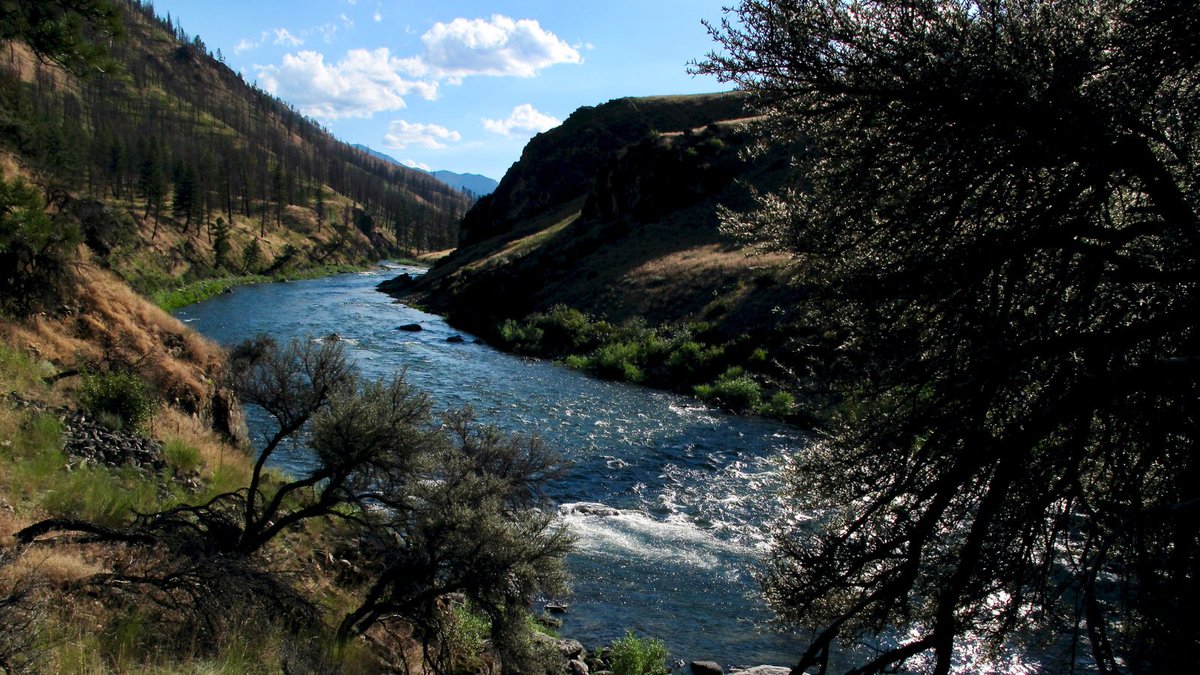
There are 2.4 million acres in central Idaho with no roads in or out.
The Frank Church-River of No Return Wilderness is the largest contiguous wilderness in the Lower 48. It's bigger than Yellowstone and Grand Teton combined.
The only way in is on foot, horseback, boat, or small plane.
In the middle of it is the Salmon River, which carves a canyon deeper than the Grand Canyon. The name comes from early boatmen who could ride the current down, but couldn't fight it back upstream.
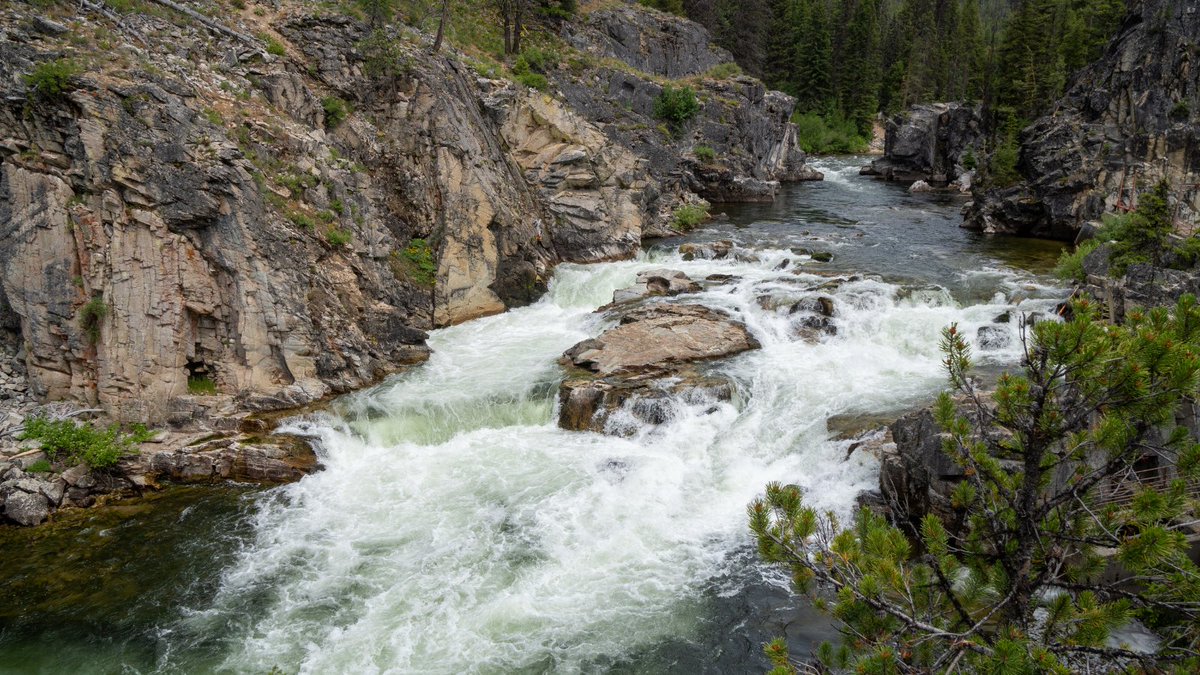
The Middle Fork has around 100 rapids in 100 miles. Natural hot springs sit along the riverbanks. Native cutthroat trout still swim in it, and they’re healthy enough that anglers travel from around the world to fish them.
More than 2,500 miles of trails run through the wilderness. Elk, wolverines, black bears, mountain lions, and wolves all still move through the land the way they always have.
In 1995, it became one of the first places in the country where wolves were reintroduced.
Most Americans will never set foot here.
Many don’t even know it exists. That doesn't make it any less worth keeping wild.
I’ve studied these two and written biographies’ worth of articles on them. They are a unique byproduct of deeply abusive families and an apartheid education system that trained them to believe they were the superior race.
They were also taught to hate people like themselves.
Peter Thiel was a young gay boy in a town & a school that were the last places in the world to use “Heil Hitler” as a greeting. Peter both believes he is superior but also that he is defective. That’s why he’s a dedicated transhumanist. He wants to ESCAPE this world—and himself—by any means necessary.
Elon is the quintessential incel—an asocial nerd with sociopathic, abusive, racist parents. He got put in the hospital for being an asshole at school. He morphed his father’s sci-fi bedtime stories and his apartheid brainwashing into a grandiose delusions of being the emperor of a colony on Mars—white people only.
The result is a messianic malignant narcissist who believes he has the right to enact a eugenics program on the world—“for our own good.” USAID was just the start.
Elon Musk doesn’t think “takers” should vote. He thinks empathy is suicidal. He actively stokes race war.
For Peter and Elon, the emotional compression of both hating everyone who doesn’t look like them AND hating themselves created genocidal monsters—because they there is nowhere to run. They’re trapped in their own private hell and they don’t care who it hurts to escape.
They found each other 30 years ago and started collaborating on the project of burning down American constitutional democracy so they can create a corporate feudalist dictatorship from the ashes. They see human life as dirty, unnecessary, and complicated. They want death—a lot of it.
Erich Fromm, who defined the term “malignant narcissist” would have called them necrophiles. They much prefer machines to people.
The American system not only failed to filter out these extraordinarily evil creatures but actively elevated them to a position of being able to present an existential danger as they do now. That failure is a cross-section of everything that needs to change.
These are the exact people we should never allow to call themselves Americans, much less give them untold billions of our tax dollars to destroy the very systems they used to obtain their obscene hoards of wealth.
We became too tolerant, too weak, and too complacent.
We have to kick this evil out or be swallowed by it. Those are the only two choices.